Watchful Dad

Watchful Dad
Great Horned Owl adult and offspring in Sitka Spruce, Chignik Lake, Alaska Peninsula, June 20, 2020

I’d always wanted to live where owls were my neighbors.

It was widely known that the village had owls. In fact, the village had always had owls. David Narver reported their presence in his study of the Chignik River Drainage in the early 1960’s. But no one knew, precisely, where the owls nested and roosted. I managed to unravel the mystery once and for all during our first winter at The Lake. After that, Barbra and I could fairly reliably locate at least one of our two resident owls on any given day.

But that didn’t make photographing them much easier. During daylight hours, the owls typically secreted themselves in the very thickest parts of an exceptionally healthy and dense copse of Sitka Spruce trees. Many times, only a hint of the large birds was visible – a patch of breast feathers, a vigilant eye, an alert ear tuft. In addition to the challenges presented by the dense spruce boughs, the copse of trees was situated in a hollow where the light was almost never what a photographer might call “good.” Not only did the owls bury themselves in the boughs of those trees, their favored roosts were fairly high up. And although I am fairly certain that I knew more or less exactly where the nest was, I was never able to put my eyes on it.

For awhile, I contemplated a variety of strategies to facilitate photographing the owls, but all of them involved bothering them in one fashion or another. I didn’t think I’d permanently spook them out of the grove, but I didn’t want to press them. Making a living in the wilderness by talon, hooked bill, eye and wit is tough enough without some human invading one’s personal space. Biologists (generally) no longer shoot specimens in order to “study” them, but I have to wonder about the merit of constant nest-watching and other practices involving invasive viewing of wildlife that are now in vogue.

And so although I regularly checked on our owls (they were along the way to one of our favorite fishing spots), I did my best not to disturb them. Every once in a while, they presented themselves, and when those times coincided with my having my camera along, I did my best to record an image.

You Comin’?

You Comin’?
Coastal Brown Bears, Chignik River, Alaska Peninsula, June 19, 2020

It’s Spring! Everybody’s an Insectivore

Male Golden-crowned Sparrow on his way to his mate and their babies
Chignik Lake, Alaska Peninsula, June 19, 2019

Golf Courses laced with poisons, mosquito traps, bug zappers, Rotenone and other toxins used to remove undesired fish species (and incidentally aquatic insects) from streams, the biological desserts called lawns, industrial agriculture and that “little bit” of whatever “cide” sprayed on the family garden – and all the additional instances in which invertebrate populations are suppressed with toxins and by other means…

…also suppress bird populations.

Even among avian species that typically consume mostly seeds, nuts or nectar, in order for the mother to create viable eggs and for the babies to develop into healthy adults, the rich supply of nutrients insects provide are critical.

JD

Home: More Nesting Boxes than Human Houses

Female Violet-green Swallow
Chignik Lake, Alaska Peninsula, May 15, 2019

One of the most charming aspects of life at Chignik Lake is that scattered throughout the village there are more homes for swallows than for humans. Each spring the arrival of the first swallows is anticipated with almost as much enthusiasm as the arrival of the year’s first salmon.

The relationship between Native Americans and insect-eating birds such as Purple Martins and swallows precedes the arrival of Europeans on the North American continent. Audubon as well as observers who preceded him reported hollow gourds appointed with an opening hole and hung around camps and villages as nesting boxes for these birds. A single swallow or martin consumes about 2,000 small insects a day. That’s enough to make a real dent in populations of mosquitoes and biting midges. So, one could purchase a powered mosquito trap for several hundred dollars – thus emptying the air of the bugs nesting birds need to feed themselves and their offspring – or one could install nesting boxes, achieve the same bug-limiting effect, and create a sustainable cycle wherein swallows and martins return each year to mate, fill the air with their happy chirps, and clean out the bug population while raising a brood. The wooden boxes will long outlive the mechanical trap, and when the box does finally expire it won’t leave behind yet another plastic contraption to add to the local dump or landfill.

Three species of swallows inhabit the Chignik River drainage. The smallest are the little brown Bank Swallows. They make their nesting tunnels in sandy banks along or near the river and are fairly abundant. With the help of humans and nesting boxes, Tree Swallows, the largest of the three species, also thrive. Violet-greens are less common, perhaps outcompeted for boxes by the larger Tree Swallows. Barn Swallows, which can be found in villages further up the peninsula, haven’t yet made their way to The Lake.

There are good DIY nesting box designs available online and in books, and they can also be purchased ready-made. There is also good information available regarding controlling European Starlings and House Sparrows which can be a problem in some areas; these invasive species are infamous for taking over nesting boxes and even killing the desired swallows.

So… what are you waiting for? It’s probably too late in the season to attract new nesters this year, but if you hang a box or three now, a year from now they’ll be appropriately weathered and attractive to newly arriving migrants. A mated pair of birds happily rearing their chicks brings cheer to any property.

Ol’ Half-a-Horn

Ol’ Half-a-Horn

I almost wasn’t going to show this photo. Despite my nicknaming him Ol’, he’s probably a fully mature but young bull – perhaps in his fourth year. He’s missing his right paddle, and the remaining antler isn’t impressive. In fact, since to be legally taken during Alaska’s moose hunting season the tip to tip, antler to antler spread has to span at least 50 inches (127 cm), he probably wouldn’t have passed muster. So, no Boone and Crockett award here.

But this is easily the closest I’ve ever been to a moose, and when he suddenly emerged -seemingly to simply materialize from a thick tangle of willows, alders and salmonberries, he took our breath away. I had mere seconds to set up and make the shot has he strolled by, appearing unconcerned, barely glancing our way – our own hearts meanwhile racing like mad. Even a young bull such as this weighs close to half-a-ton and although the big ungulates are generally peaceful, mind-your-own-business types, each year here in Alaska more people are injured by moose than by bears. In fact, an Alaska man was stomped to death by a cow protecting her calf less than two weeks ago. So anytime one finds oneself this close to an animal of this size, the thrill involves wildly mixed feelings.

As I mentioned, the moment lasted mere seconds. And then, more miraculously than its sudden appearance, this fellow simply vanished. There was no departing view of dark rump disappearing into the vegetation, no hint of willows and alders shaking as he brushed by them. He crossed before us, I made 12 quick captures, the last of which featuring mainly an eyeball, part of the rack, an ear and his nape… and then he was gone, swallowed without a sound into a thicket of alders. Had we not been exactly where we were during those few seconds, we would never have guessed a moose was nearby.

Chignik Lake, October 4, 2018 – JD

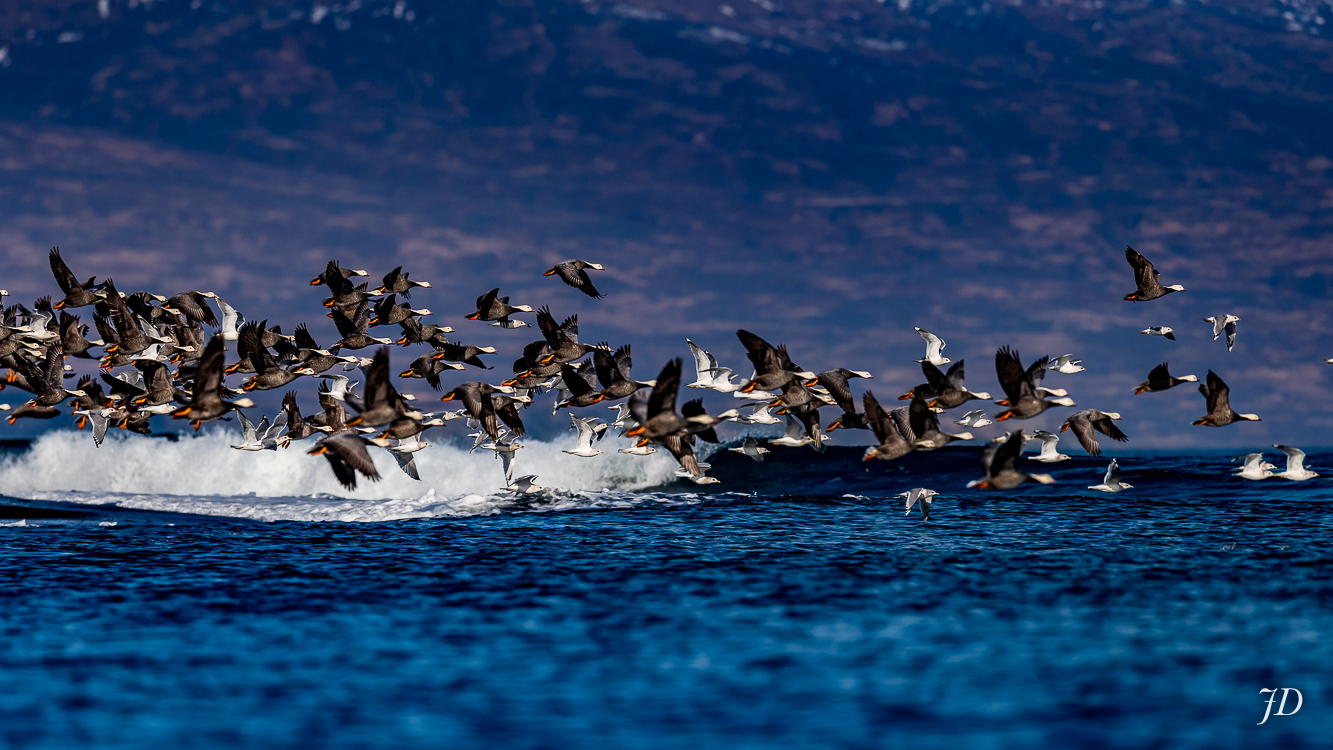
Painted Geese over Breaking Surf

Painted Geese over Breaking Surf
Emperor Geese, Chignik Lagoon, March 9, 2019

With the bright white head and nape reminiscent of the ermine capes European Royals of yore garbed themselves in, Emperor Geese (Anser canagicus) present a striking visage. But to catch a glimpse of these smallish, colorful, somewhat rare birds you have to go to coastal Western Alaska or Eastern Russia. A few dozen sometimes stop over at the sand spit at the mouth of Chignik Lagoon on the Alaska Peninsula. That’s where we found this flock, a few Glaucous-winged Gulls mixed in.

JD

Spring Rain

Spring Rain
Chignik Lake, Alaska Peninsula, May 7, 2019

Happy Friday everyone. Barbra and I hope you have an enjoyable Memorial Day Weekend. And take a moment to remember with gratitude…

JD

Spring Portrait of Love

Mated pairs of Sandhill Cranes begin appearing on the Alaska Peninsula in late April, their loud calls trumpeting the arrival of spring. They depart in late summer or early fall. If they’ve been successful, a nearly full-grown offspring accompanies them on their journey back south. Note the heart-shaped red crown – a distinction that along with the fidelity mated adults show each other makes cranes a symbol of love in many cultures. Chignik Lake, May 4, 2019

The Redpoll X

The Redpoll X
Xanthochromic Redpoll, Chignik Lake on the Alaska Peninsula, April 25, 2019
Xanthochromism refers to yellowish pigmentation occuring where it is otherwise unexpected.

The bird in the above photo is a female Common Redpoll, Acanthis flammea. The eponymous poll – the colorful head cap – is typically bright red. Here the cap is yellow. This is a rare mutation which has been reported in other finches (Northern Cardinals, House Finches and others) as well as a variety of other animals. Whether the same individual or perhaps additional birds, we encountered xanthochromic redpolls in multiple years at The Lake.

Good Morning

Good Morning
Alaska Peninsula Brown Bear, Ursus arctos gyas. Chignik Lake, October 3, 2018

Alaska Peninsula Brown Bears share the same genus and specific name as Grizzly Bears of interior Alaska, Canada and the Lower 48: Ursus arctos. They differ only in the subspecific name: gyas in the case of these Peninsula Brown Bears; horribilis for Grizzlies.

I present this image here at a 16:9 ratio because that works well on most screens. But when I print it to show, I will print it as a square and ask that it be hung at eye-level, as a kind of mirror. There is more going on behind those eyes than where the next meal is coming from.

And yes. My heart was pounding wildly to find myself suddenly this close…