Eagle with Spring Hillside Chignik Lake, Alaska Peninsula, May 20, 2019
Sam’s Boathouse, located along the shore of Chignik Lake and visible from our dining/living room windows, provided a favorite perch for eagles, ravens, magpies, gulls and occasional kingfishers. In the right light, the hillside across the lake could render a beautiful palette of colors.
Female Violet-green Swallow Chignik Lake, Alaska Peninsula, May 15, 2019
One of the most charming aspects of life at Chignik Lake is that scattered throughout the village there are more homes for swallows than for humans. Each spring the arrival of the first swallows is anticipated with almost as much enthusiasm as the arrival of the year’s first salmon.
The relationship between Native Americans and insect-eating birds such as Purple Martins and swallows precedes the arrival of Europeans on the North American continent. Audubon as well as observers who preceded him reported hollow gourds appointed with an opening hole and hung around camps and villages as nesting boxes for these birds. A single swallow or martin consumes about 2,000 small insects a day. That’s enough to make a real dent in populations of mosquitoes and biting midges. So, one could purchase a powered mosquito trap for several hundred dollars – thus emptying the air of the bugs nesting birds need to feed themselves and their offspring – or one could install nesting boxes, achieve the same bug-limiting effect, and create a sustainable cycle wherein swallows and martins return each year to mate, fill the air with their happy chirps, and clean out the bug population while raising a brood. The wooden boxes will long outlive the mechanical trap, and when the box does finally expire it won’t leave behind yet another plastic contraption to add to the local dump or landfill.
Three species of swallows inhabit the Chignik River drainage. The smallest are the little brown Bank Swallows. They make their nesting tunnels in sandy banks along or near the river and are fairly abundant. With the help of humans and nesting boxes, Tree Swallows, the largest of the three species, also thrive. Violet-greens are less common, perhaps outcompeted for boxes by the larger Tree Swallows. Barn Swallows, which can be found in villages further up the peninsula, haven’t yet made their way to The Lake.
There are good DIY nesting box designs available online and in books, and they can also be purchased ready-made. There is also good information available regarding controlling European Starlings and House Sparrows which can be a problem in some areas; these invasive species are infamous for taking over nesting boxes and even killing the desired swallows.
So… what are you waiting for? It’s probably too late in the season to attract new nesters this year, but if you hang a box or three now, a year from now they’ll be appropriately weathered and attractive to newly arriving migrants. A mated pair of birds happily rearing their chicks brings cheer to any property.
Fuel Oil Drums at The Pad Chignik River Barge Landing, May 16, 2019
Barbra has an eye for moody images such as this early morning landscape of diesel oil drums at the barge landing on Chignik River. The scene is the terminus of the three-mile road that travels from the airstrip, winds through the village of Chignik Lake (population 50 something), and then follows the river along steep hillsides till it ends here at the landing. These drums are barged to this point, about six miles upriver from the salt water lagoon, on high tides of about 10 feet or more. On lesser tides, the river is too shallow for the barges to run. From here, the fuel is loaded onto a truck and carried to the diesel generators that provide the village’s electricity. Gasoline, too, along with any sort of large stuff such as vehicles and building material is brought into the village in this fashion.
Such are some of the logistical consideration in a wilderness village.
The View from the Boat Landing Chignik River, Dawn, September 10, 2018
Behind me from where I stood as I composed this photograph, a dirt and gravel road travels a winding path along steep hillsides for about three miles to the Chignik Lake airfield, a bouncy dirt airstrip capable of handling the nine-seat bush planes and smaller aircraft that regularly travel the Alaska Peninsula. For the first two-and-a-half miles from the boat landing the road hugs steep hills, often within view of the river. Traveling the road from June through November, it’s common – at times almost a given – that you’ll see one of more of the Chignik’s massive brown bears. Sandhill Cranes, Tundra Swans, eagles and any number of passerines are frequently encountered in summer, and at any time of year a glimpse of foxes, moose, wolves and even wolverines is possible. Take note of the local hares you might catch sight of – Tundra Hares, the largest hares in the world.
The road is the road… the road to The Pad… the Top Road. Three miles. On one end, unless you are on a Honda (an ATV), you would need to board a plane to travel further by vehicle. On the other end, you need a skiff. There is no overland connection with any other community. Mountains, rough terrain and jungle-thick alders make travel by foot even to the village of Chignik Lagoon – just six miles down the peninsula from Chignik Lake – impractical. Whether one travels by air or by sea, it is 353 miles to Homer, Alaska – the closest place a road connecting with the North American mainland can be joined.
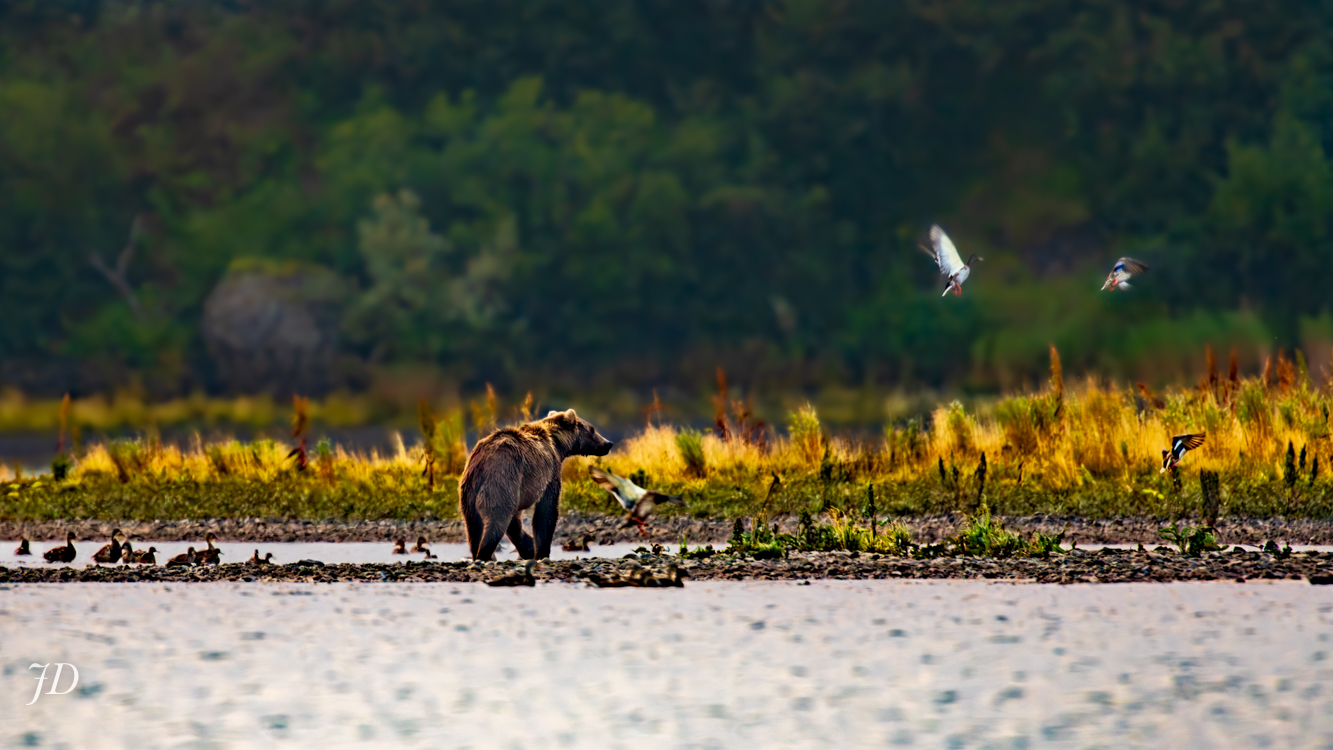
One Fine Morning – Paradise Bend on The Chignik River Ambling Bear, Mallards, Teal, White-fronted Geese, a splash of sunshine September 8, 2018
I went to the woods because I wished to live deliberately, to front only the essential facts of life, and see if I could not learn what it had to teach, and not, when I came to die, discover that I had not lived.Henry Thoreau, Walden
Located about four miles up from the salt estuary, this is the scene at the barge landing on the Chignik River during one of the big 11-foot tides that occur there when the gravitational pull of a full or new moon is at its peak. Upriver from here, the Chignik becomes unnavigable to large vessels, even at high-water. At low-water, this is a good place watch for bears, seals, otters and every so often moose. People have seen wolves here and, infrequently, lynx. This is where I once saw a nattily marked male Spotted Redshank, a bird that very rarely strays to North America from its native Asia and where on a different occasion a gyrfalcon swooped down and hovered just above me, as though to investigate. Occasional boat traffic notwithstanding, the landing is set in wilderness.
When the big tides roll up the river they bring salt scent and sea wrack, and even in the lake six miles and more up from the salt chuck the current pushes backwards and the receding water leaves behind eelgrass from the estuary. Depending on how you look at it, the landing is either the beginning or end of Chignik Lake’s lone road – three miles of dirt and gravel hugging steep hills as it winds above the river and then cuts through the village to connect the boat landing with the dirt airstrip. In fall, 10 and 11 foot tides are used to barge fuel up the river to the landing where it is loaded onto trucks that complete the short haul into the village. This is also how large equipment and building materials are brought into Chignik Lake which is otherwise accessible only by small plane.
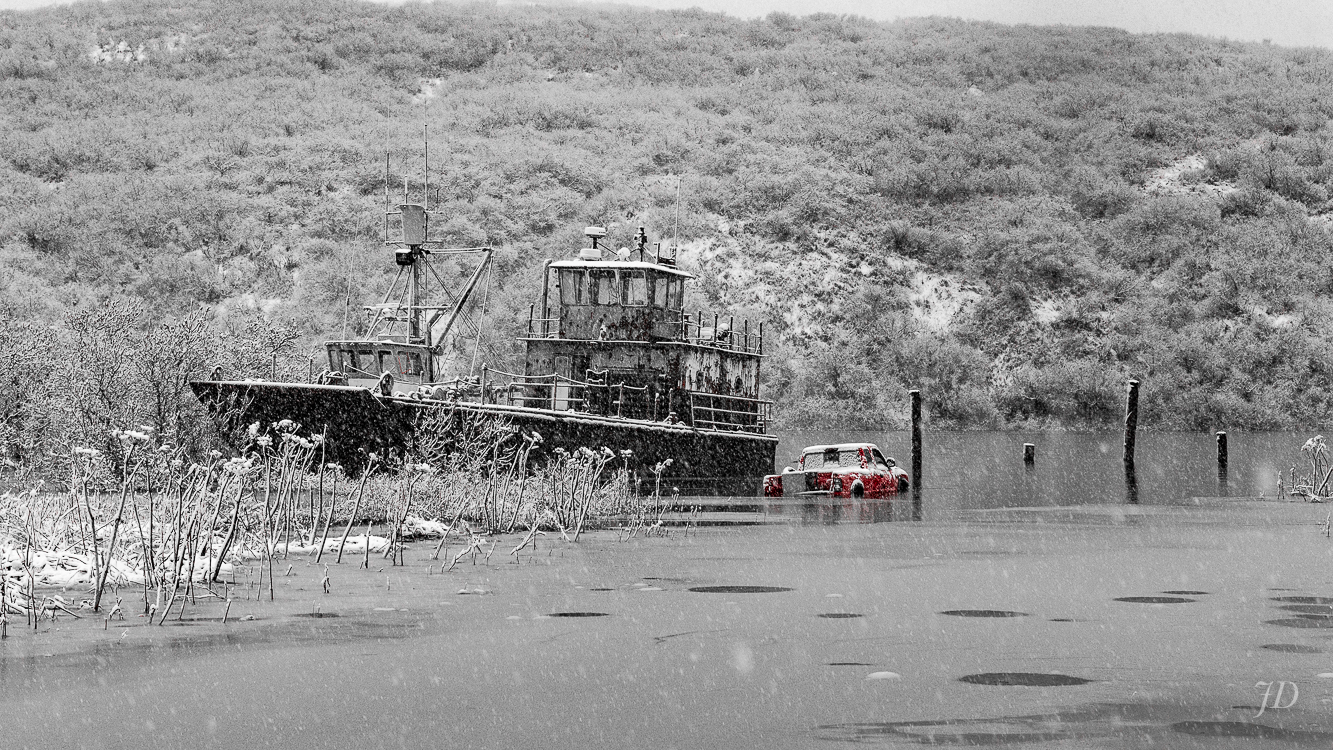
You gotta watch where you park. These big tides come up awfully fast and will snatch a carelessly beached skiff in a blink – as just about all of us have learned through experience at one time or another. I would imagine the wheel bearings on the truck in this photo are pretty much shot… among other things.
The Well-stocked Wilderness Larder We had packed in sufficient quantities of our own food and so were in no danger of going hungry when a dangerous winter storm came up out of nowhere, flash-freezing Black Lake and stranding us in a tiny cabin on its shores. But I admit… it had been a long time since I’d had a slab of fried spam; it proved to be more than I could resist. Black Lake in the Chignik Drainage, January 2018
Tundra Swans at Black Lake – The jagged Aleutian Mountains loom in the background over this bay on remote Black Lake on the Alaska Peninsula. A flock of approximately six dozen Tundra Swans rests on ice in the foreground. Not readily discernible in this photo, a few ducks, mostly Mallards, are milling about in the open water near the ice. This broad, shallow, weedy lake at the headwaters of the Chignik River Drainage provides waterfowl habitat as well as an important nursery for salmon that spawn in various tributaries. The most practical way to access the remote waters of Black Lake is by skiff – about 17 winding miles from the village of Chignik Lake up Chignik Lake and then up Black River.January 3, 2018
Sunrise From our living and dining room windows, we would follow the position of the sun as it changed with each season. Autumn mornings, when the sun rises over the lower end of the lake, are often spectacular. Coho Salmon are still migrating up the lake and river at this time of year, and on still mornings such as this we would watch from our windows for wakes and bulges along the shoreline. Chignik Lake, 10/16/17








 CutterLight