Unknown's avatar

About Jack & Barbra Donachy

Writers, photographers, food lovers, anglers, travelers and students of poetry

Philosophies for Learning to Play the Guitar at 60: Visualize

Philosophy #14

Visualize. Athletes anticipate and mentally map out desired outcomes such as the phases necessary to go through in clearing the bar in pole vaulting or in pulling in a football for a catch. This works for musicians too. Get into the practice of “seeing” ahead in a song to anticipate musical passages and chord changes. Practice chord changes by accurately and smoothly moving back and forth with your left hand without even playing. Picture the chords in your mind. Silently practice. These activities build brain synapses and muscle memory.


The Lake – for a Moment

The Lake – for a Moment
Chignik Lake, Alaska, Dawn March 26, 2019


Philosophies for Learning to Play the Guitar at 60: Listen

Philosophy #13

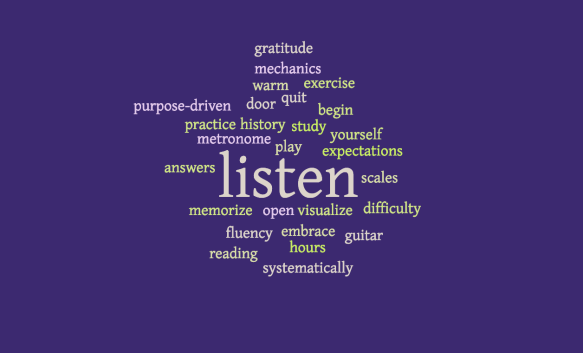
Listen. Listening well is a skill, and therefore as with any skill it can be developed through practice. A person new to birding may know only a few bird songs – perhaps not even a few. (Hollywood directors frequently – almost ubiquitously – place Blue Jay calls into film settings where no Blue Jay has ever flown; those same directors dub in hawk cries when the birds are eagles.) But with practice, anyone can learn to recognize dozens of bird calls and songs – a skill that seems almost magical at first. Similarly, as a young fly-fisherman I remember an older mentor directing my attention to the sound of bluegills feeding among lily pads along a calm lakeshore. The gentle popping-kissing sound was unmistakable, and my ears became trained to listen for it when I’m on a springtime or summertime lake where these sunfish might be patrolling the shoreline. 

With just 153 hours of practice under my belt since January 1, I cannot yet answer the question, Is it even possible for someone in their 60’s to learn to play the guitar with any meaningful degree of proficiency? But what I can say is that after even a few hours of focused practice, you will probably notice that you are hearing notes and music in a new way. Familiar songs on your iPod or Spotify playlists will suddenly sound new as chords, riffs and even lyrics that have always been there suddenly seem to leap out of the speakers. And on your own guitar you’ll probably begin to notice when strings are even slightly out of tune.

Regardless of what you play, listen carefully, for as you practice, so you will learn and eventually so you will play. Make certain your instrument is always in tune. Sound notes with care so that they ring true. Test the chords you’re learning by playing each string individually. Train your ear to expect beautiful tones.


Grandma’s Secret Is Out or Cabbage Roll Soup Meets the Alaska Bush

The tang of tomatoes, the zip of lemon, and the hint of sweetness from a bit brown sugar all mixed in with cabbage and some of Alaska’s best game meat – moose. Grandma’s secret is out!

My strongest memories of my grandmother are connected with food. She lived in Queens. Meanwhile my family was bouncing around from Brooklyn out to New Mexico and back to Albany before finally ending up in California, and so we only got to see her once in a while. When we did, I remember heartily enjoying all of her culinary creations – Jewish staples like kugel, brisket, blintzes, and of course, stuffed cabbages. I don’t know if she intended to keep her recipes secret. Maybe she thought I was too young to understand them. Maybe she thought – well, I don’t know. I could only guess. Unfortunately she passed away when I was still only in my 20s. Over the years, I have tried to make a few of her standards, producing what I think have been successes. I was particularly pleased with a crock pot recipe for cabbage rolls that I came across many years ago which I thought tasted just like hers. The problem with that recipe was that it took For Ever.

Fast forward to now. Jack and I have entered a favorite time of year. It’s the time when we look in our freezers and pantry and try to use up whatever we have on hand a la the show Chopped. With bunches of carrots, heads of cabbage, a few pounds of ground moose, and way too many onions, I thought of stuffed cabbage. It’s really a perfect recipe for the bush. We lucked into a healthy amount of moose this year. (Half a moose was flown into our village from a hunting camp earlier this year…another story.) Cabbages, carrots, and onions ship reliably through the postal service from Anchorage. Even if they get stalled at our mail hub in King Salmon for days in a row, which happens regularly, these items arrive relatively unmarred. The best stuffed cabbage is made with big, beautiful leaves. That wasn’t what I had. And time. I didn’t have that, either.

I started to think about what made my grandmother’s stuffed cabbages so good. I liked the rolls. But what I especially liked the flavor, and I liked what was left on the bottom on the pot when the cabbages fell apart. Why not make just that? Turns out, this recipe has the exact flavor of my grandma’s “secret recipe” but the time and effort is cut down – way down. With a few minutes of prep, and 45 minutes of “simmer time,” this recipe is a keeper!

Stuffed Cabbage Soup

Ingredients

  • 1 lb. moose meat (substitute lean ground beef)
  • 2 tbsp olive oil
  • 1 medium sweet onion, like Walla Walla, chopped
  • 3 cloves garlic, chopped
  • 4 cups beef bouillon (we like Penzeys beef soup base)
  • 12 ounces tomato paste reconstituted with 2 cups hot water
  • 2 tbsp brown sugar
  • 1 tsp salt
  • 1/2 tsp dried oregano
  • 1/2 tsp black pepper
  • 1/2 cup uncooked long grain brown rice
  • 5 cups green cabbage, chopped large
  • 1 cup shredded carrots
  • 2 bay leaves
  • 1 1/2 tbsp lemon juice

Directions

  1. Use a large soup pot. Place olive oil and meat in the pot.
  2. Add onions.
  3. Sauté until meat is browned.
  4. Add garlic and stir.
  5. Add broth, reconstituted tomato paste, brown sugar, salt, oregano, pepper and rice. Mix well.
  6. Add cabbage and carrots. Stir to mix.
  7. Place bay leaves in pot.
  8. Bring mixture to a boil. Reduce heat to simmer and cover the pot. Cook until rice is tender, about 45 minutes.
  9. Remove pot from heat and stir in lemon juice.
  10. Let soup rest for a few minutes before serving.

Powering Up With Freezer Fudge: Rocky Road and Monster Cookie Recipes

I suppose you should wait a few minutes for these bites to thaw a bit before diving in…but who are we kidding? They are satisfying straight out of the freezer!

I was late to the banana ice cream party. It was only a few summers ago that I discovered that blending frozen bananas has the taste and texture of delicious creamy banana ice cream. I added all sorts of flavors to this fantastic base to help us keep cool during warm air conditioner-less summers in Mongolia. As a newcomer to this confection, and back on a serious workout regimen, it only just occurred to me to take this dessert and transform it to a pre or post workout snack. The new base has a combination of frozen bananas, peanut butter and maple syrup. After that, add what you like. The idea is to keep it simple, flavorful, and leaning toward healthy choices. Ahem, a few itty-bitty mini marshmallows or M&Ms won’t kill you!

I used my silicone mini muffin pan to initially freeze the treats. The cookies pop out easily and you’re ready for another batch. Simply store your freezer fudge in a freezer-safe container lined with parchment paper, and your workout snacks will be ready when you are.

Rocky Road Freezer Fudge

Ingredients

  • 1/2 cup peanut butter
  • 1 overripe banana
  • 2 tbsp real maple syrup
  • 1/4 cup Dutch Processed cocoa powder
  • pinch salt

Directions

  1. Use a stick blender or a food processor to combine and smooth all ingredients.
  2. Scoop out tablespoon-sized portions and place in a silicone ice tray or mini muffin pan.
  3. Place tray or pan in freezer until confections are solid.
  4. Pop out the confections and place them in a freezer-safe container lined with parchment paper.
  5. Power up with a couple of these before a workout, or reward yourself after for a job well-done!

We are huge fans of monster cookies, especially monster-sized monster cookies. This freezer fudge flavor is a nod to those not-so-healthy-but-oh-so-good treats. The peanut butter base is perfect with a stir-in of the same candies that give monster cookies their famous flavor and look.

Freezer Fudge a la Monster Cookie

Ingredients

  • 1/2 cup peanut butter
  • 1 overripe banana
  • 2 tbsp real maple syrup
  • 2 tbsp M&Ms candies
  • 2 tbsp white chocolate chips
  • 2 tbsp semi-sweet chocolate chips
  • pinch salt

Directions

  1. Use a stick blender or a food processor the combine and smooth peanut butter, banana and maple syrup.
  2. Fold in M&Ms and chocolate chips.
  3. Scoop out tablespoon-sized portions and place in a silicone ice tray or mini muffin pan.
  4. Place tray or pan in freezer until confections are solid.
  5. Pop out confections and place them in a freezer-safe container lined with parchment paper.
  6. Power up with a couple of these before a workout, or reward yourself after for a job well-done!

Singing His Heart Out: A Pleasant Morning at White Spruce Grove

Resplendent! This male Pine Grosbeak came down from a tree crown to forage beneath one of the feeders at White Spruce Grove.

When we stepped out the door yesterday morning, the first thing we noticed was a new song in the air. A spring song. Returning Fox Sparrows have been the first to begin this each year we’ve been in Chignik Lake, but the warbling melody didn’t sound like a Fox Sparrow’s riff. We could see the bird, a plump silhouette atop a spruce tree near the church and since we were on the way to the White Spruce Grove to top off bird feeders anyway, the obvious choice of walking path was the one that would bring us nearer to the singer.
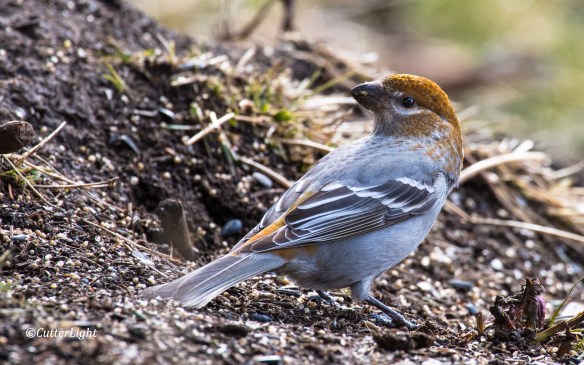
The female grosbeak briefly joined her mate.

Pine Grosbeak, brilliant red and singing for all he was worth. Quite a change from the brief but distinctive Peek Peek! we hear from this species throughout fall and winter. It wasn’t a new bird, but it was new behavior. We continued on the half-mile to the spruce grove with anticipation.
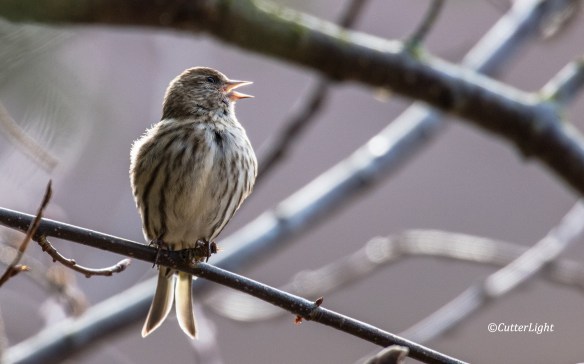
Our Pine Siskins were their usual raucous selves, singing, squabbling, gorging on seeds, darting from tree to tree.

Along the way scattered flocks of Pine Siskins buzzed and called from the sky and from a neighbors’ house where they sometimes take refuge in a few spruce trees while visiting the feeder there. Magpies, common here at The Lake, made their presence known, as did a woodpecker, almost certainly a Downy though we couldn’t find it. Further along a pair of Black-capped Chickadees gave a couple of their various calls from willows, the branches of the scrubby trees suddenly having turned bright yellow-green and beginning to bud.
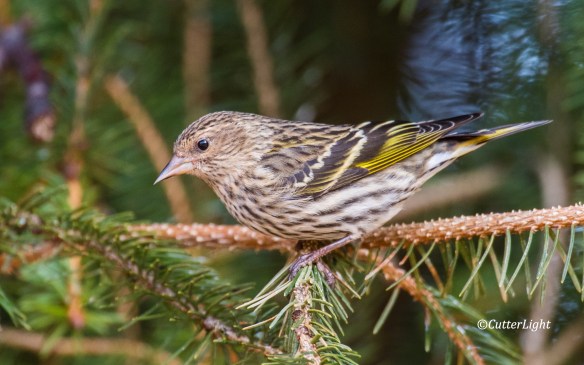
My guess is that when the time comes, the siskins will head up the peninsula to the denser spruce forests around Lake Iliamna and similar places to nest, but they’ve been welcome winter visitors the past two years.

At the White Spruce Grove the usual Siskins, which showed up last fall and have spent the winter, were busy at the feeders as well as prying the last seeds from cones. But there were a few larger, rounder shapes foraging on the ground as well. We didn’t get our binoculars up in time to have a look, but as we were filling the feeders we heard the unmistakable plaintive song of Golden-crowned Sparrows.

There’s just a touch more gold in this Golden-crowned Sparrow’s crown than there may have been a month ago. He’s still a ways off from full breeding plumage though.

Sure enough, once we scattered a little seed along the brushy edge where they like to feed, they began to show up, and they brought a Dark-eyed Junco with them. Seldom observed out on the Alaska Peninsula – and absent altogether or marked with a question on most of the region’s birding lists – Juncos have shown up in small numbers each of the three winters we’ve spent here. In fact, we think we have the only documentation on the peninsula of Oregon race juncos.
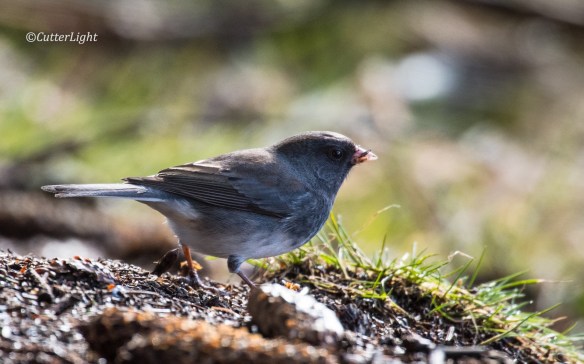
While there have been fewer Juncos at the Lake than there were last year, every so often we see one or two or three.

The Golden-crowned Sparrows appear to have just begun growing in their breeding plumage. Some of the male Siskins though are already there, showing off brilliant canary yellow in their primaries. At one point a Belted Kingfisher rattled by, most likely a male getting things ready for the females that will soon return. Ravens called in throaty croaks from a far hill. No ducks on the water and no eagles on their usual perches, which is a little unusual. Perhaps the ducks are already up at Black Lake where most of the nesting occurs. Gulls will begin returning any day.
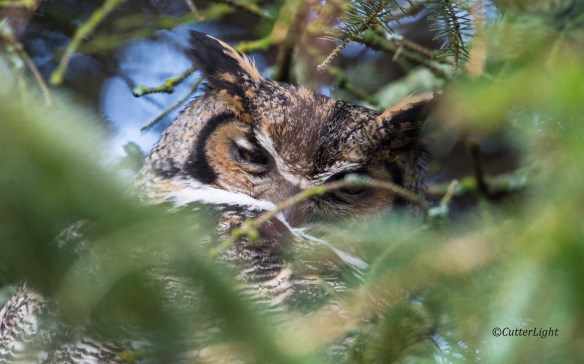
Sleepy but looking well fed, she lost both of her fully-fledged chicks last year, one to an electrical box on a utility pole and the other to some other cause. We’re hoping she nests again this year with much better luck.

We aren’t always lucky enough to see one and we rarely see both of them, but this was a red letter day as both of our Great Horned Owls – the female and the slightly smaller, more lightly colored male – were perched where we were able to find them. As is usually the case, they were buried in shadows behind thick evergreen boughs, aware of our presence but seemingly unconcerned. The ground beneath their favorite roosts is littered with bits of hair, feather, bone and beaks and oblong balls the size of two thumbs placed together packed tight with the remains of the various voles, Magpies, ermine, lemmings or whatever else constitutes one of their meals. Last year the female spent several days perched atop a winter-white Snowshoe Hare – several meals.

Discernibly smaller and with brighter plumage, we feel fairly certain that this is the male. The Ainu – Japan’s indigenous people – believed that owls protected their villages. They are certainly regal animals.

Frost on the ground this morning, but if you look closely at the photos, you can see other signs that spring is coming to Chignik Lake. Hopefully I’ll be posting a video of a Fox Sparrow singing in the near future.

With their uplifting songs and stunning plumage, if birds didn’t actually exist I don’t think we’d believe that they even could exist. They certainly brighten our world.
Philosophies for Learning to Play the Guitar at 60: Choose the Right Guitar

Philosophy #12

Take a Tip from Harold Crick:
Choose a Guitar that Makes You Want to Play.

I once owned a 2005 Toyota Tacoma pickup that was in every way so perfectly customized to suit my preferences that had I been given an assortment of the best vehicles in the world – Lamborghinis, Mercedes, Jags, whatever – they’d have sat untouched. That Tacoma was the only ride for me.

I feel that way about my guitar.

If you’ve ever watched the film Stranger than Fiction, you’ve seen what is probably the best way to choose a guitar. Harold Crick, played by Will Ferrell, has decided to finally act upon his oldest desire – to learn to play the guitar.

Like you, Harold already knows what kind of music he wants to play. And like you, he knows how much he’s willing to spend on a guitar. And so, like you, he doesn’t really need a lot of advice from the staff at the guitar shop, friends or online experts. What he needs to do is go to a store with lots of guitars, look at them, and pay attention to which one he wants to pick up and play.

And since he can’t play… not yet anyway… there’s no need to embarrass himself or anyone else by taking an instrument down and strumming it.

It doesn’t matter that when he finally made his decision, Harold chose a guitar that I wouldn’t choose and that perhaps you wouldn’t choose either. He picked the guitar that spoke to him.  Here’s a link to the minute-and-a-half clip.

Stranger than Fiction: Harold Chooses a Guitar

If you’ve made a commitment to learning to play the guitar, get one you really like now rather than later. A rose is a rose is a rose… until you get to know roses and every subtle difference among them pops out.

Although I had an inexpensive but perfectly serviceable Fender acoustic steel string when I began this experiment, I knew after two weeks of practicing on it that I wanted something else. Since I live in the Alaska bush and don’t have access to a guitar shop, I did my looking online. I knew next to nothing about guitars, but it wasn’t long before I found exactly what I was looking for – the guitar that spoke to me. 

I called Mammoth Music in Anchorage, paid a nominal fee to have the guitar delivered to Lake Clark Air (our bush plane service) and in short order I was playing the guitar of my dreams.

I love this guitar.

I love that it was crafted in my home state so that there is a connection with a place I love.

I love that the top is Sitka Spruce, and that I can follow my memory to spruce forests in Oregon, British Columbia and Alaska where I’ve hiked and camped and that I can almost smell the loam and trees, hear thrushes singing, see sunlight streaming through spruce boughs when I pick up my guitar.

I love that my very first musician hero, Johnny Cash, played this model. So did Jimmy Page, Bob Dylan and a long list of other musicians I admire.

I love that the rosette design is modestly understated, so that one’s eyes are drawn to the grain of the wood rather than distracted by embellishments.

I love the way this guitar resonates when I hit a note just right – and the fact that it doesn’t punish me too severely when I hit a string wrong.

So, go find the guitar (or fly rod, cookware, camera, or whatever it may be) that’s right for you. It can make a big difference as you continue on your journey.

Philosophies for Learning to Play the Guitar at 60: Open Door

Philosophy #11

Keep the Door Open. At least some of the time. This is about nipping stage fright in the bud. Go ahead and let people hear you play. So you make mistakes? It’s fine. You’re making music and music is to be shared. Also, when people find out you’re learning to play, they’re going to want to hear you play something. Go ahead! The more often you take advantage of these opportunities, the more at ease with an audience you’ll become. That’s the idea, right? You want to avoid becoming a person who has “been practicing” but who is still reluctant to play in front of others.

Philosophies for Learning to Play the Guitar at 60: The 90% Rule

Philosophy #10

Call 90% “Good Enough for Now.”

Perfection is an elusive target.  Strive instead for 90% – or even 85% (a sold ‘B’), knowing that you will circle back again and again to every key concept and skill. This understanding will help prevent you from becoming bogged down, frustrated or bored.


Philosophies for Learning to Play the Guitar at 60: Memorize

Philosophy #9: 

Memorize. Not only does memorization help create synapses in your brain, as you memorize melodies and scales you will begin to develop a better ear for individual notes and solos.

Yes, memorization is going to be more difficult at the age of 60 than it was at 16, 26 or even 36.

Stay with it. It’ll come.

Think of other things people come to later in life and, over time, master. RVing, fly-fishing, birding, baking and cooking can seem overwhelming at first. Yet, with repeated practice knowledge that once had to be constantly reviewed gradually becomes ingrained until various water and electrical hook-ups are done without hesitation, knots are tied easily by rote, a glance reveals the difference between a crossbill and a grosbeak, and a properly seasoned dish becomes almost instinctive.

Even if you don’t get everything you play memorized perfectly, you’re still building music connections in your brain. And you’ll probably surprise yourself. The more music you memorize, the easier additional memorization becomes.