Waterbird

Waterbird
Greater Yellowlegs (Tringa melanoleuca)
Paradise Bend, Chignik River, Alaska Peninsula, May 17, 2019

May and June of 2019 became somewhat of a turning point both in terms of photography and our relationship with the Chignik. The school at Chignik Lake had failed to meet the state’s requirement for a minimum enrollment of 10 students from kindergarten through grade 12 and was therefore to be closed at the end of May. Barbra was reassigned to the school at Newhalen, 278 miles Northeast up the peninsula, above where the ball of the hip joint might be, on the mainland. We were heartbroken about the move. Artistically, I felt as though I was just beginning to figure out my relationship with the river. Emotionally, we were both deeply attached to the people and the landscape at The Lake.

With the move scheduled for late June (we flew ourselves and everything we owned out on a small plane chartered for us by the school district), I was doing my best to take advantage of good days… good light… and reimagining what our experience at The Lake had meant… what the essence of it had been. And so I began breaking away from strictly representational documentary, looking for images that captured not merely what things looked like, but how we would remember them. JD

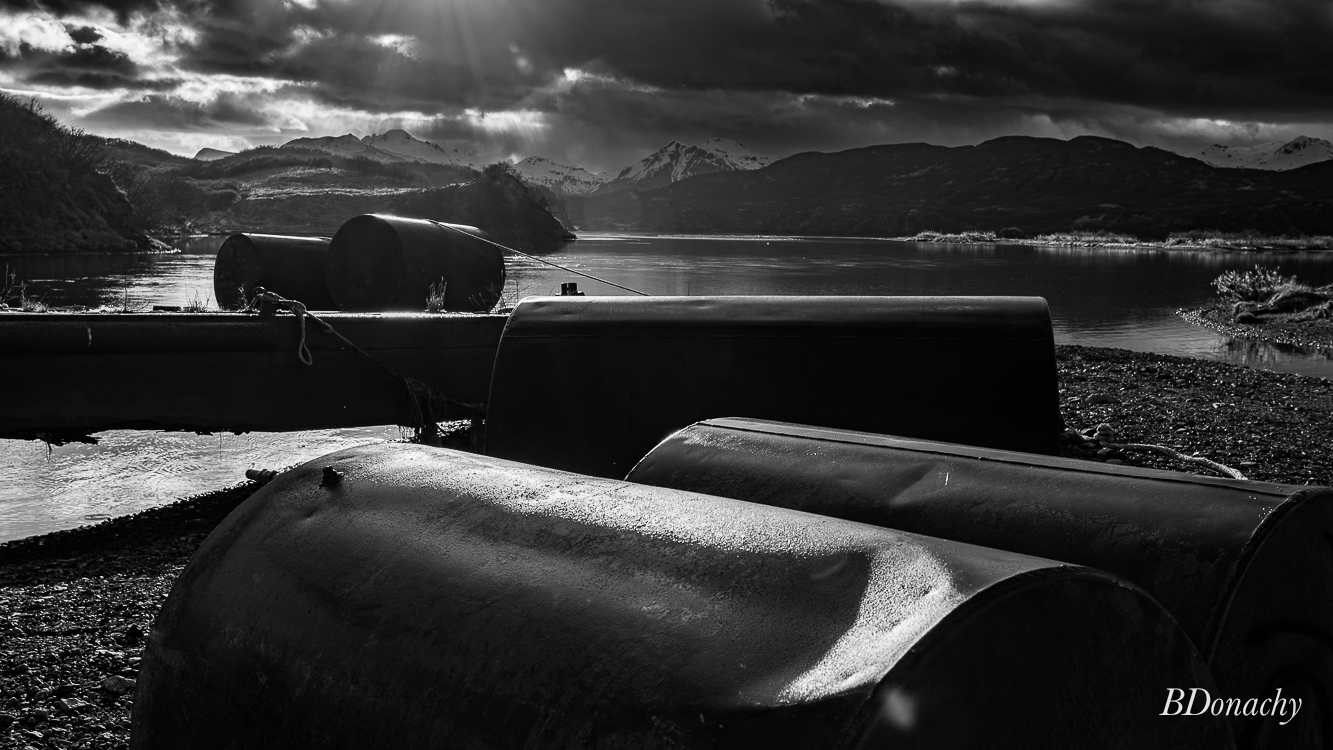
Fuel Oil Drums at The Pad

Fuel Oil Drums at The Pad
Chignik River Barge Landing, May 16, 2019

Barbra has an eye for moody images such as this early morning landscape of diesel oil drums at the barge landing on Chignik River. The scene is the terminus of the three-mile road that travels from the airstrip, winds through the village of Chignik Lake (population 50 something), and then follows the river along steep hillsides till it ends here at the landing. These drums are barged to this point, about six miles upriver from the salt water lagoon, on high tides of about 10 feet or more. On lesser tides, the river is too shallow for the barges to run. From here, the fuel is loaded onto a truck and carried to the diesel generators that provide the village’s electricity. Gasoline, too, along with any sort of large stuff such as vehicles and building material is brought into the village in this fashion.

Such are some of the logistical consideration in a wilderness village.

Ol’ Half-a-Horn

Ol’ Half-a-Horn

I almost wasn’t going to show this photo. Despite my nicknaming him Ol’, he’s probably a fully mature but young bull – perhaps in his fourth year. He’s missing his right paddle, and the remaining antler isn’t impressive. In fact, since to be legally taken during Alaska’s moose hunting season the tip to tip, antler to antler spread has to span at least 50 inches (127 cm), he probably wouldn’t have passed muster. So, no Boone and Crockett award here.

But this is easily the closest I’ve ever been to a moose, and when he suddenly emerged -seemingly to simply materialize from a thick tangle of willows, alders and salmonberries, he took our breath away. I had mere seconds to set up and make the shot has he strolled by, appearing unconcerned, barely glancing our way – our own hearts meanwhile racing like mad. Even a young bull such as this weighs close to half-a-ton and although the big ungulates are generally peaceful, mind-your-own-business types, each year here in Alaska more people are injured by moose than by bears. In fact, an Alaska man was stomped to death by a cow protecting her calf less than two weeks ago. So anytime one finds oneself this close to an animal of this size, the thrill involves wildly mixed feelings.

As I mentioned, the moment lasted mere seconds. And then, more miraculously than its sudden appearance, this fellow simply vanished. There was no departing view of dark rump disappearing into the vegetation, no hint of willows and alders shaking as he brushed by them. He crossed before us, I made 12 quick captures, the last of which featuring mainly an eyeball, part of the rack, an ear and his nape… and then he was gone, swallowed without a sound into a thicket of alders. Had we not been exactly where we were during those few seconds, we would never have guessed a moose was nearby.

Chignik Lake, October 4, 2018 – JD

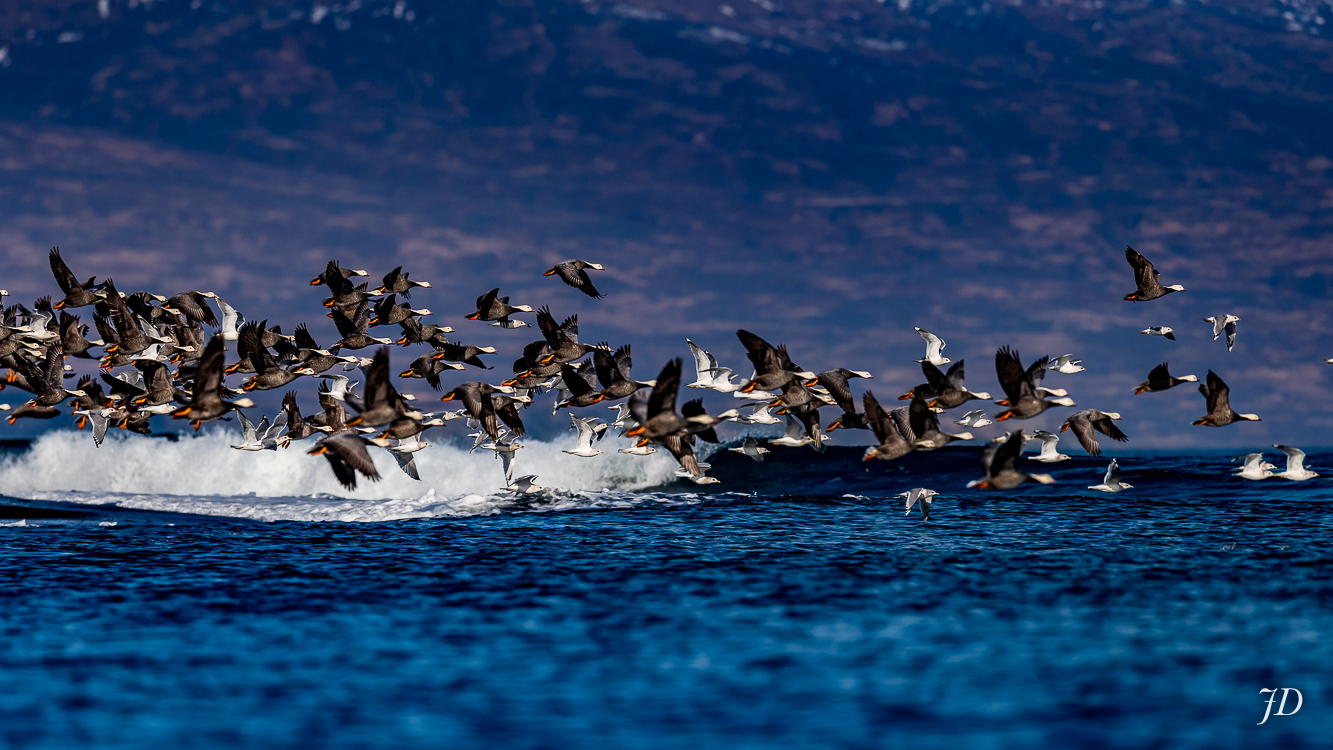
Painted Geese over Breaking Surf

Painted Geese over Breaking Surf
Emperor Geese, Chignik Lagoon, March 9, 2019

With the bright white head and nape reminiscent of the ermine capes European Royals of yore garbed themselves in, Emperor Geese (Anser canagicus) present a striking visage. But to catch a glimpse of these smallish, colorful, somewhat rare birds you have to go to coastal Western Alaska or Eastern Russia. A few dozen sometimes stop over at the sand spit at the mouth of Chignik Lagoon on the Alaska Peninsula. That’s where we found this flock, a few Glaucous-winged Gulls mixed in.

JD

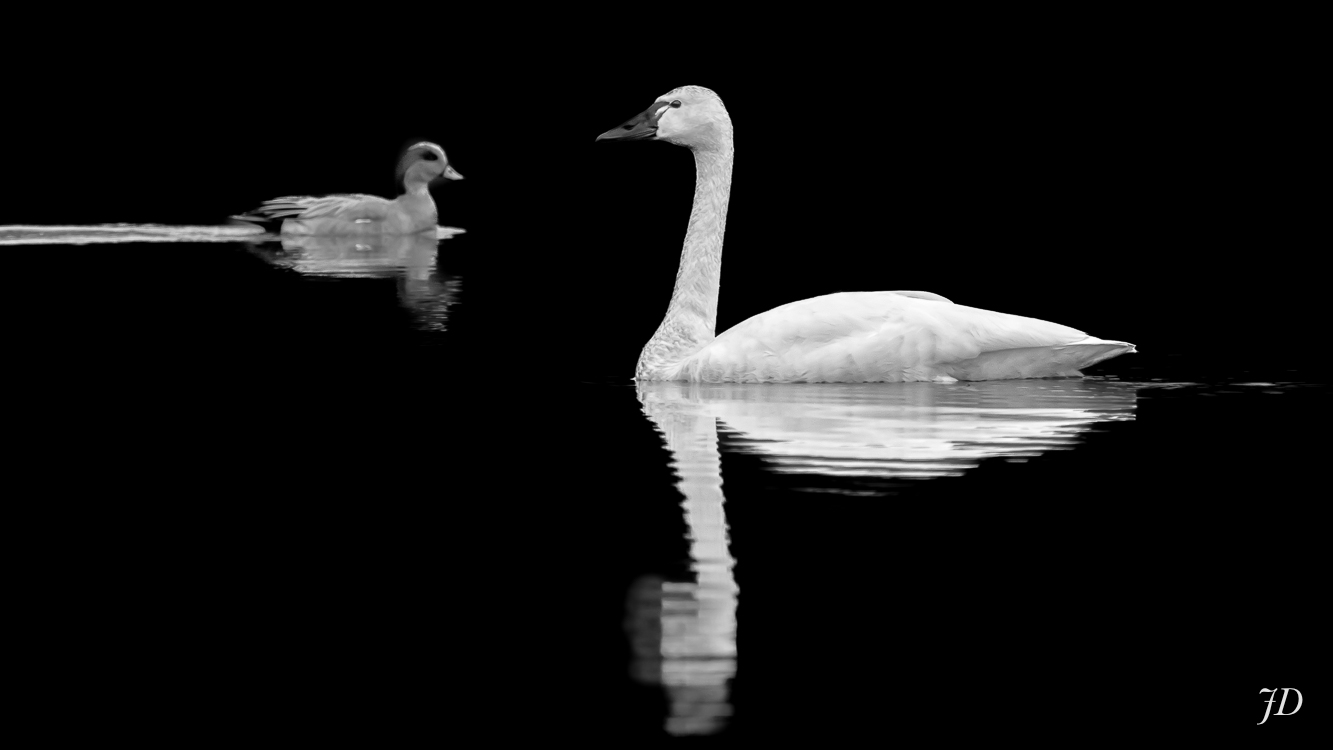
Tundra Swan with American Wigeon at Broad Pool

Tundra Swan with American Wigeon at Broad Pool
Broad Pool on Chignik River, Alaska Peninsula, May 4, 2019

The best place to look for returning Tundra Swans (Cygnus columbians) on the Chignik is at Broad Pool, about a mile downriver from the village. One evening the swans announce their arrival with far off, lonesome-sounding notes and by morning they’ve settled at the pool. There the slow-moving, weedy water provides food for the swans as well as for migrating dabbling ducks such as Mallards, Green-winged Teal, Northern Pintails and American Wigeons. Diving ducks, mostly Common Goldeneyes, Buffleheads, Greater Scaup and both Common and Red-breasted Mergansers are also likely to be present. At this time, the banks are covered in scraggly, winter-brown grasses, sedges, willows and alders and there may still by ice along the river’s edge. By the end of the month the ice is gone and the swans and most of the ducks will have dispersed to nesting areas further up the drainage, but at least one pair of Mallards and another of wigeons usually stay to nest along along the margins of Broad Pool. They are often joined there by a brood or two of Black Scoters.

Good Morning

Good Morning
Alaska Peninsula Brown Bear, Ursus arctos gyas. Chignik Lake, October 3, 2018

Alaska Peninsula Brown Bears share the same genus and specific name as Grizzly Bears of interior Alaska, Canada and the Lower 48: Ursus arctos. They differ only in the subspecific name: gyas in the case of these Peninsula Brown Bears; horribilis for Grizzlies.

I present this image here at a 16:9 ratio because that works well on most screens. But when I print it to show, I will print it as a square and ask that it be hung at eye-level, as a kind of mirror. There is more going on behind those eyes than where the next meal is coming from.

And yes. My heart was pounding wildly to find myself suddenly this close…

Blue Skies and Sunshine

Brown Bear in Sunshine
Paradise Bend, Chignik River, September 24, 2018

We didn’t get a lot of days like the one depicted above out on the cloudy, windswept Alaska Peninsula. Blue skies reflected in the river, sunshine casting everything it touched in a patina of gold. I hurried through breakfast, donned waders and a camouflage jacked, packed my camera into its soft case and bungee-corded it to the front rack of my honda. Two-and-a-half miles down the Top Road I parked near the boat landing, slung 20 pounds of tripod, camera and long lens over my shoulder and followed a trail to the broad, seldom-visited collection of braided water and islands we called Paradise Bend – the best place on the Chignik to catch morning light. Along the trail there were bear and moose tracks in soft mud, the last Wild Geraniums and Yarrow barely holding onto their purple and white blooms respectively. A snipe exploded from a little swale – late in the year for that species to be hanging around. Curious Black-capped Chickadees called from alder thickets and approached on either side to examine the intruder striding through their world and from the river I could hear the ratchety cry of a kingfisher. Further out gulls squawked and chattered – Glaucous-winged and Short-bills -, and I could just barely hear the soft, murmuring quacks of Mallards and Green-winged Teal. A pair of eagles began piping.

As I reached the bend, the wary ducks rose and repositioned themselves further downriver. There were more bear tracks in the sand along with a set of wolf prints, fresh, probably from the previous night. I waded across a river braid out to an island covered in graywacke, set up in front of small wall of autumn-yellow willows and waited. The morning sun poured over my left shoulder, a light breeze touched my right cheek. Salmon splashed in the channel in front of me as well as in shallows two hundred yards downriver to my left. My eyes were drawn to the sky as I became aware of steady, high-pitched honking growing closer – a pair of Tundra Swans winging south.

What a day. All I needed now was for a bear to come by.

Migration: The Peeps of Cordova

Western Sandpipers, Hartney Bay, Cordova, Alaska, May 3, 2024

This was the scene about six miles from the heart of Cordova this past Friday morning, and this is but a sliver of the many thousands of shorebirds that stop for a short while to fuel up and rest on tidal mudflats near the town as they make their way to nesting grounds further north. Figuring in nearby barrier islands and additional flats in the Copper River delta, some five million shorebirds represented by several species will visit the Cordova area over a few days in early May. While they are here, these Western Sandpipers will double their weight. The delta is absolutely critical to the health of these avian populations as there are only a few places in the world that offer the sheer biomass of invertebrates and biofilm these birds require in order to complete journeys that in many cases cover thousands of miles. Look for a more indepth article on this incredible migratory event in the coming days.

The View from the Boat Landing

The View from the Boat Landing
Chignik River, Dawn, September 10, 2018

Behind me from where I stood as I composed this photograph, a dirt and gravel road travels a winding path along steep hillsides for about three miles to the Chignik Lake airfield, a bouncy dirt airstrip capable of handling the nine-seat bush planes and smaller aircraft that regularly travel the Alaska Peninsula. For the first two-and-a-half miles from the boat landing the road hugs steep hills, often within view of the river. Traveling the road from June through November, it’s common – at times almost a given – that you’ll see one of more of the Chignik’s massive brown bears. Sandhill Cranes, Tundra Swans, eagles and any number of passerines are frequently encountered in summer, and at any time of year a glimpse of foxes, moose, wolves and even wolverines is possible. Take note of the local hares you might catch sight of – Tundra Hares, the largest hares in the world.

The road is the road… the road to The Pad… the Top Road. Three miles. On one end, unless you are on a Honda (an ATV), you would need to board a plane to travel further by vehicle. On the other end, you need a skiff. There is no overland connection with any other community. Mountains, rough terrain and jungle-thick alders make travel by foot even to the village of Chignik Lagoon – just six miles down the peninsula from Chignik Lake – impractical. Whether one travels by air or by sea, it is 353 miles to Homer, Alaska – the closest place a road connecting with the North American mainland can be joined.

Is “wilderness village” an oxymoron?

Environmental Stewardship and a Good Piece of Pie

Mumble Creek Brookie
That Stream that Shall Not be Named, Pennsylvania, May 2021

A few weeks ago here on Cutterlight I published a tribute to a recently passed friend and mentor, Bill Kodrich. Concurrently, I sent the article to the fly-fishing zine Hatch Magazine hoping to get Bill a bit more ink and appreciation. The editor asked for a longer piece, which I was happy to supply. The article went live on Hatch this morning. I wrote the piece as not only a tribute to Bill, but as a reminder of two things to consider as we move through life: That mentorship matters; and that when we join with others and put our shoulders to the wheel, big change is possible. Here’s the link: Environmental Stewardship and a Good Piece of Pie

I hope your day is going well.

JD