Skiffin’ – A Chignik Version of the Sunday Drive: Sunshine, Sea Birds, Seals and Snow-covered Mountains)

The view at Hatchery Beach, a wind-swept shore on Chignik Lake where sufficient upwelling and pea-sized gravel create ideal conditions for Sockeye Salmon to spawn. The stream-fed pond behind the strip of land is a feasting area for our huge brown bears from summer through fall.

It was a perfect day for skiffin’ – full-on sunshine, light breezes and a mid-day high tide pushing far enough up the river for The Shallows to be passable. The tide meant access to the Lagoon, the saltwater estuary where Chignik River debouches into the Alaska Gulf and an opportunity to photograph Emperor Geese. So when a friend called with an invitation to go out in his 18-foot Lund, we made quick work of lunch and pulled our camera gear together. Oh, and we bundled up; highs are only reaching 40° or so (4 or 5 degrees C) and it’s always colder on the water.
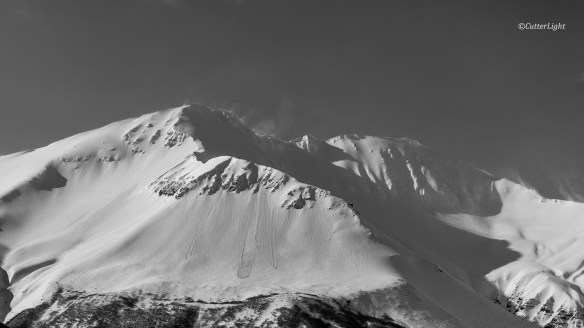
The Chignik Mountains surrounding the lake were shouldered in fresh, powdery snow. Kudos to Barbra on the landscape photographs in this article. It can be tough getting good shots from a bouncing boat.

Every plane coming into the village prompts two questions: Mail? Freight? Other than this plane and one other skiff, we had the lake, the river, the lagoon and the day to ourselves. 

Check out those talons… and that beak! Although we see eagles nearly every day, we always pause to admire these magnificent birds. I surprised myself a little with this shot. Even with a light breeze there was enough chop on the water to have the skiff (Chignik for what Pennsylvanians would call a boat) bouncing like crazy – a problem magnified several times over with a long wildlife lens and a teleconverter attached to my camera. Most of the time I couldn’t even find the bird in my viewfinder, and when I did I had less than a second to shoot before the boat rocked and the bird wildly bounced out of the frame. But he (or she) was patient with me and I had plenty of light to shoot fast when the chance came. They’ll be nesting soon, I imagine.
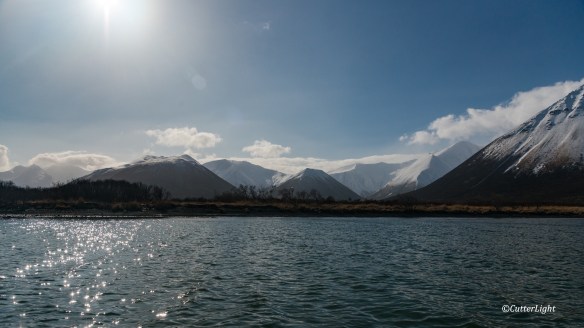
Here’s Hatchery Beach looking back toward the Clarks River watershed – a significant spawning tributary and with its nearly clear-as-air flow a magical place to fly-fish.

And a third shot moving up the lake along the Hatchery Beach shoreline. We’ve often thought that a lot of these mountains, which top out at just over 3,000 feet (1,000 meters), would make for a good climb. The main feat might be getting through the jungle-thick alders at the base.
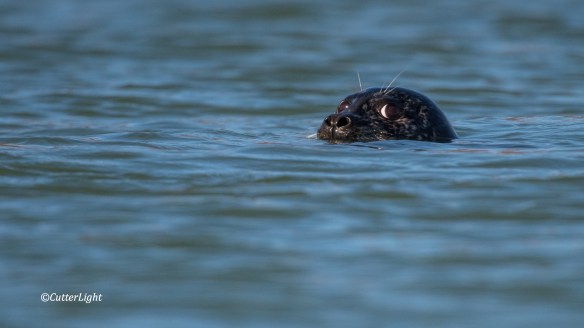
Cute, right? There always seem to be a few Harbor Seals in Chignik Lake and, I’m told, further up in the headwaters at Black Lake.
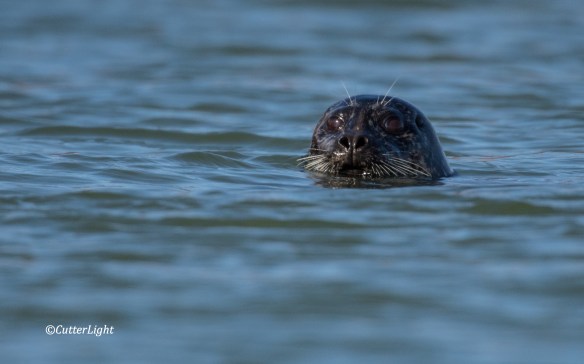
Here in Alaska, the population of Harbor Seals in Lake Iliamna gets a fair amount of attention. Yet we’ve never read a single word about the year-round seals in the Chignik System. One year I got a photo of nine seals hauled out together on lake ice across from our house. On this day, we saw this one and another that was sunning itself on a rock. I’d love to know more about what they eat once the salmon runs are finished.

Heading back down the lake toward the lagoon we passed our village on the right. Our house is the white duplex closest to the water toward the right of the photo. The large building to the left and behind our house is the school, and just to the left of that, almost center, you can see the golden steeple on the Russian Orthodox Church. Just 30 yards from the lake, our living room/dining room windows are ideal for wildlife viewing. From these windows we’ve seen a wolf, a wolverine, a beaver, moose, ermine, voles, lemmings and a number of brown bears, otters and harbor seals. Eagles, kingfishers, several species of ducks, common loons, magpies, ravens and a number of passerines are common along with our resident Great Horned Owls. Falcons are less common but Merlins nest here, and during summer we frequently hear and occasionally see sandhill cranes.
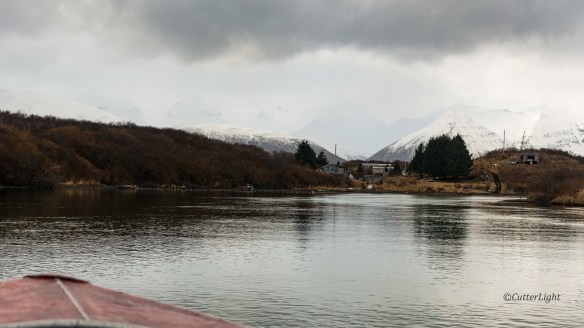
This photo was taken at the head of the Chignik River on the return upriver to the village. I include it because it shows the copse of 20 trees we call White Spruce Grove – a small but important piece of bird habitat. This is where we see most of the black-capped chickadees, juncoes and other sparrows, redpolls, Pacific wrens, golden-crowned kinglets, pine siskins and white-winged and red crossbills we’ve written about in other articles. Thus far, we’ve documented over 70 species of birds in or near Chignik Village, a few of which had, to our knowledge, never before been reported on the Alaska Peninsula. Predators such as sharp-shinned hawks, merlins, owls and shrikes use these trees as well. Note the net, marked by a line of white floats on the water, extending from a skiff out into the river. A neighbor has been catching Sockeyes of about 22 to 23 inches, most probably a resident strain of fish that never go out to sea.
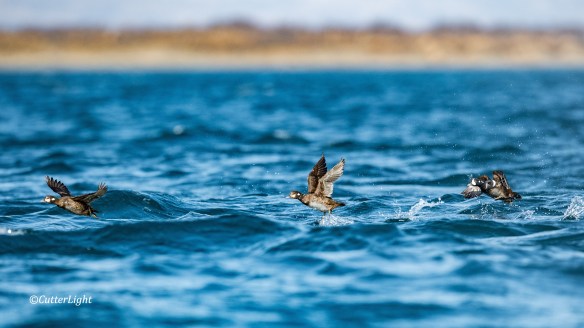
Although they occasionally visit the river during summers, and rarely are seen on the lake, we found lots and lots of harlequin ducks at the lagoon, the males (far right) already beginning to come into breeding plumage.

As with the harlequins, pelagic cormorants are uncommon visitors to the lake and river but abundant in the lagoon. And as with the photo of the eagle, some of these shots surprised me when I got them on the computer. This was a point, swing, hope and click effort with a pelagic heading in the opposite direction as our skiff cruised by.

I can count on one hand the number of times long-tailed ducks have shown up on the lake. Usually mixed in with other species, their distinctive coloration (a little like a scoop of strawberry, chocolate and vanilla Neapolitan ice cream) always makes me do a double-take. But they proved to be probably the most common bird on the estuarine lagoon on this outing, rivaled only by harlequins. The center bird is displaying his eponymous tail. Like harlequins, long-tailed ducks are fairly catholic in their dining habits and there’s simply a broader smorgasbord in the lagoon than in nearby freshwater. We foolishly left our binoculars behind, but there were a number of other species on the lagoon including what appeared to be a football-shaped phalarope so stuffed with whatever it was eating it could barely fly. From June through September the lagoon and nearby waters are a staging area for millions of returning salmon – in good years nearly two million reds (sockeyes) along with tens of thousands of silvers (coho) as well as pinks, chums and kings. 

Our friend had mentioned the lagoon’s flocks of Emperor Geese and I was hopeful of getting some photos. Unfortunately, as a hunted species, they proved to be fairly wary. Here a group of 200 or so birds take flight while we’re still well off their sand spit roost. (Thanks for the hero shot, Barbra!)

At the one place where we were able to get reasonably close to a few geese, colliding current and wind caused the skiff to bounce like crazy. But these handsome birds with white heads and napes, pink bills and yellow-orange legs are emperors – the first I’d photographed and a new bird for my Chignik List.

There’s little as stirring as wildlife abundance. I estimated close to 200 geese crowded together along with a few gulls on this last significant spit before the lagoon opens into the Alaska Gulf.

And there they go. I hate spooking wildlife. Just prior to this shot, birds were still dropping in to join the roost – but often it only takes one bird with antsy wings to get the rest up and going. The day was a lot of fun though and we got a few shots. Hopefully we’ll do another episode of skiffin’ in a few weeks to inventory the bird population again!

If you enjoyed this article, try typing “birds” into the search bar near the top of the page. You can find additional reading about our tiny bush village of Chignik Lake by typing those words into the search bar as well.
Philosophies for Learning the Guitar at 60: 500 Hours

Philosophy 3

Humble yourself to 500 hours. How long does it take to be able to play the guitar with basic proficiency? The answer depends on innate ability, prior experience, the quality and consistency of practice sessions, and how the term “basic proficiency” is defined. So any number we might choose will be somewhat arbitrary. That being said…

I’m using 500 hours as a benchmark. That’s about how much classroom, practice and study time I estimate I’d need to really get down all the material in a two-semester college level beginning guitar course. It’s also roughly the amount of work it appears it will take to thoroughly complete the 24 lessons in Collin McCallister’s Learning to Play the Guitar: Chords, Scales and Solos at The Great Courses along with the supplemental material I’m using.

This 500 hours does not include the time it takes to pick up and tune your guitar, locate your music, repeatedly check the clock or take a phone call. This is 500 hours of purpose-driven practice.

Let’s take a moment to consider what this means in terms of skill acquisition.

  • Committing to daily practice of 30 minutes, it will be 1,000 days before 500 hours of meaningful practice have been invested. That’s 2 years and 9 months. With these relatively short practice sessions, a high percentage of time will be spent warming up. Days will go by between circling back to practice certain skills and there often won’t be sufficient time to work through problems. Thus, even with 500 hours (2 years and 9 months) under your belt, you will likely not have attained the same skill level as someone got to 500 hours through longer practice sessions over a shorter period of time.

As a young person, you or someone you know may have been instructed to practice half-an-hour a day on the piano, violin or another instrument. It’s a fairly common prescription. But with time off during summer, missed weekends and holidays, inevitable illnesses, visits with friends and relatives, school projects and other commitments intervening, and (let’s be honest) a certain amount of wasted time during those practice sessions, it is often the case that practice only occurred on about 200 days in a given year. That’s only 100 hours of practice. At this pace – which is a fairly typical one – a person could take lessons for 5 years before hitting the 500 hour benchmark. Meanwhile, with all the interruptions, much of that 500 hours would have been devoted to review. This is one reason so many people who attempt to learn a musical instrument (or a foreign language) come away from the experience believing they have “no talent” for it. In reality, they never gave themselves an opportunity to develop the talent that they probably do have.

  • With 1 hour a day, the time to 500 hours is cut to 1 year, 4-and-a-half months. Because a higher percentage of practice time will have been devoted to skills beyond warm-ups, and because you can both practice a broader range of skills in each session (thus avoiding forgetting and other forms of skill deterioration) and because you’ll have more time to work through challenging areas and to experiment, at the conclusion of 500 hours you’re likely to be well ahead compared with had you committed to shorter sessions.

Still with days off here and there, you’re looking at close to a year-and-a-half before you’ve got 500 hours under your belt. That’s a fairly long time.

  • Two hours a day will get you to 500 hours in just over 8 months. In other words, within a year of first picking up a guitar, you could be playing it fairly well.
  • And so on. A schedule in which one begins with an hour a day in the first month, progresses to two hours in the second month as hands become stronger, and then ups practice time to three hours per day thereafter will get the guitarist to 500 hours in just over 5½ months. Consider the path any accomplished musician – or cook, fly-fishing master, athlete, educator, artist, or writer – took to reaching proficiency. They got there with lots of purpose-driven practice.

From 1960 to 1962 The Beatles worked bar gigs in Hamburg, Germany where they played five hours a night seven nights a week. That’s thousands of hours of meaningful, purpose-driven practice before their first #1 single in October 1962, Love Me Do.  

Keep in mind that the annals of achievement are filled with stories of people who weren’t very good (or who were actually quite awful) when they started, but by sticking with it and putting in the time went on to accomplish great things. Conversely, there are at least as many stories of people who began with great promise but who didn’t invest in the time and who subsequently fizzled out.

I offer the above as grist for thought rather than advice; each person must determine their own schedule and the pace of their own journey. But here’s a further observation. We all know people who have practiced a given skill “for years” and who still aren’t particularly accomplished at it. That’s because, as the above example with piano lessons illustrates, skill acquisition cannot meaningfully be measured in years. Dabbing at or dabbling in a complex skill in short practice sessions interrupted by distractions and further chopped up with lengthy periods when the thing is not practiced at all is a slow, long path and one most likely to end in discouragement.

As to 500 hours… It’s a lot of time. Think of it as a journey, enjoy it, and when you arrive you’ll be able to look back at that time when it (guitar or whatever else “it” is) was just a dream to a present time when you have acquired enough skills to make yourself say “Wow! I’m doing this!”

Philosophies for Learning the Guitar at 60: Purpose-driven Practice

Philosophy 2

A skill is built hour by hour engaged in focused practice guided by a purpose. There is no other way.

Philosophies for Learning the Guitar at 60: Begin

Begin. This first step may seem too obvious. It’s not. We Baby Boomers have known about guitars most of our lives. We were playing air guitars by the time we were eight. Maybe like me, you’ve owned a guitar in the past and even taken a couple of lessons. And then quit. For some reason you’ve put off getting serious about learning to play a guitar for 50 years or more. Part of your journey might be understanding what has blocked you in the past – what was in the way.

It wasn’t lack of time. I think it’s important to accept this. Yes, throughout our adult life most of us must make a living. But no one’s work is all-consuming unless one chooses it to be so. And that’s the operative word here: choice. For whatever reasons, learning the guitar wasn’t made a priority. And so instead of becoming guitar players, we devoted our free time to reading novels and newspapers, clubs and memberships, and on and off commitments (or perhaps sustained commitments) to fitness and sundry other hobbies. There have been social events and Sunday drives, certain time-consuming rituals that probably deserve more reflection than we’ve given them (maintaining a lawn, for example), and TV. Hours and hours of TV.

So what was my story? Well, this is a piece of it.

There was a piano in our home. My mother played. A little. I don’t know what prompted her to enroll us in lessons when I was eight and my younger sister was seven. Something like vaguely defined social expectations, I would imagine.

At the conclusion of our first lesson with Ms. Zilhaver, an older woman who periodically stepped away with coughing fits for a few puffs on a cigarette, we were instructed to practice for half-an-hour each day. I did so with alacrity. The following week I reported back to Ms. Zilhaver, prepared for my second lesson. She seemed impressed. I was given additional pieces of music to work on. And so it went for the next few weeks. Making good progress, there were times when I found myself still at the piano well after the prescribed 30-minute period was up.

My sister came to it more slowly. She put in her time, but not without a fair amount of her usual fidgeting and not a minute more than was necessary. After a few weeks, she was still working on music I’d finished.

That’s when my mother intervened.

I can’t tell you her motivations. I can only guess. She was a feminist with a Gibraltar-sized chip on her shoulder and a mission to prove the superiority of women. And girls. Maybe the answers lie in there somewhere. Maybe they lie elsewhere. I don’t know.

In any event, one Saturday afternoon when she thought I was outside playing, I happened to overhear her end of a phone conversation with Ms. Zilhaver. In the future, Ms. Zilhaver was not to advance me further than my sister. If I got ahead, I was to be held back till my sister caught up. It sounded like there was some push-back from the piano teacher, but as many others have discovered, there was no arguing with my mother.

When she got off the phone, I asked her – with some desperation – why she was giving these orders. The only response I got was a scolding for “eavesdropping.” (I wasn’t. I just happened to be in the house). When I pressed, I was answered with the familiar Nadine Donachy “We’re not going to have this conversation.”

Nonetheless, for the next few days I continued practicing as before. At the following lesson, I performed a piece well. In the past, it would have been starred and I would have been assigned a new piece. Not this time. “Let’s just keep working on these same pieces for awhile,” Ms. Zilhaver said.

At that point, I was done with it.

I spent the next eight years in piano limbo. I did not practice. I did not advance. But I was forbidden from quitting. Thus, I suppose, my mother had her evidence of the inferiority of boys, and I had developed a perfectly rotten relationship with learning music.

Fifty-three years of water under the bridge later, it feels freeing to have thought this through. And now, to paraphrase Jimmy Buffet, I’m not going to think about it too long. I’ve got a guitar that wants to be played.

Learning to Play the Guitar at 60: La Grande Expérience (or Is it even Possible?)

It has been said that a guitar sounds good even when it is dropped. I suppose that depends on whether or not the guitar is in tune – and perhaps who is doing the dropping. It is also said that one is never to old to learn to play the guitar, a statement that seems to hinge to some extent on what is meant by the word “play.”

For much of my adult life, I have owned a guitar. My Poco, my grandmother, gifted me the money for my first one when I was 18. I took a couple of lessons, didn’t get far and allowed it to collect dust over the next couple of years until I enlisted in the U. S. Navy whereupon I sold it. My father opined that I should “accept the fact” that I was bereft of “any musical talent.” He’d made similar pronouncements at the outset of other ventures. To this day he cannot believe – will not accept – that I got into the college I got into, let alone that I graduated from it. His assessments always stung, but they generally proved to be nothing to go by. The fact is, I had never practiced much on any sort of musical instrument. So a hypothesis as to whether or not I had – or have – aptitude for such a thing has remained untested.

After leaving the navy I purchased a new guitar, another inexpensive but serviceable steel string acoustic. Like its predecessor, it remained tuned and otherwise barely touched until some years later when it was stolen from my vehicle during a cross country move.

A third guitar, a Fender DG 8S replaced that one. Like the two previous guitars it has a solid spruce wood top, retails for a modest price and gets decent reviews as a “beginner” guitar. It has come with me on successive moves from Astoria, Oregon to Sacramento, California, to two Eskimo villages in the Alaskan Arctic, to Mongolia and back to Alaska where it has resided on a stand in the corner of our living room. All the while it has been regularly dusted, generally kept in tune, and otherwise neglected. Thus, over the course of 32 years of on and off guitar ownership, I learned to play the C Major scale, the chords C, D, G and F (OK, I couldn’t really play the F chord), and, imperfectly, the first four very simple songs in Mel Bay’s Modern Guitar Method Grade 1, peaking with Sparkling Stella, aka Twinkle, Twinkle Little Star on page 11. Page 12 remained beyond me. I could barely read music and I never spent enough time with even the simple songs I “knew” to master them in any meaningful way. Evolving from a halting rendition of Twinkle, Twinkle to the blues-folk music I dreamed of playing seemed an impossible journey.

I suppose some of these old tapes and a few more were in my head this past New Year’s Eve when, with a beer in my belly and another in my fist, I found myself admiring the glow of decorative holiday lights reflecting on the polished spruce of my guitar. I had been putting together a compilation of goals for the coming year: run a half-marathon, send out at least five articles for publication, improve my fly-casting, etc. when a new thought suddenly presented itself.

Wouldn’t it be a neat trick to finally learn to play the guitar at the age of 60?

On January 1, I picked up the Fender and began practicing. It made my fingertips hurt – a stage I’d experienced in the past and had never gotten through. This time I stayed with it. Sixty-two days later, on March 3, I reached a small milestone: my first 100 hours of meaningful, purpose-driven practice – more practice… far more… than in the previous 59 years of my life combined on any musical instrument. The fingertips of my left hand now bear thickly calloused pads which are impervious to the steel strings’ bite. Both hands have developed newfound strength and dexterity and I’m gradually getting the hang of the patting-your-head-while-rubbing-your-stomach gymnastics necessary in guitar playing.

Meanwhile I’ve scoured the Internet searching for examples of people who picked up a guitar for (essentially) the first time in their 7th decade and went on to acquire any sort of meaningful mastery of it. The search results have not been encouraging.

I was unable to find even one such instance. Yes, there were examples of people who had played well in their younger days, set the instrument aside, and then returned to it later in life. But that’s an entirely different matter than starting virtually from scratch.

What I did find were repetitions of advice and “encouragement” which I found to be quite patronizing. One trope begins “Many of my older students…” Really? Well then pray, share with us an example in this day and age of Youtube videos.

Even more condescending is the repeated assurance that “Older students can derive great benefits from learning to play the guitar.” Articles written under this thesis generally go on to reveal that by “benefits” the author is referring to the kinds of advantages one might as readily derive from a walk in fresh air followed by a rousing game of Scrabble. In this vein, a 2016 Washington Post Article concludes with one such older student declaring, “My cats have stopped yowling, which I take as a good sign.” Really? That’s where the bar is set?

I like walking and I like Scrabble, but I’m not looking for “benefits;” I want to learn to play the guitar, and I want to know if, as I close in on 60, I may have waited too long.

I have read again and again that one is “never too old to learn to play the guitar.” Yet, there comes a point when one is too old to achieve meaningful mastery of new, complex skills. Memory, finger dexterity, hand speed and the ability to create new connections in one’s brain all deteriorate. I expected there to be research-based guidance and exemplars regarding this matter. The only worthwhile bit of information I’ve turned up is that others are asking this same question to little avail.

And so, what began on the evening of December 31, 2018 as a somewhat whimsical challenge to myself has morphed into La Grande Expérience – The Great Experiment. Starting with little or no previous experience:

Can a sexagenarian reasonably expect to achieve any sort of meaningful mastery of the guitar? Or must one concede that by that age, windows have closed and the best to be hoped for are vaguely defined “benefits?”

I will conclude for now with that question. I have left open what I mean by “meaningful mastery.” Nor have I said anything about my own progress over these past 62 days. I leave those subjects to future installments under this heading.

For now, I offer a thought and a question. Perhaps two questions. First, the thought.

If you are an older person – approaching or past 60 – and you have taken up or are considering taking up a new endeavor, I say whole heartedly, Go for it! I will cross the threshold of 60 in less than four months. In recent years I’ve added a number of new skills to my life: sailing, bike trekking, photography and birding to name a few. I’ve greatly expanded my skills as a home chef, brought to hand my first salmon caught on a fly (and many more thereafter), engaged in my first ever cross country skiing, made more progress with a foreign language in a few months than I had in all the years of high school and college classes combined and am presently in training to complete my first half-marathon in 10 years. All of these disciplines have added depth and joy to my life. It hardly matters that there are no prospective Olympic medals, National Geographic assignments or recognition as the next Lee Wulff in the offing. It feels good to be strong, to be opening new doors and to have the capacity to immerse myself in new worlds.

That being said…

Have you… or do you know of someone who has… achieved a reasonable degree of proficiency on the guitar (or other instrument) having picked it up as a beginner in their 60th year or later?

And this: drawing perhaps from your own experience, what advice do you feel might be offered to others who wish to acquire a new skill?

All Quiet at The Lake

Dawn, late February, Chignik Lake, Alaska

It has been a winter unlike our previous two at Chignik Lake – quiet, even by the quiet standards we’ve become accustomed to. Pine Siskins, dozens of them, have taken over the White Spruce Grove. A raucous lot, it may be that they’ve driven off most other birds. In any event, the Dark-eyed Juncos and other sparrows of past years have been all but absent, and we’ve not seen a sign of Golden-crowned Kinglets, Redpolls or wrens. There’ve been fewer, far fewer, ducks on the lake this year as well. Perhaps this unusually warm Alaskan winter has given waterfowl other open water to choose from. And while we did spot our first ever winter-white Short-tailed Ermine as well as a pure white Collared Lemming awhile back, otherwise wildlife has been scarce, a very occasional fox, otter or seal notwithstanding.

A friend has been setting a net and catching a few Sockeyes. Mirror bright, free of sea lice and small at just 22 inches or so, they are almost undoubtedly representatives of a resident lacustrine population – kokanees that never migrate out to sea but spend their lifecycle in the lake. One such fish is on the dinner menu for this evening. I will poach it whole in a broth of clam juice, lemon and saffron. The broth in turn will serve as the base for a salmon bisque.

As quiet as it has been, Barbra and I remain as busy as ever. There are unending lists of new recipes and baking, many thousands of photographs from previous adventures to edit, Barbra’s duties as a teacher to attend to, literature to read and study and future adventures to plan for. We’re looking forward to slightly warmer weather when we can more comfortably work on our fly-casting. We’re both on pace to be in shape to run a half-marathon this summer – our first in 10 years. Meanwhile, I’ve been putting in full days and then some between putting together articles for magazines and my new interest, learning to play an acoustic steel string guitar. The quiet provides a pleasant backdrop for these activities.

Only three months till Sockeyes begin returning to the Chignik River. Biologists are forecasting a strong run. It’s raining on the Lake this morning, but there’s new snow on the mountains. A neighbor reports hearing our owls make “strange noises” lately. Spring is coming.


Thick-billed Crow’s Lucky Day

Got ‘em!

A few days ago we were in Rausu, Hokkaido at a bed and breakfast where Blakiston’s Fish Owls can be seen. From head to toe and wing tip to wing tip, these are the world’s largest owls – and one of the rarest. We had hoped to get a look and maybe some photographs. 

In the stream that flows in front of the property, the minshiku owners have created a small pool which they keep stocked with trout. Most nights this time of year a breeding pair of fish owls take turns showing up at the pool to forage for themselves and their chicks. We got some nice photos of both the female and the male owl which we’ll include in an article at a later date.

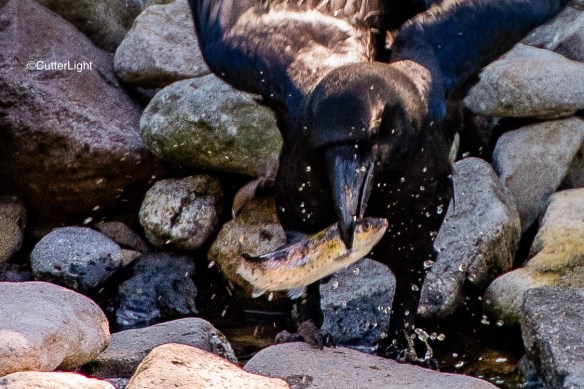
In addition to the owls, minks – a species introduced from America – are occasional nighttime visitors to the pool. In wintertime, bears follow spawning salmon up the stream. One afternoon I was watching the pool, camera in lap, when a Thick-billed Crow landed in a nearby tree. I knew right away what he had in mind, so I focused on the pool and waited. What I wasn’t prepared for was the short work he made of catching this trout. 

Knee Deep in Trout and Char (somewhere in Hokkaido)

Iwana (Dolly Varden Char) are one of Hokkaido’s most celebrated cold-water fish.

I have an incurable habit of looking into water for fish. It doesn’t matter what kind of water. At the beach I check the translucent prisms of waves for whatever might be cruising the surf. Coming upon pools on rivers during hikes I make efforts to position myself so that I’m looking into shade rather than glare so that I can maybe catch a glimpse of something with fins. I’ll even check out coin fountains in the off chance that a carp or even a goldfish might be swimming around. But bridges on quiet country roads crossing pretty little trout streams are especially inviting. There’s almost always a pool below the bridge, and if the water has a population of trout, there are often a few of them hanging out right there. No matter how hard-fished the water might be, it’s worth a look.

Yamame could literally be translated as “Mountain Girl” – a lovely name for a lovely fish. More commonly the stream-dwelling form of this species is called “Cherry Trout.” Similar to Cutthroat and Rainbow Trout of the Pacific Northwest, (to which yamame are related), some go to sea where they attain sizes measured in pounds and return to their natal rivers to spawn bright as polished chrome – Cherry Salmon.

And so there we were, mid-afternoon, straddling our bikes and leaning over the the concrete side of a bridge on a quiet road running through a mix of forest and farmland somewhere in Hokkaido. The water was perfectly clear, but the trout and char are so adeptly camouflaged to match the stony bottoms of these streams that unless one moves they are all but impossible to pick out. 

One moved. As it rose to take something off the surface I could even see its spots. A char of some type. I hadn’t done any fishing yet in Hokkaido. This fish was telling me it was time I did.

I didn’t expect the fish to be large and they weren’t. But in the space of about two hours I covered a couple hundred yards of this silvery mountain stream and caught two dozen or so fish  About half of them were iwana. The others were yamame. A few came to a parachute Adams – my favorite dry fly searching pattern. A lot more came to a pheasant tail nymph – my favorite nymph. A couple of overly eager types tried to eat the pea-sized orange strike indicator I was using. 

A younger version of myself would have kept a few of these fish for the frying pan. But these days I fish for trout in part to simply confirm that they are present, and I wanted these fish to remain present. So Barbra took a couple of photos and I released everything to continue living out their lives in this silvery piece of water and light somewhere in Hokkaido.

There wasn’t a single human footprint along the banks, much less a path. Knee deep in a cold mountain stream full of trout and char – sitting on top of the world, legs hanging free.

Tunnels of Love – Light at the end of the Tunnel – Tunnel Vision: A Bicyclist’s Point of View

A kind snow tunnel – not too long, plenty of light, and just enough shoulder.

There is something about tunnels, sometimes dark and scary, sometimes magical and transformative.

When I was very young, my family drove around in a Volkswagen Beetle. I remember enjoying the magic of the immediate darkness of tunnels. The dark would be simultaneously met with the crackle of static on the radio as we lost reception. Then the heartbeat of yellow lights would blink into the windows from the dim tunnel lighting providing a rhythm to accompany the radio static. With a jolt from this world, the Beetle would be blasted back into the light and back into normal. It was fascinating to my young imagination.

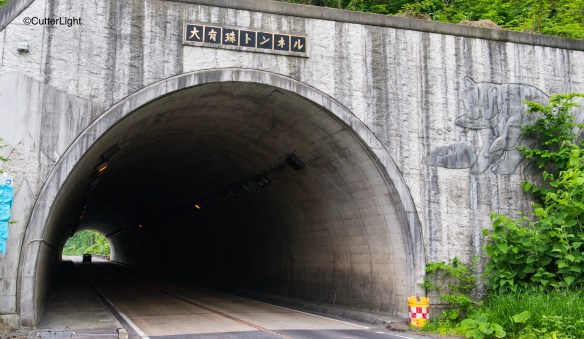
Some welcome! Eighteen meters tall (almost 60 feet), the demon of Noboribetsu would be the perfect host to some of the tunnels we traversed.

Fast forward to our current bike trek in Hokkaido. Our ride has brought a whole new stream of consciousness to the tunnel. In recent years, hadn’t given much thought to these marvels of modern engineering, the exception being the time I drove our pickup while towing our fishing vessel Gillie through the unnervingly narrow tunnel that leads to the town of Whittier, Alaska. Steering wheel gripped tightly in my hands, I could feel the boat trailer sashaying back and forth on the slick railroad tracks that transversed the abyss. But that is another story.

The first “real” tunnel seemed long, but at just over a mile, it turned out to be merely average.

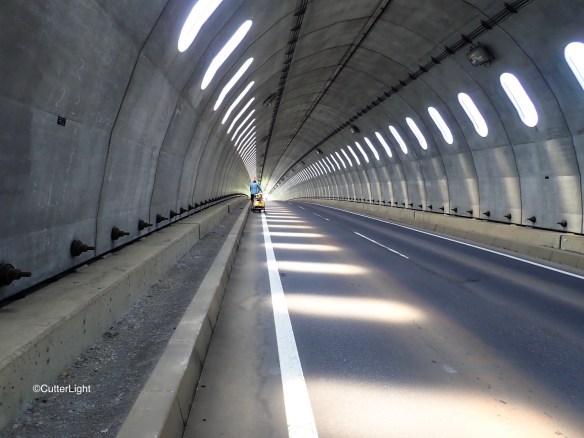
Our introduction to the tunnel by bicycle happened the very first day of our Hokkaido trek. It was a kind introduction as the tunnel was of the type designed to keep the heavy winter snowfalls off the road. Wrapped tight to a mountain pass, the tunnel’s outside wall featured a series of openings where sunlight poured in, giving the space a comfortable, open feeling. Moreover, there was a large enough shoulder to ensure safe passage even for our somewhat Rubinesque, trailer-towing bikes. Though several hundred meters in length, this first light-filled tunnel with its wide sidewalk was a breeze.

Our first “real” tunnel – dank, dark, cold, long and narrow – came later. We hugged the shoulder, our safety lights blinking, pedaling as fast as possible, worried that approaching vehicles wouldn’t see us in time. The amplified roar of oncoming traffic echoed and mixed with the odor of mold, grease, diesel and exhaust fumes and in that dark tube we experienced the paradox of simultaneously feeling that we we traveling very fast while making little progress. Jack found the energy in his legs to pull ahead, even while pulling the trailer. My nerves must have been apparent as a kind driver slowed behind me and escorted me to daylight.

At this point, I can’t believe how many tunnels we’ve gone through. The best tunnels have been the snow tunnels. They rank high because of the natural light and their relative brevity. On rare occasions, we’ve traveled through tunnels with a sidewalk separated by a safety railing. But even these tunnels can’t muffle the brain-rattling sounds of roaring trucks and screaming motorcycles, and there’s always the sense that you’ve got to concentrate on maintaining an unerringly straight course lest you pin yourself to some protrusion jutting out from the soot-stained tunnel wall.

One day, we had a relatively short ride from Yoichi to Otaru along Hokkaido’s southwest coast. The map showed tunnels…lots of tunnels…between the two towns and in fact the ride felt almost like a constant tunnel as even when we weren’t physically inside a tube we were psychologically preparing for one. This day featured our worst tunnel experience.

As usual, we were swallowed into the tunnel in question just as we had been swallowed into the semi-darkness and wet chill of previous tunnels. We rode on a sidewalk, which was just wide enough to handle our bike’s girth with panniers and the trailer. But perhaps a kilometer into the dimness and utterly without warning, the sidewalk shrunk to half its size. The next thing I knew, Jack’s front panniers hit the railings and he screeched to a stop. Escaping with a bloodied knuckle and a mouthful of expletives, we survived the tunnel by crowding into the flanks of our bikes and walking the remainder of the way, our shins absorbing a few pedal bites in the process, the experience bringing fresh gratitude for the light at the end of the tunnel!

After a wonderful two-days in the city of Otaru, we steeled our nerves for the ride up the coast. The ride would be beautiful. But there would be tunnels. Lots and some really long ones. Rattled from the most recent tunnel experience, at the first one we encountered we opted to push our bikes through on the very narrow sidewalk. Just wide enough to accommodate our bikes in this fashion, the sidewalk seemed to have been installed for maintenance workers rather than pedestrians. Our plan was for me to follow Jack closely and shout a warning if the outside trailer wheel got too close to the edge of the walk. Using this strategy was maybe safer, but it seemed like it took forever.

As we traveled up the coast, traffic grew lighter. We couldn’t stomach another long walk through another dark and deafening tunnel and the one we were now facing was truly a beast – two nearly adjoining tunnels spanning almost four miles. It was time to shore up our confidence and place some faith our fellow drivers. We strapped on headlamps and, as I was in the rear position, I added a couple of blinking lights to my rig and off we went.

Translation? Tunnel after tunnel after tunnel after tunnel!”

At some point, I had adopted a strategy of singing in the tunnels in order to drown out the deafening noises and to distract myself from my own nerves. I didn’t just sing. I sang at the top of my lungs. This turned out to work pretty well – once Jack didn’t take my singing noises as anguished cries for help. And so for most of four miles I belted out any song that came to mind.

Time to take in some sunshine, enjoy lunch, and scan for birds.

Once we had finally put the beast behind us, we pulled off the road for a rest and a celebratory lunch. Apparently you can burn some serious calories pedaling like a dervish while simultaneously singing at the top of your lungs!

Tinged with the unknown and eliciting perhaps mixed emotions of safety and danger, tunnels remain fascinating to me. For a little while, they take you out of the world in which you’ve been residing, close in around you, carry you along in a way that demands a kind of trust… and then deliver you to some newly lighted world on the other side.

A happy bear eating salmon at one end and light at the other. A perfect tunnel.

Agehachou – Asian Swallowtail Butterfly

Almost surreal in it irredescence, this agehachou is one of the many stunning butterflies we’ve encountered on our Hokkaido bike trek.

We’re not lepidopterists, but it would be all but impossible not to notice the incredible beauty and diversity of the moths and butterflies – not to mention the amazing variety of caterpillars – we’ve been encountering on our bike trek around Hokkaido, Japan. If you find them early enough in the morning when they’re still warming up, you can sometimes sneak a decent photo. This agehachou (Asian swallowtail) is among the more stunning butterflies we’ve found, but it seems that all butterflies are beautiful. As the summer progresses and flowers change, different species are emerging. Today the paths were filled with nearly iridescent black caterpillars, leaving us wondering what form they’ll take as adults.