Ol’ Half-a-Horn

Ol’ Half-a-Horn

I almost wasn’t going to show this photo. Despite my nicknaming him Ol’, he’s probably a fully mature but young bull – perhaps in his fourth year. He’s missing his right paddle, and the remaining antler isn’t impressive. In fact, since to be legally taken during Alaska’s moose hunting season the tip to tip, antler to antler spread has to span at least 50 inches (127 cm), he probably wouldn’t have passed muster. So, no Boone and Crockett award here.

But this is easily the closest I’ve ever been to a moose, and when he suddenly emerged -seemingly to simply materialize from a thick tangle of willows, alders and salmonberries, he took our breath away. I had mere seconds to set up and make the shot has he strolled by, appearing unconcerned, barely glancing our way – our own hearts meanwhile racing like mad. Even a young bull such as this weighs close to half-a-ton and although the big ungulates are generally peaceful, mind-your-own-business types, each year here in Alaska more people are injured by moose than by bears. In fact, an Alaska man was stomped to death by a cow protecting her calf less than two weeks ago. So anytime one finds oneself this close to an animal of this size, the thrill involves wildly mixed feelings.

As I mentioned, the moment lasted mere seconds. And then, more miraculously than its sudden appearance, this fellow simply vanished. There was no departing view of dark rump disappearing into the vegetation, no hint of willows and alders shaking as he brushed by them. He crossed before us, I made 12 quick captures, the last of which featuring mainly an eyeball, part of the rack, an ear and his nape… and then he was gone, swallowed without a sound into a thicket of alders. Had we not been exactly where we were during those few seconds, we would never have guessed a moose was nearby.

Chignik Lake, October 4, 2018 – JD
Why did the Brown Bear Cross the River?

At the Swimmin’ Hole
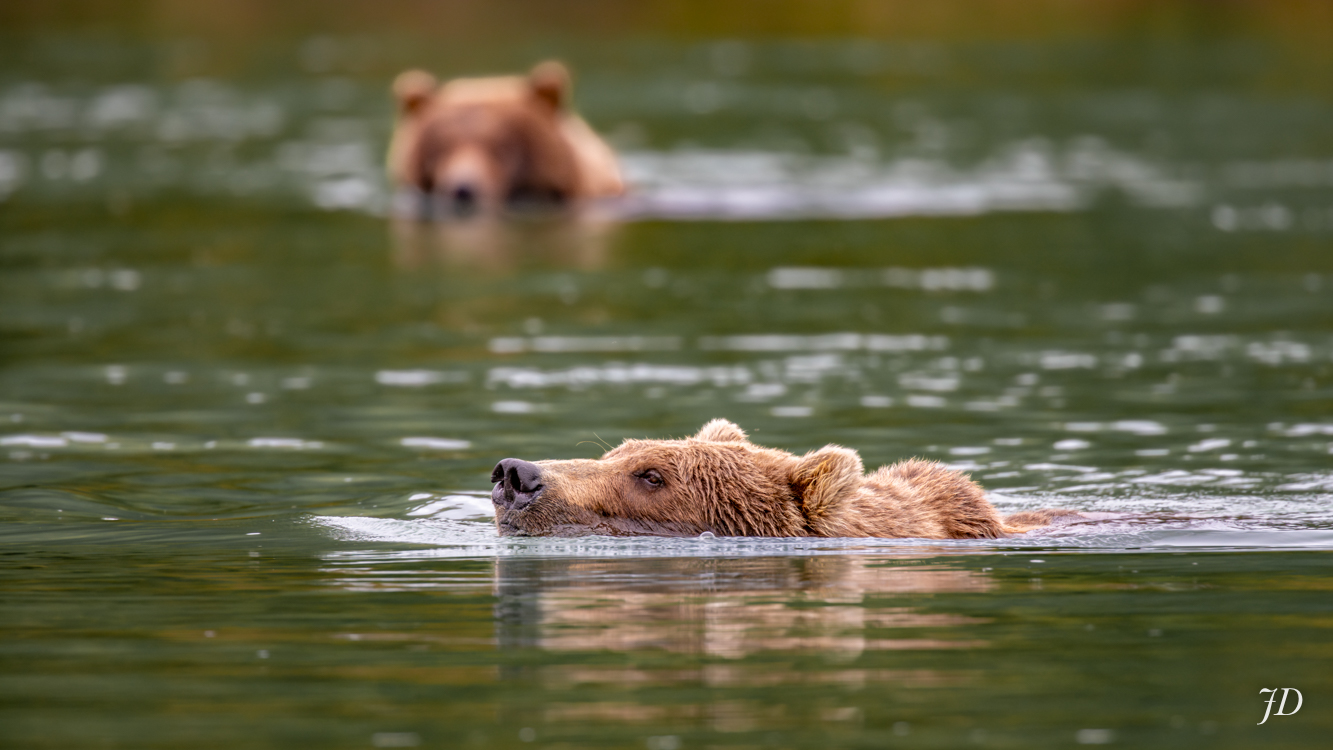
Coastal Brown Bears crossing the Chignik River, September 22, 2018

Why did the Brown Bear cross the river?

Happy Friday, everyone!

Incoming

Incoming
Twice the male Orca swam beneath our small skiff, so near the hull we could see him plainly through the Alaska Gulf’s semi-clear water. Each time, he emerged on the other side very close, turning parallel with our watercraft, eyeing us. Using our 20-foot skiff as a comparison, I estimate his length at over 25 feet in length, shimmering, bulky, muscular, liquid, graceful. Was he simply curious? Cautiously keeping us in check while his mate and daughters practiced hunting with the still living seal she’d carried out into open sea to the left of this photo? Showing off? Warning us? Each time the male came in close our hearts rose in our chests, our breath stuck in our throats. I blew those shots, able to fit only a fraction of his massive body in the frame created by the 70mm lens, shutter speed too slow to freeze him as his movements always appeared slower than they actually were. But I did get this capture of him swimming in for one of those dives beneath our boat.

The light was in and out throughout the encounter, the sun at times obscured behind dark clouds, at other times breaking through clear blue skies. Here dappled light is filtered through thin clouds, creating a rainbow-like effect accentuating blues, mauves and purples. This image is interesting for the background landscape as well. The land mass to the left is Nakchamik Island. The smaller island to the right is the smaller of the two Kak Islands. On the right is (I think) Little Castle Cape on the mainland.
JD, Chignik Bay, Gulf of Alaska, May 6, 2018

Those Crickety Chirps Mean It’s Fall on the Chignik

Male Golden-crowned Kinglet – Chignik Lake, Sitka Spruce Grove, January 23, 2018
Making our way along a bear trail I hacked open as it descends through a dense alder thicket toward creek bottom, we hear them – cricket-like whisper-chirps. They’re in there somewhere, hidden in a jungle leaves the alders are stubbornly holding onto even as nighttime temperatures dip and we awake to frosted mornings. Kinglets. The Silvers are in, all but the Monkey Flower, Goldenrod and maybe the last of the Yarrow is gone… Fireweed gone to seed, big brown bears fat with Sockeyes, terminal dust on the mountains. Fall on the Chignik.

Golden-crowned Kinglets are another species that is either absent or listed only as “rare” on Alaska Peninsula avian checklists. This might be because they are only a fall through early spring visitor to that part of the world, as is the case at The Lake. Or it could be that even in those non-breeding seasons these hardy little being rely on the shelter provided by mature spruce trees which, for now, only occur near the peninsula’s tiny, scattered villages. JD

Frost in March Sunshine

Frost in March Sunshine – One of our all-time favorite foxes, Frost often slept on the sunny bank just below our home at The Lake. March 26, 2017

Water Necklace

Water Necklace – Chignik River, September 18, 202

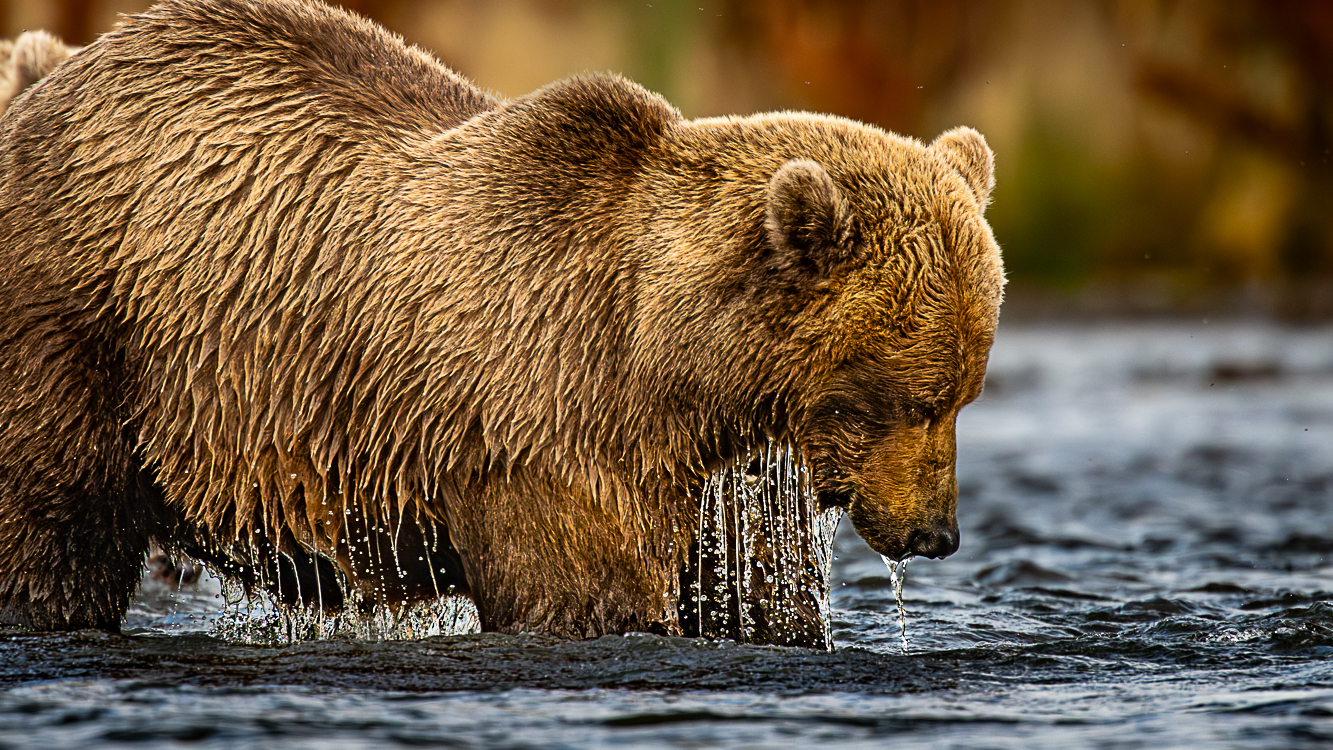
A second bear is just barely visible in the upper left of this photograph of a healthy sow that has trapped a spawning Sockeye Salmon in her forepaws beneath the water. Anytime the salmon are running from July through November, bears can be expected along the river and lake.

Loafin’

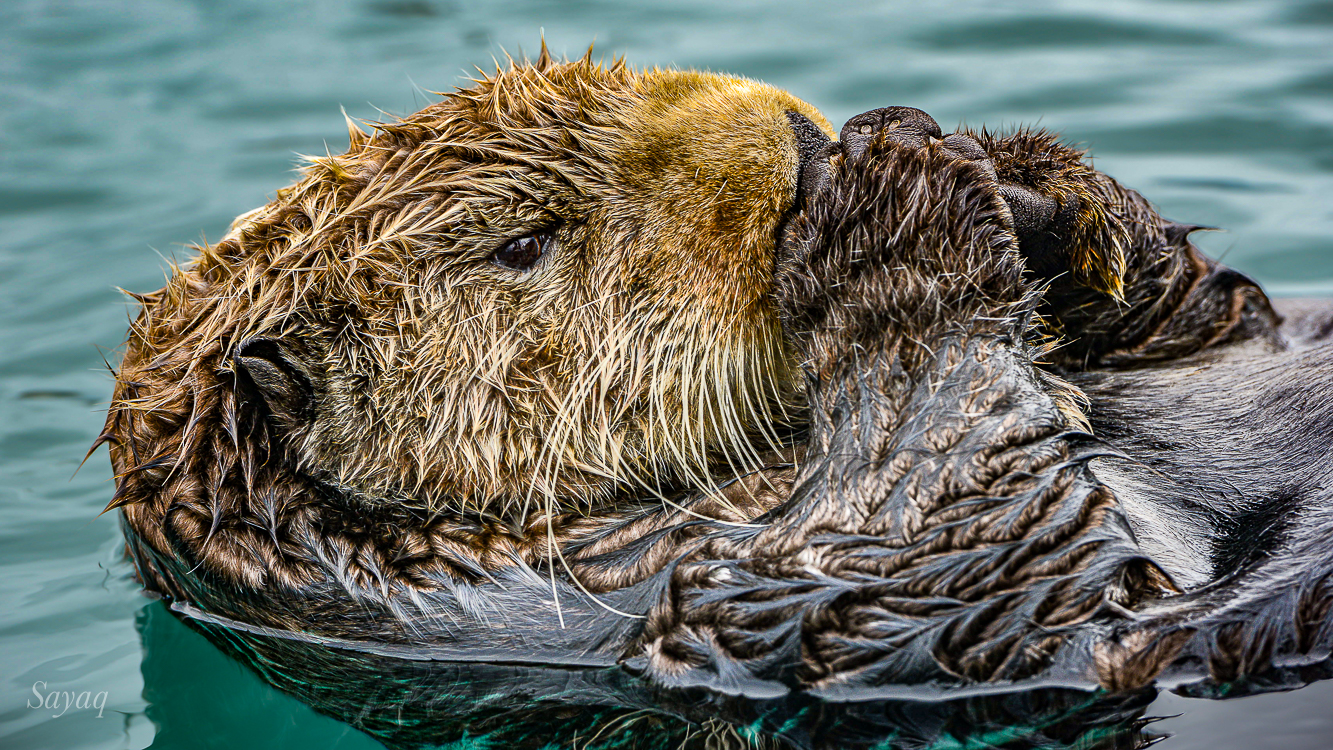
Close-up portrait of a Sea Otter loafing in the harbor at Seward, Alaska.
Loafin’ Sometimes Sea Otters hanging around in harbors become quite accustomed to humans. For this photograph, I got down on my belly and lowered my arms and camera over the side of a dock. Unable to look into the view finder, I let the camera’s autofocus do its job. They’re awfully cute. Seward Harbor, Alaska, 6/25/13

Knighted by a Finch

Male Pine Grosbeak, Chignik Lake, Alaska, February 3, 2017
Actually not grosbeaks at all but a member of the finch family, their large beaks are useful for feeding on leaf buds, much as ptarmigan which have similarly robust beaks.

I had only recently acquired the kind of camera equipment necessary for serious avifauna documentation when one fall morning as I was walking through the village, 20 pounds of camera, lens and tripod slung over my shoulder, a flock of Pine Grosbeaks descended all around me in the willows, scrub alders and salmonberry brakes along the dirt road. I knew the species from books but had never encountered them. Keen to get photographs, I set up to shoot. No sooner was I in position than one of their tribe flew over, rested for a moment on the long lens of my camera, and then hopped onto on my head. A passage from Walden came immediately to mind:

  “I once had a sparrow alight upon my shoulder for a moment while I was hoeing in a village
  garden, and I felt that I was more distinguished by that circumstance than I should have been by any epaulette I could have worn.” (Thoreau, Walden, “Winter Animals”)

I quickly made photographs documenting the species’ presence in that part of the world (David Narver did not observe them in the Chignik Drainage during his field work in the early 1960’s, and they are listed as “rare” or “uncommon” on peninsular checklists), but the species proved to be common in the years we were at The Lake and year by year I improved on those first pictures. As I continue sorting through the many thousands of photographs comprising “The Chignik Files,” I will show other photos of these beautiful finches… the Cardinal of the Far North.

Tiny Balloons

Wintertime close portrait photograph of a Great Horned Owl sleeping, tiny, colored balloon-like droplets of moisture at the tips of hairlike feathers above the owl's nares (nostrils).
Tiny BalloonsIt was a red letter day when I finally located where the village’s Great Horned Owls roosted and nested.Everyone knew about them, but no one knew where the spent their days and reared their young. One frosty late winter morning I made the above photograph of one of the owls sleeping, tiny frosty balloons at the tips of feathers above the nares (nostrils). Chignik Lake, March 12, 2017

Breakfast at The Lake

Photograph of a River Otter with a starry flounder climbing out onto the ice on frozen Chignik Lake, Alaska.
Breakfast at The LakeOther photos show that this River Otter’s right canine is partially broken off, but overall this specimen is in prime condition and perhaps the best fisherman of his or her tribe. Lovely evening light coming in from the left really lit up the fins on this Starry Flounder. Chignik Lake, February 2, 2017