On A Frozen Sea

Sphere and Pyramid
The Chukchi Sea, April 21, 2012

In late winter and early spring, our Inupiat friends in Point Hope began talking about “breaking trail” across the frozen Chukchi Sea so that snow machines (snow mobiles) and hondas (ATVs) could be driven out to leads (open lanes in the ice) in order to set up whaling camps. “Breaking trail?” Informed by our experiences with freshwater lakes, we wondered, “Can’t you just drive out across a smooth blanket of ice?”

Well, as we learned, a frozen sea isn’t like that. As ice forms and expands and is pushed around by winds and currents, sheets separate (creating leads) and later are pushed together again, the resulting pressure ridges can heave up massive jumbles of jigsaw ice. Some of the chunks are as large as a garage. This was all new to us the first time we hiked out to a camp. In the above photo our eyes are drawn to an otherworldly sphere and pyramid lit blue in pre-dawn light.

Sentinel

Engraved with a cross and reaching into the sky, the jawbone of a Bowhead Whale stands sentinel over a grave buried in spring snow at Point Hope, Alaska. April 12, 2012

Umiak Artist

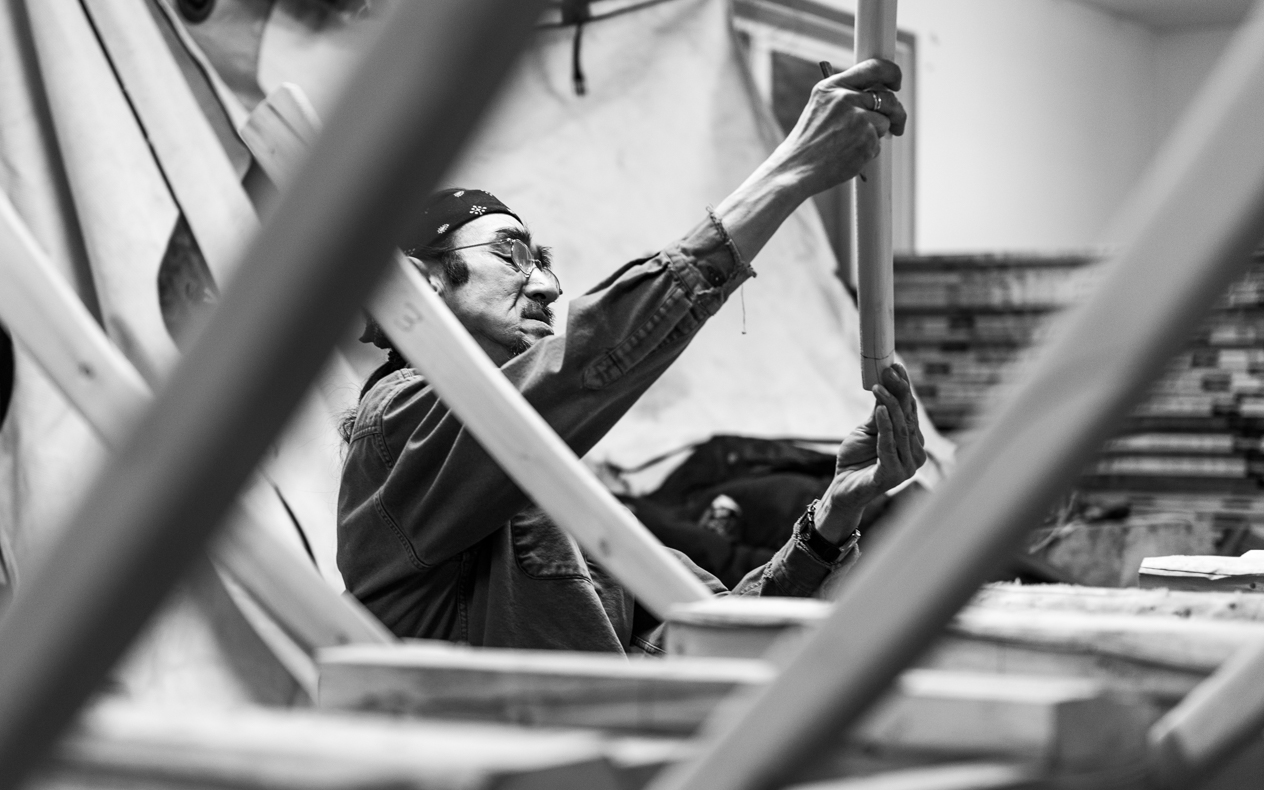
Artist and boatwright Henry “Hanko” Koonook at work on an umiak in his shop. The keel, thwarts and each wooden rib is hand fashioned and precisely fitted. When the frame is finished, it will be covered with the stretched skin of an ugruk (bearded seal). This will be the boat’s hull. Traditional skin boats such as these are still used by Inupiat whaling crews in Point Hope and other villages of the far north. Long may it be so. Point Hope, Alaska, March 21, 2013.

Umiak

This umiak – a traditional whaling boat, the hull made of Bearded Seal skin stretched tight and lashed over wooden ribs – was positioned on a rack, allowing me to make a photograph of the inside, upside down. Point Hope, Alaska, March 27, 2012.

The Catch: Bringing a Whale up on Sea Ice in Arctic Alaska

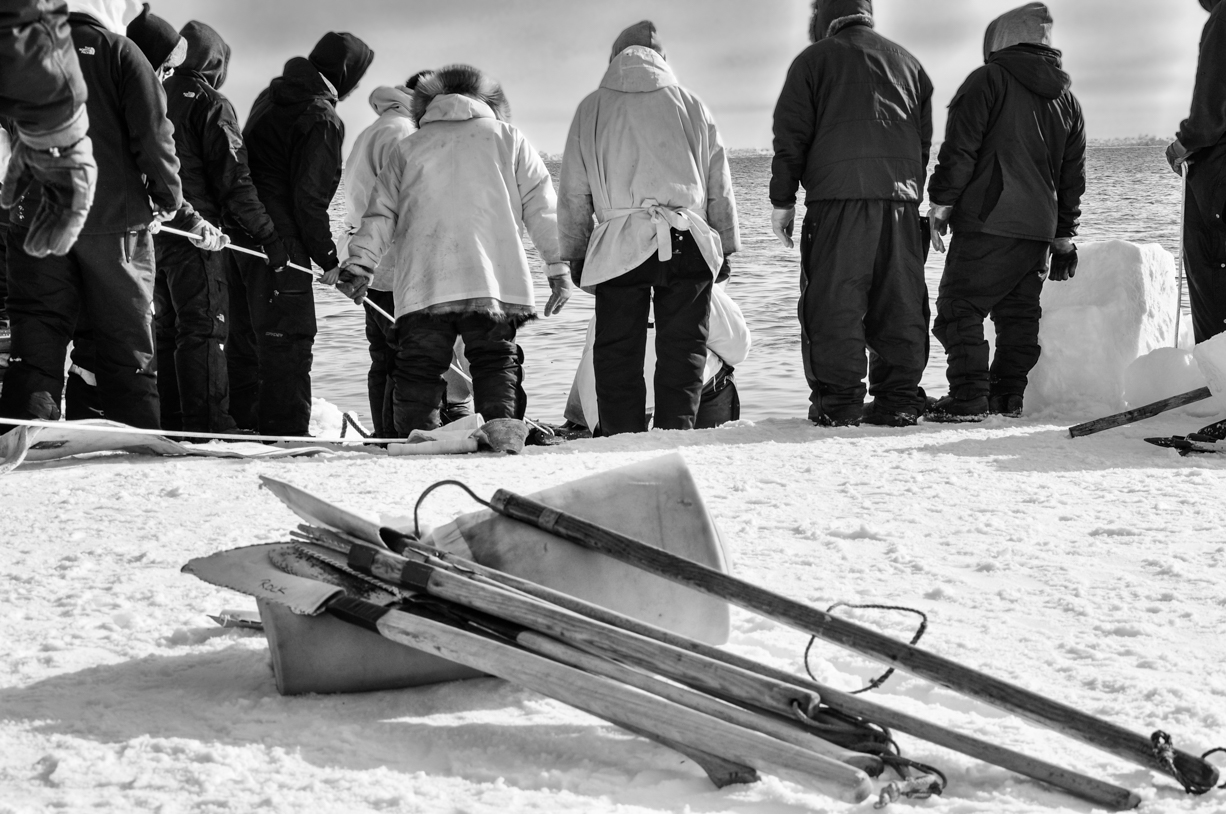
Inupiat whaling on the frozen Chukchi Sea near Point Hope, Alaska. April 26, 2012

As Bowhead Whales go, this was a small one – perhaps 10 tons or so. We had hiked approximately three miles from the village of Point Hope across the frozen Chukchi Sea to the camp where we had heard a whale had been caught. Locals had traveled by snowmachine and honda (snowmobile and ATV). There is always the danger of encountering a Polar Bear in this environment, and so we were armed. After snapping this picture I handed the camera to Barbra and took a place on the rope.

The open water in this picture is called a lead – an opening between two sheets of ice. You can see, across the water, the jumble of ice along the edge. Sea ice is often not the smooth sheet of white one might imagine. It continuously buckles, pushes up along pressure ridges, drifts apart and then presses back together. In a way, it behaves like the Earth’s tectonic plates, buckling, heaving, colliding, lifting. And so in order to make a whaling camp, trails must first be made through these places where jagged ridges of ice, individual chunks the size of cars, some much larger, must be broken through and smoothed out.

It is a lot of work to take a whale.

The Bones of Tikigaq: Whaling Festival Site, Point Hope, Alaska

The Bones of Tikigaq
Whaling Festival Site, Point Hope, Alaska. The larger bones presented as arches are the jawbones of Bowhead Whales. Traditionally, the skull is returned to the sea so that the whale’s spirit is properly released. Point Hope, Alaska, August 12, 2012

Anticipation

Barbra and I hiked from the Arctic village of Point Hope about three miles across the frozen Chukchi Sea to where a Bowhead Whale had been caught. These Inupiat crews still use handmade wood-framed boats fitted with seal skin hulls. Here the crew is preparing to bring the whale up onto the ice. It is cold, difficult work; that day a man lost part of his finger setting up the block-and-tackle. But it is joyous, too, as the meat and blubber is distributed throughout the village. After taking this picture, I handed the camera to Barbra and added my shoulder to the tow rope.

I have recently (mostly) completed curating over a decade’s worth of photographs taken during the years we lived in the Alaska Bush – villages not accessible by road. Keep watching this site for a new photograph each day. Your comments are appreciated. JD

Tikigaq Cemetery

Weathered jawbones of bowhead whales form a fence around the cemetery in Tikigaq, (Point Hope) Alaska).

After four consecutive weeks of daily rain – a precipitation rate almost unheard of in this semi-arid region of the Arctic – we’ve had several days of brilliant sunshine. The past three mornings, the gravel that makes up the ground here in Point Hope has been hard underfoot. Frost. The cloudberries are over, and the frost means it’s time to go pick cranberries. In the old days, the dead were not buried. “The land all around was our graveyard,” I was told by one of the people of the village. But when the missionaries came, they told the people of the village that the dead must be buried. And so this cemetery was created. 

Today while Barbra and I were eating lunch, we saw a snowy owl outside my classroom window. Last week a brown bear – a grizzly – passed by the edge of town. This might be a good weekend to get up early and walk up the beach in hopes of seeing a walrus.

Whaling Camp: Frozen Seas and Icescapes

Ball and Pyramid, Chukchi Sea, Alaska: This icescape, photographed with a Nikon D90 and a Sigma Bigma 50 – 500 mm lens, has been slightly processed to increase contrasts. The operative word here is “slightly.” Even to the naked eye, these frozen-sea icescapes are other-worldly.

Evocative, perhaps, of a scene from Star Trek, winter hikers venture across the frozen ocean out to a whaling camp. The gun the lead person is carrying is for protection. Although we saw no sign of polar bears on this day, friends of ours who took a slightly different path encountered fresh tracks.

Seal-skin boat at the ready, these men stand vigile for bowhead and beluga whales. Note the light blue block of ice they’ve cut out and positioned near their gear as a shield. These men are standing on sea ice just a few feet from the open sea. Last year was a good year for whaling in Point Hope, with three bowhead whales harvested. The hunt is dependent on the right ice conditions, which can be elusive. So far this year, no whales have been taken.

A well-equipped wall tent, complete with a supply of propane, serves as one of several whaling camps near the village. These camps are set up on sea ice, and may be anywhere from a few hundred yards to several miles offshore. The hunters travel out to leads – areas where the ice is open. Winds and currents can open and close leads quickly, underscoring the need for whaling crews to be constantly alert.

Sea ice seem to be lit from within by blue light. Heaved up in pressure ridges and broken into fragments weighing several tons, it is easy to appreciate the arduous work “breaking trail” entails as hunters go out onto the ice to set up camps. 

A black and white composition heightens the contrasts in these massive blocks of broken ice.

There’s a sense of being somewhere other than Earth…

And then a flock of common murres skims across a lead…

Arctic Spring

Hand stitched ugruk (bearded seal) skins cover the wooden ribs of this traditionally-crafted boat as it sits atop a rack in Point Hope, Alaska. With spring officially here (the Vernal Equinox was March 20), whaling season has begun. Whaling crews have been going out to break trail these past few days. This is rough going across the frozen, buckled landscape of the Arctic Ocean. 

Each Arctic day is lengthening by eight minutes, and the sun is shining with perceptible warmth as months of negative double digit cold gradually give way to highs approaching an even zero degrees Fahrenheit. Although the seas continue to be locked up tight, that is how it should be this time of year. Once the trail is broken, the village’s two whaling crews will set up their camps far out on the ice near open water, where, with boats stitched together from the skins of bearded seals at the ready, men dressed in warm, white parkas will wait and watch.
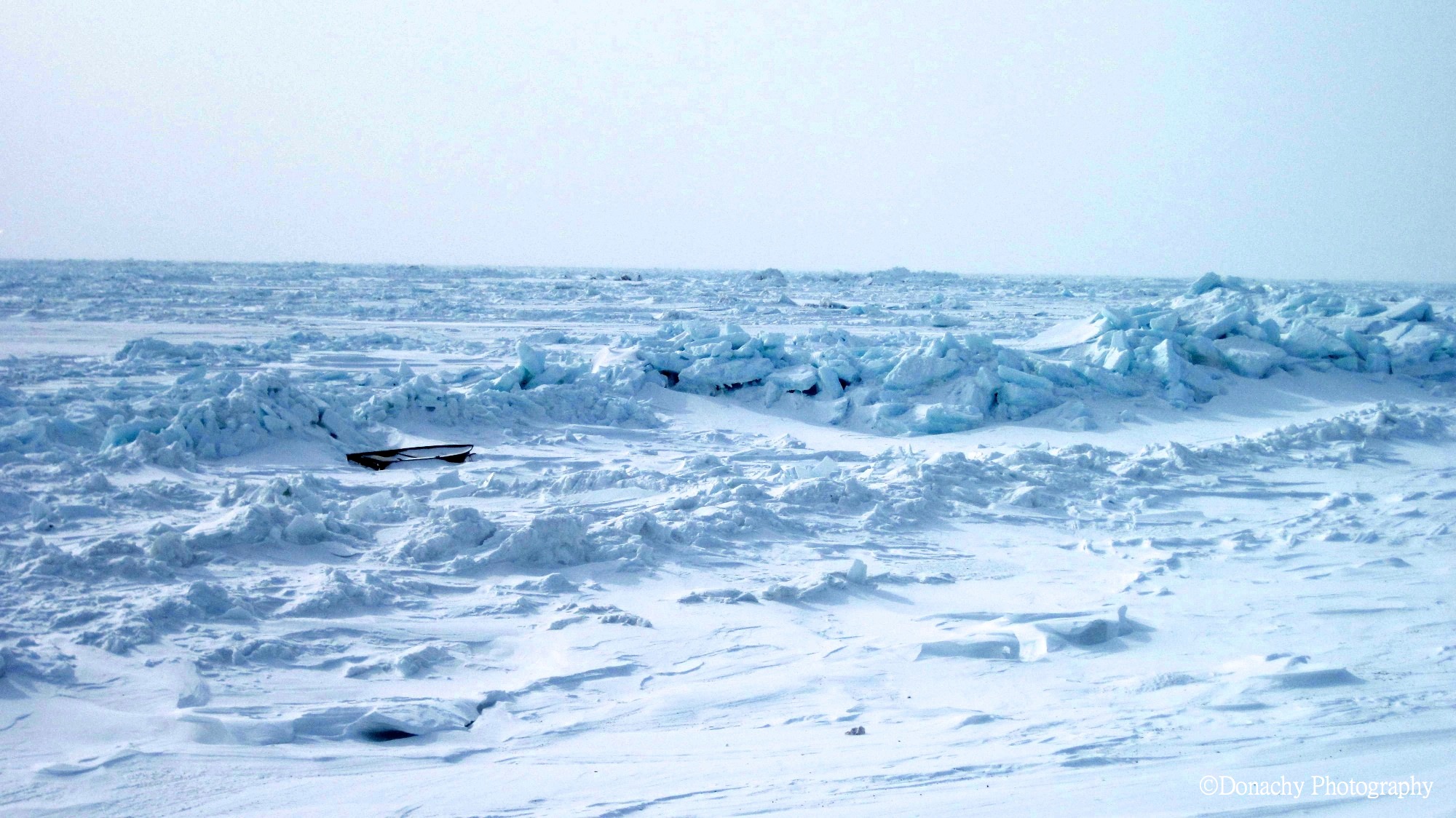
A small skiff seems to await the Chukchi Sea’s thaw.

Last year, three whales gave themselves to the village. That is the way people here say it. Animals are not “killed.” They give themselves, and for a whale to give itself, the hunters’ skill, preparation and worthiness must all come together. Point Hope is one of the oldest continuously inhabited settlements in the Americas. Perhaps the oldest. Here, the unique interplay of sea and river, hills and tundra bring salmon, char, seabirds, caribou, whales and even berries to the inhabitants. Compared to many other villages, the people of Tikigaq (Crooked Finger – so named for a narrow thrust of land at the tip of the peninsula that long since eroded away) have seldom had to go far for food.

The whales are bowheads, a right whale. These baleen whales may weigh 30 tons or more. Occasionally ivory, slate and jade harpoon heads of old are discovered buried deep in a whale’s blubber, indicating that they have a lifespan of at least 150 years. Although commercial whaling in the 1800’s pushed populations to near extinction, they have gradually recovered and numbers in the Chukchi Sea continue to grow by about 3% each year to over 10,000 currently.

Inuit artist Kenojuak Ashevak’s painting (above) depicts the circle of Arctic seasons. Her painting shows open water for less than half of the year.

When we leave the village in mid-May to spend our summer further south in Alaska, much of the tundra and the Chukchi Sea will still be locked in ice. When we return in mid-August, the tundra will be carpeted in shades of green, some of it already giving way to Autumn’s gold. In high summer, flowers bloom in profusion, but by August, most will be done. Berries – cloudberries, cranberries and crowberries near the village, joined by blueberries further out – will follow. Waves will tumble on the shore as though the ice never existed, and salmon and char will be swimming in the clear-green water.