Painted Geese over Breaking Surf

Painted Geese over Breaking Surf
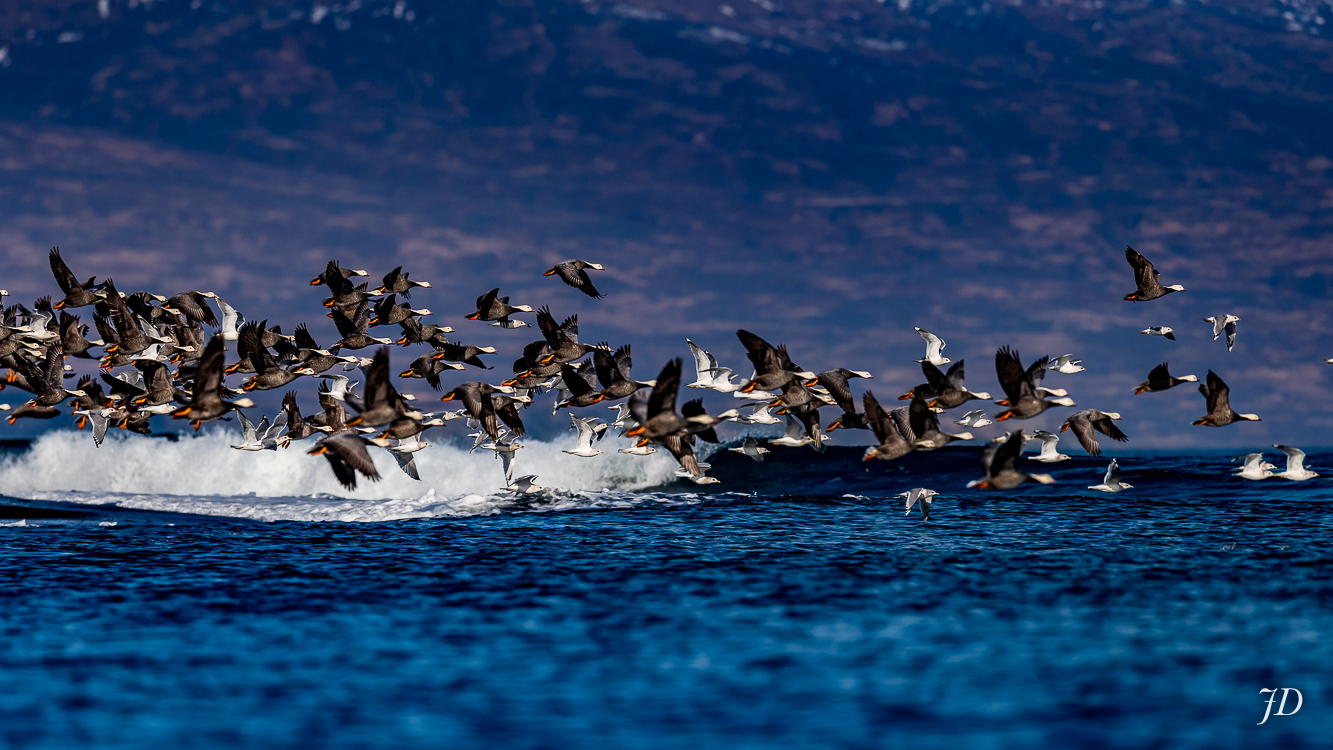
Emperor Geese, Chignik Lagoon, March 9, 2019

With the bright white head and nape reminiscent of the ermine capes European Royals of yore garbed themselves in, Emperor Geese (Anser canagicus) present a striking visage. But to catch a glimpse of these smallish, colorful, somewhat rare birds you have to go to coastal Western Alaska or Eastern Russia. A few dozen sometimes stop over at the sand spit at the mouth of Chignik Lagoon on the Alaska Peninsula. That’s where we found this flock, a few Glaucous-winged Gulls mixed in.

JD

Migration: The Peeps of Cordova

Western Sandpipers, Hartney Bay, Cordova, Alaska, May 3, 2024

This was the scene about six miles from the heart of Cordova this past Friday morning, and this is but a sliver of the many thousands of shorebirds that stop for a short while to fuel up and rest on tidal mudflats near the town as they make their way to nesting grounds further north. Figuring in nearby barrier islands and additional flats in the Copper River delta, some five million shorebirds represented by several species will visit the Cordova area over a few days in early May. While they are here, these Western Sandpipers will double their weight. The delta is absolutely critical to the health of these avian populations as there are only a few places in the world that offer the sheer biomass of invertebrates and biofilm these birds require in order to complete journeys that in many cases cover thousands of miles. Look for a more indepth article on this incredible migratory event in the coming days.

Salmon Watch

Salmon Watch
Chignik River, September 22, 2018

One Fine Morning

One Fine Morning – Paradise Bend on The Chignik River
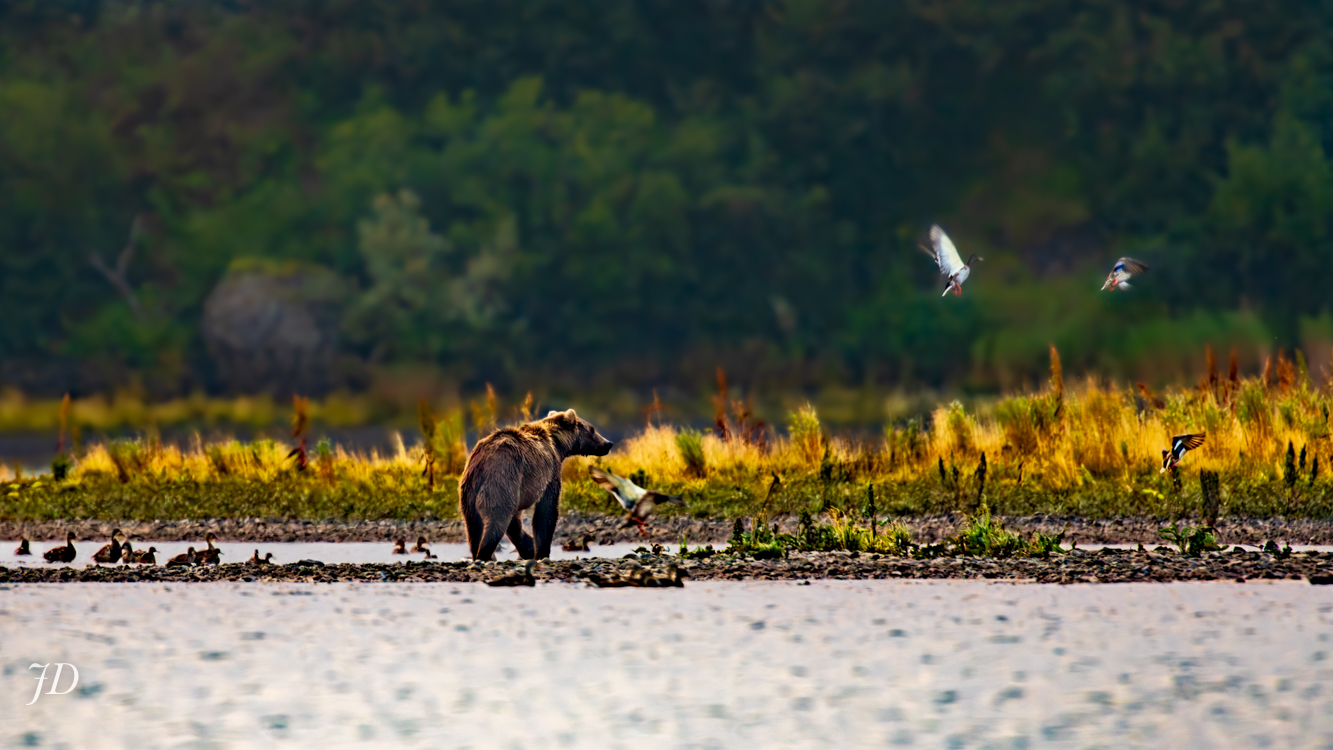
Ambling Bear, Mallards, Teal, White-fronted Geese, a splash of sunshine
September 8, 2018

I went to the woods because I wished to live deliberately, to front only the essential facts of life, and see if I could not learn what it had to teach, and not, when I came to die, discover that I had not lived. Henry Thoreau, Walden

Wood Hex

At one of the last campsites we stayed at on our bicycle camping trek around Hokkaido, early in the morning a small child was running around banging together cooking pot lids. Annoying. So I fixed it. JD

Peacock Butterfly on Black-eyed Susans

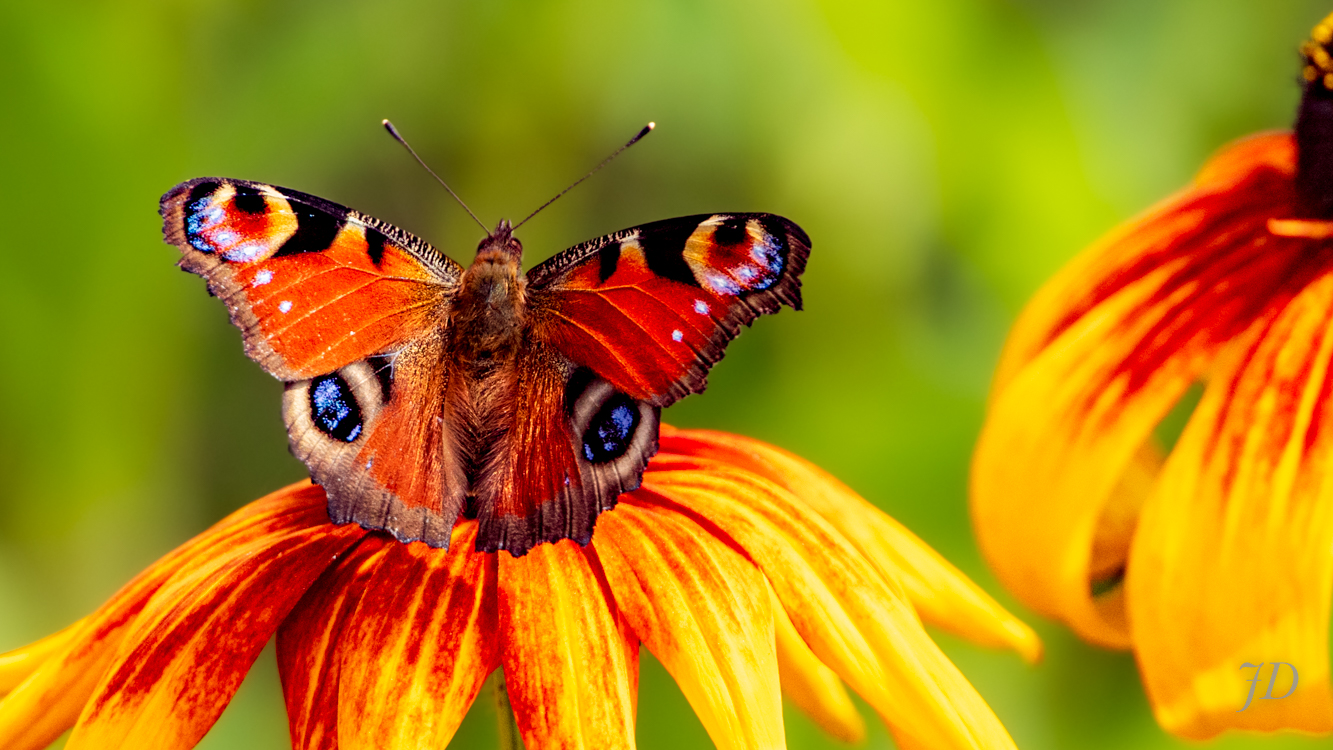
Peacock Butterfly on Black-eyed Susan
Kushiro Shitsugen National Park, Hokkaido, Japan, July 29, 2018

Wherever you are, we hope your day is going well!

Ursus Arctos… In a Bamboo Forest?

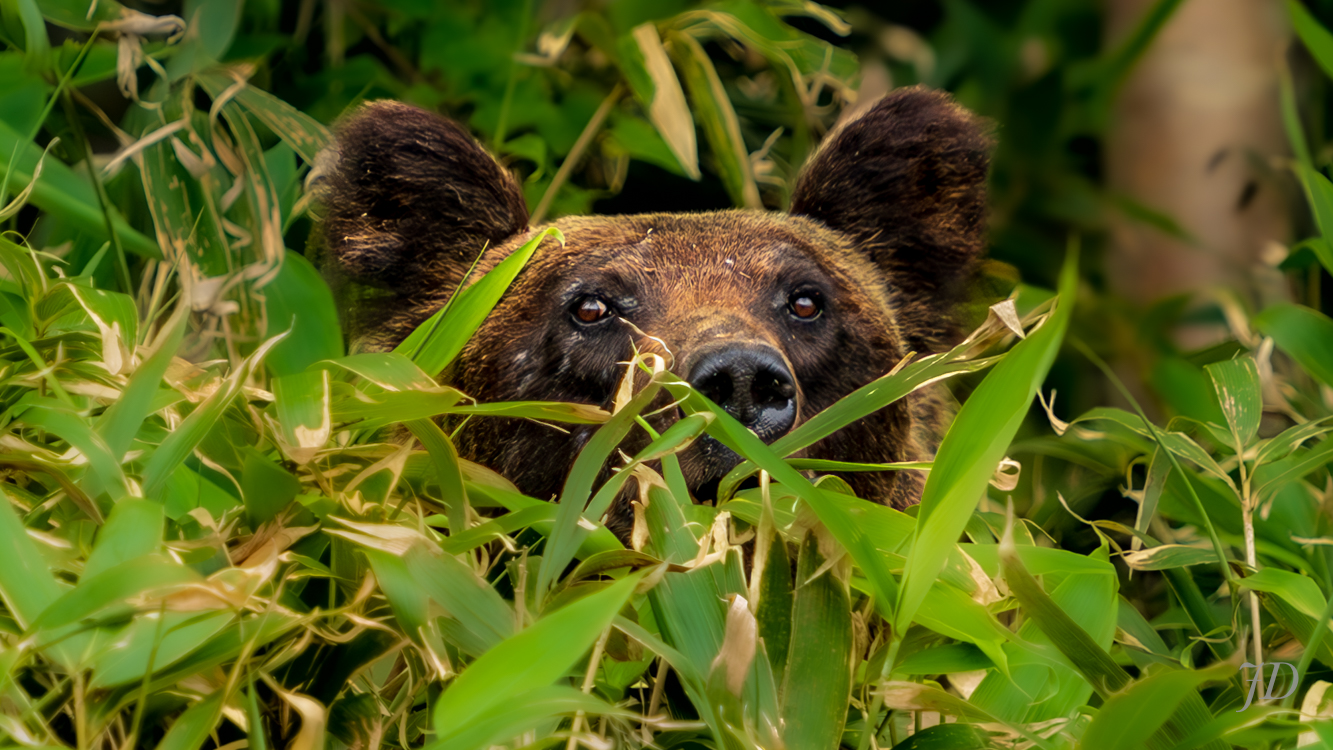
Brown Bear in Bamboo, Shiretoko Peninsula, Hokkaido, Japan, July 21, 2018

Ursus Arctos is a holarctic species represented by several subspecies throughout the Northern Hemisphere including the Grizzlies of the North America West (U. a. horribilis), the massive Coastal Brown Bears of Kodiak Island Alaska (U. a. middendorffi), the equally impressive Chignik (Alaska Peninsula) bears (U. a. gyas) and various additional species scattered from the harsh Gobi Desert to Siberia, the Italian Alps and other regions. Adapted to a variety of climates and diets, physiologically Ursus arctos is the most varied of all bear species.

The Brown Bears we encountered in Hokkaido, U. a. yesoensis, are similar in appearance to the Coastal Brown Bears of Kodiak Island and the Alaska Peninsula which makes sense as, like their Alaskan cousins, Hokkaido’s Brownies subsist on a salmon-rich diet. But at an average weight of only about 450 pounds – large males topping off at under 700 pounds -, Hokkaido’s bears are small compared to those found in Alaska; Chignik and Kodiak bears can reach weights of well over half a ton.

Still, bears are bears and regardless of size, they can be fierce. Approximately 12,000 Brown Bears inhabit Hokkaido, a land area about the size of the state of South Carolina or the country of Austria and home to just over five million people. There have been 57 human deaths attributed to Hokkaido’s Brown Bears over the past 61 years. When the sow in the above photo cautiously emerged from the forest and woofed for her two cubs to follow her across the steep road we were pushing our bicycles up, we gave her the right of way.

The rugged, forested 470 square mile Shiretoko Peninsula where we encountered these and several other bears as well as Blakiston’s Fish Owls, Ezo Red Foxes, Sika Deer, Dall’s Porpoises, eagles and other birds is a UNESCO World Heritage Site.

The World’s Largest Owl is a Piscivore

Blakiston’s Fish Owl
Shiretoko Peninsula, Hokkaido, Japan, July 23, 2018

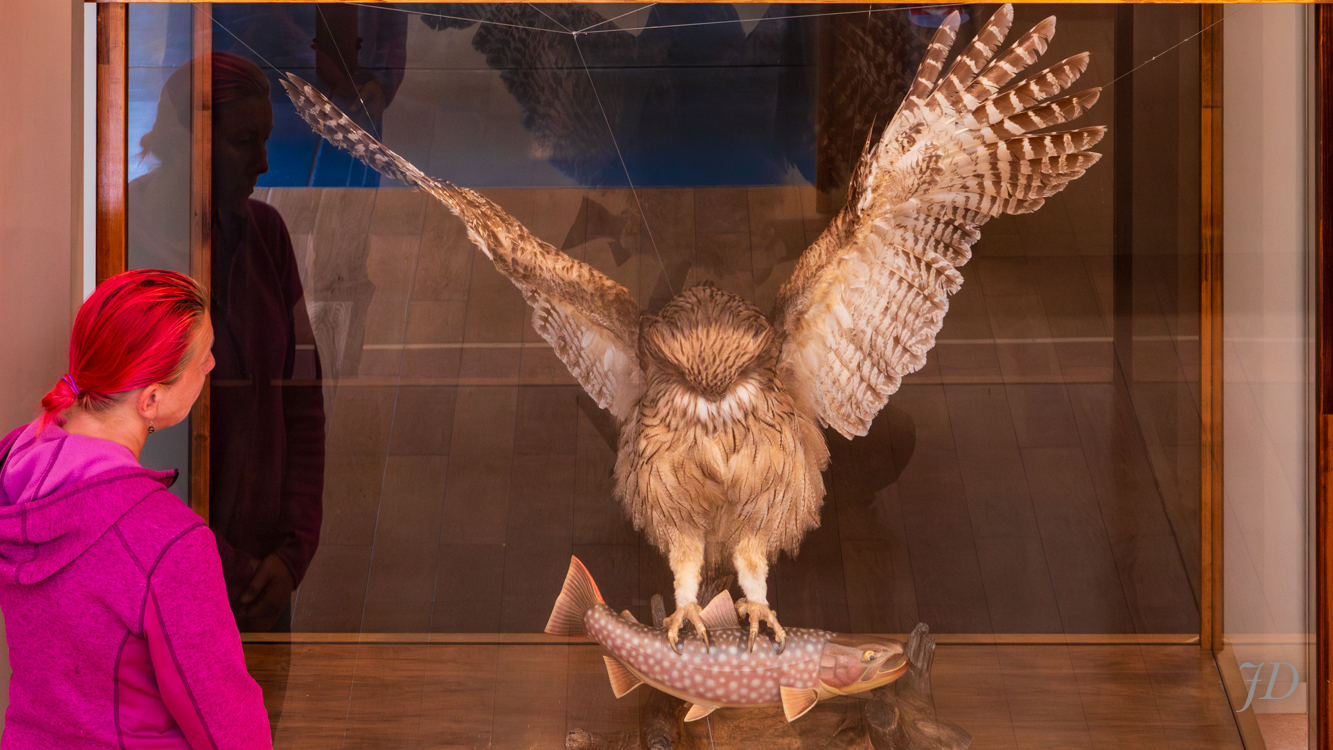
With a wingspan ranging from about 5′ 10″ to 6′ 3″ (170 – 190 cm), Blakiston’s Fish Owls are generally regarded as the world’s largest living species of owl. The photograph above is of one of a known wild pair which have been banded. The owls regularly visit a small stream where a pool has been created with natural rocks and is regularly stocked with Cherry Trout (sakuramasu, O. masau). A small inn with windows overlooking the pool provides guests with opportunities for a glimpse of this rare species which may visit the pool at any time during the night. The indigenous people of Hokkaido, the Ainu, regarded these great owls as spiritual protectors of their villages.

For context, Barbra with this taxidermy specimen grasping a White-spotted Char (Rain Char). Blakiston’s Fish Owl is a type of Eagle Owl and therefore related to the familiar Great Horned Owl of North America. The Great Horned Owl has a wingspan of approximately four feet, two feet less than the Blakiston’s span of around six feet.

Eureka!

Japanese Glass Fishing Floats
Hokkaido, Japan, July 16, 2018

The summer I turned nine I encountered my very first Japanese glass fishing floats. I was in Oregon, and in addition to populating gift shops and restaurant decor, back then these mystical treasures still occasionally washed up on Oregon’s beaches, particularly after big winter storms. That summer I concluded my 13th consecutive reading of Call of the Wild, and Treasure Island and Robinson Crusoe were still fresh. My mind was filled with dreams of faraway lands. The floats, hand blown by craftsmen, fragile, beautiful, traveling across the vast Pacific over decades and thus providing a link not only with the exotic country of Japan but also with ships and fishermen and a culture of yore were utterly captivating.

Over the years, we’ve been gifted a collection of these floats from friends lucky enough to have lived along one of the few beaches where they still wash up. The gifts are appreciated… but it’s not the same as finding one myself. From California to Alaska, in all the years since that Oregon summer I’ve never visited a beach without harboring vague hopes of finding one.

Somewhere past the town of Shari (斜里町) as we approached the Shiretoko Peninsula, we stopped at a beach to have our breakfast and watch sport fishermen cast into the surf for Cherry Salmon.

Barbra found the first one. My stomach turned a little… conflicted. Happy for her find, but disappointed that it hadn’t been me. But where there’s one… maybe… Planting my feet where she found that first float, I scanned every inch of the beach through binoculars. And then, without a word, I handed the binoculars to Barbra and took off, running with all the joy of a young boy turning nine.

He Ain’t Comin’

He Ain’t Comin’

I made this image from a picture I took at Mokoto Train Station in Hokkaido when I looked up into a mirror above the waiting platform and saw Barbra there looking at her phone. There’s something about the scene – populated with houses and rail, and yet eerily empty – and Barbra, alone, looking at her phone -, that seemed to imply something universal about loneliness and the fine line between expectation and disappointment. Compositionally, the frame within the frame here appeals to me… as do… exotic elements such as Barbra’s bright red hair, Japanese writing and the ambiguity suggested by rail that appears to be rusted and perhaps no longer in use.

I am happy to acknowledge the influences of others… here a nod to Stefanie Schneider and her Instant Dreams series, which I invite readers to check out on Instagram or elsewhere. I’m not sure that there isn’t a hint of the old Twilight Zone TV series in this image as well… I think virtually all of us of a certain generation carry within our psyches some lingering effect of Rod Serling’s creation.

Speaking of which… as I attempt to build more exposure for my own work, I’ve been regularly posting on instagram. At some point, I intend to build a website dedicated to photography. Until then, Instagram is a good place to see photographs in one place without needing to click around a lot. If you’re interested, here’s the link: jackdonachy. Be sure to leave a “like” if you like what you see. Thanks!