Looking for Love

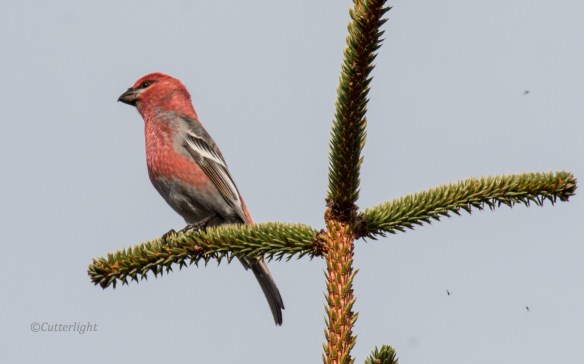
His colors will never be brighter than they are right now, nor his call more cheerful. Pine Grosbeaks tend to be irregular in their presence, but for the past two years in Chignik Lake they’ve been regular residents. For a look at a nearby female, which is very differently colored, see below. (Note the midges flying around to the right in the above photo. With big insect hatches coming off the lake and river, our swallows should be here any day!) 

Most days in the village the optimistic Peee-Peeet! of Pine Grosbeaks can be heard as they fly overhead or perch atop the tallest spruce trees. Always striking, the males are particularly colorful during springtime. Like their crossbill cousins, Pine Grosbeaks can be remarkably unwary. Move slowly around them, sit quietly, and they may forage on the ground practically at your feet. I’ve even had one perch on my head!
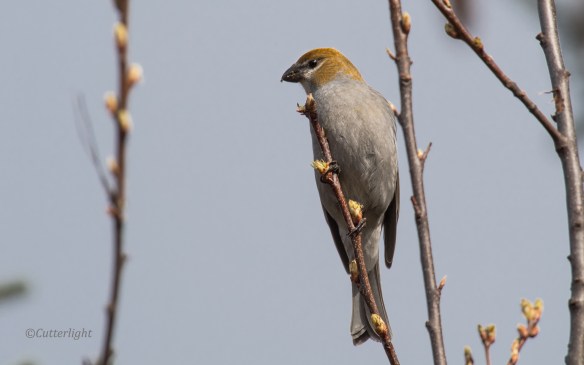
Female Pine Grosbeaks feature a rich olive-gold on their head, upper back, rump and often on their upper breast. This time of year, the leaf buds of deciduous trees figure heavily in Pine Grosbeaks’ diets. During wintertime they can be attracted to feeders featuring black oil sunflower seeds, suet or (I’m guessing) peanuts. They also love small fruit and during warmer months will include insects in their diet.

The “gros” of grosbeak is from the French gros, which means large. This is a species we’ll be looking for this summer in Hokkaido, Japan – part of their ranged across the Northern Hemisphere.
Two Thumbs Up – Meet the Alula

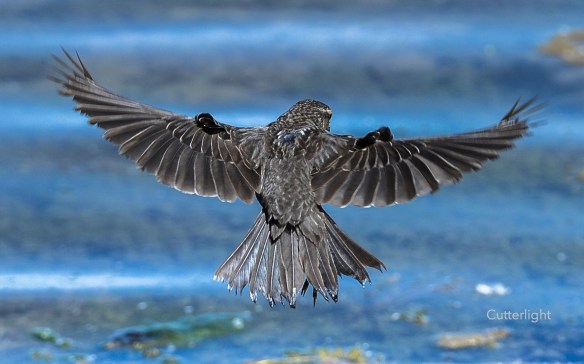
Hovering as she hunted for flying insects at a Montana pond, this female Red-winged Blackbird was able to keep from “stalling out” by redirecting air flow over her wings with her alulae, the tufts sticking up on the fore edge of her wings.

It’s easy to find oneself marveling at the ease and grace with which a raptor or songbird flies – the seamless changes of direction, the steep climbs, the ability to hover, the smooth landings. Aiding in these intricate maneuvers is a small tuft of tiny feathers that the bird can manipulate to create a pocket of whirling air – a vortex – which helps it finesse some of its most amazing moves.

It appears that the alula evolved approximately 130 million years ago during the Cretaceous Period, first in genus Protopteryx and a few million years later in Eoalulavis, or Dawn Bird. Earlier species such as the bird-like dinosaur Archaeopteryx, Old Wing, lacked alulae, indicating that while they probably were capable of gliding, they most likely did not fly in the sense that modern birds fly.


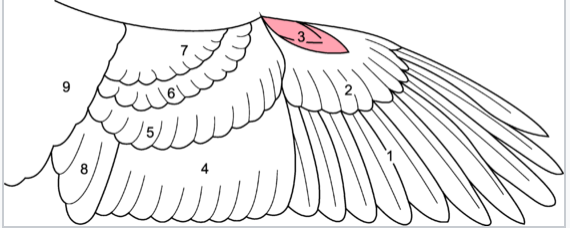
Bearing 3 to 5 small, asymmetrical flight feathers, the alula is found on modern bird species as well as on some pre-avian dinosaurs that were capable of flight. It’s the bird’s first digit, analogous to the human thumb. Illustrations courtesy of: Muriel Gottrop – https://commons.wikimedia.org/wiki/File:BirdWingFeatherSketch.png

Ink and Light: Snow Birds and Basho

Snow Birds: House Sparrows, Ulaanbaatar, Mongolia

Come!
Let’s go snow-viewing
till we’re buried!
Matsuo Basho, 1644 – 1694

House Sparrow males and females are dimorphic: a female is center in this photo, accompanied by three males. This species has adapted so well to life with people, they’ve become nearly ubiquitous in places of human habitation throughout the world – and nearly absent in more natural environments.

Basho suffered from severe bouts of depression, occasionally becoming recluse for long periods of time. A solitary nature took him on a number of journeys, alone, along routes that were often well off the beaten path. The Edo Five Routes which he followed on one of his earliest journeys were considered to be among Japan’s most dangerous roads; When he first embarked on this trek, he expected to be killed by thieves or to simply die along the way. Widely regarded as the world’s finest master of hokku (haiku), his poetic travel log Oku no Hosomichi (The Narrow Road to the Interior) is considered to be his finest work. 

Ink & Light: “At First Sight” – Love and Lines from Richard Brautigan

x-at-first-sight-copy-n

At First Sight: Sandhill Cranes, Northern British Columbia

Sandhill Cranes choose partners based on graceful mating dances and remain together for life.

…and our graves will be like two lovers washing
their clothes together
In a laundromat
If you will bring the soap
I will bring the bleach.
Richard Brautigan (from Romeo and Juliet, 1970)

– Raised in abject poverty, Richard Brautigan (1935-1984) was struggling to gain a foothold in San Francisco’s literary scene when, in 1967, he published Trout Fishing in America. The counter-culture novel catapulted him to international fame. A year later he solidified his reputation with In Watermelon Sugar. 

Ink and Light: “The meanest flower that blows…”

x-feather-fan-n

Feather Fan: Junco

To me the meanest flower that blows can give
Thoughts that do often lie too deep for tears.
William Wordsworth – Intimations of Immortality, 1807

Along with Samuel Coleridge, Wordsworth (1770-1850) is credited with founding English Literature’s Romantic Age. He was the country’s Poet Laureate from 1843 until his death.

Ink and Light: “Amber Eyes” with a quote by Sir David Attenborough

amber-eyes-11-16-2012-n

Amber Eyes: Arctic Fox, Point Hope, Alaska

The thick, soft fur of the Arctic Fox is the most efficiently warm of any land mammal.

It seems to me that the natural world is the greatest source of excitement; the greatest source of visual beauty; the greatest source of intellectual interest. It is the greatest source of so much in life that makes life worth living.
David Attenborough – BBC Life documentary series, 2009

Knighted in 1985, Sir David Attenborough turned 90 in 2016. The world’s most recognized narrator of natural history films, he remains in possession of amazing vitality.

First Snow, Chignik Lake

September 18: First snow in the mountains.

September 21: First frost along the lake.

Bull Fight on the Al-Can

Bison Bull Fight n

Nearly a ton each, when wood bison decide to take over a piece of the Alaska-Canada highway, they do. Shooting from the deck of our C-Dory, we found ourselves surrounded by leathery thuds of muscle smacking muscle, the crack of horn on horn, hooves pounding pavement and turf as animals the size of small trucks worked themselves into sprints, snorts, grunts, bellows and the thick odor of bison. We’d been photographing more placid scenes in a herd of about 100 animals – cows and nursing calves, young bulls, grandpa bulls and The Kings – the taut-muscled mature males that stood hands higher than the other members of the herd. Aside from a few younger males occasionally testing each other with head-butts, all was tranquil. The older bulls, hump-shouldered, muscle-ripped massive beasts, grazed peacefully along with the cows and calves or rolled in dust wallows.

The dynamics changed in the blink of an eye. A couple of the big boys started snorting at each other, then locking horns hard and kicking up dust. Suddenly every big bull in the herd, including the largest bull, was on high alert, tails held high, heads lowered as they zeroed in on the point of conflict. Kicking up grass, shrubs, sand and dust, these muscle-sculpted kings moved with impressive speed in their attacks which were aimed at bellies and buttocks as well as heads and shoulders.

Vehicles on the road cautiously edged backwards to give the sparring bison sufficient berth. The motorcyclist seen on the left side of this photo turned around and headed in the opposite direction as the fight edged closer to him.

Still Life with Woodpecker

pileated woodpecker n

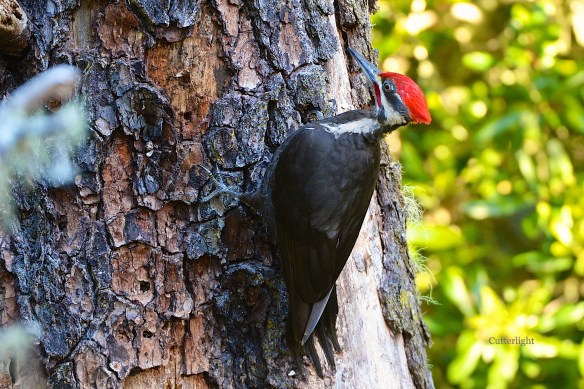
Traveling up Highway 1 through Oregon, heading back home to Alaska, reading Tom Robbins’ Still Life with Woodpecker along the way. Saw this pileated woodpecker in Bullards Beach State Park.

Lots of wildflowers and butterflies, too, and a herd of Roosevelt elk.

Still Life with Woodpecker

Snow and Flowers: It’s Spring in Mongolia!

yellow flower beautiful n

Our most recent heavy snow was just two weeks ago, and we’ve had a few flurries since then. But out in the countryside near Ulaanbaatar, wildflowers have begun to grow in profusion. 

snow drop mongolia n

Snow drops (above) are among the very first flowers to show.

white flowers w yellow, pink orange n

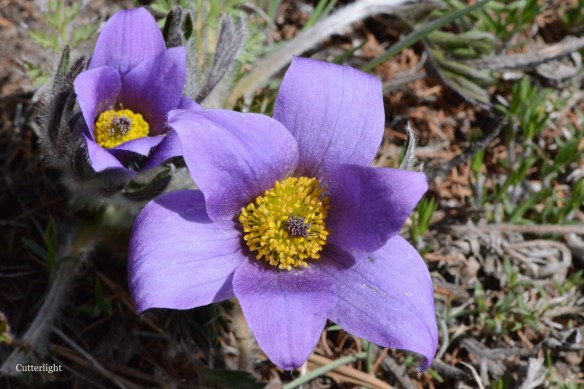
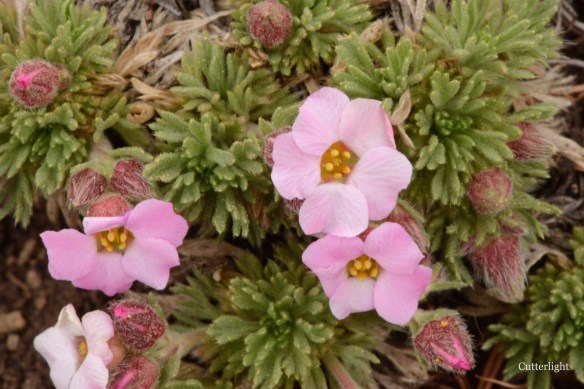
Notice the small red ant on the right side of the photo. The centers of these particular flowers reveal a tell-tale indication of their age, with the youngest flowers having yellow centers. Most of the early wildflowers are small. But they’re everywhere, and close examination they often reveals intricate beauty…

purple flower macro n

…making us wish we knew more about these splashes of color.

purple flower macro inside pollen n

pink flower macro stamens n

yellow poppy w pink n

forget-me-nots mongolia n

And happy to come across something as familiar as Alaska’s state flower, forget-me-nots.

rubarb wild n

There’s wild rhubarb, too, and wild mint and caraway are abundant.

purple flower Mongolia n

But it’s the flowers that capture our attention.

pink flower succulent n

And leave us vowing to take a botany course when we return to Alaska.

wild iris n

Bar May snowstorm n

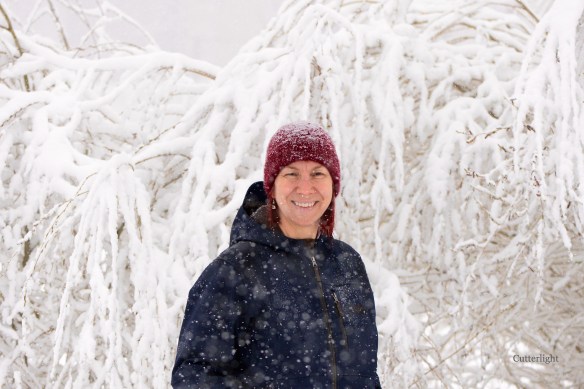
The scene in Ulaanbaatar just over two weeks ago on May 11.