Home: More Nesting Boxes than Human Houses

Female Violet-green Swallow
Chignik Lake, Alaska Peninsula, May 15, 2019

One of the most charming aspects of life at Chignik Lake is that scattered throughout the village there are more homes for swallows than for humans. Each spring the arrival of the first swallows is anticipated with almost as much enthusiasm as the arrival of the year’s first salmon.

The relationship between Native Americans and insect-eating birds such as Purple Martins and swallows precedes the arrival of Europeans on the North American continent. Audubon as well as observers who preceded him reported hollow gourds appointed with an opening hole and hung around camps and villages as nesting boxes for these birds. A single swallow or martin consumes about 2,000 small insects a day. That’s enough to make a real dent in populations of mosquitoes and biting midges. So, one could purchase a powered mosquito trap for several hundred dollars – thus emptying the air of the bugs nesting birds need to feed themselves and their offspring – or one could install nesting boxes, achieve the same bug-limiting effect, and create a sustainable cycle wherein swallows and martins return each year to mate, fill the air with their happy chirps, and clean out the bug population while raising a brood. The wooden boxes will long outlive the mechanical trap, and when the box does finally expire it won’t leave behind yet another plastic contraption to add to the local dump or landfill.

Three species of swallows inhabit the Chignik River drainage. The smallest are the little brown Bank Swallows. They make their nesting tunnels in sandy banks along or near the river and are fairly abundant. With the help of humans and nesting boxes, Tree Swallows, the largest of the three species, also thrive. Violet-greens are less common, perhaps outcompeted for boxes by the larger Tree Swallows. Barn Swallows, which can be found in villages further up the peninsula, haven’t yet made their way to The Lake.

There are good DIY nesting box designs available online and in books, and they can also be purchased ready-made. There is also good information available regarding controlling European Starlings and House Sparrows which can be a problem in some areas; these invasive species are infamous for taking over nesting boxes and even killing the desired swallows.

So… what are you waiting for? It’s probably too late in the season to attract new nesters this year, but if you hang a box or three now, a year from now they’ll be appropriately weathered and attractive to newly arriving migrants. A mated pair of birds happily rearing their chicks brings cheer to any property.

One Hangin’ and Heave Ho: the Compelling Cool of Environmental-Documentary Portraits

Heave Ho
Fred Shangin, cigarette hangin’ as per, puts his back into a pot of Tanner Crabs from Castle Bay off the gulf side of the Alaska Peninsula. May 6, 2018

Going through these many thousands of photos from The Lake and beyond – while at the same time these past few days putting together a magazine piece paying tribute to a recently deceased mentor and friend from my Pennsylvania youth – I find myself recognizing that as photographers one type of image we might not capture often enough is portraits of friends. The best of these photos are often environmental-documentary portraits – my own hybrid category to describe pictures that capture the subject in an authentic act of life in a setting that tells the viewer about that person’s life. There’s an art to it… the photo that isn’t staged; that doesn’t depict the subject self-consciously looking into the lens (or self-consciously looking away from the lens); an image that captures an authentic moment rather than a pose.

For me, learning to make these types of images has been predicated on a lengthy process of growth toward freedom from my own limiting shyness. Coupled with the kind of confidence that enables a photographer to make such portraits is, I think, a necessary agreement – tacit or verbalized – that gives the photographer permission to shoot at will (with appropriate discretion).

Strictly environmental portraits are in most cases staged. In making such an image, the photographer might have the subject sit at her fly-tying table as she ties or gives the impression of tying a fly. Noticing clutter, the photographer tidies up the scene. Further compositional considerations prompt lighting manipulation – perhaps nothing more than slightly moving a lamp or opening or closing a curtain, but manipulation nonetheless. Clothing choices are given thought, a certain tilt of the subject’s head is decided upon as favorable, perhaps a few already-tied flies are placed in the foreground, a book arranged so that it’s title can be read. Images such as this have their place, but to me there’s a compelling cool in a real-time photograph – a moment frozen, captured, documented as is with no quick brush through the subject’s hair, the everyday jacket with its stains, imperfect lighting, maybe a little motion blur or grain.

And in the case of the above photograph, one hangin’.

Sentinel

Engraved with a cross and reaching into the sky, the jawbone of a Bowhead Whale stands sentinel over a grave buried in spring snow at Point Hope, Alaska. April 12, 2012

Umiak Artist

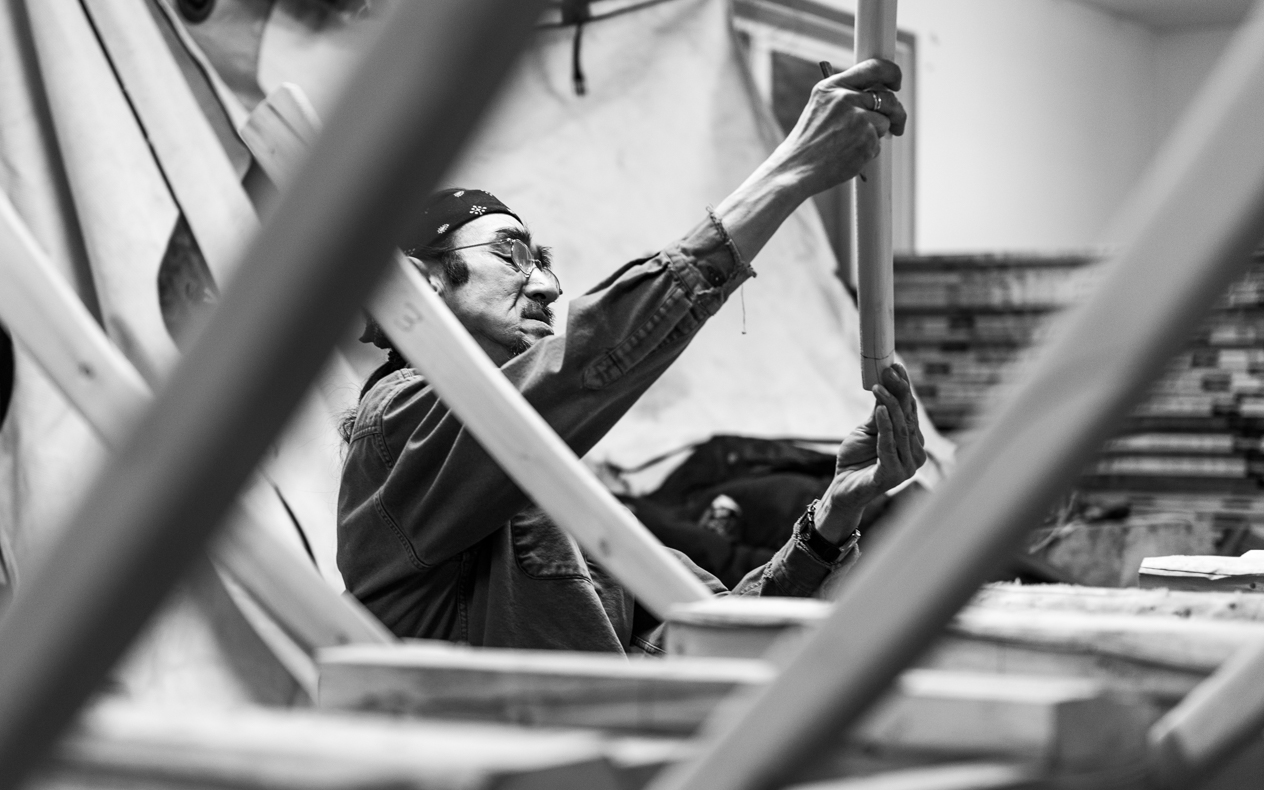
Artist and boatwright Henry “Hanko” Koonook at work on an umiak in his shop. The keel, thwarts and each wooden rib is hand fashioned and precisely fitted. When the frame is finished, it will be covered with the stretched skin of an ugruk (bearded seal). This will be the boat’s hull. Traditional skin boats such as these are still used by Inupiat whaling crews in Point Hope and other villages of the far north. Long may it be so. Point Hope, Alaska, March 21, 2013.

Umiak

This umiak – a traditional whaling boat, the hull made of Bearded Seal skin stretched tight and lashed over wooden ribs – was positioned on a rack, allowing me to make a photograph of the inside, upside down. Point Hope, Alaska, March 27, 2012.

Igloo: Arctic Home made of Whale Bone, Ship Timbers & Sod

Ghost village ruins of an Inupiat home constructed from ship timbers, sod and the bones of Bowhead Whales. Tikigaq, Alaska September 3, 2011

Saltwater inundation caused by an encroaching sea forced the people of Point Hope to relocate further inland down Tikigaq Peninsula a few decades ago, but I am told that as recently as the 1970’s a few people still inhabited homes such as the one above. In fact, on at least one such structure we saw, there was a junction box for electricity. Along with these igloos (a term which refers not just to structures made of ice, but to any dome-shaped Inupiat dwelling), there were other more familiar-looking homes in old Tikigaq, but those too have long been abandoned to decay back into the Arctic tundra.

Icehenge

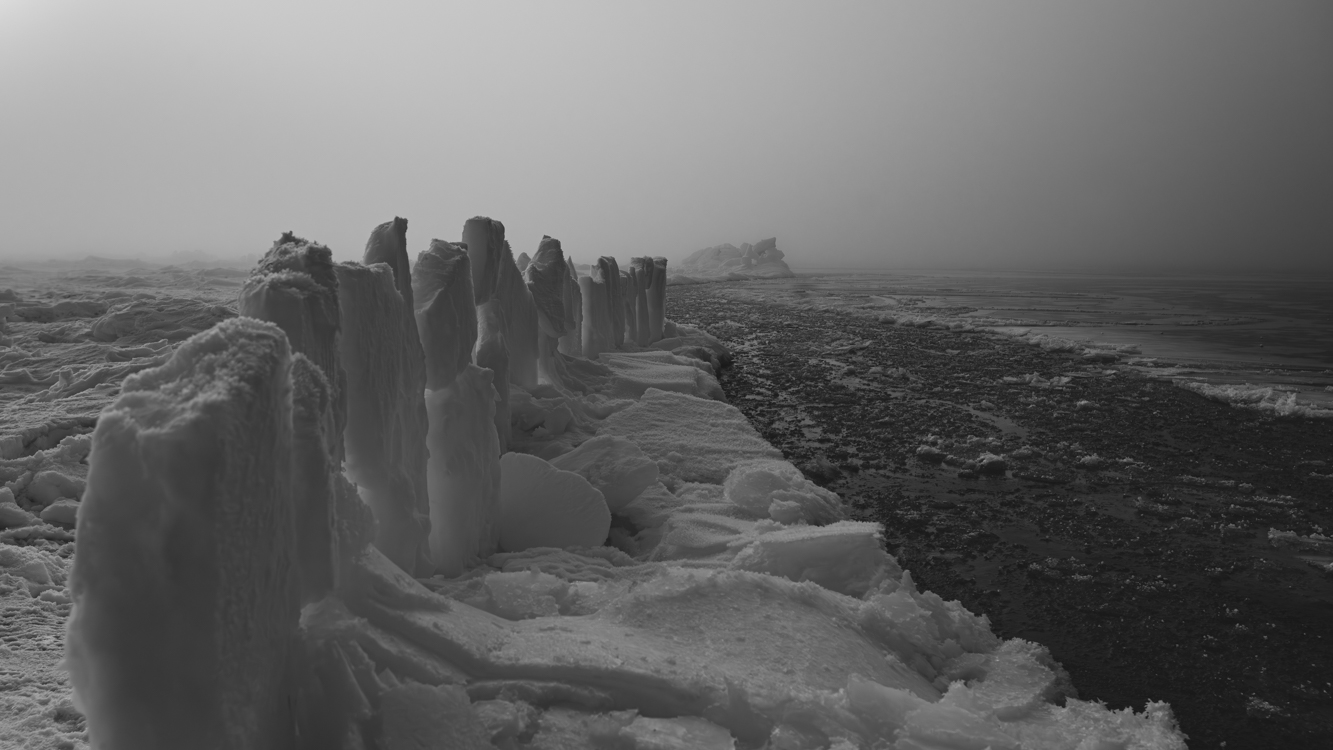
Black and white photograph of a hunting blind made of large ice slabs positioned along the edge of Arctic sea ice by Inupiat whalers.
Three miles out on the frozen Chukchi Sea, 125 miles north of the Arctic Circle, thick fog lifts to reveal slabs of ice positioned by Inupiat whalers to serve as a hunting blind along the edge of a slushy lead. Both Bowhead and Beluga Whales are taken as they migrate through these open lanes between sheets of ice. Near Point Hope. Alaska, May 3, 2012

The Bones of Tikigaq: Whaling Festival Site, Point Hope, Alaska

The Bones of Tikigaq
Whaling Festival Site, Point Hope, Alaska. The larger bones presented as arches are the jawbones of Bowhead Whales. Traditionally, the skull is returned to the sea so that the whale’s spirit is properly released. Point Hope, Alaska, August 12, 2012

Dog Sled Races, Shishmaref, Alaska

Black and white photograph of an unknown musher and his team dog sledding during a race in Shishmaref, Alaska.
A number of families kept teams of dogs, and during the wintertime holidays there were dog sled races. These were short races of perhaps a few miles. The speed and skill demonstrated was incredible. December 27, 2010

Blueberry Days: and thoughts regarding Alaska’s bush education system

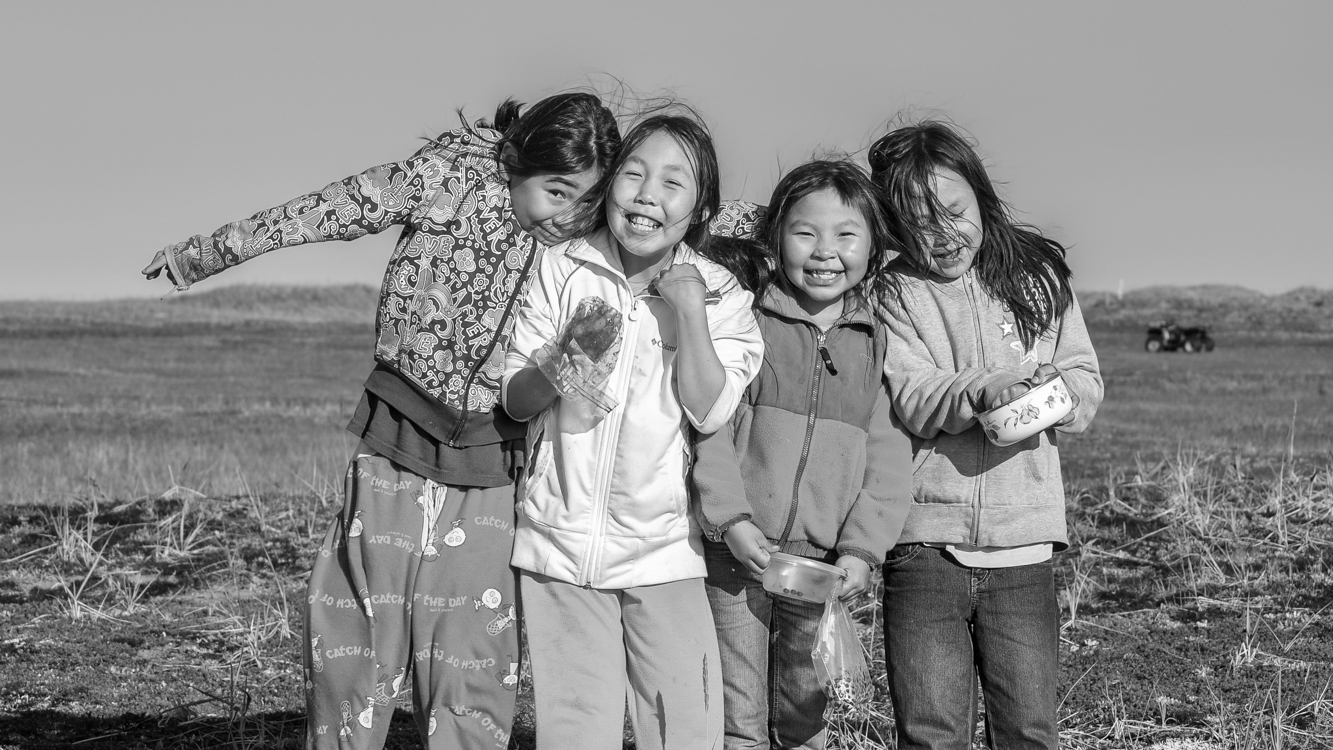
Blueberry picking on the Arctic tundra. This photograph was used in a Ted Talk about Climate Change. Sarichef Island, September, 2010

As is the case anywhere one might go, there are multiple realities in Shishmaref – or in any bush village. Some of these realities fit together neatly in a positive and even happy manner, like smiling faces after berry picking on a pleasantly crisp fall morning. Some realities exist more as collective memories, and you’d have to dig and observe closely to find their vestiges. Other realities contradict and clash and it can be difficult to understand how they are connected to the broader cultural, and still other realities go mostly undiscussed – pretended away – as they seep into village fabric like a sludgy toxin.

A reality in the “sludgy toxin” category in most bush communities we are familiar with are the schools. For anyone who was fortunate enough to be educated in a fairly decent k-12 system, or who has taught in such schools, the level of professional misfeasance and malfeasance – the combination of indifference, incompetence and outright corruption in Alaska’s bush schools – would probably defy belief. Before coming to Alaska, Barbra and I taught in good schools in the lower 48. So we know what that looks like. Nothing in that experience prepared us for what we encountered in the Alaskan Bush. The blame, when one talks to many teachers and administrators in bush Alaska, is placed on the children themselves and their parents. These educators and administrators spin their tales to state legislators, the governor’s office, department of education officials, university education departments and anyone else who asks, and Alaska’s state legislators, the governor’s office, department of education officials and university personnel nod along, agreeing that little can be done to improve matters.

But the reality is that any of the schools we taught in, visited or heard about from others could have easily… and I emphasize easily… been improved with a bit of competent administration. The acquiescence to self-serving fictions among Alaska’s leadership – the phony wistful sighs followed by reassurances among themselves that the problems can’t be fixed, so therefore they aren’t obliged to try – continues year after year.

Because it is easy to dismiss these bush schools and the Native communities they serve. After all, these are other people’s children.

Thank you for allowing me to finally get that off my chest. Comments, as always, are welcome. JD