
Sentinel
2


Saltwater inundation caused by an encroaching sea forced the people of Point Hope to relocate further inland down Tikigaq Peninsula a few decades ago, but I am told that as recently as the 1970’s a few people still inhabited homes such as the one above. In fact, on at least one such structure we saw, there was a junction box for electricity. Along with these igloos (a term which refers not just to structures made of ice, but to any dome-shaped Inupiat dwelling), there were other more familiar-looking homes in old Tikigaq, but those too have long been abandoned to decay back into the Arctic tundra.

As Bowhead Whales go, this was a small one – perhaps 10 tons or so. We had hiked approximately three miles from the village of Point Hope across the frozen Chukchi Sea to the camp where we had heard a whale had been caught. Locals had traveled by snowmachine and honda (snowmobile and ATV). There is always the danger of encountering a Polar Bear in this environment, and so we were armed. After snapping this picture I handed the camera to Barbra and took a place on the rope.
The open water in this picture is called a lead – an opening between two sheets of ice. You can see, across the water, the jumble of ice along the edge. Sea ice is often not the smooth sheet of white one might imagine. It continuously buckles, pushes up along pressure ridges, drifts apart and then presses back together. In a way, it behaves like the Earth’s tectonic plates, buckling, heaving, colliding, lifting. And so in order to make a whaling camp, trails must first be made through these places where jagged ridges of ice, individual chunks the size of cars, some much larger, must be broken through and smoothed out.
It is a lot of work to take a whale.

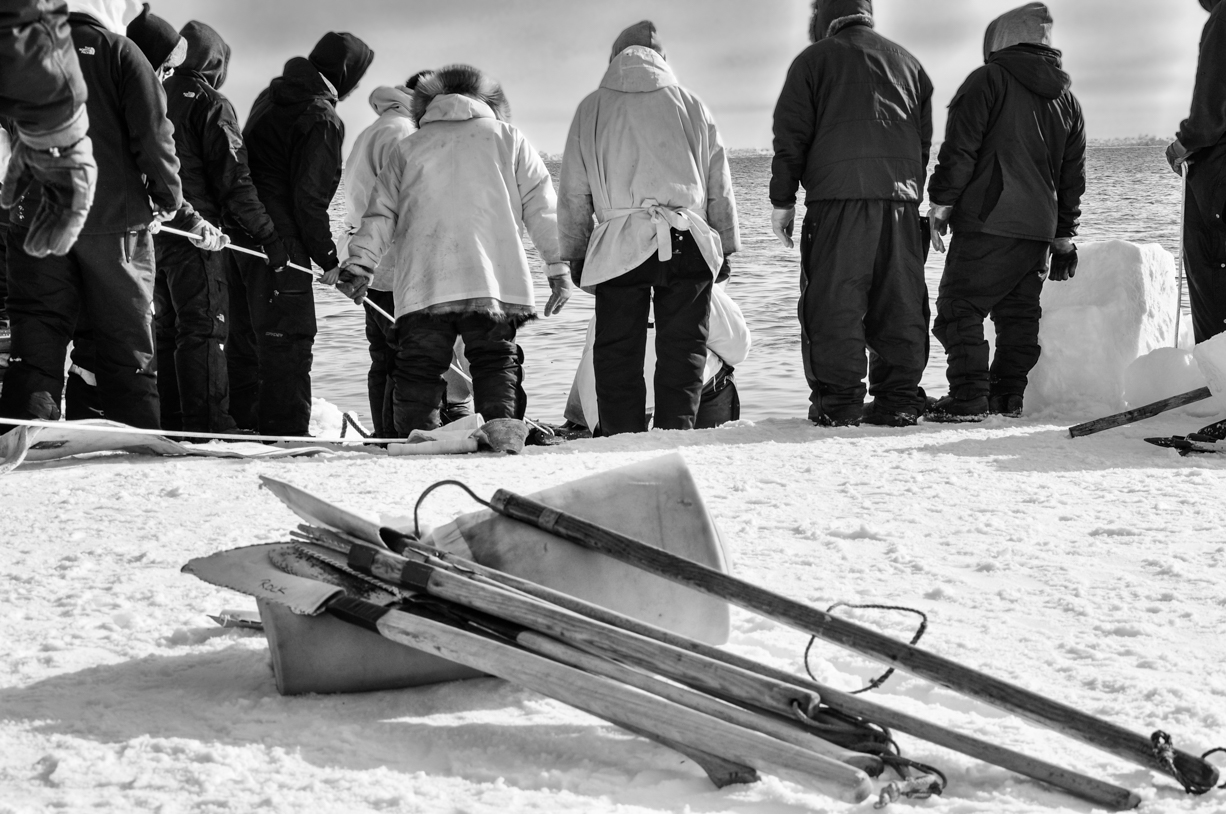
Barbra and I hiked from the Arctic village of Point Hope about three miles across the frozen Chukchi Sea to where a Bowhead Whale had been caught. These Inupiat crews still use handmade wood-framed boats fitted with seal skin hulls. Here the crew is preparing to bring the whale up onto the ice. It is cold, difficult work; that day a man lost part of his finger setting up the block-and-tackle. But it is joyous, too, as the meat and blubber is distributed throughout the village. After taking this picture, I handed the camera to Barbra and added my shoulder to the tow rope.
I have recently (mostly) completed curating over a decade’s worth of photographs taken during the years we lived in the Alaska Bush – villages not accessible by road. Keep watching this site for a new photograph each day. Your comments are appreciated. JD
 CutterLight