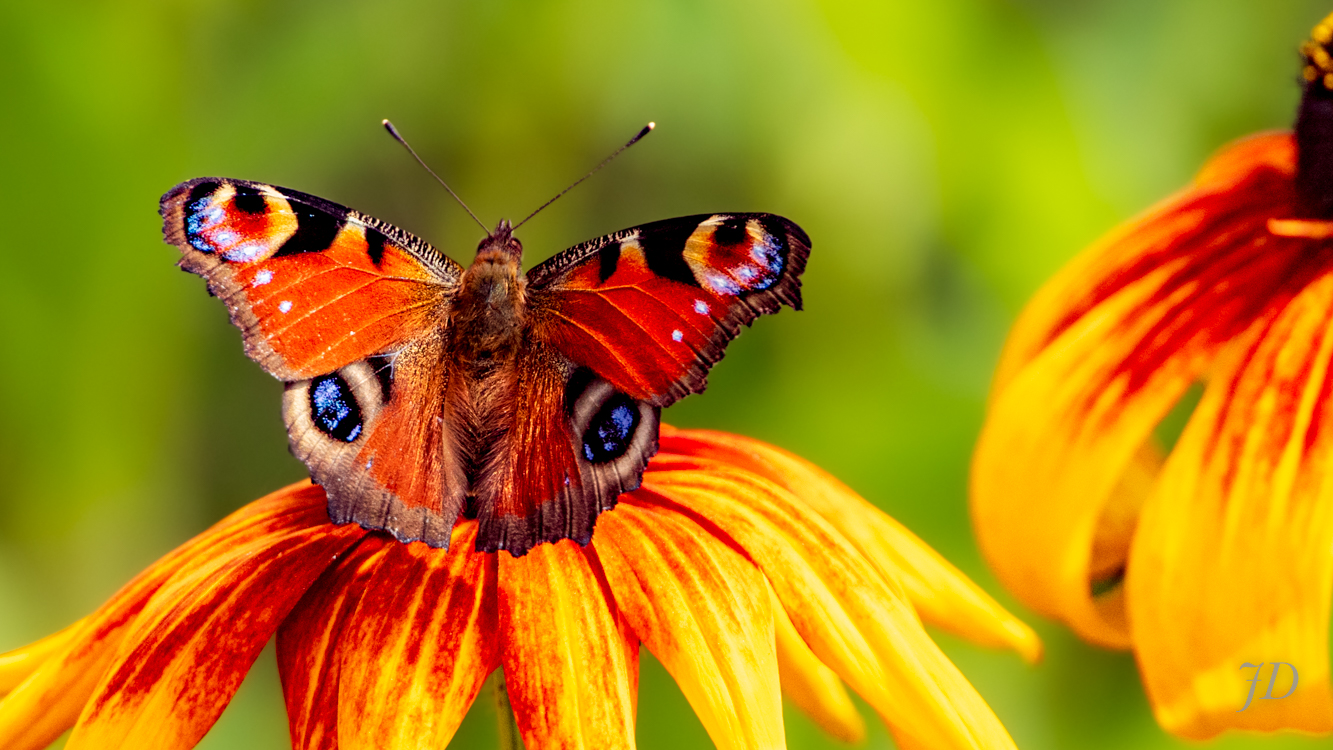
Kushiro Shitsugen National Park, Hokkaido, Japan, July 29, 2018
Wherever you are, we hope your day is going well!

Wherever you are, we hope your day is going well!
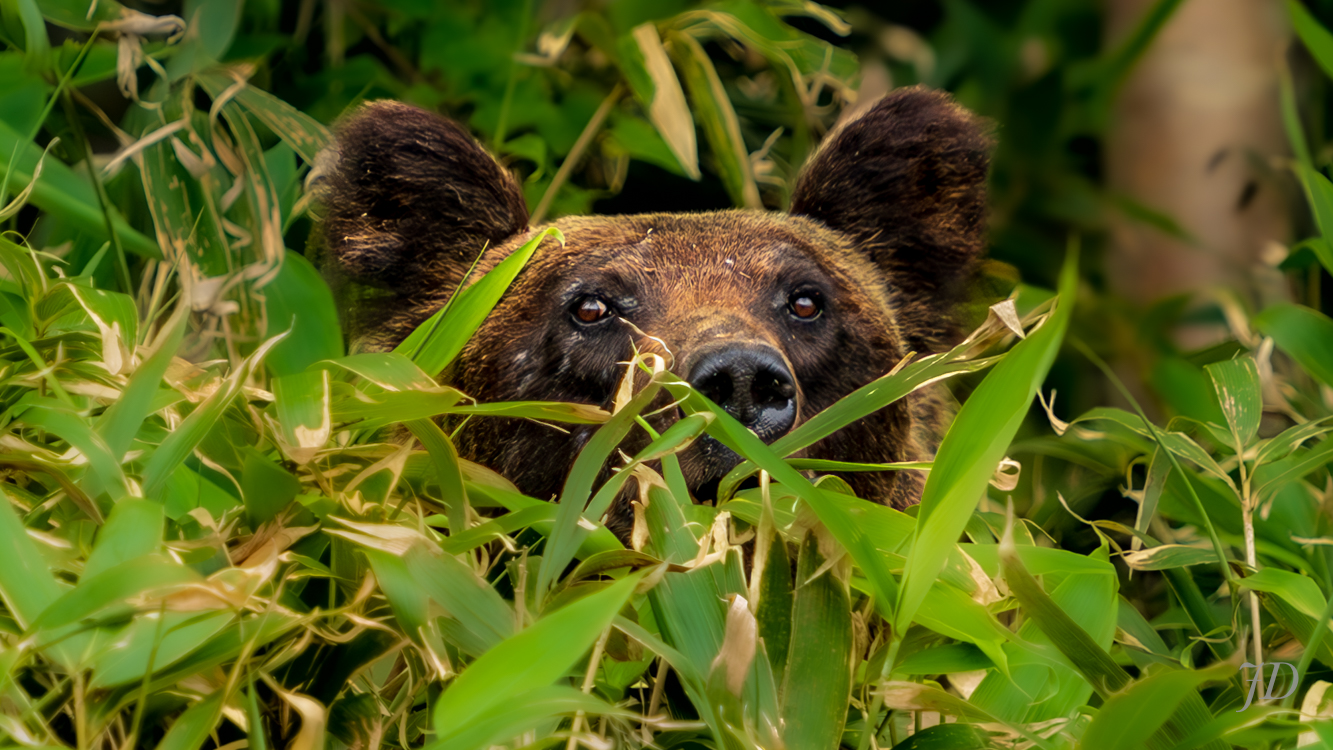
Ursus Arctos is a holarctic species represented by several subspecies throughout the Northern Hemisphere including the Grizzlies of the North America West (U. a. horribilis), the massive Coastal Brown Bears of Kodiak Island Alaska (U. a. middendorffi), the equally impressive Chignik (Alaska Peninsula) bears (U. a. gyas) and various additional species scattered from the harsh Gobi Desert to Siberia, the Italian Alps and other regions. Adapted to a variety of climates and diets, physiologically Ursus arctos is the most varied of all bear species.
The Brown Bears we encountered in Hokkaido, U. a. yesoensis, are similar in appearance to the Coastal Brown Bears of Kodiak Island and the Alaska Peninsula which makes sense as, like their Alaskan cousins, Hokkaido’s Brownies subsist on a salmon-rich diet. But at an average weight of only about 450 pounds – large males topping off at under 700 pounds -, Hokkaido’s bears are small compared to those found in Alaska; Chignik and Kodiak bears can reach weights of well over half a ton.
Still, bears are bears and regardless of size, they can be fierce. Approximately 12,000 Brown Bears inhabit Hokkaido, a land area about the size of the state of South Carolina or the country of Austria and home to just over five million people. There have been 57 human deaths attributed to Hokkaido’s Brown Bears over the past 61 years. When the sow in the above photo cautiously emerged from the forest and woofed for her two cubs to follow her across the steep road we were pushing our bicycles up, we gave her the right of way.
The rugged, forested 470 square mile Shiretoko Peninsula where we encountered these and several other bears as well as Blakiston’s Fish Owls, Ezo Red Foxes, Sika Deer, Dall’s Porpoises, eagles and other birds is a UNESCO World Heritage Site.

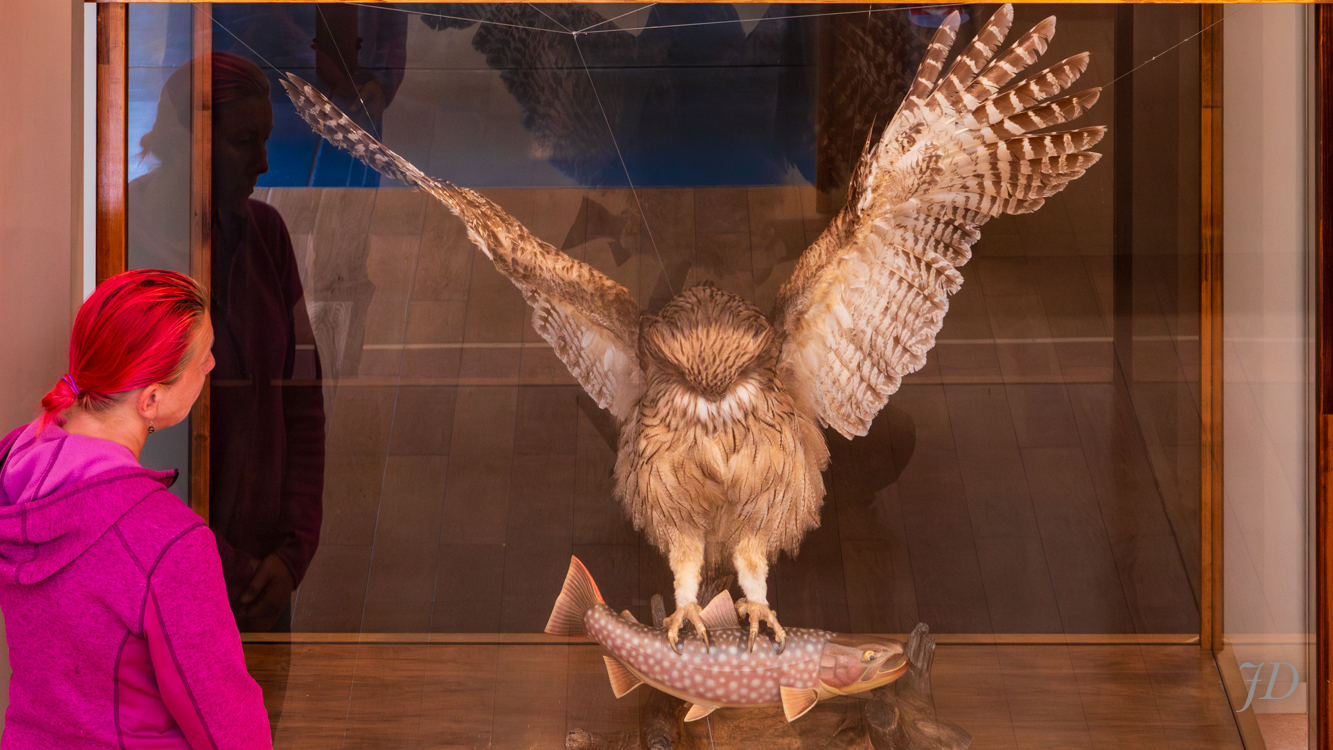
With a wingspan ranging from about 5′ 10″ to 6′ 3″ (170 – 190 cm), Blakiston’s Fish Owls are generally regarded as the world’s largest living species of owl. The photograph above is of one of a known wild pair which have been banded. The owls regularly visit a small stream where a pool has been created with natural rocks and is regularly stocked with Cherry Trout (sakuramasu, O. masau). A small inn with windows overlooking the pool provides guests with opportunities for a glimpse of this rare species which may visit the pool at any time during the night. The indigenous people of Hokkaido, the Ainu, regarded these great owls as spiritual protectors of their villages.
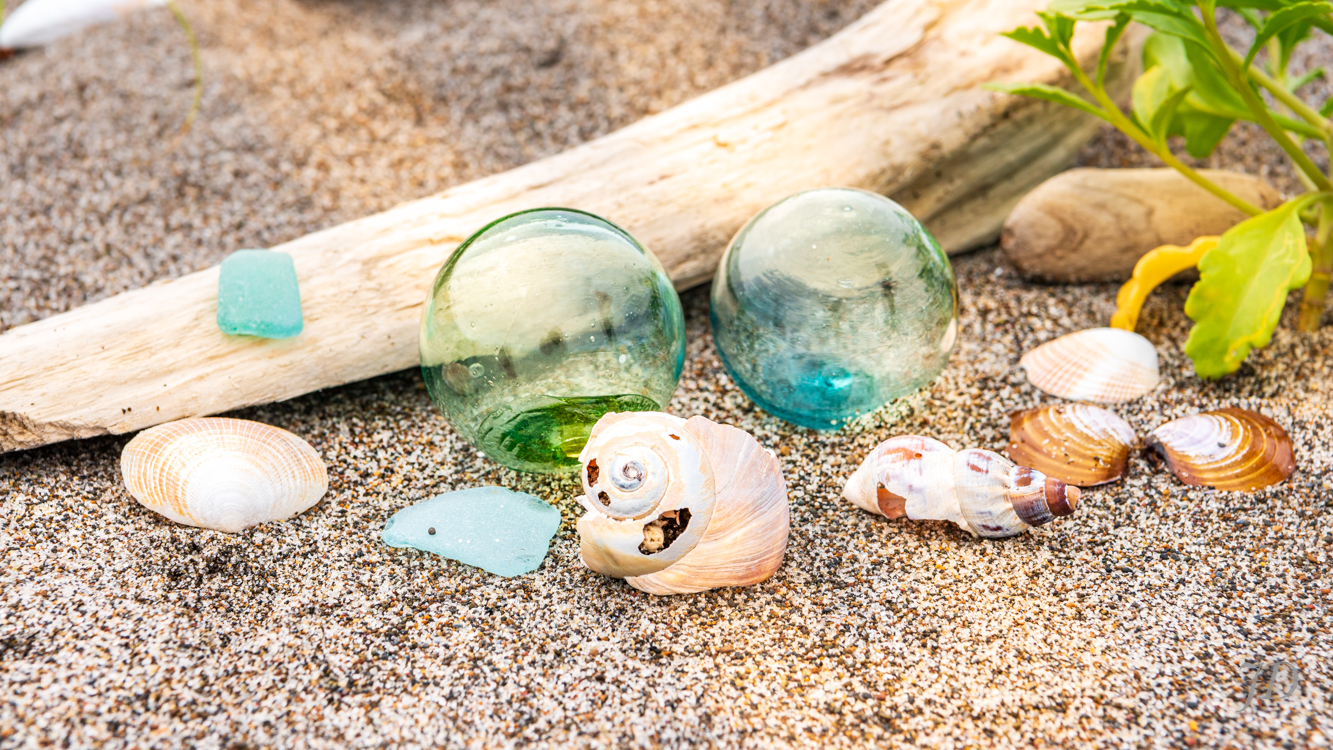
The summer I turned nine I encountered my very first Japanese glass fishing floats. I was in Oregon, and in addition to populating gift shops and restaurant decor, back then these mystical treasures still occasionally washed up on Oregon’s beaches, particularly after big winter storms. That summer I concluded my 13th consecutive reading of Call of the Wild, and Treasure Island and Robinson Crusoe were still fresh. My mind was filled with dreams of faraway lands. The floats, hand blown by craftsmen, fragile, beautiful, traveling across the vast Pacific over decades and thus providing a link not only with the exotic country of Japan but also with ships and fishermen and a culture of yore were utterly captivating.
Over the years, we’ve been gifted a collection of these floats from friends lucky enough to have lived along one of the few beaches where they still wash up. The gifts are appreciated… but it’s not the same as finding one myself. From California to Alaska, in all the years since that Oregon summer I’ve never visited a beach without harboring vague hopes of finding one.
Somewhere past the town of Shari (斜里町) as we approached the Shiretoko Peninsula, we stopped at a beach to have our breakfast and watch sport fishermen cast into the surf for Cherry Salmon.
Barbra found the first one. My stomach turned a little… conflicted. Happy for her find, but disappointed that it hadn’t been me. But where there’s one… maybe… Planting my feet where she found that first float, I scanned every inch of the beach through binoculars. And then, without a word, I handed the binoculars to Barbra and took off, running with all the joy of a young boy turning nine.
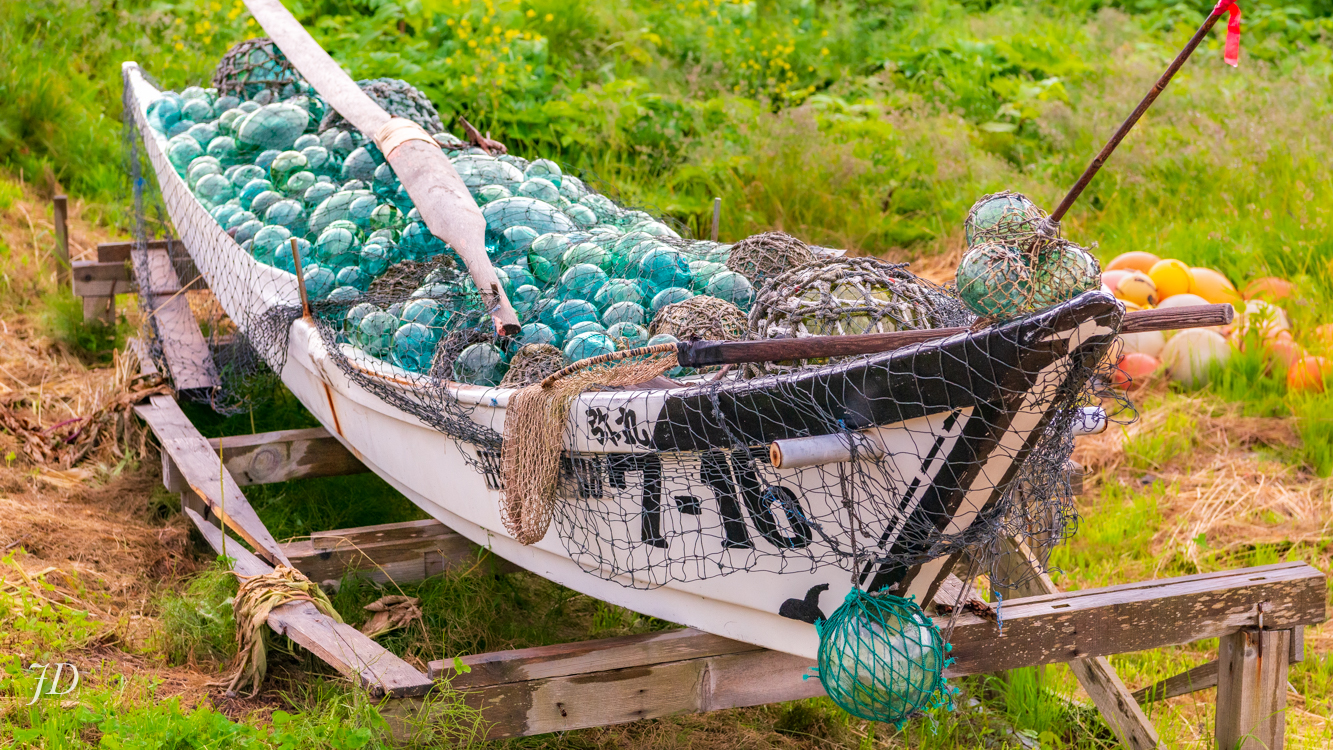
With the exception of a very few tennis-ball-sized glass floats used in skates set for Olive Flounder (hirame, 平目, ヒラメ), glass fishing floats are artifacts of yesteryear. Broken free from lines and nets perhaps decades ago, they still wash up on North American beaches, especially in parts of Alaska. We came across some beautiful collections during our Hokkaido trek. Here a loaded skiff on Yagashiri Island.
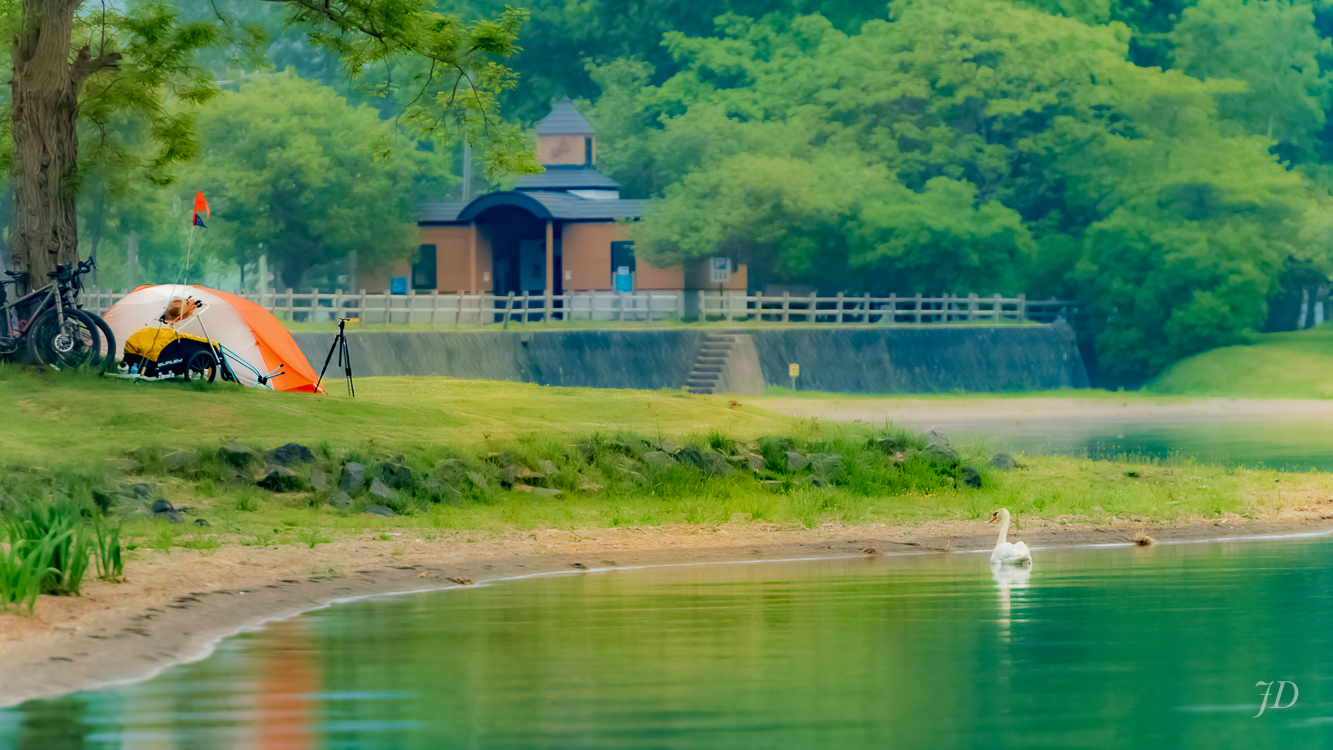
We found one terrific (often idyllic) campsite after another during our Hokkaido trek. Above is Nakatoya Campground on the shores of Toya-ko (Lake Toya). The lake formed in an ancient volcano caldera, complete with an island near the center – similar to Oregon’s Crater Lake. Overall, Hokkaido’s campgrounds were quiet, clean, and inexpensive. In fact, several were free and if memory serves even the most expensive site was only about $20 (in 2018). Most ranged from five to 10 dollars per camper per night.
In the past, language might have been a barrier to traveling in Japan. I speak some Japanese, which was immensely helpful, but these days with language apps right there on your phone, most locals eager to assist well-mannered visitors, and a lot of printed material such as highway signs, menus, national park information and so on written in English, even language differences need not impeded a tour of this wonderful, lightly-visited island. On a latitude approximating that of Oregon and Massachusetts, summertime biking in Hokkaido is pleasant, particularly along the coast.
I had forgotten that I’d softened so many of these Hokkaido images… Dreamy summertime bike trek.

This photo is an early experiment with softening rather than sharpening an image… taken before I appreciated how important careful note-taking is… I think this is in the harbor of Hagino.
We arrived in Japan on May 28, spent three days in the Crown Prince Hotel in Chitose, Hokkaido getting acclimated – figuring out where we might purchase fuel for our camp stove, re-assembling our bicycles and so forth -, and then on June 1 we embarked on a 67-day, 1,300 mile bicycle-camping trek circumnavigating most of coastal Hokkaido. For both of us, the trek was a fulfillment of childhood dreams of a self-guided bicycle trek in a foreign country. It was quite possibly The Most exhilarating adventure either of us had ever undertaken.
I paid for a significant part of the trip when I published an article in Adventure Cycling Magazine, which if you’re interested you can find here. We also published several articles about this trip right here on Cutterlight. The easiest way to access those is to simply type Hokkaido in the search box in the upper right of any Cutterlight page.
As I go through the 1,342 photographs from this trip (that’s after the initial culling), I’m not sure how many new images I’ll have to post. But I will underscore the feeling Barbra and I came away with after the trip. Go! If you’ve ever thought that a bicycle trek is something you might want to experience – think back to when you were 12 or 13 or 8 or 58 and riding in a car passed a couple or a small group of bike trekkers and wondered what it was like… wondered if you could do something like that – our answer is Why not?

Made it to Haneda! Bicycles, trailer, gear & clothing. On to Chitose!
Planning a bike trek around Hokkaido, Japan has been quite a challenge. People travel abroad. We’ve traveled abroad. People go on fishing sojourns. We’ve gone on fishing sojourns. People undertake photography safaris. We’ve undertaken photo safaris. People bike trek. We’ve… ridden our bikes. The challenge has been that people don’t typically do all these things in one, long, self-guided camping trip. Nor do they normally wait until they’re in their 50’s to attempt their first foray into something like this.
To prepare, we read books on bike trekking – from words of wisdom on ultra light traveling to advice from folks who tote along babies and dogs. We watched countless videos on how people pack and camp with their bikes. Along the way we feathered in fishing. And photography. And pack-rafting. And camp cooking. And backpacking. And bird watching. And then there was the fitness training schedule to help us get into shape for this adventure. With as many people in the world who have already pioneered all of these different adventures, no one seems to have attempted the catch-all combination of what we are hoping to embark on.
During the planning phase, we practice-packed several times. Each time, we realized another layer of equipment had to be fine-tuned. Without bringing a pack mule or a SAG wagon, we weren’t going to be able to carry along everything that we wanted to.
The pack raft was the first thing to go. Our rafts compact into fairly small bags, but they necessitate paddles and PFDs. The amount of space and additional weight all of that entails wasn’t going to work. A subsequent trial packing made it clear that our plan to backpack and camp in the back country of the Shiretoko Peninsula, a world heritage site, also required too much stuff – mainly the backpacks themselves. We still plan to explore a backpacking trip, but we’ll look into renting backpacks.
The next activity to get a hard look was fishing. Hokkaido is reported to have good populations of trout and char and even some salmon fishing as well as opportunities to ply ocean beaches and rocky shorelines for a variety of species. While we considered getting into at least some fishing to be a non-negotiable, we desperately had to figure out how to skinny down our equipment to one rod tube and one waist pouch. The compromise we settled was sharing gear instead of bringing two of everything. Additionally, we modified our lone fly rod to double as a spinning rod. (If it works, we’ll tell you all about it.) In the end, we packed a fly reel, a spinning reel, an 8-weight rod, a tenkara rod, a few small boxes of flies and lures and a small assortment of leaders and tippet material.
The next nonnegotiable was photography gear. Last summer, we limped through with substitute equipment and felt handicapped the entire summer. When we returned home and finally got our photos up on the computer screen for editing, they left us disappointed with the quality. So, our preparation for this summer involved numerous discussions and field tests regarding what gear would best capture the sights and experiences of our journey. What made the cut may seem like a lot to some, but we feel confident that we’ve streamlined our gear without sacrificing too much versatility.
The guiding question in all of this was, What kind of experiences do we most want to have? And the not-so-surprising lesson has been that if the trip is to be about going and doing rather than simply going and seeing, a certain amount of specialty gear is necessary. We know, for example, that we can enjoy first-rate food experiences while keeping our budget reasonably low by visiting markets and cooking for ourselves. But this strategy necessitates carrying with us cookware up to the task. Even birding pretty much requires that we take along a decent pair of compact binoculars and a field guide (which Jack went through with a box cutter and pared down to the bare essentials).
With our gear as fine-tuned as possible, we flew to Anchorage where Paramount bike shop took over the bike-packing – otherwise known as breaking down the bikes and packing them into big cardboard boxes. Meanwhile, we filled two much smaller cardboard moving boxes with the rest of our gear – boxes we’ll discard once we arrive in Hokkaido. And so, ready or not we’ve begun this summer’s adventure with three bicycle boxes and two moving boxes colorfully decorated with neon orange duck tape, packed to withstand the long journey down the West Coast and across the Pacific Ocean.
At the Anchorage airport, a helpful Alaska Airlines ticket agent was ready to assist us with the puzzle of moving our over-sized bike boxes through the maze of four planes, four airports, two languages and two countries. We were nervous about our baggage surviving the journey or getting lost along the way. As unconventional as it is to travel with ducked-taped cardboard boxes, we are happy we did. At our San Francisco stop, we looked out the plane window and saw our boxes being loaded into the plane. And thanks to the day-glow orange tape, we quickly spotted our luggage as it hit the conveyor belt in Tokyo. Hi-vis tape was a great idea! By the way Big Kudos go out to Terrie at the Alaska Airlines desk-for-troubled-travelers. She was able to figure out how to check our bags all the way to Hokkaido from Anchorage. Amazingly, the cost for all of our baggage was a very-reasonable $200! (Go Club 49!)
As the nerve-wracking airplane travel segment of our journey comes to a happy conclusion, we can now focus on the next leg of the adventure: putting our bikes back together, finding stove fuel and purchasing a few groceries. And then we will answer the question that has been in the backs of our minds (and the pits of our stomachs) ever since we conceived this trip: Will we be able to balance, steer and propel these vehicles??? Stay tuned!
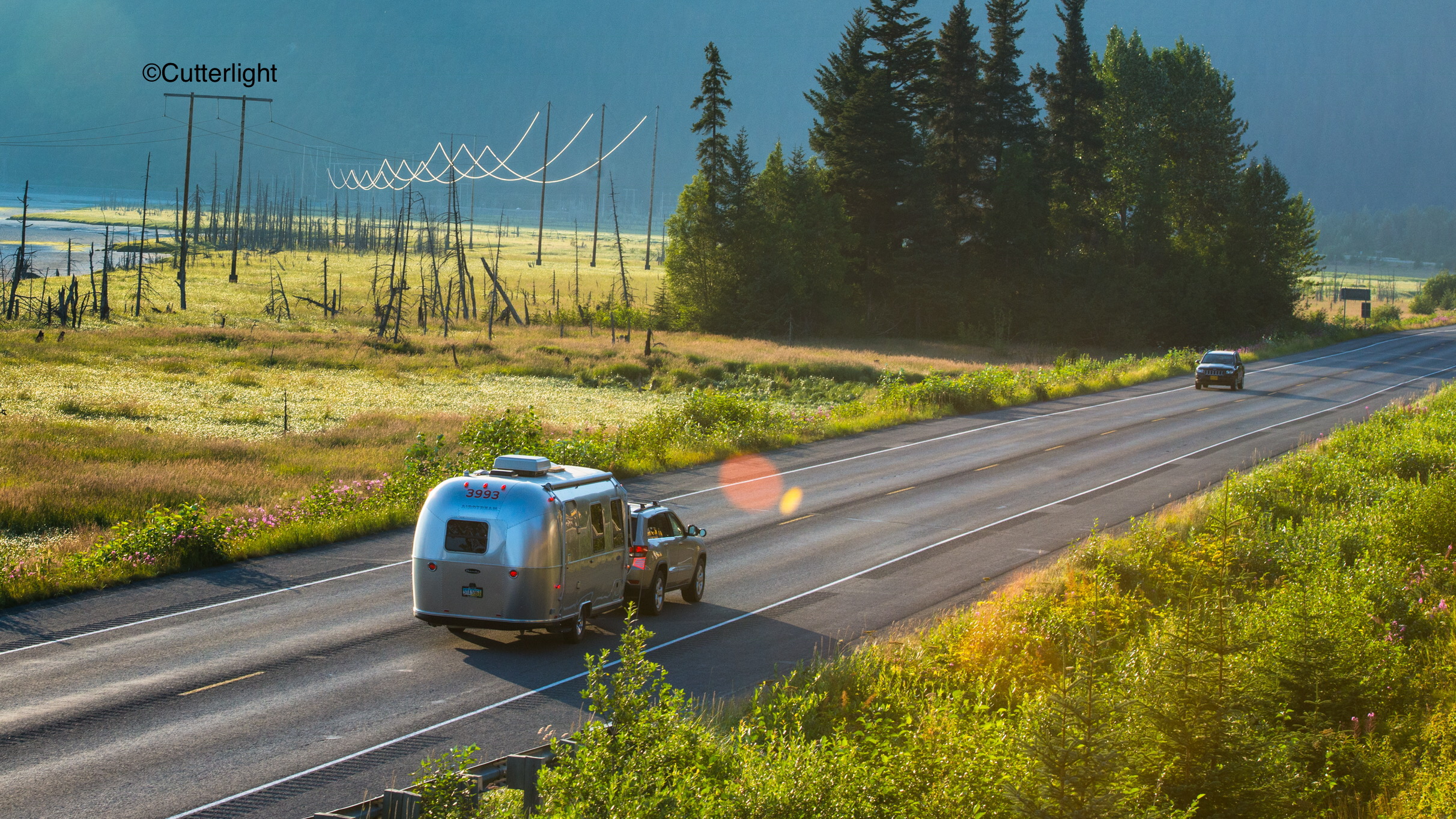
Nowhere in particular to get to… and all summer to get there.
May 19: We’d saved a couple fingers of bourbon for this, our final evening in Chignik Lake. Measured out in a pair of our favorite glasses, the mellow amber-brown glow of the whisky suited a similar mellowness that had settled over us as we looked around a clean, tidy home that only a few days before had been an explosion of camping gear, bikes, technical clothing, camera gear, panniers and check lists. Our bicycles and camping gear had already been flown to Anchorage where they were waiting for us at Lake Clark Air. Scheduled to fly out of Chignik Lake the following day, ahead of us was a five-day scramble in the big city of Anchorage in which to reconnect with friends, make last-minute adjustments to our bikes and have them boxed for air travel, and to pick up necessities ranging from fly-fishing leaders to all-purpose hiking/biking/street/camp shoes as well as a couple of dozen additional odds and ends. Oh, and to get one of the three store-bought haircuts we treat ourselves to each year.
And then on Saturday, May 26, we’ll board Alaska Air bound for San Francisco where we’ll switch to Japan Airlines into Chitose, Hokkaido. If all goes according to plan, we’ll spend the next 85 days exploring Hokkaido, Japan by bike.
Why Hokkaido? I suppose it comes down to the fact that both of us have wanted to do a bicycle trek ever since we were kids but never did. Lacking experience in this sort of thing, it made sense to go for it in a country known for being safe and for having a bicycle friendly culture. Factor in campgrounds that typically range in price from free to $5 or $6 dollars, a cool, comfortable summer climate, beautifully diverse landscapes featuring smoking volcanoes, snow-capped mountains, bird-rich marshes and forests, fields of flowers, six national parks, seaside villages and the distinct possibility that we just might get into some decent trout and char fishing. Japan’s northernmost island seemed to us to be the best possible place to make this leap into a new way of travel.
Hokkaido’s cuisine surely ranks among the world’s finest. Regional seafood specialties include scallops, oysters, several species of crab, shrimp, salmon, squid and succulent, softball-sized sea urchins. As Japan’s agricultural capital, Hokkaido is also known for its fresh fruits and vegetables as well as local beef and pork, and people rave about the rich ice-cream. There may even be opportunities to sample wild game. Soba – those tasty buckwheat noodles that are especially delicious served cold – is made from local grain, and it seems that virtually every city, town and village has its own unique twist on ramen. Visions of donburi – bowls of rice piled high with a variety of colorful, fresh seafood – have been dancing in our heads for months. If that’s not enough, micro-brews have caught on, there’s a nascent wine industry and even a couple of world-class single malt distilleries. Every yen we don’t spend on campground fees is another yen we’ll be able to spend eating our way around the island.
So stay tuned. We intend to publish throughout the summer – food experiences that inspire, new birds, exotic species of trout of char, encounters with wildlife and the challenges and successes we’re bound to encounter pedaling our way along sea coasts and through mountain villages. But the thing we’re most looking forward to is meeting new people and immersing ourselves in a new culture. I’ve been practicing my Japanese, to be sure. But if experience is any guide, connections trump vocabulary. We can’t wait to share our loves of fly-fishing, photography, birds, food, camping and hiking with friends we haven’t yet met, half-a-world away, who find similar joy and fascination in such things. Hopefully our journeys will bring us into conversations with soba masters, commercial fishermen, trout chasers, farmers, ranchers, biologists and people who call Hokkaido home and love living there.
Wherever the coming summer finds you, we wish for you days filled with pleasant adventures, good food and deepened connections old and new.
 CutterLight