Fishing and Camping along Oregon’s Deschutes River

Edged by a thin strip of green, the Deschutes River is born in mountains southwest of Bend. Brookies – aggressive and abundant – dominate the headwaters where it flows out of Little Lava Lake. When the river hits Crane Prairie Reservoir, rainbows (and largemouth bass) dominate. Once the river drops into canyon country north of Bend, redbands come into their own. Although canyon trout typically don’t run large, there’s a good chance you’ll have the water to yourselves, as we did. Further downstream, steelhead attract attention from fly fishermen who spend hours swinging flies in hopes of that one, elusive, electrifying grab. (Click on any of the photos for a larger view.)

In June of 2009, Maia and I spent a week camped along the Deschutes River near Bend, Oregon where we were enrolled in an Orvis Fly Fishing School – an experience we highly recommend to any parent-son/daughter, husband-wife or fishing partner team looking to boost their skills and knowledge. (We’d love to take one of their saltwater fly fishing or wing shooting schools in the future.)

Tumalo State Park proved to be an excellent location for our headquarters. Tent friendly, it was both quiet and conveniently close to Bend and the region’s excellent fly fishing. In addition to the Deschutes Canyon, we also explored the nearby Metolius River, Lava Lake, Little Lava Lake and the Upper Deschutes.
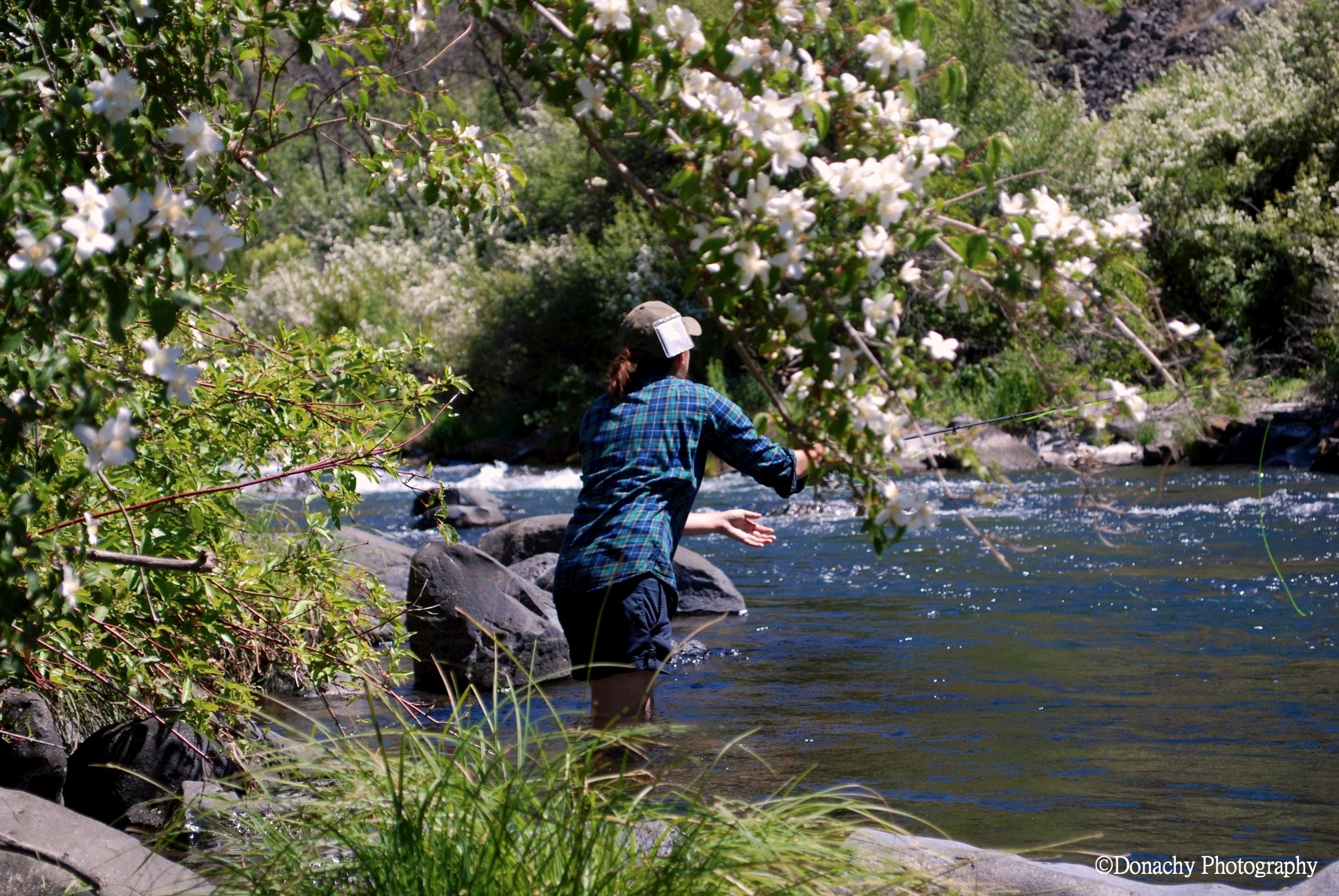
Fishing an elk hair caddis, Maia coaxed a pair of the Deschute’s redband trout from this canyon pool.

The redbands of the canyon are not large, but numbers are good, the water is beautiful and the setting is dramatic.
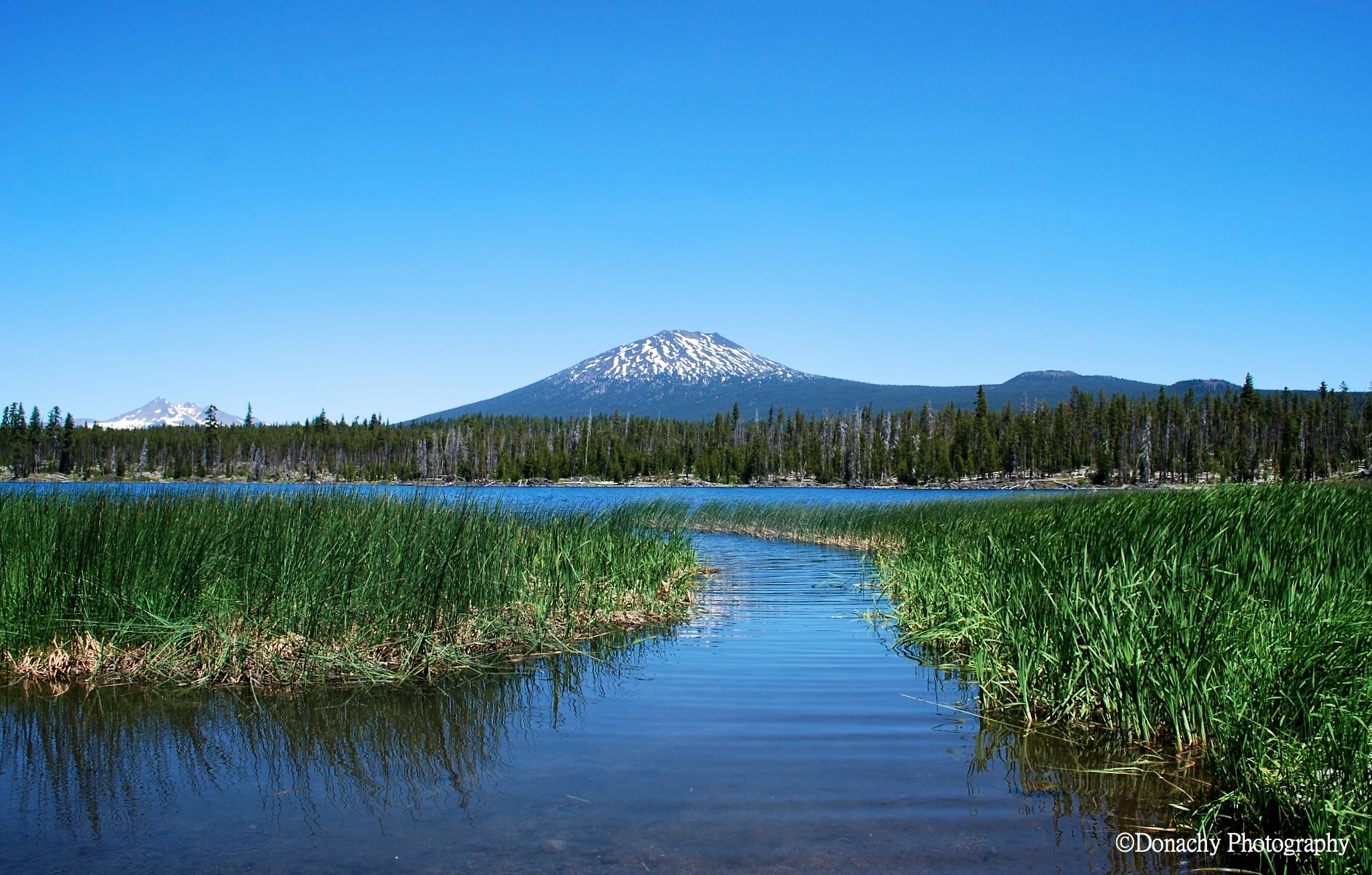
The float tube launch on Lava Lake seems to lay out a path to Mount Bachelor, one of Oregon’s premier ski destinations.

As Maia and I were preparing to launch our float tubes on Lava Lake, a fly fisherman who appeared to be in his 70’s was just coming in. “Wanna see what I’ll be having for breakfast?” he asked with a playful grin. He then pulled from a wet canvas creel a fat, 18 inch rainbow. The silvery fish had undoubtedly been stocked as a fingerling and grown heavy on a diet rich with scuds and aquatic insects. “Been coming here for decades,” he said. “Fishing’s still good, and you can’t beat the setting.” Since we were after a trout or two for dinner that night, we were heartened by his success. And sure enough, in addition to a couple of smaller trout, a rainbow just shy of two pounds fell to an bead head olive wooly bugger in the short time we spent on the lake.

After a dinner of salad, pan-friend New York strip steak, freshly caught trout and multi-colored Peruvian potatoes, we relaxed in front of our campfire enjoying a finger or two of Scotch, reminiscing about the day’s fishing, about the fishing we’d had other days going all the way back to afternoons spent float fishing for bluegills and bass on our home river in Japan when Maia was only three, and dreaming about trips we’d take in the future…

Until I lived in Oregon, I’d never seen garter snakes hunt fish. This one was working the margins of Lava Lake.

We had read about Hosmer Lake’s unique (and quite challenging) Atlantic Salmon and Brook Trout fishing. Kicking around in our float tubes in water only slightly less clear than air, we could see fish – big ones – nearly 20 feet deep. The white edges on their fins gave the brookies away; the others, we surmised, must be the salmon. The fish were beyond us on this particular day, but what a lovely piece of water. Excellent nature watching, too – birds, otters, wild flowers along the shore, and, of course, the fish in aquarium-like conditions.

In the week we spent sampling the fishing near Bend, we barely scratched the surface. In addition to miles of river, there are several lakes accessible by vehicle and numerous  hike-in fisheries. Area campground fees range from reasonable to downright cheap, and Bend itself is a cool city of about 80,000 that merits time set aside for exploration.
There is a Lake…

At a remote lake we discovered by chance, the trout are not as long as your leg. Lots and lots (and lots) of 14 to 18 inchers though.

Weighing in at about 15 pounds (including flippers), Super Cat pontoons inflate quickly, can be worn like backpacks, and fish comfortably.

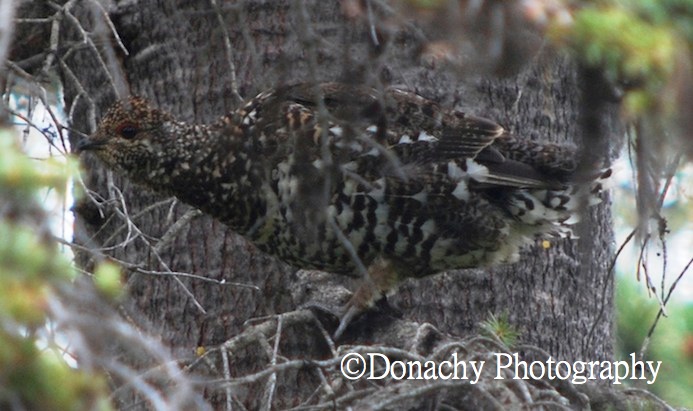
The walk in to remote waters is part of the adventure. On this particular hike, there were wildflowers, game tracks, berries, and a well-camouflaged covey of grouse perched in spruce trees.

Each summer, Maia, Barbra and I make it a point to meet up somewhere to fish, cook together, catch up with each other’s lives, and enjoy good wine and beer and stories. The fishing is secondary, but catching is definitely more fun than not catching. This is the kind of lake where you lose count of the fish turned, hooked or landed and settle into a gentle rhythm of casting, kicking and intense line watching, vigilant for the slightest twitch.

It is a beautiful and rare thing these days to fish a lake – no matter how remote – free from even a solitary scrap of litter. Such was the case on this lake. There was a hiking trail, and part of it traversed a log and board walk over a marshy area, but it was clear that those who know about this lake care about it. Save for a few mountain goats high up on a slope overlooking the lake, a pair of ospreys occasionally circling overhead and a small family of loons, we had the pristine water to ourselves.

On many remote (and not so remote) lakes, a size 8 or 10 bead head nymph dressed in olive, brown or black and jazzed up with something that sparkles is a killing pattern, and such was the case on this day. Lush beds of weeks were visible in the clear water. That’s where the insects were, and of course, the trout.

With a healthy population of trout and several size classes represented, we kept four smaller fish for dinner back at our campsite on a different lake. Evidence of a diet rich with scuds (freshwater shrimp), their flesh was as red as sockeye salmon flesh.

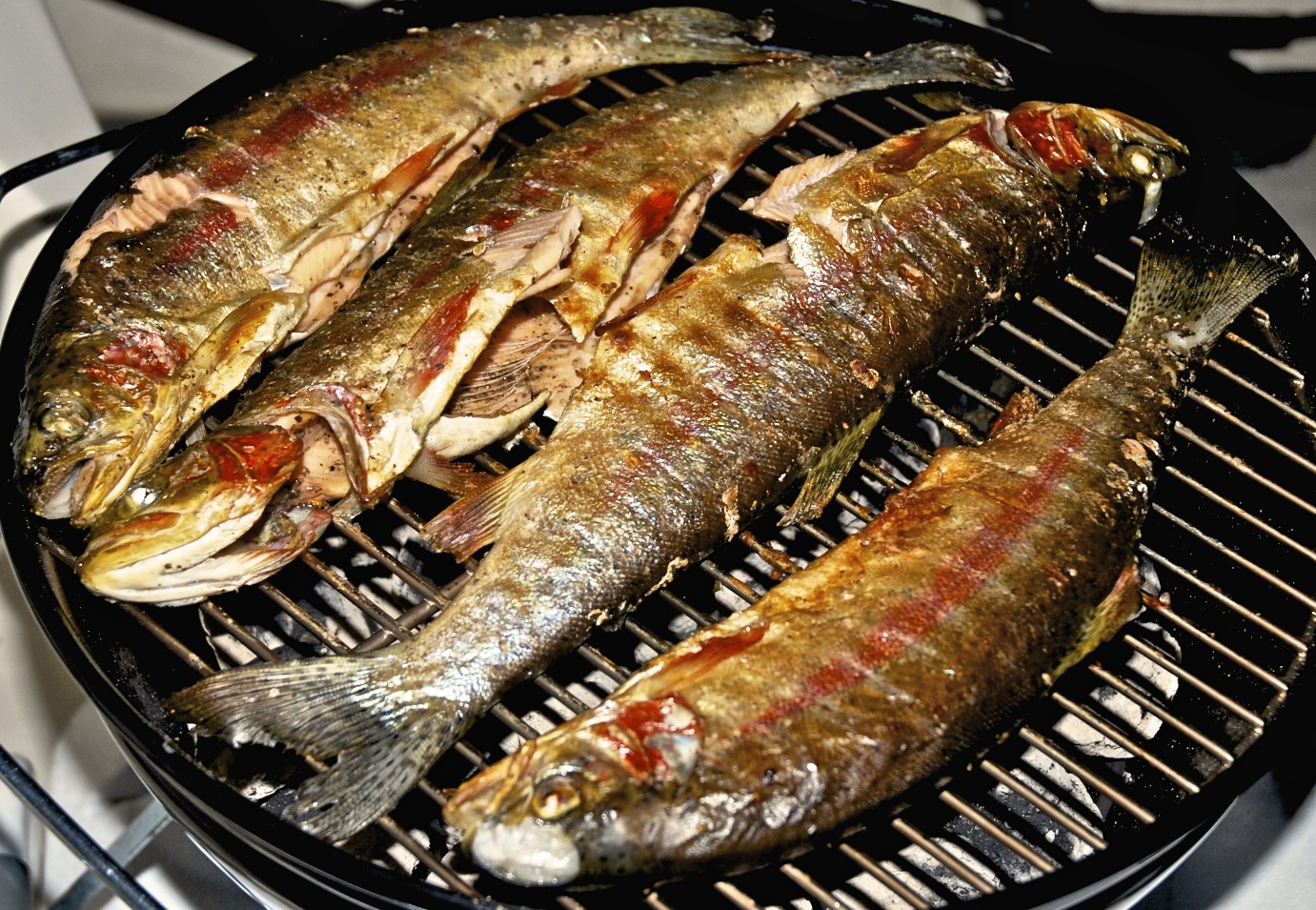
It’s difficult to improve on salt, ground pepper, and glowing charcoal when cooking just-caught fish. Accompanied with freshly picked sweet corn, roasted potatoes and a bottle of Chardonnay enjoyed around a campfire as the evening sky grew dark, our conversation was punctuated by an occasional pop from the fire and loons calling back and forth across the lake. 

C-Dory 22 Angler: A Boat for Alaska

The Gillie: Our 2008 C-Dory 22 Angler taking a cruise on the Sacramento River

“Gillie” is a Scottish term that refers to a fishing or hunting attendant, much like a guide. As such, armed with an excellent electronic fish-finding unit, a dependable 90 hp Honda engine (and an 8 hp kicker), and enough open deck to comfortably fish two or three anglers (four in a pinch), this boat has proved to be a reliable gillie. Barbra and I have spent many nights both on the water and on land snuggly tucked away in the cuddy cabin, and the dinette table in the pilot house is just big enough for the two of us to enjoy a meal. These boats are capable of storing an amazing amount of gear, the hull is tough, and on flat water loaded down with fishing gear and four medium-sized adults, it tops out around 25 knots (about 29 mph). Inside the pilot house with the Alaskan bulkhead door closed, making long runs is both warm and quiet. The 90 hp Honda trolls beautifully when we’re running rigs for salmon, and the shallow draft (well under two feet) allows us to get in the rocks in pursuit of species close to shore.

Ask a typical boat owner what the best boat is, and they’re likely to tell you, “The one I own right now.” That’s how we feel about our C-Dory. With a beam of only 7’9″, it’s a breeze to tow, yet it’s enough boat to feel safe on fairly big water–from the California coast to the ocean bays of Alaska. You’ve probably heard the quip that goes, “The two happiest days in a boater’s life are the day he buys the boat and the day he sells it.” Not with a C-Dory. The happiest days are the ones we have it on the water.