Vacancies at Chignik Lake’s New Nesting Boxes are Filling Fast: Tree Swallows have Arrived!

We knew that with Violet-greens having returned, Tree Swallows wouldn’t be far behind. This pair didn’t let much daylight burn before checking out a homesite. They may have used this same box last year. That’s the female perched on top of the box while the male, decked out in shimmering shades of blue, assesses the nesting quarters.

Just before leaving The Lake for our epic 65-day bicycle tour of Hokkaido last spring, we installed four new nesting boxes. We left just as the swallows were returning, but when we got back we were informed that our boxes had immediately attracted new tenants. So we’ve been keeping our eye on them, eager for the arrival of Violet-green and Tree Swallows this spring to see who might move in. Violet-greens first showed up on May 14 and headed straight for a set of older boxes at a neighbors’ house. But even with some 40 boxes in the village, we knew every available site would soon have a pair of nesting birds.

This morning when I stepped outside, I lifted my binoculars to scope out silhouettes on a power line near two of our boxes. Tree Swallows – the season’s first! With the early morning sun buried behind gray clouds, there wasn’t much light. But the office where I work on photos and writing has a view of one of our boxes, so I kept my eye on things. Within a couple of hours, new arrivals were checking out the two boxes closest to our home. And then the sun popped out, giving me an opportunity to make a couple of pictures of birds beginning to set up housekeeping at each box.

For awhile, several birds sallied back and forth around this box. Finally a female entered and stayed put for quite awhile. Here the male is checking up on her.

Interested in attracting your own mosquito-eating backyard friends? Check out our previous post on Violet-green swallows where you’ll find tips for putting up nesting boxes as well as the article below that for tips on placing your new boxes. Establishing nesting boxes is way more interesting (and way, way more ethical) than plugging in those nasty electric bug zappers. Click the links below!

Our Violet-greens are Back at The Lake!

New Homes Available! Swallow Nesting Boxes at Chignik Lake

Sandhill Cranes Foraging and Vocalizing – Alaska Peninsula

Barbra’s school year ended on May 1st. With a new home waiting for us in Newhalen, Alaska, we could have left Chignik Lake the following day. But bears are waking, buds are bursting and springtime’s migrant birds have begun to return, so we’ll remain at The Lake till late June. We’ve been loving our decision. In the past few days we’ve scored photo upgrades of several Chignik species including Northern Pintails, American Widgeons and Harlequins. We just missed adding photos of a skittish dark morph Rough-legged Hawk as well, but we got nice American Robin photos (the ones that pass through the Chigniks are considerably more wary than the suburban birds we’ve known) and…

…our first really good photos of Chignik’s Sandhill Cranes.

The more we photograph birds, the more we appreciate how difficult it can be to predict their behavior. Years ago, we had a photo op with a pair of Sandhill Cranes foraging on a lawn in Homer. While Barbra crept around the yard with our “fledgling” camera gear snapping photos, the cranes very casually walked off a few paces to let her know when she got too close. After that, Barbra tucked in and shot away. We left before the birds did. We weren’t birders in those days. The encounter was one of our first with cranes, and so we concluded that cranes must not be particularly wary.

Years later and multiple mind’s eye images of Sandhills that saw us long before we saw them gliding off toward the horizon on six or seven foot wingspans have prompted revisions of our earlier ideas about these magnificent birds. Cranes are hunted, and like most species that are hunted, they can be exceedingly wary. Unless the cranes have located themselves in a refuge of some sort, it seems that your best chance of getting close enough for a decent look at them is to a) stay quiet and b) don’t look like a human.

The other day while birding, we lucked out. Using a truck as a blind, we were able to observe a pair of foraging cranes for about 15 minutes – plenty of time to add quality photographs to our library and to make a short video which, happily, caught them vocalizing. The male in this video stands over four feet tall. From now till September, their brassy, ratchety calls will echo through the Chigniks, carrying as much as two-and-a-half miles. In addition to the full-throated vocalizations, listen for the little croak the male gives early in the video. And incidentally, the songbird in the background is one of our recently-returned Sooty Fox Sparrows. (The chirping is the modified sound of Jack’s camera shutter.)

Knee Deep in Trout and Char (somewhere in Hokkaido)

Iwana (Dolly Varden Char) are one of Hokkaido’s most celebrated cold-water fish.

I have an incurable habit of looking into water for fish. It doesn’t matter what kind of water. At the beach I check the translucent prisms of waves for whatever might be cruising the surf. Coming upon pools on rivers during hikes I make efforts to position myself so that I’m looking into shade rather than glare so that I can maybe catch a glimpse of something with fins. I’ll even check out coin fountains in the off chance that a carp or even a goldfish might be swimming around. But bridges on quiet country roads crossing pretty little trout streams are especially inviting. There’s almost always a pool below the bridge, and if the water has a population of trout, there are often a few of them hanging out right there. No matter how hard-fished the water might be, it’s worth a look.

Yamame could literally be translated as “Mountain Girl” – a lovely name for a lovely fish. More commonly the stream-dwelling form of this species is called “Cherry Trout.” Similar to Cutthroat and Rainbow Trout of the Pacific Northwest, (to which yamame are related), some go to sea where they attain sizes measured in pounds and return to their natal rivers to spawn bright as polished chrome – Cherry Salmon.

And so there we were, mid-afternoon, straddling our bikes and leaning over the the concrete side of a bridge on a quiet road running through a mix of forest and farmland somewhere in Hokkaido. The water was perfectly clear, but the trout and char are so adeptly camouflaged to match the stony bottoms of these streams that unless one moves they are all but impossible to pick out. 

One moved. As it rose to take something off the surface I could even see its spots. A char of some type. I hadn’t done any fishing yet in Hokkaido. This fish was telling me it was time I did.

I didn’t expect the fish to be large and they weren’t. But in the space of about two hours I covered a couple hundred yards of this silvery mountain stream and caught two dozen or so fish  About half of them were iwana. The others were yamame. A few came to a parachute Adams – my favorite dry fly searching pattern. A lot more came to a pheasant tail nymph – my favorite nymph. A couple of overly eager types tried to eat the pea-sized orange strike indicator I was using. 

A younger version of myself would have kept a few of these fish for the frying pan. But these days I fish for trout in part to simply confirm that they are present, and I wanted these fish to remain present. So Barbra took a couple of photos and I released everything to continue living out their lives in this silvery piece of water and light somewhere in Hokkaido.

There wasn’t a single human footprint along the banks, much less a path. Knee deep in a cold mountain stream full of trout and char – sitting on top of the world, legs hanging free.

New Homes Available! Swallow Nesting Boxes at Chignik Lake

Construction Complete! Lovely one-room summer homes with lake and mountain views available now! Perfect for rearing a brood of chicks.

Reading John J. Audubon’s accounts of his journeys throughout the United States in search of every species of bird for his paintings, I’m always charmed by his portraits of communities and their abundant bird nesting boxes.

“Almost every Country tavern has a Martin box on the upper part of its signboard;” he wrote of 1840’s America, “and I have observed that the handsomer the box, the better does the inn generally prove to be.”

The prevalence of hollow gourds fashioned with holes and used as nesting sites in Native American villages is also well documented. Apparently the symbiotic relationship between swallows and humans goes back a long time and cuts across cultures. Virtually everyone seems to love these harbingers of spring, their artistic mastery of the air, and the serious damage they do to mosquito populations and to other annoying insects.

And so it is here in Chignik Lake. Upon moving here we were struck by the numerous swallow nesting boxes situated on posts, nailed to utility poles and affixed to buildings throughout the village. Here we have mostly Tree Swallows along with occasional Violet-green Swallows. In the absence of invasive species such as House Sparrows and Starlings – which take over nesting boxes -, and with a lake featuring copious hatches of midges and other insects, this is a perfect place for swallows to rear a brood of chicks. Magpies can be a scourge, so it’s important that nesting boxes not feature any sort of perch to allow them to access the eggs and chicks, but other than our Merlins, there are essentially no other serious threats to the swallows of Chignik Lake.

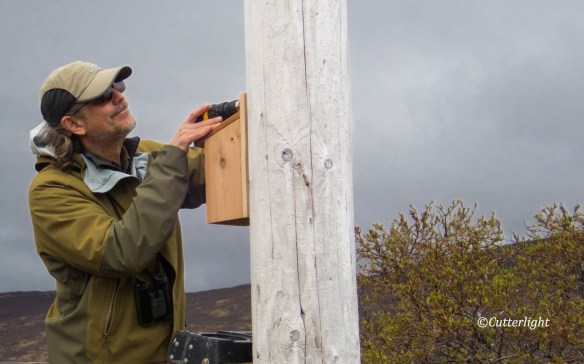
The major factor limiting the number of swallows Chignik Lake can accommodate is… accommodations. So this spring we did our part to help these birds out by putting up four new cedar nesting boxes. The first Tree Swallows showed up sometime around May 9, and the early birds have already begun choosing nesting sites. Our boxes may have gone up a bit late for this year’s birds, but after they’ve weathered for a year and the swallows have had an opportunity to check them out, we’re hopeful they’ll attract these welcome summer visitors in future years.

Location, location, location. High enough up, away from occupied buildings and busy roads, near a lake chock full of bugs, and a pesticide & herbicide-free environment. Heck, if we were Tree Swallows, we’d spend our summers here!

If you’d like to put up swallow nesting boxes in your area:

  • Place the boxes high enough off the ground to avoid predators
  • Although swallows like to feed and nest near water, position the boxes well back from the shore. Predators cruise shorelines.
  • Although swallows will at times happily nest in apartment-style boxes (a friend in Chignik Lake has a row of about a dozen boxes that fill up with residents every summer) it is generally recommended that for Tree Swallows and Violet-greens, boxes be placed at least 30 feet apart.
  • Do Not attach a roosting peg or ledge anywhere on the box. Swallows don’t need such a perch, but avian predators will use it to to prey on eggs and chicks.
  • Swallows prefer nesting boxes in open areas, at least 30 feet or so away from buildings. This is by no means a hard-and-fast rule, and don’t let a lack of open space prevent you from putting up nesting boxes. Boxes placed near shrubs and trees are likely to attract wrens, sparrows and other birds rather than swallows.
  • Do what you can to keep European Starlings and House Sparrows out of the boxes. These invasive species have had a negative impact on a number of native bird species. A hole diameter of 1⅛” – 1⅜” is said to be large enough for swallows but will keep starlings and sparrows out.
  • Keep cats indoors. This is a good general rule to protect wildlife, but is especially important if your aim is to attract birds. You don’t want to invite birds only to have them and their chicks fall prey to a pet.

Chignik Lake Bald Eagle

Waiting for Salmon, Chignik Lake, Alaska

May 1, Tuesday Morning, frost: Eagles are once again daily encounters as they take up familiar roosts and join the village in watching for salmon. A few fish have trickled in, but usually it’s June before the run really gets going. A couple of nice char have been caught. Catkins on the willows, leaf buds everywhere ready to burst. A small flock of Pine Grosbeaks was in the village yesterday, the males as brilliant pinkish-red as they’ll ever be.

A Chignik River Springtime Float

We began the float by paddling our Alpacka Gnu to the north shore of Chignik Lake opposite of Chignik Lake village, which looks as tiny as it actually is tucked up against the Chignik Mountains. Chignik means “big winds.” Not on the morning of April 14. (For a look at this same float in December, 2017, see: Early December in Paradise – a Float down the Chignik River.)

It was one of those days when we woke with no plans, and now the day was making a plan for us. The sun slid through a few thin clouds hovering above snowcapped mountains downriver to the east, casting a silvery light across the glassy lake. From our dining room window we could see fish rising, leaving little rings on the lake’s surface.

“We should do a float,” Barbra said. “It’s beautiful.”

“I’ll get breakfast going if you’ll start putting our gear together,” I replied.

Within an hour we were on the water, our inflatable canoe gliding down the lake to the narrows where the water quickens to become Chignik River. Magpies and chickadees called from the banks and as we slipped past the White Spruce Grove we could hear a cacophony rising from the 30 or so Pine Siskins that have spent the winter here. Salmon fry, fingerlings and parr dimpled the river surface all round us, occasionally leaping clear to add a shimmer of silver to the morning light. A kingfisher rattled as it flew overhead. With the shoreline suddenly teaming with small salmon and sticklebacks, our kingfishers will soon be back in numbers. Maybe this will be the year I find a nest.

Behind polarized sunglasses we let our eyes to adjust to the water’s clear-green depths, searching the cobblestone riverbed for the year’s first Sockeyes, a big Dolly Varden or a rare steelhead. No luck, but a neighbor has already found two ocean-bright salmon in his net, the year’s first. A million more are on their way, and with them eagles, harbor seals and bears.

With the wind down and as much time as we cared to take to float the two miles to the barge landing, we let the easy current do most of the work, dipping in our paddles mainly to keep a true course. Being the first boat on the water, we had a good chance to encounter any ducks or swans that might be around. And you never know: bears are just beginning to wake up, and the shores are frequently patrolled by foxes, otters and mink and less frequently by wolves, lynxes and wolverines. We spoke softly, scanned the banks, and listened.

Long before we came around a bend and saw them, we could hear Tundra Swans and mallards honking and quacking in one of their favorite stretches of water. There were just two swans, stately, regal, gracefully gliding along the shoreline to our left. The mallards were a bit of a surprise. There must’ve been 20 or more drakes and hens paired up, feeding on vegetation in the shallows, warily bursting into fight as our raft drifted close.

Further down the river, we came upon a pair of Barrow’s Goldeneyes, a rare species in the Chigniks. We sometimes get Common Goldeneyes in the dozens, but years go by between reports of Barrow’s. It’s possible that they might nest here if they can find the right sort of rocky crevice or opening in an abandoned structure of some sort.

On the North side of the river there’s a feeder stream we’d been talking about exploring. So when we came to it, we beached the raft, tied it down and began hiking. The stream is just eight to 15 feet wide on average and shallow enough in places to cross in Muck boots. But the water runs cold and fast and clear over clean rocks and gravel, pooling and eddying in ways that are attractive to salmon. Peering into a riffle, I noticed what appeared to be one long, continuous set of redds – salmon nests – before I thought to give the banks a closer look.
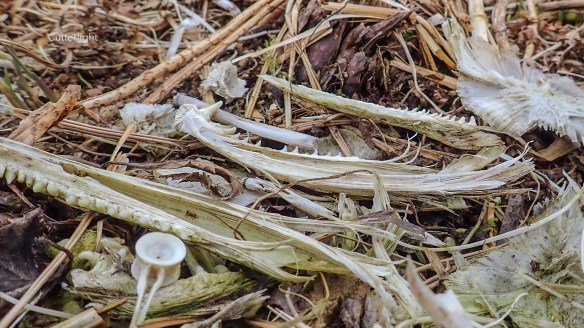
Above are the remains of a couple of salmon that became a brown bear banquet. Last fall, the Chignik system filled with the highest number of Pink and Silver Salmon anyone had seen in a long time. Fat autumn bears make for fat spring cubs. 

On both sides of the creek, the vegetation had been trampled down in broad swaths, a sure sign that bears heavily use this stream. Sure enough, when we looked down we found the area littered with the winter-bleached spines, gill plates, and tooth-filled jaws of Pink Salmon. We agreed that we’d have to make sure to fish the stream this fall when sea-run char marked in spectacular greens, reds and oranges would follow Pinks into the stream to pick off eggs that aren’t successfully buried in the redds. In places where stands of alder choked down foot traffic, the narrow trails had been worn inches deep into the soil, the work of centuries or perhaps millennia of brown bear comings and goings. Along the shoreline, every patch of sand held a carpet of fox tracks, some old, some fresh.

By the time we returned to our raft, the morning sun was high and temperatures had climbed into the 40s. Millions of tiny black midges were hatching, skittering across the water as they struggled to free themselves from the husks of their pupal stage – activity that was eliciting slashing rises from pinky-sized salmon as well as a few larger char. Mixed in with the midge hatch were a few dark stoneflies as well as big, creamy-brown caddisflies. With days warming and insects hatching, our swallows should be on their way.
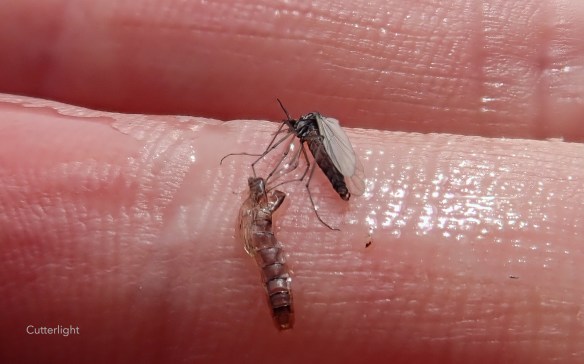
They’re small, but to some of our favorite fish and bird species (trout, char, salmon and swallows) they are indispensable food items. They’re midges, order Diptera from the Greek indicating that they use two wings to fly. During a hatch such as the one we found ourself in the midst of, midge pupae trap gas in their thorax, ascend to the water’s surface, shake off their pupal exoskeleton and emerge as winged adults – as this one on my ring finger has just done.

Drifting along the rocky bluff across from the salmon-counting weir that the Department of Fish & Game operates from June through September, we came across two large piles of sticks in the still leafless alders – active magpie nests, egg-shaped and roughly the size of a couple of basketballs. Our chickadees, too, seem to be establishing territory and selecting mates, and everywhere new green shoots are pushing up through winter-browned grass.
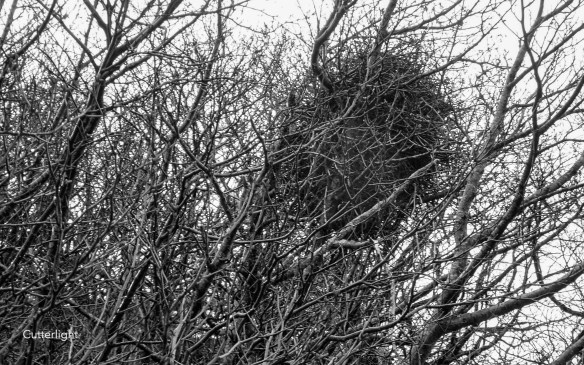
Chignik’s magpies began nesting about two weeks ago, giving away locations as they ferry large sticks into thick, brush growth along banks or into spruce trees. Somewhere in that jumble there very likely are half-a-dozen or so lightly speckled gray-green eggs. 

We beached the boat at the barge landing, deflated it, rolled it up, stuffed it in a backpack and began the three-mile hike home. Along the way we took note of bright green salmonberry shoots, the beginnings of wild irises, an unfamiliar warmth in the air. Earlier in the week it had snowed. But winter’s fighting a losing battle at this point. And every living thing knows it.
Wildlife Wednesday: Black-capped Chickadees!

barbra-feed-chickadee-dec-2016-n

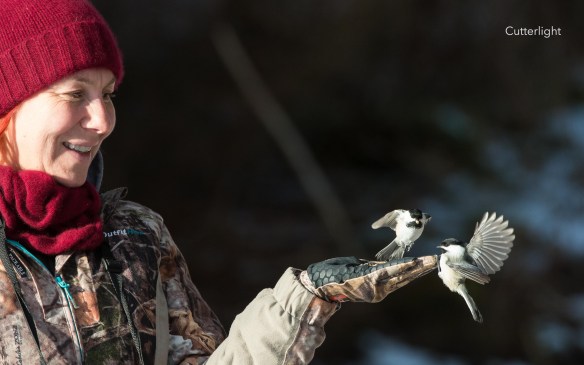
Gregarious, full of curiosity and brimming with personality, Black-capped Chickadees are often happy to take seeds right from a friendly hand. Weighing only about 10 grams (less than half an ounce) their little claws are nonetheless quite strong!

Many a hunter sitting quietly in a northern woods while waiting for a White-tailed Deer or Wild Turkey to come by has experienced a chickadee approaching ever nearer before boldly perching right on the rifle barrel – or even on the hunter’s arm or cap. Such an event feels like a stamp of imprimatur from Mother Nature herself.

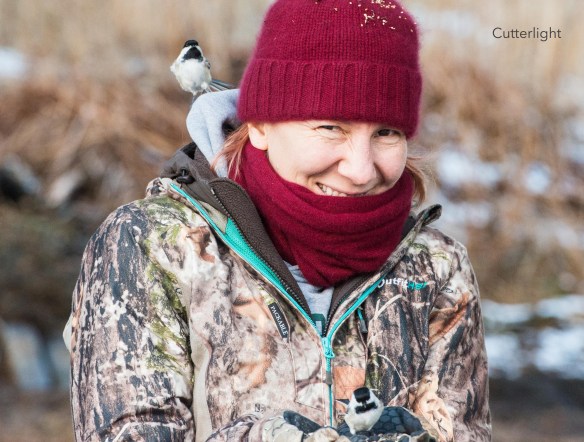
Last fall, when we hung bird feeders at the White Spruce Grove a little over half-a-mile from our home and began putting out seeds for Chignik Lake’s birds, within just a few days we noticed something uncanny. As soon as we hit the trail to the feeders, chickadees would descend upon us, fluttering and chattering with a familiarity that suggested that they somehow knew us. And each day as we came within view of the spruce trees themselves, a dozen or so chickadees would erupt in excited calls, flitting down from the boughs as though to greet us. There seemed to be no doubt that these little birds recognized us, Barbra in her red hat and scarf, me in my black watch cap, both of us in camouflage jackets. That sent us to the internet to do some research.

barbra-chickadee-shoulder-dec-2016-n

As it turns out, Black-capped chickadees are remarkably intelligent little beings, in possession of 13 different, complex vocalizations as well as memories that allow them to recall the precise location of food they’ve cached for up to several weeks. Regarding their vocalizations, not only do they warn each other with rapid dee-dee-dees, it has been shown that these calls vary according to the danger at hand, with their longest and most insistent alarms reserved for Pygmy Owls, a predator that poses an especial threat to chickadees.

Another, happier call among our local chickadees (it seemed to us) appeared to go something like, “Here come Jack and Barbra with more seeds!” While the various sparrows hung back demurely, deep in the cover of the spruce trees, the chickadees would land on our camera lens and flap around our heads.

“I once had a sparrow alight upon my shoulder for a moment, while I was hoeing in a village garden, and I felt that I was more distinguished by that circumstance than I should have been by any epaulet I could have worn.”
Henry David Thoreau in Walden

We wondered if we could get these bold, inquisitive birds to take seeds from our hands – and whether or not it would be ethical to do so.

chickadee-broke-bill-jan-2017-n

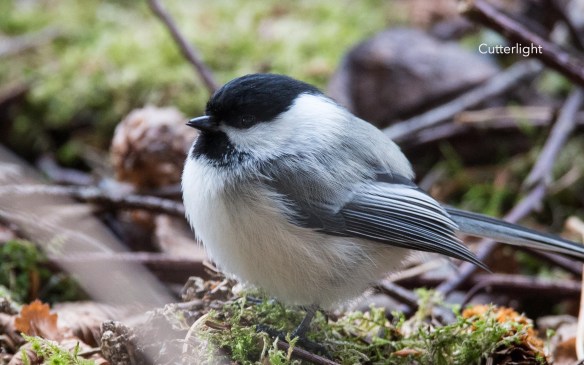
One of the advantages of feeding birds is that it provides opportunities to closely study individuals. Early last fall, we noticed that this chubby-looking fellow had broken off the tip of his upper beak. We wondered if this would adversely affect his ability to make it through the winter. Happily, it hasn’t. We still see him, and he still looks like he’s not missing any meals.

There’s no doubt that some wild animals should not be fed. Most North Americans are familiar with the cautionary proverb, A fed bear is a dead bear. That’s because bears that learn to associate humans with food become dangerous, destructive nuisances. But chickadees? After doing our due diligence in research and considering the welfare of the birds from a variety of perspectives, we felt comfortable taking our bird feeding to the next level.

Getting the birds to come to our hands proved to be fairly easy. One morning, we temporarily took down their favorite feeder, stood near the tree with outstretched arms and seeds in our hands… and waited. After a number of feints and false starts, one particularly brave bird took the plunge and was rewarded with a nice, fat sunflower seed. After that, it was one bird after another.

jack-chickadee-head-dec-2016-n

For the next few days, hand feeding our feathered friends was the highlight of the day. During those few days, we learned quite a lot. In addition to their many and varied vocalizations, Black-capped Chickadees establish pecking order by silent bill-gaping – an aggressive, open-mouthed gesture that is enough to cow a rival bird into waiting its turn or leaving the immediate feeding area altogether. There also seemed to be quite a range of distinctive personalities, with some birds readily and repeatedly feeding from our hands – and remaining long enough to carefully sort through the offerings for the choicest seeds -, while other birds hung back or landed only briefly.

The National Audubon Society encourages people to feed wild birds. Habitat is shrinking, and with that loss food sources can be scarce. Place your feeders in areas where birds have easy, quick access to the safety of shrubbery and trees, keep cats indoors, and to prevent the spread of disease among birds, occasionally clean the feeders. Once you start, keep the feeders full so that birds that have come to expect a food source aren’t suddenly left high and dry during inclement weather. But be warned: you might discover that the view out your window becomes more interesting than whatever’s on TV!

Wildlife Wednesday: The Short, Happy Life of Chippy the Long-Tailed Weasel*

weasel-skull-02-2017-n

Alas, poor Chippy. I knew him, Barbra; a fellow of infinite jest; of most excellent fancy…

I was probably about 12 when I read Jean Craighead George’s My Side of the Mountain. In this book, which surely ranks as among the greatest adventure stories for young people ever written, the 15-year-old protagonist, Sam, leaves his parents’ confining New York City apartment and strikes out for his great grandfather’s abandoned farm in the Catskills. There, he takes up residence in a hollow Hemlock Tree, catches trout, raises a Peregrin Falcon and…

Finds a weasel in a box trap he’d set in hopes of catching animals for sustenance. Sam allows the weasel to come and go as it pleases. The weasel hangs around and Sam bestows on it the name Barron for its bold, confident demeanor. How cool. wanted a weasel like that.

Imagine my thrill when, shortly after moving into our place here in Chignik Lake, one of these spry little fellows practically ran across my foot as he darted past me and dashed under the steps of our Arctic entrance as I opened our front door. The steps, while inside the foyer, are open and the foyer itself sits atop earth. It is a haven for voles, shrews and, of course, weasels. Chippy (I named him or her almost immediately) spun around, sat up and looked at me through the steps. What a handsome, self-assured creature with those large eyes, round ears, pink nose and whiskered face, dapper in a brown coat and white underbelly. In truth, I only saw Chippy a couple of times after that, and only for the briefest of moments each time. Nonetheless…

We had a weasel living with us.

But winter came, and neither of us had seen Chippy for quite some time. Occasionally in the early morning after a fresh snowfall, we’d see weasel tracks and although they could have belonged to any number of weasels (there is no shortage of them here in the village), we liked to imagine they were Chippy’s, evidence of happy nights spent chasing voles and other small creatures.

Meanwhile, the area beneath the owl trees has become a veritable boneyard. Magpie feathers, skulls and wishbones litter the ground along with smaller avian skulls, vole-sized pellets of mashed together bone, teeth and fur, jawbones of small mammals and…

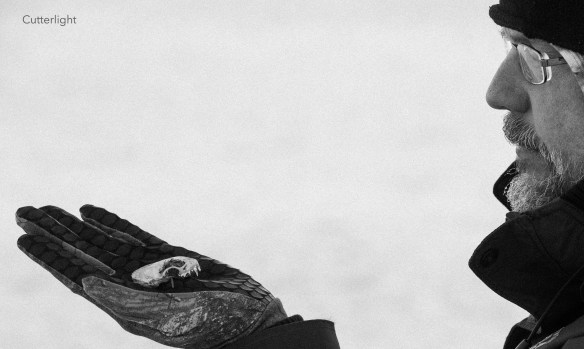
The skull of a weasel. We’re very happy that our resident Great Horned Owls are making it through this unusually cold winter, but… Chippy, we hardly knew ye.

Short-tailed Weasel, Mustela erminea (Photo Credit: Steve Hillebrand, USFWS on Wikipedia)
Also known as Stoats and Ermine, Long-tailed Weasels are related to otters, mink, martens and wolverines. Although they’re only about 10 inches long (25 cm) from nose to tail tip, like their biological cousins, they are fierce predators, sometimes preying on much larger animals. In winter, their fur becomes snow white except for the tip of their tail which remains black. Six years is a long life for a Short-tailed Weasel.

*It is unlikely that the skull we found beneath the White Spruce Grove is actually Chippy’s – or that this is the only weasel Chignik Lake’s Great Horned Owls have dined on.

Fans of Shakespeare will recognize this passage from Hamlet’s musing on mortality as he holds in his hand the exhumed skull of a favorite court jester, Yorick.

This is the first article for Wildlife Wednesday, a new column on Cutterlight. Stay tuned (or sign up) for weekly articles on birds, mammals, insects, wildflowers and more.

Ink and Light: “Amber Eyes” with a quote by Sir David Attenborough

amber-eyes-11-16-2012-n

Amber Eyes: Arctic Fox, Point Hope, Alaska

The thick, soft fur of the Arctic Fox is the most efficiently warm of any land mammal.

It seems to me that the natural world is the greatest source of excitement; the greatest source of visual beauty; the greatest source of intellectual interest. It is the greatest source of so much in life that makes life worth living.
David Attenborough – BBC Life documentary series, 2009

Knighted in 1985, Sir David Attenborough turned 90 in 2016. The world’s most recognized narrator of natural history films, he remains in possession of amazing vitality.

First Snow, Chignik Lake

September 18: First snow in the mountains.

September 21: First frost along the lake.