Ghost Trees and Ghost Birds: Video and a Poem

At some point during my youth in western Pennsylvania, I read about a magnificent bird – the ivory bill woodpecker, the Lord God Bird. I wanted badly to see one and I knew that my dad – a naturalist – would know where to look. “They’re gone,” he said. I looked at him quizzically. “They’re extinct. They need big, old forests, and the big, old forests have all been cut down.” My dad was right. You should know that going into this film – a feature-length documentary that is powerful and sad and very much worth seeing.

.

Ghosts of Trees, Ghosts of Birds

People imagine they see them still,

ivory bills,

in remnant stands of virgin forests

too small to sustain these great birds.

In that way God Lord Birds are everywhere –

an image in burnt toast, a shadow pulling itself

into a triangular head,

a flash of red

as the late sun slants through the canopy,

or a fractured rock on a hillside gathering the feathered light

and darkness like a black and white diamond on a water oak trunk.

Ghosts of trees, ghosts of birds

Their nesting holes,

five inches across, 50 feet up –

hewn into hardwood with bone-chisel bill –

gone, too,

vanished with the ancient forests

into the humid air

above the endless spread of soy bean fields

Ghosts of trees, ghosts of birds

And so we pause

in the late morning

and set our paddles across the canoe’s gunwales

amidst the cypress knees, black gum and snags

as the mist lifts from this swamp

far enough away from all that

that it could be

the last place on earth

these birds exist

and strain our ears

and listen for double knocks

that rose and died 60 years ago.
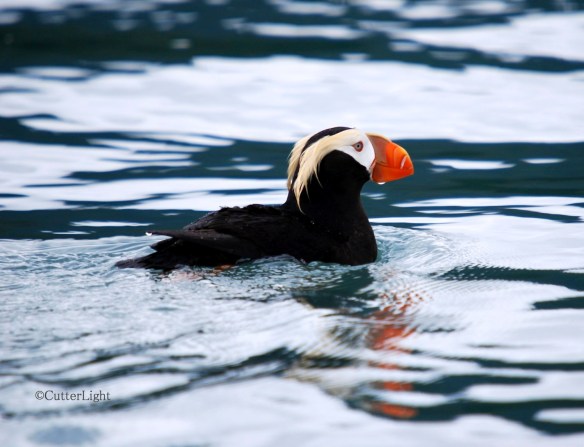
Tufted Puffins, a Name Change and Best Wishes for 2013

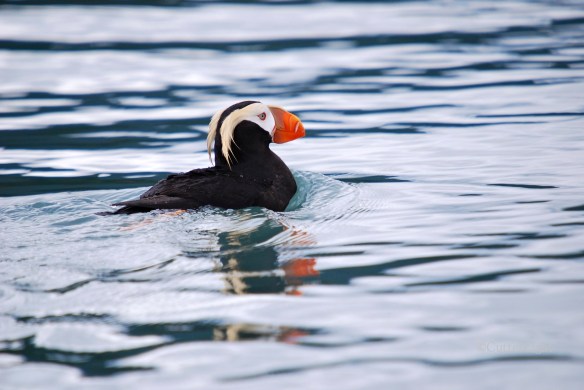
Tufted puffin near Homer I_nUnmistakable with their toucan-like bright orange beaks and combed back white tufts of head feathers, tufted puffins (Fratercula cirrhata) are among Alaska’s most familiar ambassadors.

When we began this blog a little over two years ago, it was for ourselves. The blog was to be a place to catalogue our recipes and keep a photographic record of our travels and adventures. And so we named it Frozen Moments and didn’t think too much about it. It seemed an appropriate name for a blog where photographs are highlighted (frozen moments) and especially so since our home nine months of the year is in Arctic Alaska (frozen months).

Tufted puffin near Homer II_nBut as we got more into it, we discovered that Frozen Moments was a little too obvious. Others were already using the name. We realized we’d eventually want to make a change. CutterLight has its origins in two sources. Cutter derives from our summer home in Seward – our cutter-rigged sailboat. To us, the term evokes images not just of sailing, but of travel and adventure in general, as well as a spirit of being willing to learn and experience new things.

Tufted puffin near Homer III_nLight, too, holds multiple meanings for us. There is of course the “light” which all photographers are concerned with. As our skills and interest in photography grow, we are finding that we are becoming, inevitably perhaps, obsessed with light. It permeates our world now in ways it never did before, and this newfound awareness affects everything from the way we watch movies to how we perceive the world around us to how we deal with the deceptively elusive basic elements of photography.

Tufted puffin near Homer IV_nBut Light holds a second meaning – one which is perhaps even more central to our lives. As we move forward toward fulfilling our goals as writers, photographers and sailors, we have pared away much of what we once considered necessary. Not much fits on a 35-foot sailboat. A succession of yard sales and donations to thrift shops allowed us to part with most of our possessions before we moved to Alaska three years ago. Since then, every new item we add to our lives is carefully evaluated for the value it brings in terms of utility and pleasure. Few items make the cut. We are moving forward with a life that feels lighter yet stronger. It is a wonderful feeling.

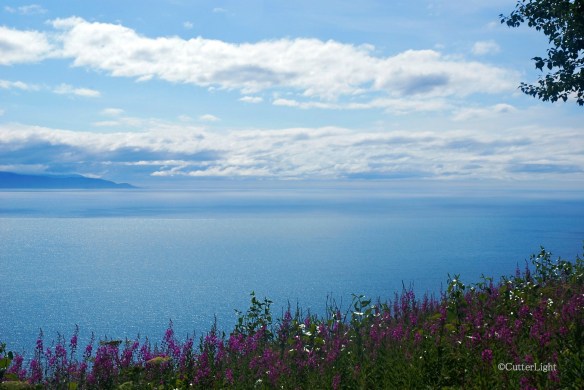
Lower Cook Inlet near Homer_nLooking out over lower Cook Inlet from the bluffs above Homer, Alaska.

As we look back on 2012, it is with a deep sense of appreciation. Many new friends came into our lives this year, and we also were fortunate to have had some really special reconnections with people from our former lives. We are happy, too, that our blog is finding an appreciative audience. We wish one and all fair winds and following seas in the coming year.

Jack and Barbra Donachy

30,000 Seabirds

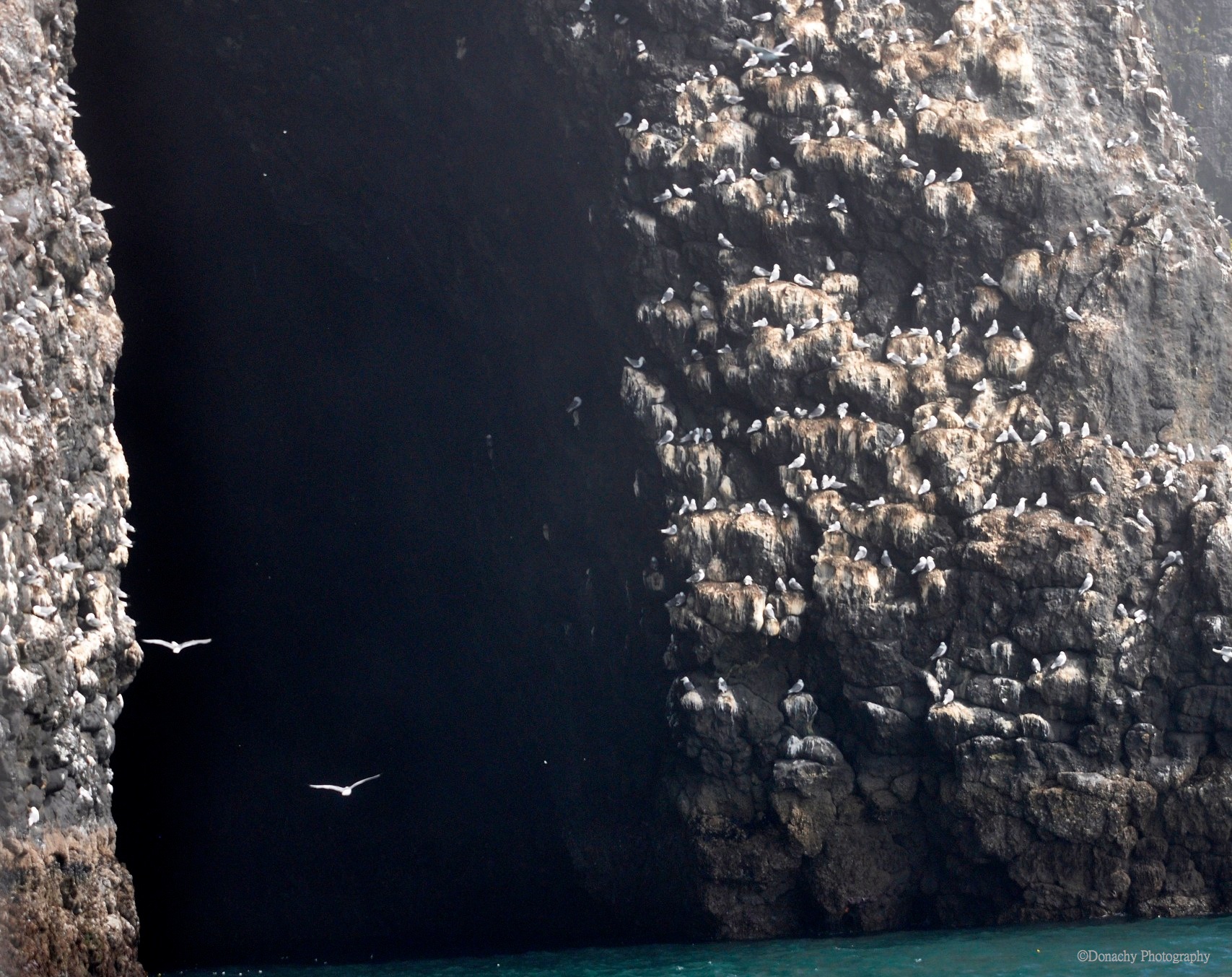
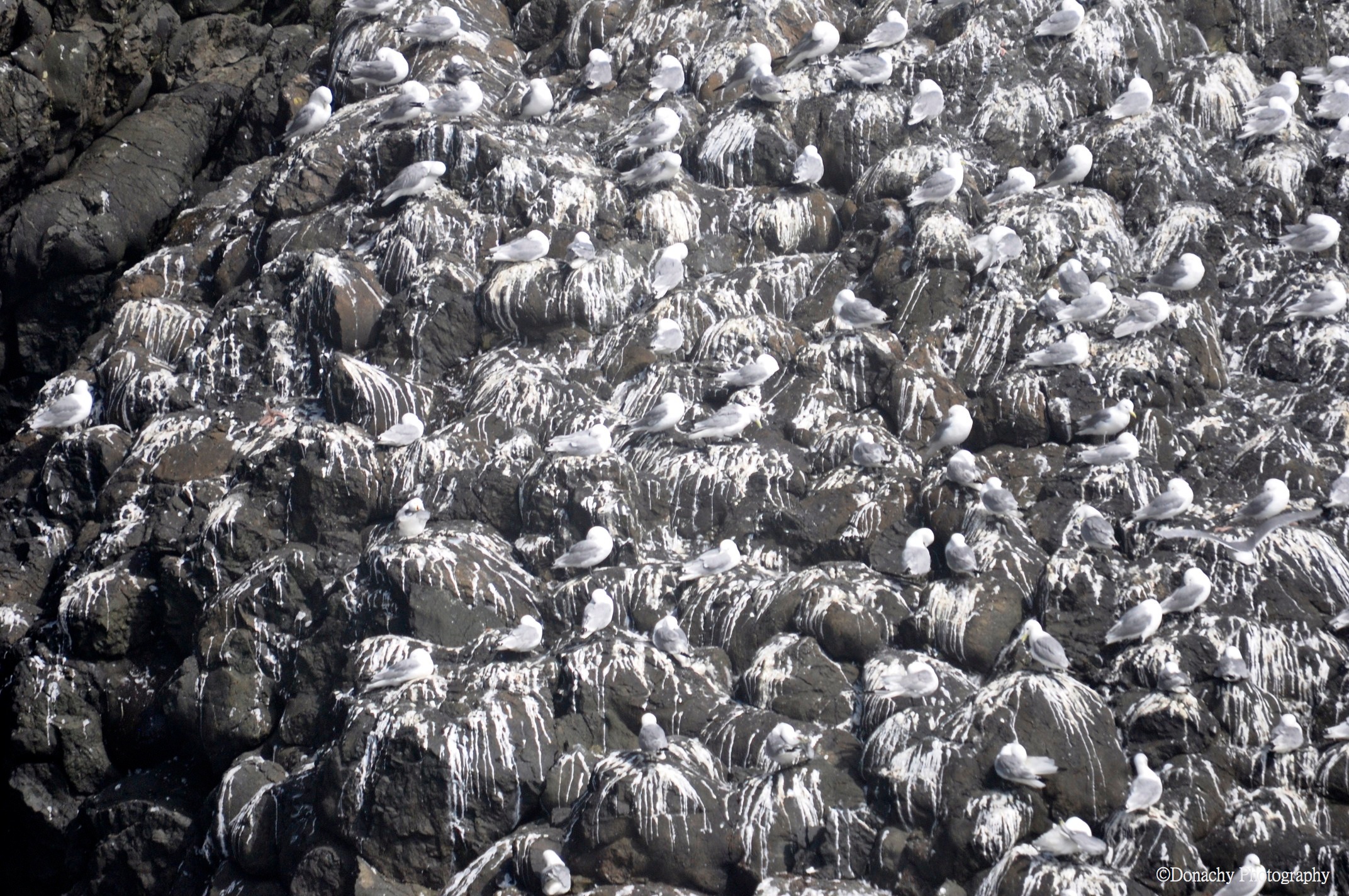
At any given moment, there are as many as 30,000 seabirds roosting, nesting, flying and feeding at Cape Resurrection near Seward, Alaska. While kittiwakes and common murres are the two most abundant species, tufted and horned puffins, murrelets, guillemots, auklets, oyster catchers, cormorants, various gulls and other seabirds are also in the mix. Above and below: black-legged kittiwakes in the thousands take advantage of every available ledge.

The noise (and smell) generated by these colonies is as startling as the sheer number of birds. 

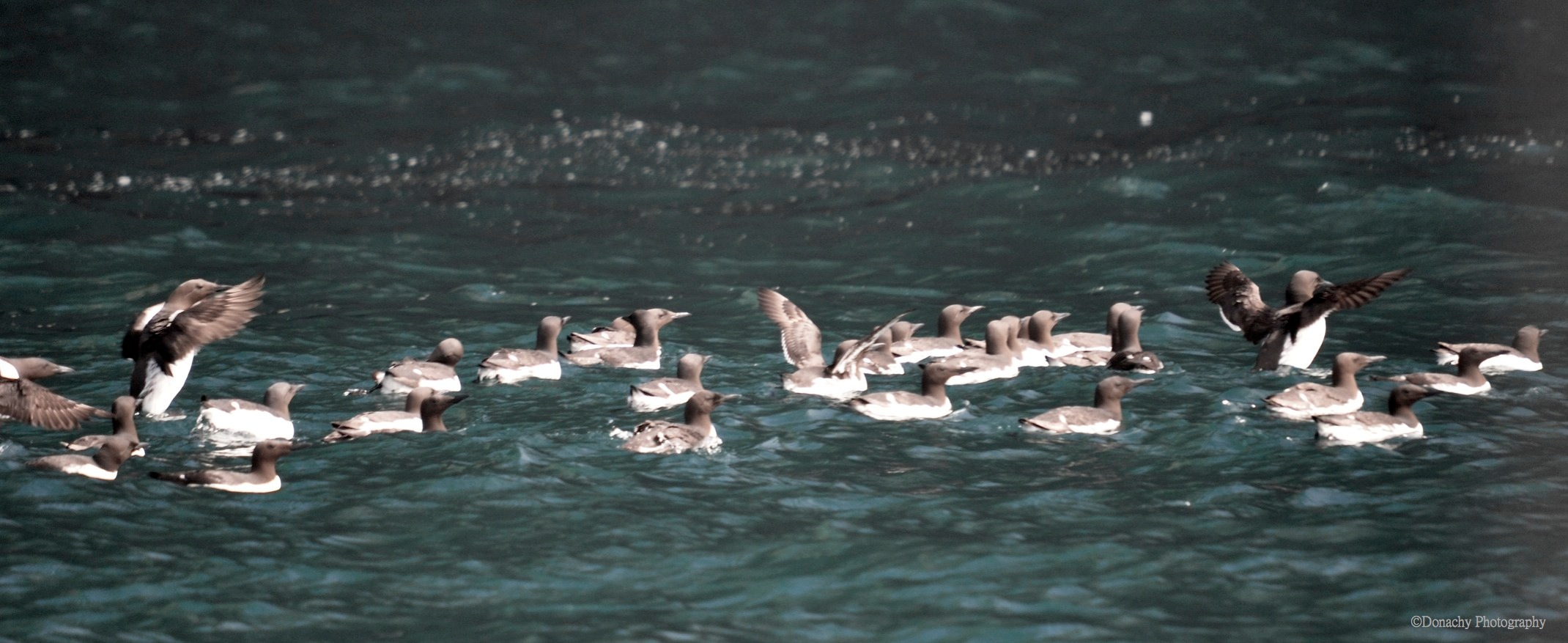
The cape also hosts large rafts of common murres containing dozens or even hundreds of birds.  

Horned puffins (above) and tufted puffins are also quite common. They use their thick, uniquely-hinged bills not only to fish, but to dig nesting burrows up to several feet deep. Once the nesting season is over, puffins spend the rest of the year at sea.

In flight, puffins look like large bumblebees, beating the air into submission with their stubby wings. In search of the small fish they feed on, puffins can dive up to 80 or more feet deep and are agile swimmers. 

On land, with their white bellies and dark backs, murres look a lot like penguins, and like penguins, they are very much at home in water. Murres have been recorded diving to depths of  600 feet. Their eggs are various shades of blue with brown speckles and are steeply pointed at one end to prevent them from rolling off the cliffs where they nest. 

Eagle in Fog, Fishing

The fog was so dense we were apprehensive about even being out on the water. Besides, the fishing was slow. We’d just come through a large group of Orcas, (see Orcas Near Resurrection Bay )and, surmising that they were feeding on salmon, we figured the fish had to be there. But after an hour or so of drifting and not catching…

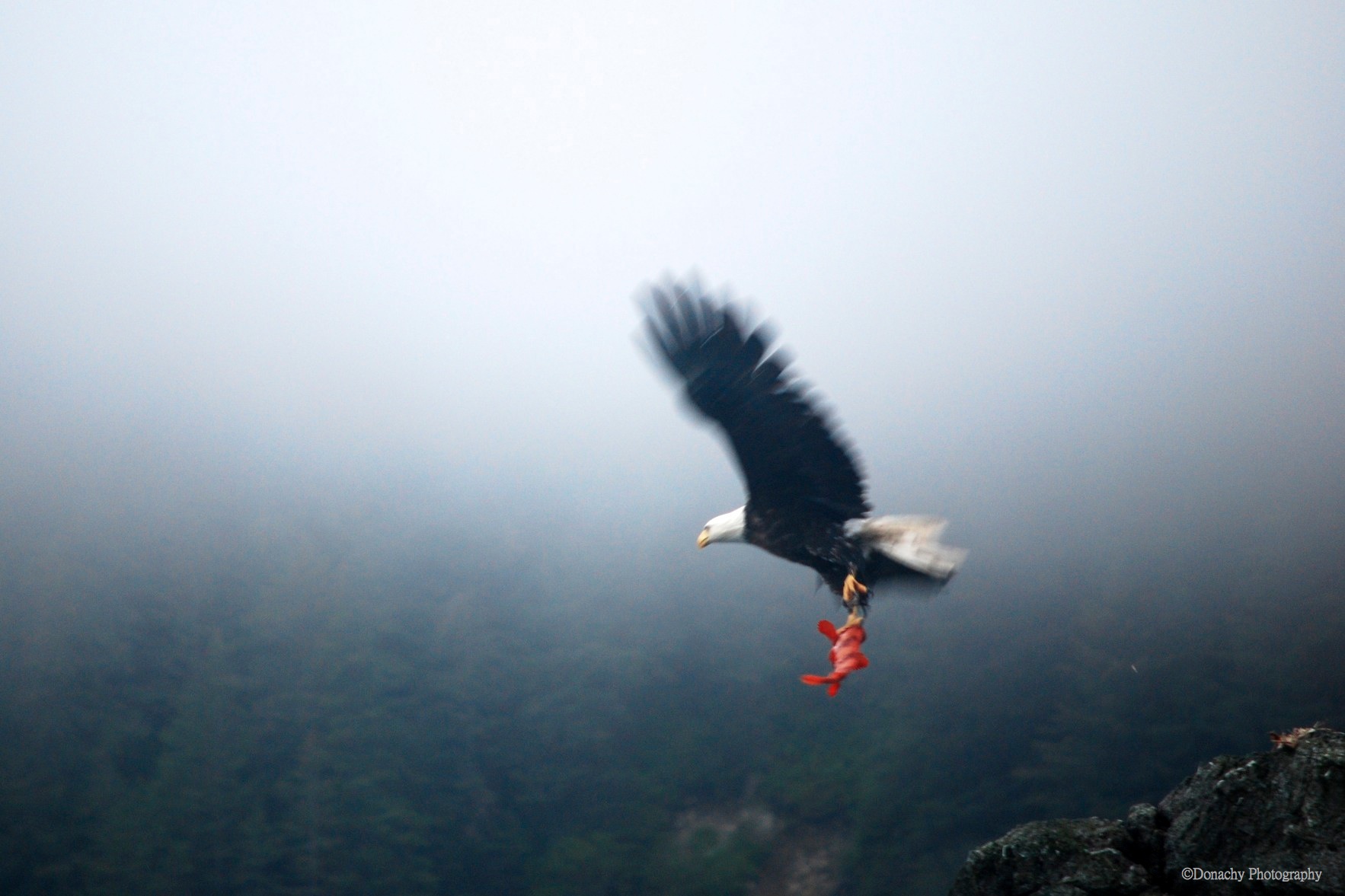
We decided to take a break from mooching for salmon and drop jigs to the bottom for rockfish. Barbra didn’t waste any time putting a fat five-pound black rockfish in the cooler, but that turned out to be the extent of our success. A brilliantly marked orange and black tiger rockfish hit my metal jig. The fish was small and we had been fishing shallow enough that I thought it would survive a release, so I let it go.

The tiger darted for the bottom, but a few moments later appeared on the surface several feet from our boat. That’s when an eagle that had been watching us lifted from its rocky perch and swooped in. You can tell from the photo above that he’s done this before; notice the tell-tale bones of another rockfish.

Savannah Sparrow

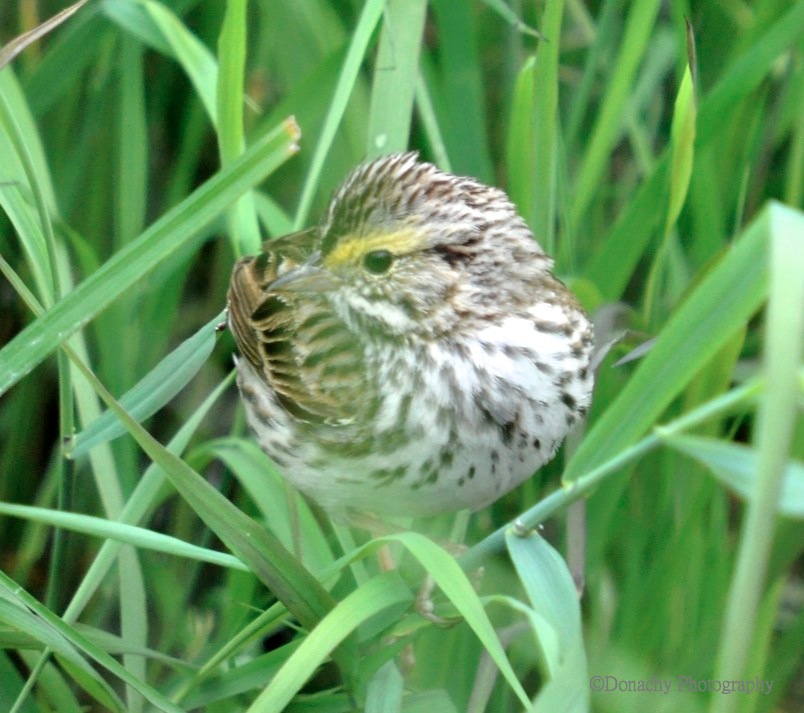
Savannah sparrows (Passerculus sandwichensis) are common and widely distributed in North America. The distinctive yellow lores (eye stripe) is the best way to distinguish savannah’s from other sparrows with streaked plumage.

All across North America – including all over Alaska – savannah sparrows are a common sight in open fields and marshes and in low brushy areas. Mainly seed eaters most of the year, they include insects in their diet as well, particularly during the breeding season. Their song has been described as “insect like,” and although it has a buzz to it, the description doesn’t really do it justice. Listen for the notes of the savannah’s high, buzzy song next time you’re in an open area. They can be hard to spot in the low brush and ground cover they call home, but when flushed, they usually fly just a short distance and may perch to take a look around. About five to six inches from beak to tail, savannah’s nest on or near the ground, laying  four to six blue-green eggs speckled with dark brown in cup shaped nests. The sexes are similar.

Incidentally, the species name sandwichensis comes from Sandwich Bay in Unalaska, Alaska. This photos was taken at Potter Marsh, near Anchorage.

Sandhill Cranes with Chick: Potter Marsh, Alaska

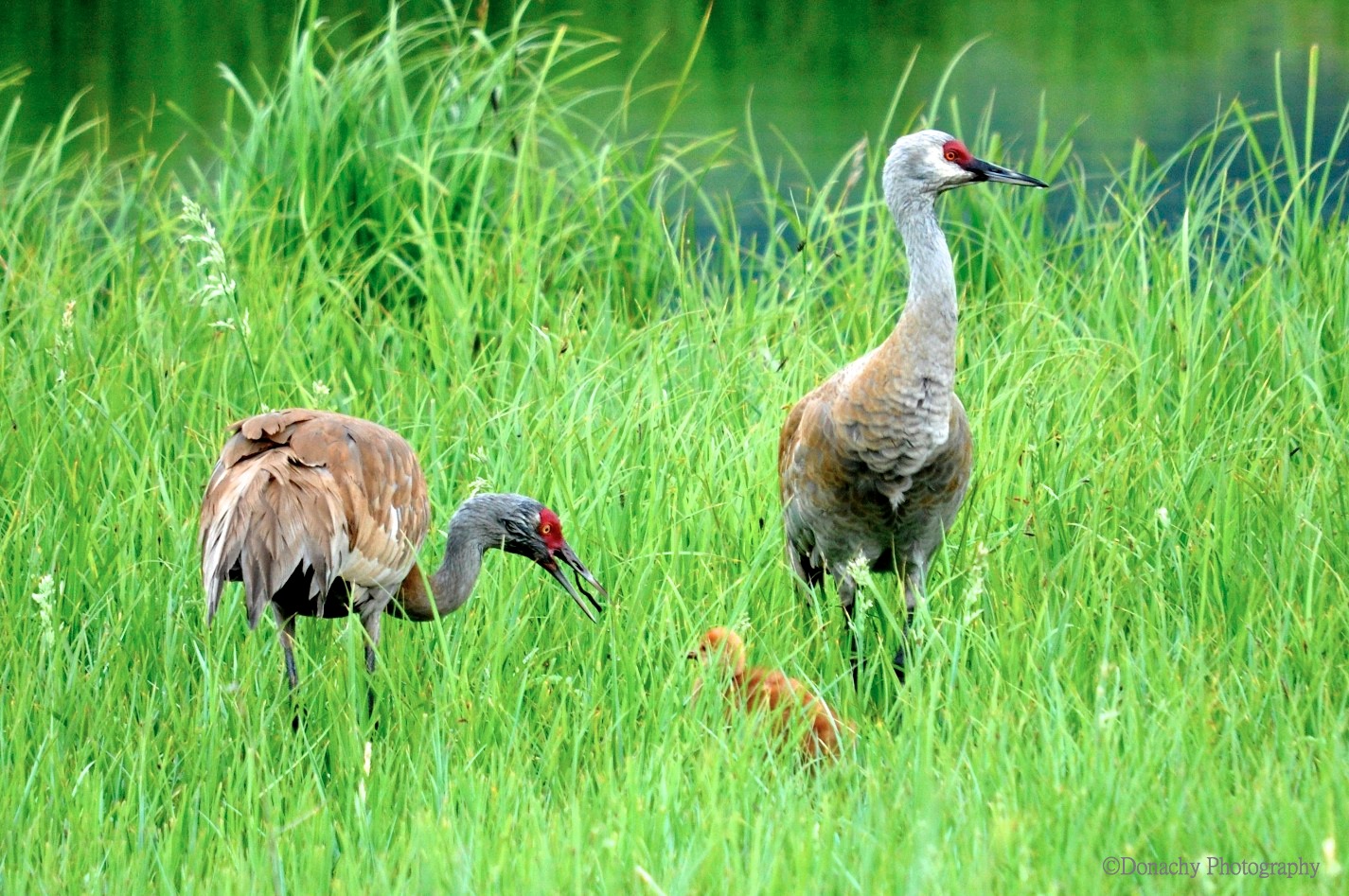
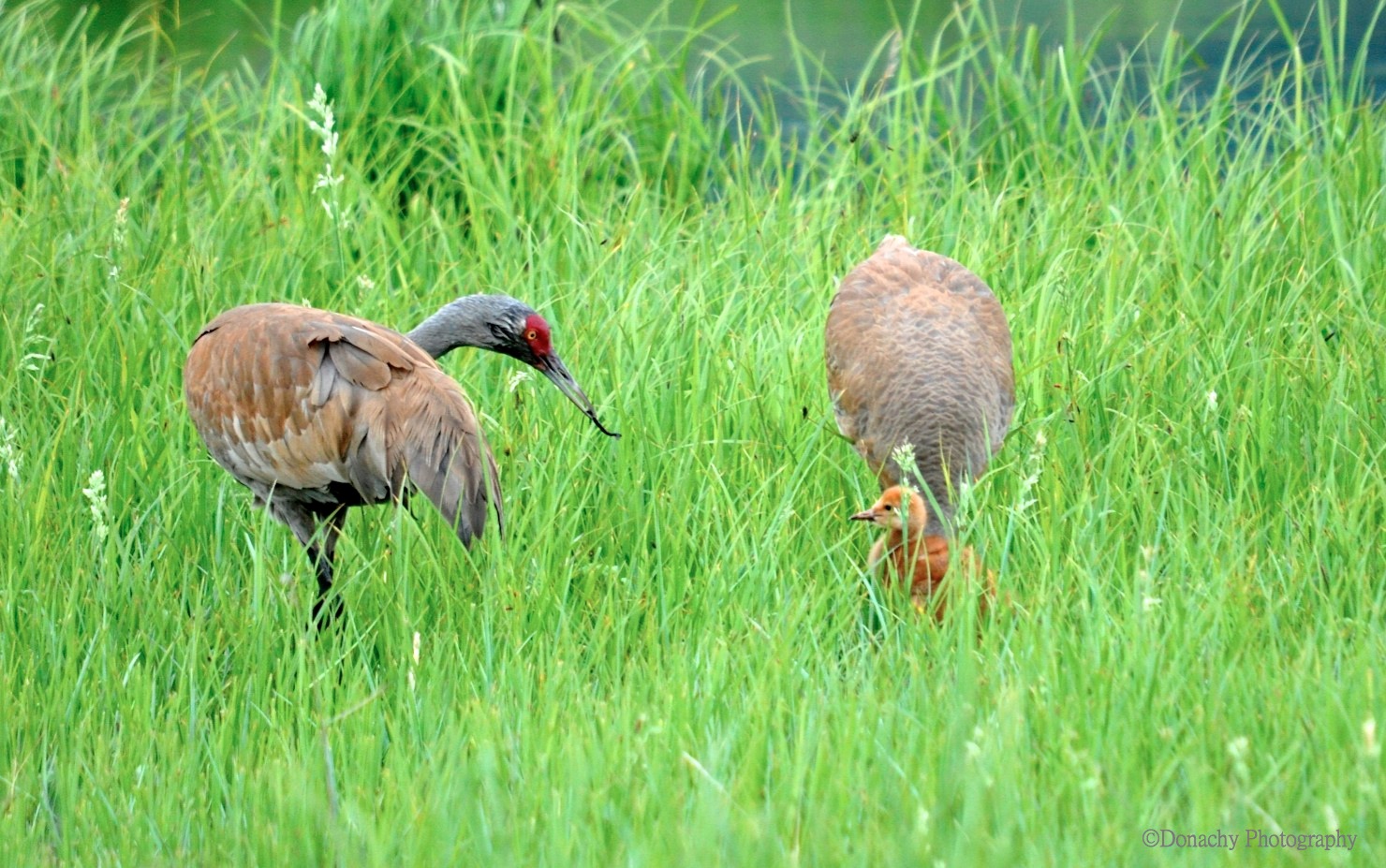
Driving to Anchorage from Seward recently, we spotted these sandhill cranes at Potter Marsh and decided to park the truck and walk out onto the boardwalk for a closer look.

Large birds are cool, and in North America, there aren’t many birds larger than Grus canadensis, sandhill cranes. Adults typically weight 8 to 10 pounds. The stand four to five feet tall and have wingspans of five-and-a-half feet to nearly seven feet. Sandhills are fairly common in the west, and in a few places can be viewed by the hundreds or even thousands. More frequently, they are seen here and there in pairs, in small groups, or as individuals.

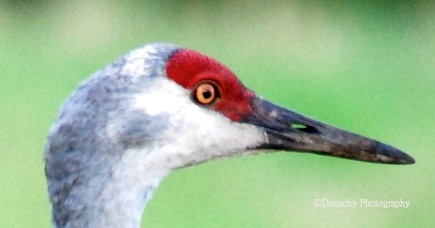
The sexes are similar. Plumage ranges from drab gray to rusty brown. Aside from size, the most distinguishing characteristic is the red crown. (Click the photos for a larger view.)

We couldn’t quite make out what the adult bird is feeding the chick. Cranes are catholic in diet. Berries and seeds make up a large portion of their diet, but insects and other small animals figure in as well.

This chick will stay with its parents for 10 months or so – until just before next year’s breeding season when the parents will lay one to three eggs. Sandhills have a life expectancy of about seven years in the wild, but may live up to three times that long. Several subspecies occur throughout the U.S. and across the Pacific to Siberia. Accidentals have been reported in Europe.

Violet-green Swallow

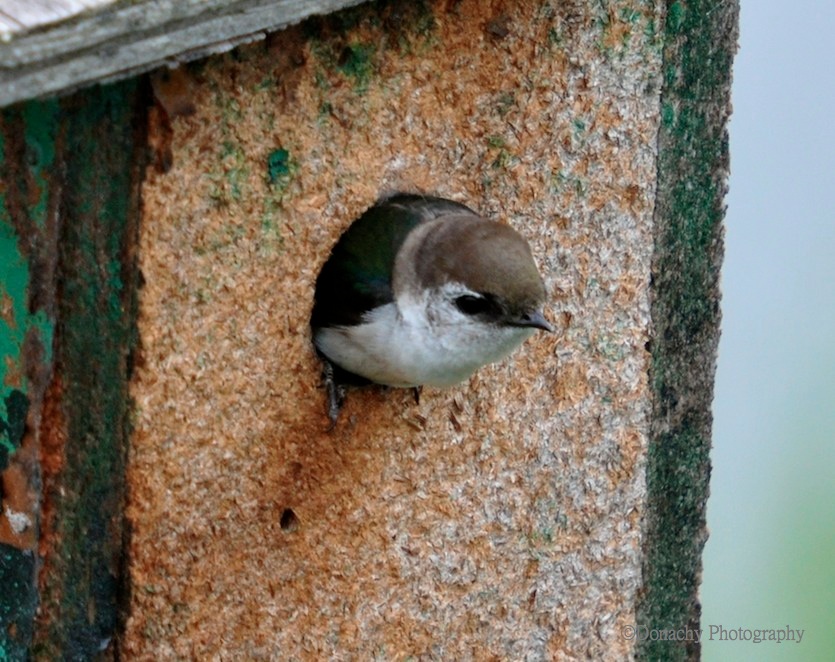
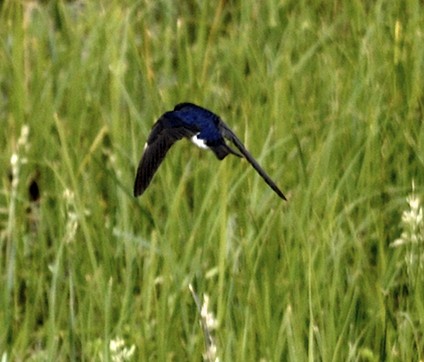
Violet-green swallows (Tachycineta thalassina) are common throughout the western U.S., Canada and Alaska. In flight, look for the distinctive white on the sides of the rump. When they perch, look for white cheeks with white extending above the eye to distinguish them from tree swallows (Tachycineta bicolor).

Depending on the light, violet-greens’ backs can appear to range in color from teal to metallic green to purple. This is the male, above.

Females’ colors, above, tend be a bit more muted than males. 

Look for violet-greens in open areas and semi-open areas where they feed on insects. They can be attracted to nesting boxes.


Orange-crowned Warbler, Potter Marsh near Anchorage

Oranged-crowned warblers (Vermivora celata) are fairly common, but it’s rare to get a good look at these tiny, active birds. Even less common is finding an individual with an identifiably orange crown. 

Color is often the first thing we go to when attempting to differentiate among like species. The perplexing thing is that color is often misleading.

The orange-crowned warbler’s orange crown is seldom visible. What birders typically see is a small, greenish-yellow-brown bird flitting through alders and willows. A warbler. But which warbler?

If you don’t see an orange crown, another tell is the complete absences of barring on the wings.

Orange-crowned warblers feed on insects, worms, nectar and berries. They’re ground nesters. What a thrill it would be to find a nest, tucked away beneath low-growing willows. When summer ends in Canada and Alaska and the Western United States, orange-crowns migrate to the southern U.S. and Central America.

We were lucky to catch this guy preening on an open branch at the edge of Potter Marsh, on the southern edge of Anchorage, Alaska. He stayed long enough for several photos. Before flitting off into the underbrush, he gave us one final view of his seldom-seen orange crown.

Morning Song

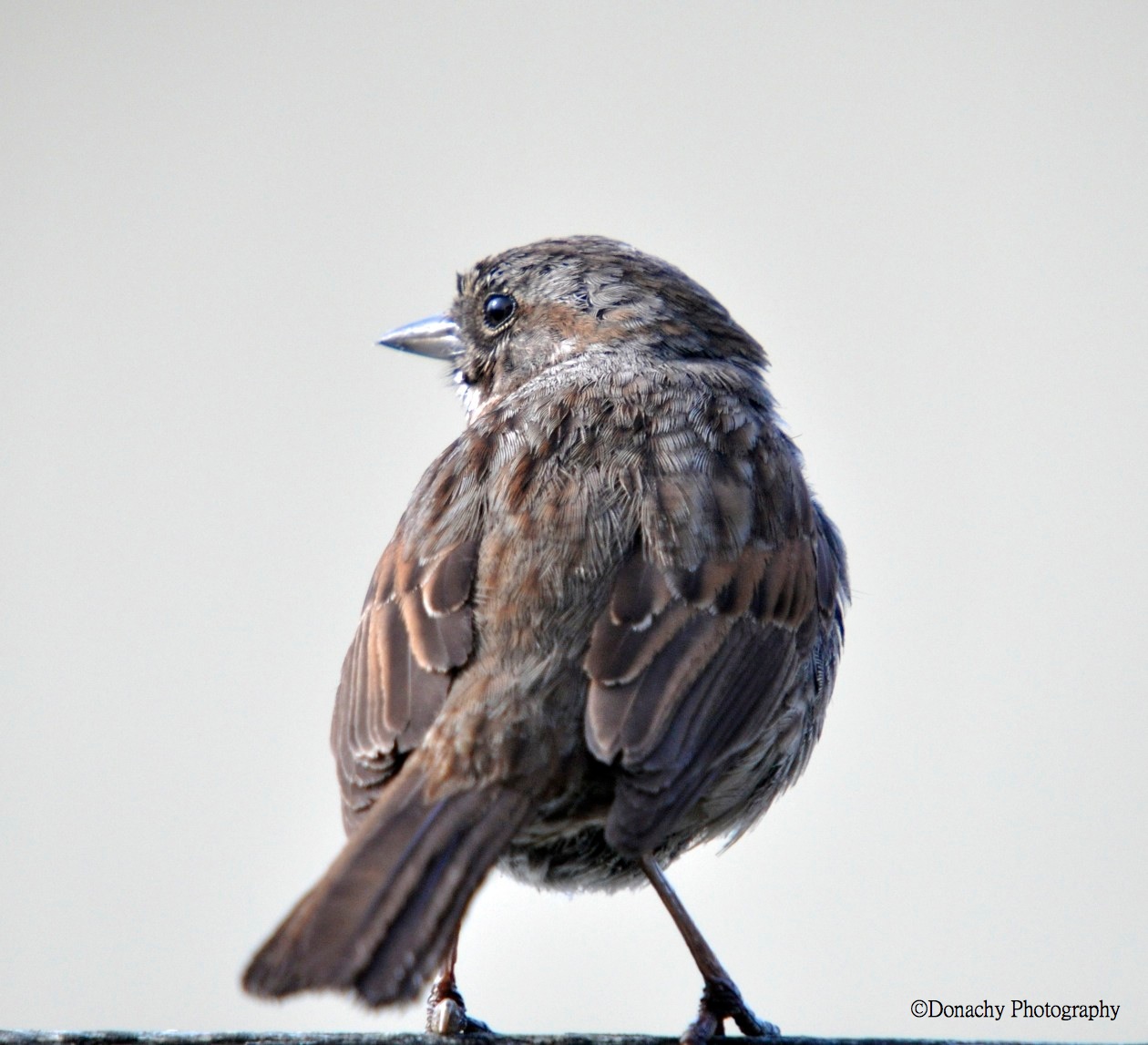
This little guy, a fox sparrow (Passerella iliaca) has been bringing in our days every morning here in Seward with the loveliest song. Day by day, he’s grown a bit tamer. Today he was gracious enough to allow us to get these photos. 

“LBB’s,” my undergraduate ornithology teacher called them. Little brown birds. You see one, and even if you get a really good look at it, when you go to Peterson’s or some other bird guide, what you see quickly becomes a blur of what you think you saw mixed in with a handful of similar-looking birds. But the songs are compelling and unique, and so you keep going back and forth from binoculars to field guides, and if you do this often enough over enough years, distinct species begin to take form.

Here he is, singing his heart out. No doubt some avian version of something clear and strong about being in the right time and place, eager and ready. We humans hear that in birdsong, and it lifts us. 

There are four subspecies of fox sparrows, each geographically unique, except when they overlap. Which they do. And when they do, the birds interbreed. More LBB’s. More scrutiny through binoculars. More head scratching over pictures in bird books.

When I approached too close, he went for a familiar place: the ground. Fox sparrows love underbrush and are often heard rustling through leaves or glimpsed flitting from one low willow to another. 

We’re lucky. We who live in North America. These migratory passerines breed up here. Which means they sing. In the places they head to during the winter, they don’t breed, and they typically don’t sing.

Before he flew off, he perched atop a wooden sign and gave a backward glance. The early morning sky was gray. I returned to the camper to make a blueberry pancake and fry some bacon while Barbra cut a grapefruit in half and made us big mugs of coffee.

Sandhill Cranes: Up Close and Personal

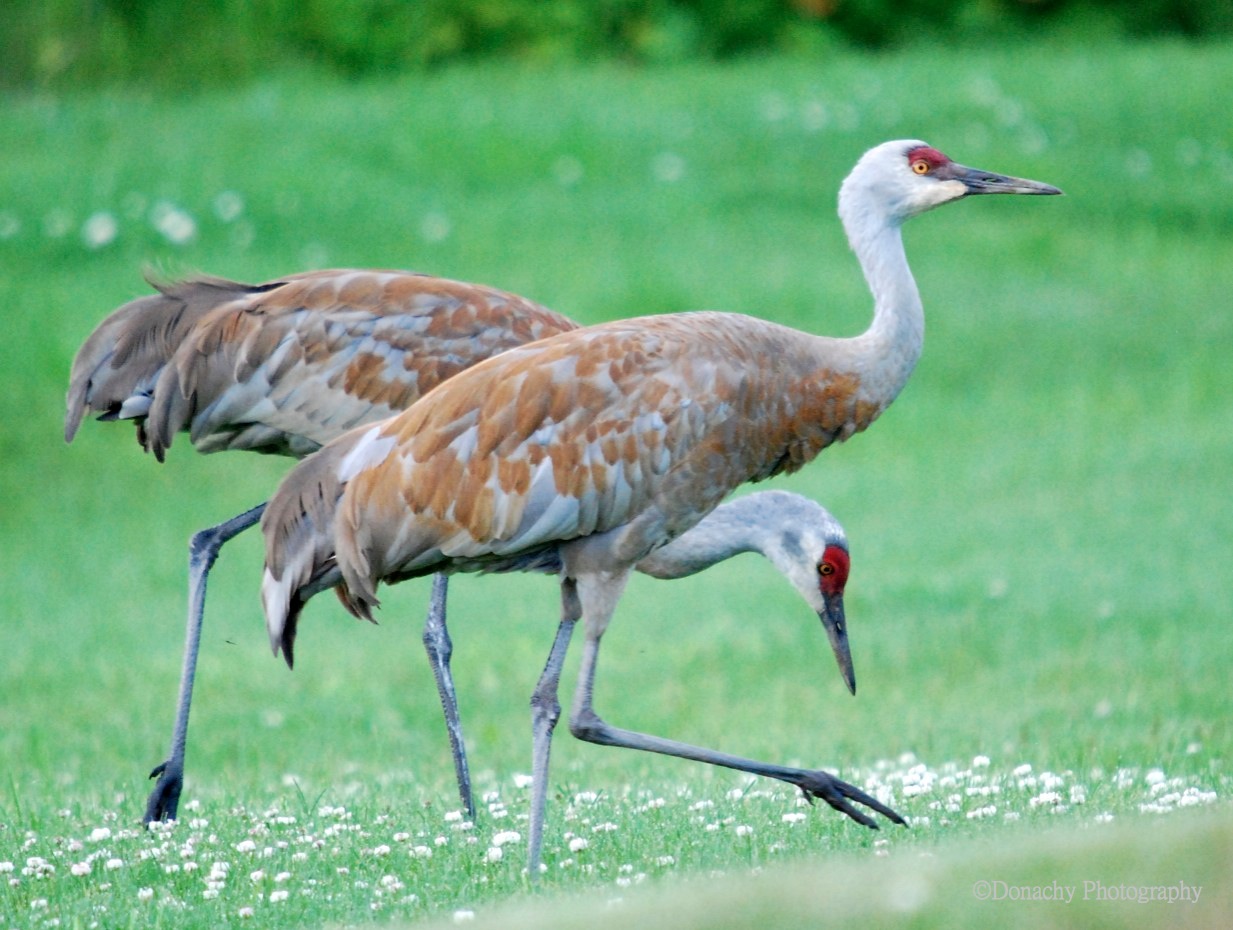
Driving into Homer, Alaska one summer we encountered this beautiful pair of gray and rust colored sandhill cranes (Grus canadensis) foraging on an expansive lawn. Cranes are opportunists, and although they are mainly herbivores seeking grains and seeds, they supplement their diet with insects, small mammals and other animals they encounter.

Bird weights can be deceptive due to their hollow bones. Even though adults have wingspans of six to seven feet (1.8 to 2.1 meters) and stand four to five feet tall (1 to 1.2 meters), they typically weigh less than 10 pounds (4 kilograms).

Since cranes are hunted in Alaska and can be quite wary, we felt lucky to find a pair that wasn’t too skittish. 

Other times we’d seen cranes, they were flying overhead, or, as was the case one summer in Yellowstone, far out on a plain. 

We stalked them for awhile, snapping photos, gauging our distance without spooking them into flight, and then we left the couple to continue their hunting. 

Of course, this being Alaska, when we looked up from the field where we’d been intently watching the cranes, this is what we saw – the Kachemak Glacier, which flows out of the Harding Icefield.