The Hike to Clarks River: An Alaska-Sized Landscape on the Remote Southwest Peninsula

Like a vast infinity pool, Chignik Lake pulls in the mountains and sky and seems to go on forever. 

We woke before dawn to clear skies, still air and frost. With noon temperatures projected to reach a nearly summer-like high of 50° F, it was the perfect day for the three-mile hike from Chignik Lake up to Clarks River. By the time we downed hot bowls of steel cut oats and slabs of energy-rich, thick-cut bacon, the sun had cleared the snow-capped mountaintops across the lake from our house. Outside the air was still brisk from the nighttime freeze, but American Robins, Golden-crowned Sparrows, Sooty Fox Sparrows, Pine Grosbeaks and Redpolls were already filling the sleepy village with song. We didn’t know it yet, but Violet-green Swallows would arrive later in the day to add to the chorus.
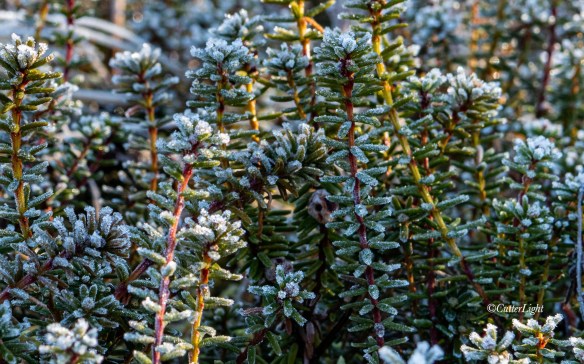
By the time we hit the trail, soft sunlight was beginning to brush the frost off crowberry plants and other vegetation.

Skim ice covered puddles and everything about the morning felt crisp and full of promise. Savannah Sparrows sang from brushy perches. Somewhere down by the lake a Sandhill Crane trumpeted in brassy notes. On a morning like this, there was no telling what we might see. I tapped the bear spray in my coat pocket. We stopped often to listen and to glass patches of open tundra and hillsides.
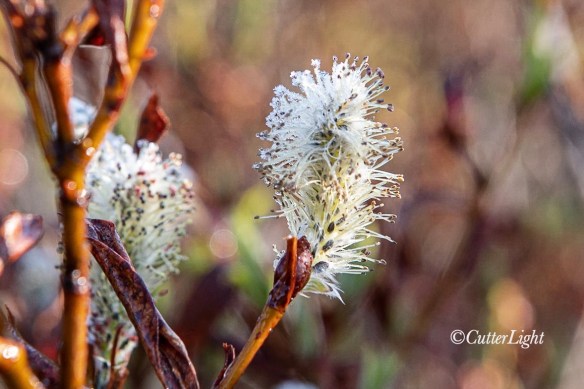
Most of the catkins were finished. In places bathed in light during these 18-hour spring days willows were leafed out in brilliant green.

As we approached Lower Pond, a pair of Black-capped Chickadees emerged from a tangle of still bare alders to look us over. A crane soared low over the path and landed somewhere out of sight. Fresh avalanche runs tongued the steep Chignik Mountain slopes, still buried in snow. When we hit the Blueberry Bog, a snipe exploded from an edge that often seems to have one of these wary, secretive birds. Mindful of not bothering a possible nest, we kept moving.

Barbra hikes into a landscape traversed by fewer than 100 living people. Clarks River lies straight ahead. The lake is to the right. 

As we hiked we noted that Fireweed shoots were at the perfect stage for picking. We’d brought along a small bag to gather some on the way back to add to the evening’s teriyaki salmon stir-fry.
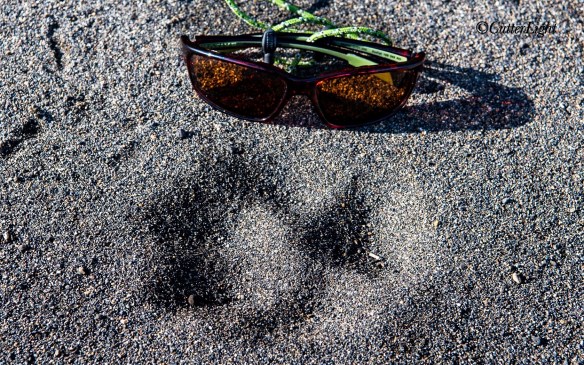
Wildlife tracks ran all along the beach, their number and variety increasing the closer we got to the river. Seldom seen, wolves are always around, as this track attests.

One for the books, this is the largest Brown Bear track we’ve ever come across. With males routinely topping 1,000 pounds and sometimes exceeding a standing height of 9 feet, Chignik’s bears are among the world’s largest, rivaling those of Kodiak Island in size. An abundance of salmon makes for a healthy bear population – and a healthy ecosystem in general. Barbra’s sunglasses measure 5¾ inches from temple to temple.

In addition to lots of fox tracks, two sets of wolf tracks and several sets of bear tracks, it was evident that a troupe of River Otters had recently been through the area. Though it was mostly quiet under the mid-morning sun, a Red-throated Grebe rested out on the lake, and along the far shore we could just make out Scaup, a Red-breasted Merganser and a few Common Goldeneyes. Savannah Sparrows sang and flitted from bush to bush and as we approached the mouth of Clarks, a yellowlegs or perhaps a Wandering Tattler took off up the river.

The remains of a feast, this bleached piece of Red Salmon jaw was a reminder of last fall when the banks of Clarks were trampled down into a bear highway and the shores and shallows were carpeted with spawned-out Sockeyes and Silvers.

We paused to let our eyes search a pool below a beaver dam in a small tributary before Clarks, recalling a fall when we’d seen it stacked with maybe a thousand Coho Salmon. The beavers, like those salmon, are long gone. Tiny salmon fry and parr darted through the pool in tight schools, the parr occasionally rising to take a midge off the water’s surface. Around the pool’s edge, the first light pink salmonberry blossoms were opening.
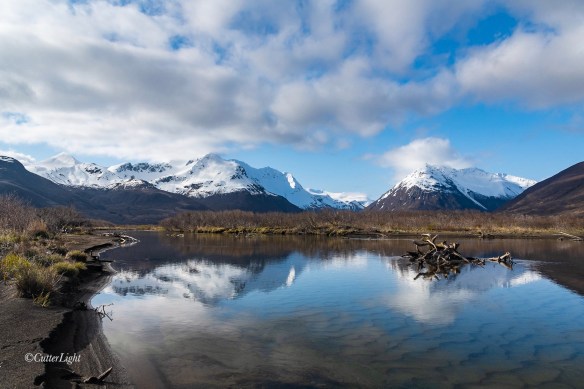
Clarks River forks just before it debauches into the lake. This is the lower, quieter piece of water. In late summer and fall, tens of thousands of salmon ascend this cold, snow-fed river.

We found a warm spot in the sun on the sandy beach, made a makeshift picnic blanket of my coat amidst otter tracks, and had lunch. Magpies chattered from a distance as we scarfed down trail mix and reminisced about the fine fly-fishing we’d had at the mouth of this river for bright Silvers. You never stop scanning for bears when you’re out here, and of course there are the wolves. The salmon will return soon, new birds are steadily filling the landscape and there’s the prospect of getting that gargantuan Brown Bear in the view finder of one of our cameras – so many incentives to get out into this country to look around.

Singing His Heart Out: A Pleasant Morning at White Spruce Grove

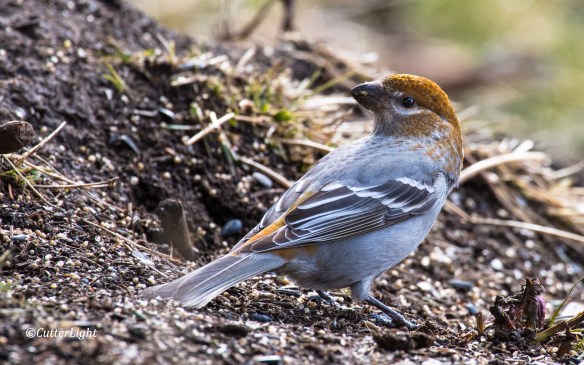
Resplendent! This male Pine Grosbeak came down from a tree crown to forage beneath one of the feeders at White Spruce Grove.

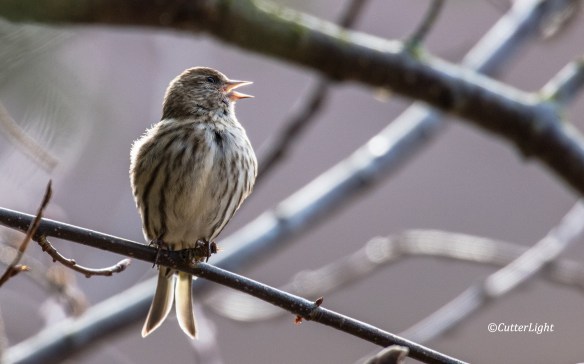
When we stepped out the door yesterday morning, the first thing we noticed was a new song in the air. A spring song. Returning Fox Sparrows have been the first to begin this each year we’ve been in Chignik Lake, but the warbling melody didn’t sound like a Fox Sparrow’s riff. We could see the bird, a plump silhouette atop a spruce tree near the church and since we were on the way to the White Spruce Grove to top off bird feeders anyway, the obvious choice of walking path was the one that would bring us nearer to the singer.

The female grosbeak briefly joined her mate.

Pine Grosbeak, brilliant red and singing for all he was worth. Quite a change from the brief but distinctive Peek Peek! we hear from this species throughout fall and winter. It wasn’t a new bird, but it was new behavior. We continued on the half-mile to the spruce grove with anticipation.

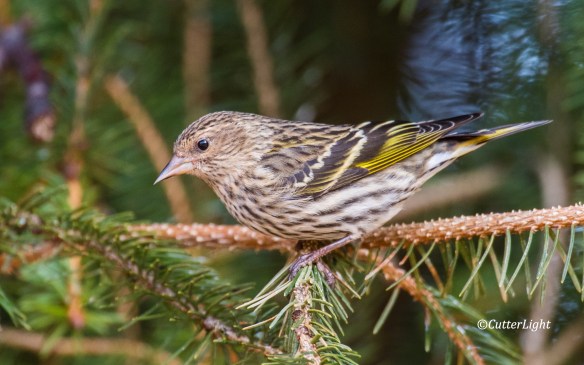
Our Pine Siskins were their usual raucous selves, singing, squabbling, gorging on seeds, darting from tree to tree.

Along the way scattered flocks of Pine Siskins buzzed and called from the sky and from a neighbors’ house where they sometimes take refuge in a few spruce trees while visiting the feeder there. Magpies, common here at The Lake, made their presence known, as did a woodpecker, almost certainly a Downy though we couldn’t find it. Further along a pair of Black-capped Chickadees gave a couple of their various calls from willows, the branches of the scrubby trees suddenly having turned bright yellow-green and beginning to bud.

My guess is that when the time comes, the siskins will head up the peninsula to the denser spruce forests around Lake Iliamna and similar places to nest, but they’ve been welcome winter visitors the past two years.

At the White Spruce Grove the usual Siskins, which showed up last fall and have spent the winter, were busy at the feeders as well as prying the last seeds from cones. But there were a few larger, rounder shapes foraging on the ground as well. We didn’t get our binoculars up in time to have a look, but as we were filling the feeders we heard the unmistakable plaintive song of Golden-crowned Sparrows.

There’s just a touch more gold in this Golden-crowned Sparrow’s crown than there may have been a month ago. He’s still a ways off from full breeding plumage though.

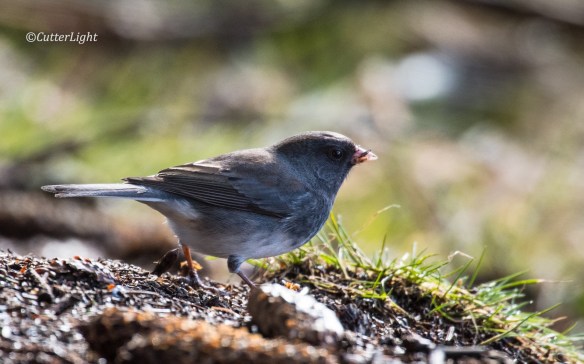
Sure enough, once we scattered a little seed along the brushy edge where they like to feed, they began to show up, and they brought a Dark-eyed Junco with them. Seldom observed out on the Alaska Peninsula – and absent altogether or marked with a question on most of the region’s birding lists – Juncos have shown up in small numbers each of the three winters we’ve spent here. In fact, we think we have the only documentation on the peninsula of Oregon race juncos.

While there have been fewer Juncos at the Lake than there were last year, every so often we see one or two or three.

The Golden-crowned Sparrows appear to have just begun growing in their breeding plumage. Some of the male Siskins though are already there, showing off brilliant canary yellow in their primaries. At one point a Belted Kingfisher rattled by, most likely a male getting things ready for the females that will soon return. Ravens called in throaty croaks from a far hill. No ducks on the water and no eagles on their usual perches, which is a little unusual. Perhaps the ducks are already up at Black Lake where most of the nesting occurs. Gulls will begin returning any day.

Sleepy but looking well fed, she lost both of her fully-fledged chicks last year, one to an electrical box on a utility pole and the other to some other cause. We’re hoping she nests again this year with much better luck.

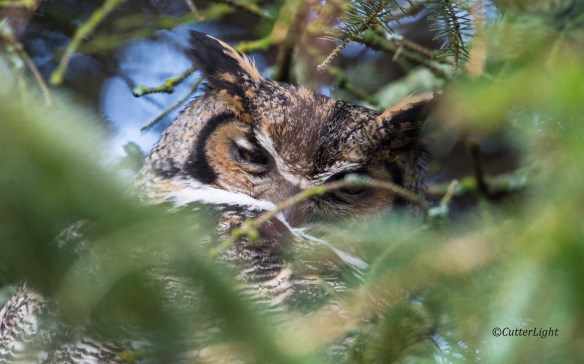
We aren’t always lucky enough to see one and we rarely see both of them, but this was a red letter day as both of our Great Horned Owls – the female and the slightly smaller, more lightly colored male – were perched where we were able to find them. As is usually the case, they were buried in shadows behind thick evergreen boughs, aware of our presence but seemingly unconcerned. The ground beneath their favorite roosts is littered with bits of hair, feather, bone and beaks and oblong balls the size of two thumbs placed together packed tight with the remains of the various voles, Magpies, ermine, lemmings or whatever else constitutes one of their meals. Last year the female spent several days perched atop a winter-white Snowshoe Hare – several meals.

Discernibly smaller and with brighter plumage, we feel fairly certain that this is the male. The Ainu – Japan’s indigenous people – believed that owls protected their villages. They are certainly regal animals.

Frost on the ground this morning, but if you look closely at the photos, you can see other signs that spring is coming to Chignik Lake. Hopefully I’ll be posting a video of a Fox Sparrow singing in the near future.

With their uplifting songs and stunning plumage, if birds didn’t actually exist I don’t think we’d believe that they even could exist. They certainly brighten our world.

Artists of the North Pacific Seas: The Watercolors of Dall’s Porpoises

Dall's Porpoise, full animal n

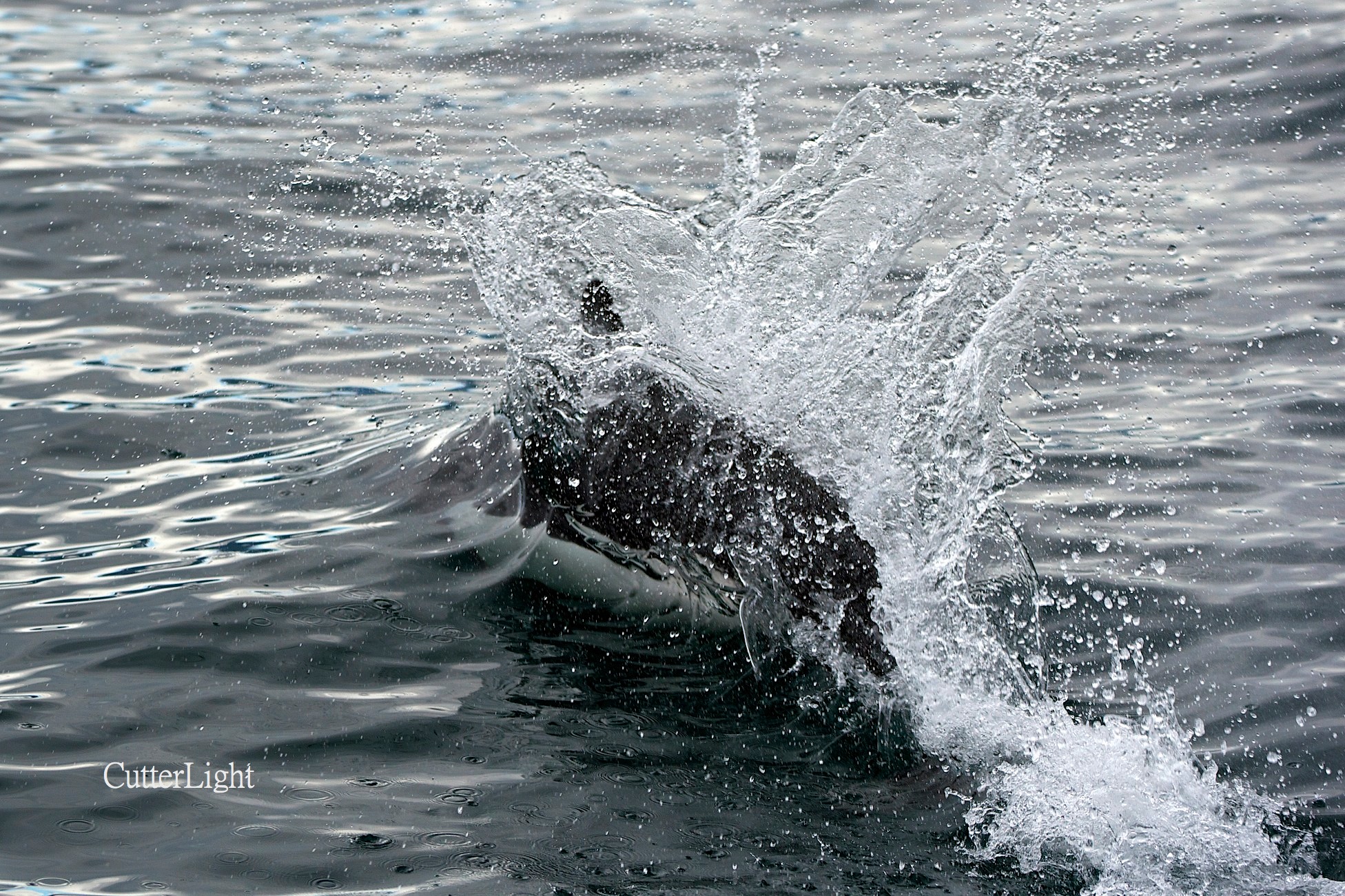
You might see a plume of ocean spray, a glimpse of black and white and if you’re close enough, you’ll hear a burst of expelled air as one of the speedsters of the sea comes up for a breath. Playing in the boat’s wake, Dall’s porpoises create ephemeral pieces of art out of seawater, light and air.

Dall's porpoise saltwater mohawk n

Water & Light Mohawk. Dall’s porpoises are capable of keeping pace with boats cruising at over 30 mph (55 kph), a speed that places them with or perhaps slightly ahead of Orcas and Pilot Whales as the sea’s fastest cetaceans. 

Dall's porpoise folded water n

Folded Glass. In Alaska’s seas, a steady diet of herring and other small fish help keep the population robust. Males, which attain larger sizes than females, can grow to a length of about eight feet and attain weights just under 500 pounds.

Dall's porpoise black and silver on blue n

Black and Silver. Typically traveling in pairs or in packs up to a dozen or so animals, tell-tale water spouts in the distance are a sign that the porpoises are in the area. If their stomachs are full and the speed of the boat is just right, they may come zipping across the water to play.

Dall's Porpoise Tail n

Watercolor Brush. Dall’s porpoises can seem to appear out of nowhere, and before long they disappear again. 

Dall's porpoise water burst n

Farewell Waterburst. Currently, populations of Dall’s porpoises are doing well. They prefer to swim over deep (500 feet), cold water along the continental shelves ranging from southern Japan, as far north as the Bering Sea, and along the west coast of America as far south as Southern California. As a species, they would benefit from international cooperation to conserve the fish stocks they rely on for food and to ensure that they are not accidentally caught in fishing nets.