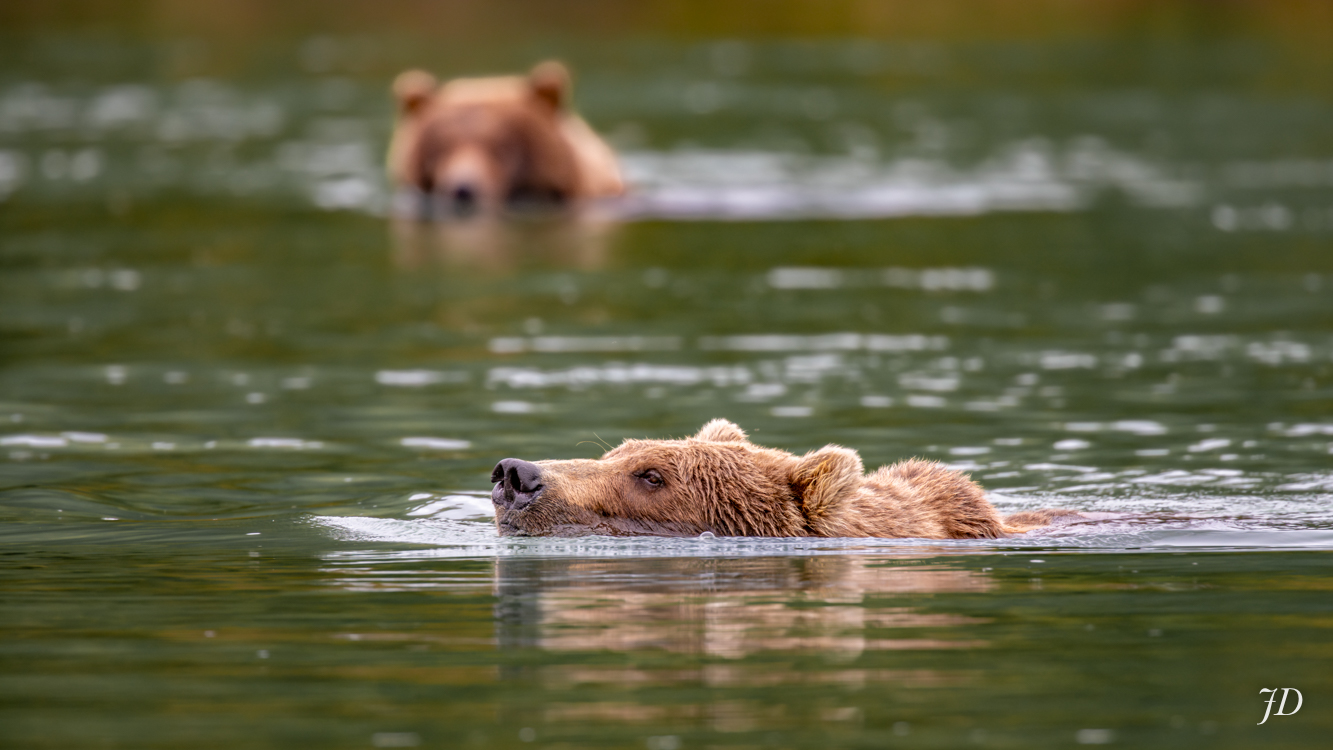
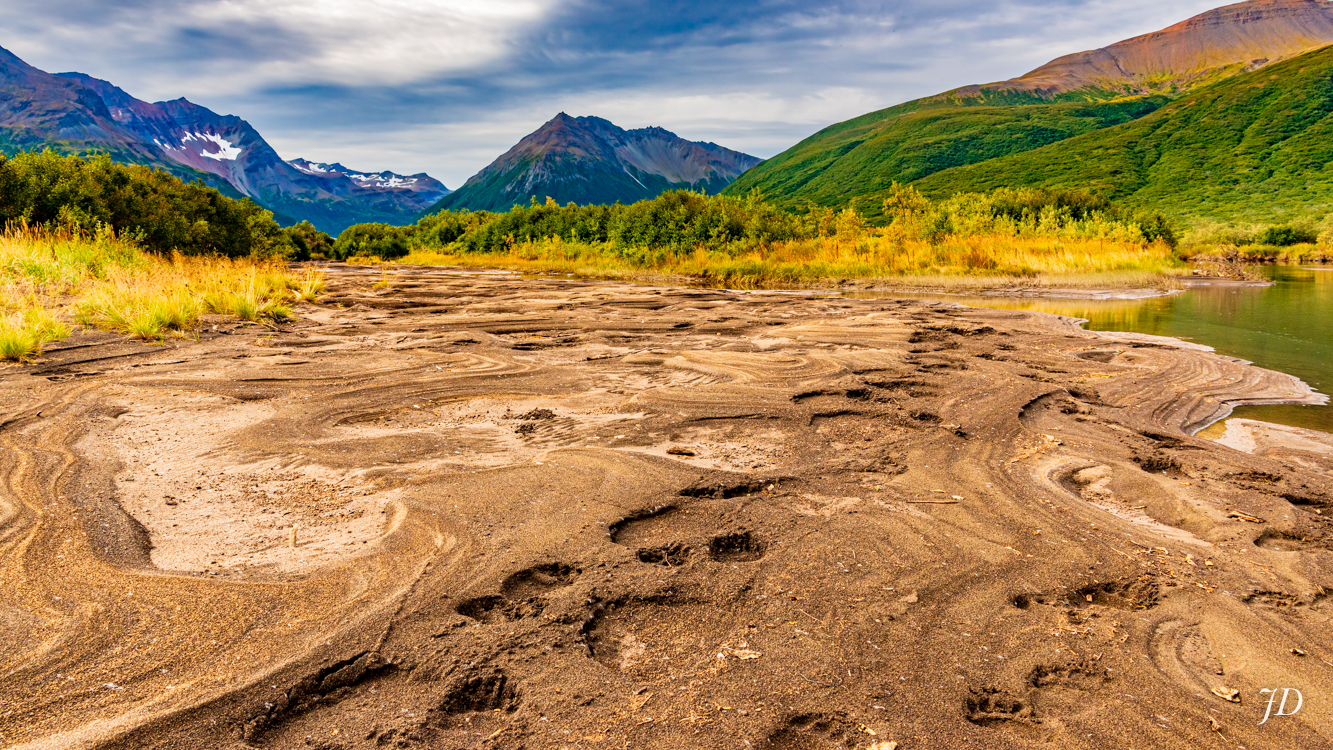
Clarks Bay Beach with Brown Bear Tracks in September A few hundred yards up the beach from where this photograph was composed, Clarks River debouches into Chignik Lake. Small enough to cross when wearing waders but large enough to navigate in a skiff equipped with a jet drive, Clarks provides major spawning habitat for Sockeye and Coho salmon. Lots of salmon. Lots of bears.September 13, 2018
Western Sandpipers, Hartney Bay, Cordova, Alaska, May 3, 2024
This was the scene about six miles from the heart of Cordova this past Friday morning, and this is but a sliver of the many thousands of shorebirds that stop for a short while to fuel up and rest on tidal mudflats near the town as they make their way to nesting grounds further north. Figuring in nearby barrier islands and additional flats in the Copper River delta, some five million shorebirds represented by several species will visit the Cordova area over a few days in early May. While they are here, these Western Sandpipers will double their weight. The delta is absolutely critical to the health of these avian populations as there are only a few places in the world that offer the sheer biomass of invertebrates and biofilm these birds require in order to complete journeys that in many cases cover thousands of miles. Look for a more indepth article on this incredible migratory event in the coming days.
The View from the Boat Landing Chignik River, Dawn, September 10, 2018
Behind me from where I stood as I composed this photograph, a dirt and gravel road travels a winding path along steep hillsides for about three miles to the Chignik Lake airfield, a bouncy dirt airstrip capable of handling the nine-seat bush planes and smaller aircraft that regularly travel the Alaska Peninsula. For the first two-and-a-half miles from the boat landing the road hugs steep hills, often within view of the river. Traveling the road from June through November, it’s common – at times almost a given – that you’ll see one of more of the Chignik’s massive brown bears. Sandhill Cranes, Tundra Swans, eagles and any number of passerines are frequently encountered in summer, and at any time of year a glimpse of foxes, moose, wolves and even wolverines is possible. Take note of the local hares you might catch sight of – Tundra Hares, the largest hares in the world.
The road is the road… the road to The Pad… the Top Road. Three miles. On one end, unless you are on a Honda (an ATV), you would need to board a plane to travel further by vehicle. On the other end, you need a skiff. There is no overland connection with any other community. Mountains, rough terrain and jungle-thick alders make travel by foot even to the village of Chignik Lagoon – just six miles down the peninsula from Chignik Lake – impractical. Whether one travels by air or by sea, it is 353 miles to Homer, Alaska – the closest place a road connecting with the North American mainland can be joined.
Mumble Creek Brookie That Stream that Shall Not be Named, Pennsylvania, May 2021
A few weeks ago here on Cutterlight I published a tribute to a recently passed friend and mentor, Bill Kodrich. Concurrently, I sent the article to the fly-fishing zine Hatch Magazine hoping to get Bill a bit more ink and appreciation. The editor asked for a longer piece, which I was happy to supply. The article went live on Hatch this morning. I wrote the piece as not only a tribute to Bill, but as a reminder of two things to consider as we move through life: That mentorship matters; and that when we join with others and put our shoulders to the wheel, big change is possible. Here’s the link: Environmental Stewardship and a Good Piece of Pie
Harbor Seal and King Salmon Chignik River, September 9, 2018
Chinook Salmon begin entering the Chignik in late June. They continue spawning into August. By September, spawning has ended and the spent salmon begin giving into the current, death at hand the big fish slowly drifting back downriver – easy meals for the Chignik’s Harbor Seals.
One Fine Morning – Paradise Bend on The Chignik River Ambling Bear, Mallards, Teal, White-fronted Geese, a splash of sunshine September 8, 2018
I went to the woods because I wished to live deliberately, to front only the essential facts of life, and see if I could not learn what it had to teach, and not, when I came to die, discover that I had not lived.Henry Thoreau, Walden
The Lake: Waning Crescent with Venus I captured this image from our living room window on September 8, 2018
Month by month, photo by photo I’m making progress with this daunting task, key-wording, culling, editing, retouching the tens of thousands of photographs we’ve accumulated. The collection goes back to old print photographs we scanned into Lightroom, continues through our years together in Sacrament and on into our years in Alaska which have been punctuated with travels elsewhere and a two-year span in Mongolia.
Usually I’ve drawn energy from this project as I revisit memories and track the progress we’ve made as photographers. My editing and retouching skills have dramatically improved, and that too has been satisfying. But there have been low periods as well. Recently I pitched a story to the editor of a magazine. He liked the draft I showed him and asked for more. I finished the piece, sent it in… and nothing. It’s as though I’ve been ghosted. Unpleasant.
And so I find myself revisiting old questions. Have I lost the touch? Usually editors are enthusiastic about my work. Does “lost the touch” really mean “gotten too old?” Which leads to a downward spiral into the really big question I find hanging over my head at times: What if nothing ever comes of all this? What if this late-in-life push is, ultimately, pointless?
Things can get dark. But, are you enjoying your life? Barbra asks, trying to be helpful and cheering. The answer to her question is (on most days) an unequivocal Yes. And yet… and yet…
Faith in the past as an indicator tells me this moment of doubt will pass. That same past tells me that the only way to know is to keep moving forward. I suppose I could construct a metaphor about moons waning, disappearing… and then finding themselves again and waxing into fullness.
Ermine (Short-tailed Weasel) Chignik Lake, Alaska Peninsula, August 2018
A Collared Lemming burst from a thicket of grass and swam across a narrow finger in the lake which was filled to the brim with recent rains. Just as the little rodent disappeared in a patch of thick grass on the opposite side of the water, an Ermine popped out from where the lemming had just come, paused, looked around, appeared to sniff the air, then also swam the same course. I was scrambling with my camera hoping to capture something of the surprise sighting and managed to capture the above image just before the Ermine dove into the grass.
We didn’t often encounter either of these species during our years at The Lake, but there was hardly a walk after a fresh snowfall that we didn’t come across small paired tracks left by Ermines bounding through snow, so they appeared to be fairly abundant. Cool animals. I would love to have made friends with one the way Sam made friends with Baron in My Side of the Mountain… The closest I came was when one ran across the toe of my boot and into the entrance of our house as I opened the door one morning.