Teuri Island: The Place to be for Rhinoceros Auklets

Rhinoceros Auklet Breeding Grounds, Teuri Island
Hokkaido, Japan, June 18, 2018

Not a lot appears to be going on in the above daytime photograph taken on Teuri Island’s cliff-lined northwest. The 2.1 square mile island (5.5 square km) hosts the breeding grounds for several species of birds, most notably seabirds. The holes in the above photograph are the burrows of Rhinoceros Auklets, a species for which Teuri serves as the world’s largest breeding ground.

While it doesn’t appear that much is going on in the photograph – a few gulls milling around notwithstanding – at the end of each burrow, which may be up to six meters (20 feet) in length, a Rhinoceros Auklet chick is waiting for twilight when parents will return from the sea, stomachs, gullets and bills crammed with catches of sand lances and squid. Gulls – primarily Slaty-backed which also breed on the island – will intercept some of the returning adults, but most will make it past the parasitic phalanx. Recent estimates put the auklet population at around 400,000 breeding pairs. Add in the chicks and the species count rises to over a million. Perhaps you can imagine the sight and the cacophony as night gathers and hundreds of thousands of adult auklets return, evading squawking gulls, somehow locating the specific burrow each parent calls home.

Teuri is also an excellent place to see Spectacled Guillemots, Common Guillemots and other seabirds as well as passerines such as Blue Rock Thrushes and Siberian Rubythroats. Regular, bicycle-friendly ferries from Haboro make it easy to get out to the island, and if you don’t choose to stay at the lovely campground (which you’re likely to have to yourself) there are wonderful inns offering comfortable accomodations and truly some of the world’s best fresh seafood.

Date in Morning Fog

Date in Morning Fog
Hokkaido, June 7, 2018

On the morning of the sixth day of our Hokkaido trek, we passed through Date (dah-tā), a seaside town southwest of Sapporo on the shore of Uchiura Bay. The town is known for maricultural products such as scallops and sea urchins. This photo is another early experiment in softening rather than sharpening an image.

Seawall Foggy Morning with Fishermen, Hokkaido

Seawall Foggy Morning with Fishermen
Hokkaido, Japan, June 4, 2018

This photo is an early experiment with softening rather than sharpening an image… taken before I appreciated how important careful note-taking is… I think this is in the harbor of Hagino.

We arrived in Japan on May 28, spent three days in the Crown Prince Hotel in Chitose, Hokkaido getting acclimated – figuring out where we might purchase fuel for our camp stove, re-assembling our bicycles and so forth -, and then on June 1 we embarked on a 67-day, 1,300 mile bicycle-camping trek circumnavigating most of coastal Hokkaido. For both of us, the trek was a fulfillment of childhood dreams of a self-guided bicycle trek in a foreign country. It was quite possibly The Most exhilarating adventure either of us had ever undertaken.

I paid for a significant part of the trip when I published an article in Adventure Cycling Magazine, which if you’re interested you can find here. We also published several articles about this trip right here on Cutterlight. The easiest way to access those is to simply type Hokkaido in the search box in the upper right of any Cutterlight page.

As I go through the 1,342 photographs from this trip (that’s after the initial culling), I’m not sure how many new images I’ll have to post. But I will underscore the feeling Barbra and I came away with after the trip. Go! If you’ve ever thought that a bicycle trek is something you might want to experience – think back to when you were 12 or 13 or 8 or 58 and riding in a car passed a couple or a small group of bike trekkers and wondered what it was like… wondered if you could do something like that – our answer is Why not?

On A Frozen Sea

Sphere and Pyramid
The Chukchi Sea, April 21, 2012

In late winter and early spring, our Inupiat friends in Point Hope began talking about “breaking trail” across the frozen Chukchi Sea so that snow machines (snow mobiles) and hondas (ATVs) could be driven out to leads (open lanes in the ice) in order to set up whaling camps. “Breaking trail?” Informed by our experiences with freshwater lakes, we wondered, “Can’t you just drive out across a smooth blanket of ice?”

Well, as we learned, a frozen sea isn’t like that. As ice forms and expands and is pushed around by winds and currents, sheets separate (creating leads) and later are pushed together again, the resulting pressure ridges can heave up massive jumbles of jigsaw ice. Some of the chunks are as large as a garage. This was all new to us the first time we hiked out to a camp. In the above photo our eyes are drawn to an otherworldly sphere and pyramid lit blue in pre-dawn light.

Khongoryn Els: The Gobi Desert’s Singing Dunes

It was a long held dream to walk along the ridges of Khongoryn Els, the Gobi Desert’s famed Singing Dunes. Mongolia, October 19, 2014

There are several examples of singing sands around the world. Not to be confused with the pleasant squeak sand sometimes makes as one walks along a beach, these dunes really do sing, producing a range of eerie, harmonious and lovely tones as the wind reshapes the peaks and ridges, causing individual grains of sand to rub against each other. Even the mini avalanches of sand caused by walking can produce music.

Racing Horses at a Nadaam Festival

Racing Horses at Nadaam. Mongolia, July 12, 2015

Almost There, or… Who Does This? Hokkaido Bicycle Trek 2018

Made it to Haneda! Bicycles, trailer, gear & clothing. On to Chitose!

Planning a bike trek around Hokkaido, Japan has been quite a challenge. People travel abroad. We’ve traveled abroad. People go on fishing sojourns. We’ve gone on fishing sojourns. People undertake photography safaris. We’ve undertaken photo safaris. People bike trek. We’ve… ridden our bikes. The challenge has been that people don’t typically do all these things in one, long, self-guided camping trip. Nor do they normally wait until they’re in their 50’s to attempt their first foray into something like this. 

To prepare, we read books on bike trekking – from words of wisdom on ultra light traveling to advice from folks who tote along babies and dogs. We watched countless videos on how people pack and camp with their bikes. Along the way we feathered in fishing. And photography. And pack-rafting. And camp cooking. And backpacking. And bird watching. And then there was the fitness training schedule to help us get into shape for this adventure. With as many people in the world who have already pioneered all of these different adventures, no one seems to have attempted the catch-all combination of what we are hoping to embark on. 

During the planning phase, we practice-packed several times. Each time, we realized another layer of equipment had to be fine-tuned. Without bringing a pack mule or a SAG wagon, we weren’t going to be able to carry along everything that we wanted to. 

The pack raft was the first thing to go. Our rafts compact into fairly small bags, but they necessitate paddles and PFDs. The amount of space and additional weight all of that entails wasn’t going to work. A subsequent trial packing made it clear that our plan to backpack and camp in the back country of the Shiretoko Peninsula, a world heritage site, also required too much stuff – mainly the backpacks themselves. We still plan to explore a backpacking trip, but we’ll look into renting backpacks. 

The next activity to get a hard look was fishing. Hokkaido is reported to have good populations of trout and char and even some salmon fishing as well as opportunities to ply ocean beaches and rocky shorelines for a variety of species. While we considered getting into at least some fishing to be a non-negotiable, we desperately had to figure out how to skinny down our equipment to one rod tube and one waist pouch. The compromise we settled was sharing gear instead of bringing two of everything. Additionally, we modified our lone fly rod to double as a spinning rod. (If it works, we’ll tell you all about it.) In the end, we packed a fly reel, a spinning reel, an 8-weight rod, a tenkara rod, a few small boxes of flies and lures and a small assortment of leaders and tippet material.

The next nonnegotiable was photography gear. Last summer, we limped through with substitute equipment and felt handicapped the entire summer. When we returned home and finally got our photos up on the computer screen for editing, they left us disappointed with the quality. So, our preparation for this summer involved numerous discussions and field tests regarding what gear would best capture the sights and experiences of our journey. What made the cut may seem like a lot to some, but we feel confident that we’ve streamlined our gear without sacrificing too much versatility.

The guiding question in all of this was, What kind of experiences do we most want to have? And the not-so-surprising lesson has been that if the trip is to be about going and doing rather than simply going and seeing, a certain amount of specialty gear is necessary. We know, for example, that we can enjoy first-rate food experiences while keeping our budget reasonably low by visiting markets and cooking for ourselves. But this strategy necessitates carrying with us cookware up to the task. Even birding pretty much requires that we take along a decent pair of compact binoculars and a field guide (which Jack went through with a box cutter and pared down to the bare essentials).

With our gear as fine-tuned as possible, we flew to Anchorage where Paramount bike shop took over the bike-packing – otherwise known as breaking down the bikes and packing them into big cardboard boxes. Meanwhile, we filled two much smaller cardboard moving boxes with the rest of our gear – boxes we’ll discard once we arrive in Hokkaido. And so, ready or not we’ve begun this summer’s adventure with three bicycle boxes and two moving boxes colorfully decorated with neon orange duck tape, packed to withstand the long journey down the West Coast and across the Pacific Ocean. 

At the Anchorage airport, a helpful Alaska Airlines ticket agent was ready to assist us with the puzzle of moving our over-sized bike boxes through the maze of four planes, four airports, two languages and two countries. We were nervous about our baggage surviving the journey or getting lost along the way. As unconventional as it is to travel with ducked-taped cardboard boxes, we are happy we did. At our San Francisco stop, we looked out the plane window and saw our boxes being loaded into the plane. And thanks to the day-glow orange tape, we quickly spotted our luggage as it hit the conveyor belt in Tokyo. Hi-vis tape was a great idea! By the way Big Kudos go out to Terrie at the Alaska Airlines desk-for-troubled-travelers. She was able to figure out how to check our bags all the way to Hokkaido from Anchorage. Amazingly, the cost for all of our baggage was a very-reasonable $200! (Go Club 49!)

As the nerve-wracking airplane travel segment of our journey comes to a happy conclusion, we can now focus on the next leg of the adventure: putting our bikes back together, finding stove fuel and purchasing a few groceries. And then we will answer the question that has been in the backs of our minds (and the pits of our stomachs) ever since we conceived this trip: Will we be able to balance, steer and propel these vehicles??? Stay tuned!

Planes, bikes, ferries & feet – Ready for 85 Days in Hokkaido, Japan

Nowhere in particular to get to… and all summer to get there.

May 19: We’d saved a couple fingers of bourbon for this, our final evening in Chignik Lake. Measured out in a pair of our favorite glasses, the mellow amber-brown glow of the whisky suited a similar mellowness that had settled over us as we looked around a clean, tidy home that only a few days before had been an explosion of camping gear, bikes, technical clothing, camera gear, panniers and check lists. Our bicycles and camping gear had already been flown to Anchorage where they were waiting for us at Lake Clark Air. Scheduled to fly out of Chignik Lake the following day, ahead of us was a five-day scramble in the big city of Anchorage in which to reconnect with friends, make last-minute adjustments to our bikes and have them boxed for air travel, and to pick up necessities ranging from fly-fishing leaders to all-purpose hiking/biking/street/camp shoes as well as a couple of dozen additional odds and ends. Oh, and to get one of the three store-bought haircuts we treat ourselves to each year.

And then on Saturday, May 26, we’ll board Alaska Air bound for San Francisco where we’ll switch to Japan Airlines into Chitose, Hokkaido. If all goes according to plan, we’ll spend the next 85 days exploring Hokkaido, Japan by bike.

Why Hokkaido? I suppose it comes down to the fact that both of us have wanted to do a bicycle trek ever since we were kids but never did. Lacking experience in this sort of thing, it made sense to go for it in a country known for being safe and for having a bicycle friendly culture. Factor in campgrounds that typically range in price from free to $5 or $6 dollars, a cool, comfortable summer climate, beautifully diverse landscapes featuring smoking volcanoes, snow-capped mountains, bird-rich marshes and forests, fields of flowers, six national parks, seaside villages and the distinct possibility that we just might get into some decent trout and char fishing.  Japan’s northernmost island seemed to us to be the best possible place to make this leap into a new way of travel.

Hokkaido’s cuisine surely ranks among the world’s finest. Regional seafood specialties include scallops, oysters, several species of crab, shrimp, salmon, squid and succulent, softball-sized sea urchins. As Japan’s agricultural capital, Hokkaido is also known for its fresh fruits and vegetables as well as local beef and pork, and people rave about the rich ice-cream. There may even be opportunities to sample wild game. Soba – those tasty buckwheat noodles that are especially delicious served cold – is made from local grain, and it seems that virtually every city, town and village has its own unique twist on ramen. Visions of donburi – bowls of rice piled high with a variety of colorful, fresh seafood – have been dancing in our heads for months. If that’s not enough, micro-brews have caught on, there’s a nascent wine industry and even a couple of world-class single malt distilleries. Every yen we don’t spend on campground fees is another yen we’ll be able to spend eating our way around the island. 

So stay tuned. We intend to publish throughout the summer – food experiences that inspire, new birds, exotic species of trout of char, encounters with wildlife and the challenges and successes we’re bound to encounter pedaling our way along sea coasts and through mountain villages. But the thing we’re most looking forward to is meeting new people and immersing ourselves in a new culture. I’ve been practicing my Japanese, to be sure. But if experience is any guide, connections trump vocabulary. We can’t wait to share our loves of fly-fishing, photography, birds, food, camping and hiking with friends we haven’t yet met, half-a-world away, who find similar joy and fascination in such things. Hopefully our journeys will bring us into conversations with soba masters, commercial fishermen, trout chasers, farmers, ranchers, biologists and people who call Hokkaido home and love living there.

Wherever the coming summer finds you, we wish for you days filled with pleasant adventures, good food and deepened connections old and new.

Intrepid Trepidations

Staring at my readied bike loaded with gear for this summer’s epic adventure, I am filled with… fear, excitement, anxiety, worry, nerves…

I’ve read so many articles and blogs and books about traveling. The common theme in these stories is excitement. The stories often have a dramatic edge. In the spirit of excitement, there is often reckless abandonment of caution and unplanned success. The stories are invigorating and inspiring – always with a happy ending. As my bike stares back at me, daring me … I find myself thinking that I’ve never read the version of the story that started with a daunting case of nerves. This seems to be my story.

The inspiration for this summer’s adventure began a few lifetimes ago. When I was young, my family used to camp. I remember watching bicyclists loaded with camping gear trekking along California blue roads from the window of our VW Camper. I loved to ride my bike. And I was instantly in love with the idea of being self-sufficient on two-wheels trekking anywhere I wanted to go.

Anyone who has known me over the past few decades could testify that I am an adventurous person. I have been known to get up and go do something based on very little information, sometimes on just an idea that something would be fun. I have had many happy endings to those stories, just like those I have read. So why worry now?

I stare at my bike. Its panniers and fork bags puffy with camping gear. As if in answer to my question, the front fork bag of my bike falls off and spills.

It’s the logistics of this trip that make it like no other. I’ve always been able to fill a backpack or a suitcase and go. But this summer, the adventure includes more than what can be packed in a backpack. We’ve planned a trip that involves bicycling around a foreign country for three months. The activities on the trip are to include sightseeing, culinary adventures, fishing, photography, backpacking and maybe even pack rafting. Aside from test packing and other activities we can do to get ready while in Alaska, the additional logistics are mind boggling. In order to get this trip started, there is the first leg – which seems to be the most daunting of the logistics – we need to maneuver all of our gear from our tiny village of Chignik Lake, through the city of Anchorage and all the way to the north island of Hokkaido, Japan. The other part of the logistics is planning for daily mileage and making sure we are in good enough shape to pull off this physical adventure.

All this planning is, of course, in theory. I have so many questions… How many miles can we realistically bike? Can we carry all the gear we want to carry? Are we over packing? Are we forgetting something critical? Will our gear be safe from thieves? Will we be able to find campgrounds as easily as we hope? Will the roads be safe to ride on? Are we going to have trouble transporting our gear with the airlines? Is this too big an undertaking?

So, Jack and I sat down to tackle, not the questions, but the psychology behind the questions. Our discussion centered around the question, “Do we really want to take on a trip so far outside of our comfort zone?” The answer, it turned out, was a resounding Yes!

So, plane tickets have been purchased. The first test packing has been completed. Our trip itinerary is coming together. The bike and treadmill workouts are underway. And the faith that we are resourceful people is the response to those questions that really can’t be answered until we begin the journey.

And now I propose a toast: Here’s to another summer of epic proportions living well off the beaten path. Cheers!

And Then Gillie was Gone… Or… Intrepid C-Dory Thwarts Thieves!

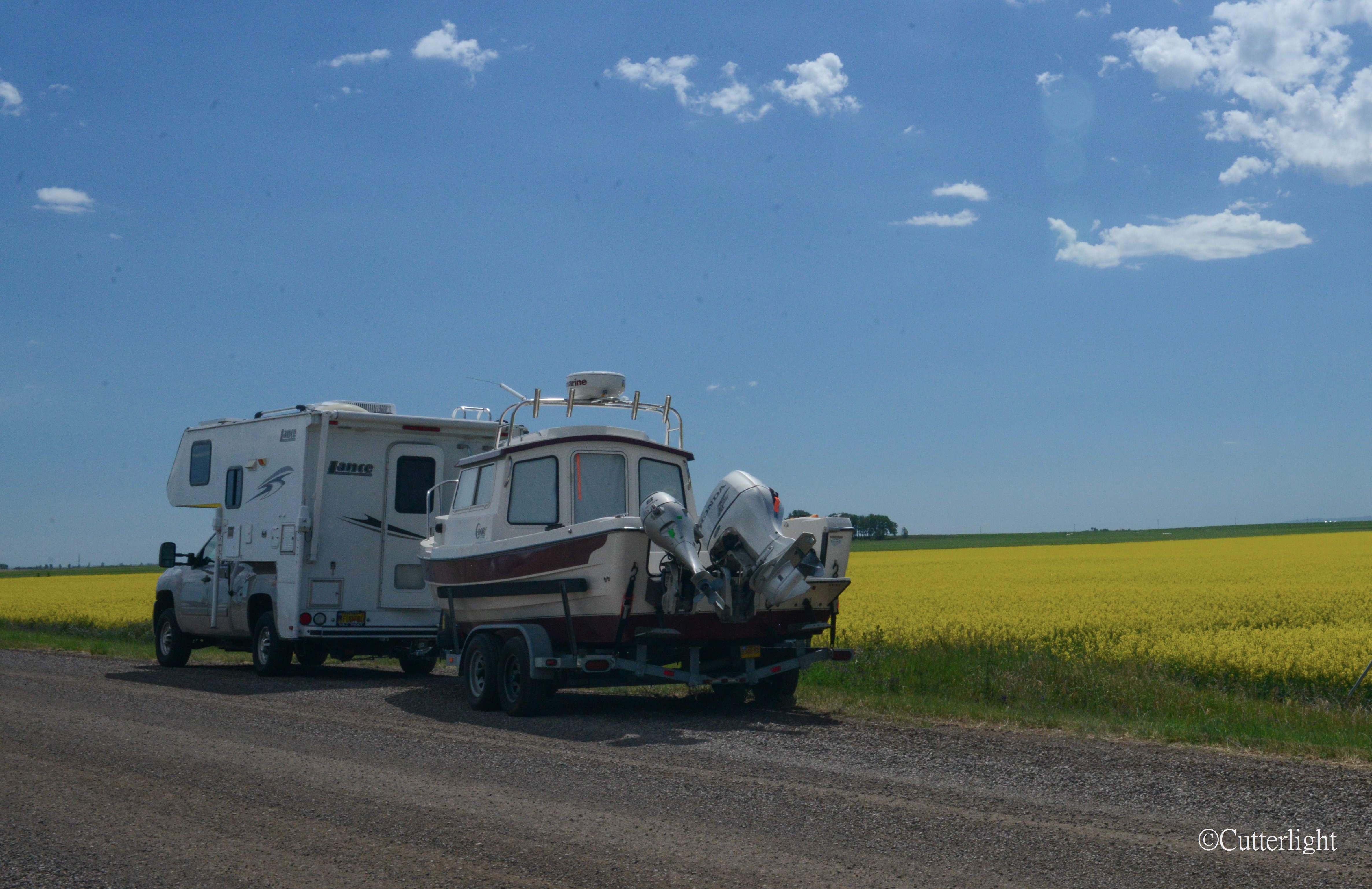
Gillie and Canola_n

Gillie faithfully following her crew, enjoying the canola fields of Alberta.

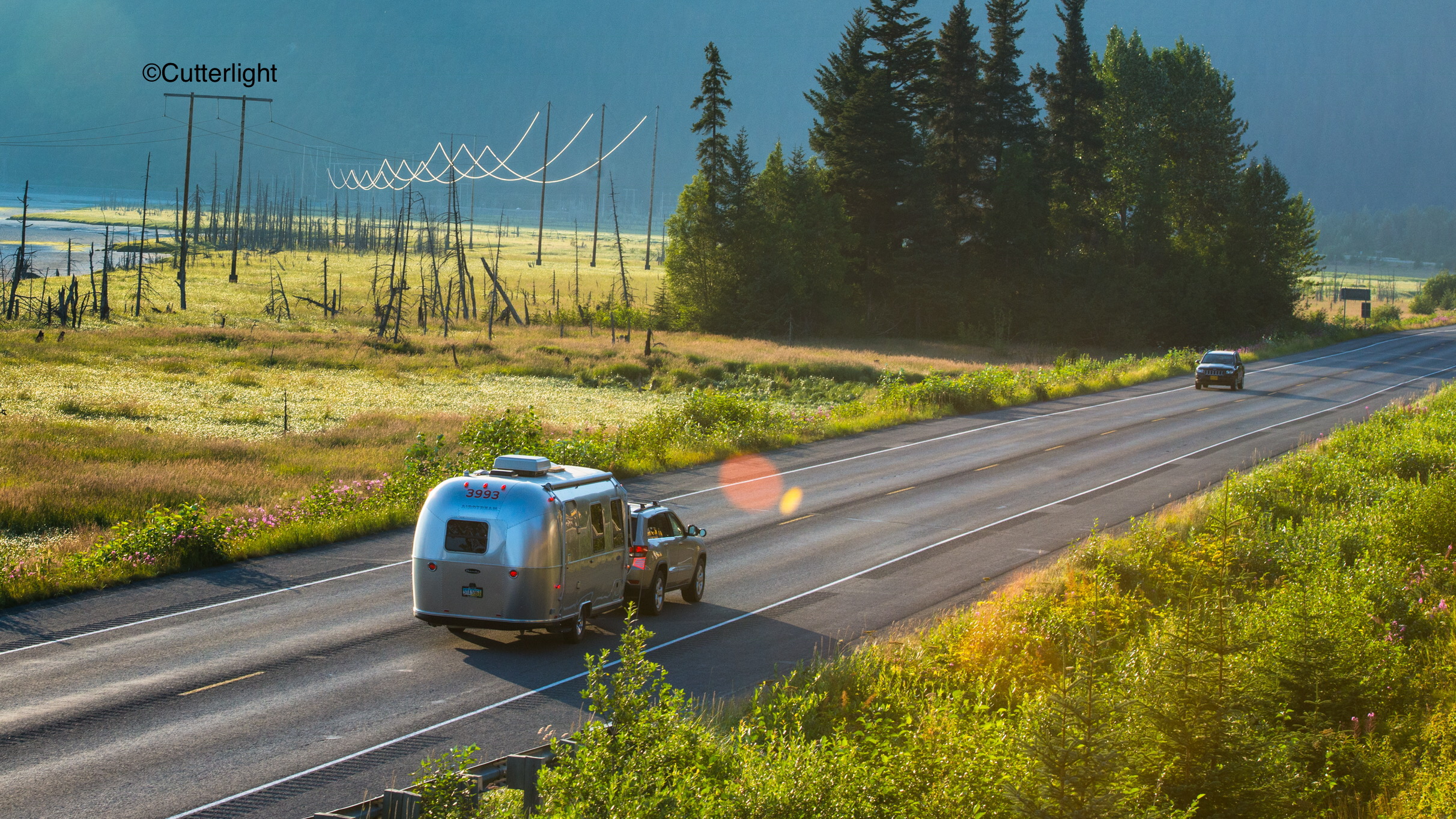
July 18, 2016, Yukon Territory. In an incredible act of heroism, the fishing vessel Gillie, a 22’ C-Dory Angler freed herself from an attempted abduction. Following her captains north to Alaska on the Alaska-Canada highway, Gillie, along with Stanley the Chevy Silverado and Lance the Cab-Over Camper, had pulled off the highway for a driving break at the Smart Creek turn-out near the British Columbia/Yukon Territory border. Her captains were gone for mere minutes, looking for grayling and char in the trouty-looking river just out of Gillie’s view when the thugs attacked.

Armed with precisely the right tools, the perpetrators made short work of Gillie’s couplings, hitched her to their own criminal vehicle, and sped off. At this point, Gillie feared the worst. She imagined herself in a chop shop, her engines torn from her stern, her insides gutted. She shuddered, knowing she may never see her beloved captains again.

But when she shuddered, she noticed that in their haste, the thieves had neglected to properly secure the nut holding the hitching ball in place. Each time the speeding trailer hit a bump on the very bumpy Al-Can, Gillie put her own two tons of weight into the bounce. Bit by bit, the nut worked its way down the hitching ball shank.

“If I can just get free before they hit the chop shop…” She didn’t complete her thought. Not more than 50 meters up the road was a bright orange marker. She knew what that meant. Big Bump.

“This is it,” she thought, digging deep for the courage she’d need to withstand the crushing impact when the tongue of her trailer hit the pavement at 70 miles (110 kilometers) per hour. The front wheels of the thieves’ truck hit the bump, Gillie gave herself a mighty lift, the trailer wheels careened over the bump, Gillie slammed down hard on the hitching ball and, to her great joy, rebounded, catching just enough air to lift herself clear.

The tongue of the trailer came down with a heavy, metallic, grating crash! The safety chains holding the trailer to the truck went tight. Now, atop the trailer, still upright, Gillie was being dragged along while the tongue of the trailer cut a scar into the highway asphalt. From the cab of the truck, Gillie could hear loud shouting and words that can’t be printed here.

The next thing she knew, the truck was pulling off the highway. “Yea!” Gillie exclaimed in thought. But the shoulder was steeply canted. “If they go any further, I’m going to roll!” She thought in a panic.

Just in the nick of time, the whole rig skidded to a halt. The thieves burst out of their truck, cursing their “bad luck” and accusing each other. They had little choice and they knew it. Already, police between Watson Lake and Teslin were looking for the most unmistakable boat on the Al-Can. Gillie didn’t know it, but her captains had already supplied the Royal Canadian Mounted Police (who always get their boat) with a photo of Gillie and a description of a possible suspect vehicle. Gillie didn’t know this, but thanks to their friends who listened to police scanners, the thieves did know it. With a hot boat atop a disabled trailer and police on the lookout, the thieves had no choice but to cut and run.

Her captains were in the midst of a rather quiet, pensive dinner at the Yukon Motel and Restaurant in Teslin when Officer Stelter of the Royal Canadian Mounted Police entered the establishment and confidently strode toward their table, barely able to suppress a grin.

“She’s on the road, down at marker 1168. It looks like they abandoned her.”

The restaurant hostess quickly packed the dinner “to go.” The captains climbed into the Chevy, fueled up and hustled to the site, 42 miles to the east. By the time they arrived, Officer Stelter had already secured a brand new 2” hitching ball to the trailer – held fast in place with a properly tightened nut.

You never saw a bigger smile on a boat. Her captains were smiling pretty hard, too.