
Spring Portrait of Love
Reply


Going through these many thousands of photos from The Lake and beyond – while at the same time these past few days putting together a magazine piece paying tribute to a recently deceased mentor and friend from my Pennsylvania youth – I find myself recognizing that as photographers one type of image we might not capture often enough is portraits of friends. The best of these photos are often environmental-documentary portraits – my own hybrid category to describe pictures that capture the subject in an authentic act of life in a setting that tells the viewer about that person’s life. There’s an art to it… the photo that isn’t staged; that doesn’t depict the subject self-consciously looking into the lens (or self-consciously looking away from the lens); an image that captures an authentic moment rather than a pose.
For me, learning to make these types of images has been predicated on a lengthy process of growth toward freedom from my own limiting shyness. Coupled with the kind of confidence that enables a photographer to make such portraits is, I think, a necessary agreement – tacit or verbalized – that gives the photographer permission to shoot at will (with appropriate discretion).
Strictly environmental portraits are in most cases staged. In making such an image, the photographer might have the subject sit at her fly-tying table as she ties or gives the impression of tying a fly. Noticing clutter, the photographer tidies up the scene. Further compositional considerations prompt lighting manipulation – perhaps nothing more than slightly moving a lamp or opening or closing a curtain, but manipulation nonetheless. Clothing choices are given thought, a certain tilt of the subject’s head is decided upon as favorable, perhaps a few already-tied flies are placed in the foreground, a book arranged so that it’s title can be read. Images such as this have their place, but to me there’s a compelling cool in a real-time photograph – a moment frozen, captured, documented as is with no quick brush through the subject’s hair, the everyday jacket with its stains, imperfect lighting, maybe a little motion blur or grain.
And in the case of the above photograph, one hangin’.
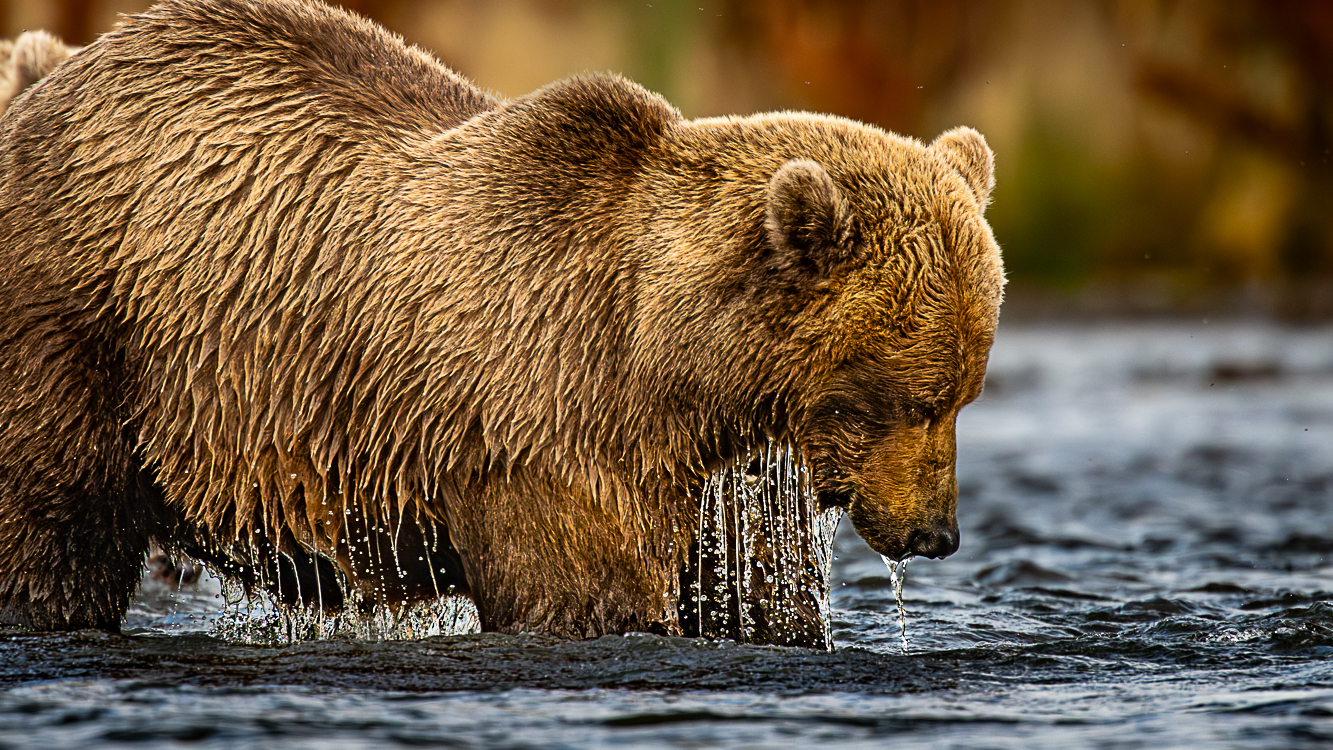
A second bear is just barely visible in the upper left of this photograph of a healthy sow that has trapped a spawning Sockeye Salmon in her forepaws beneath the water. Anytime the salmon are running from July through November, bears can be expected along the river and lake.


 CutterLight