One Hangin’ and Heave Ho: the Compelling Cool of Environmental-Documentary Portraits

Heave Ho
Fred Shangin, cigarette hangin’ as per, puts his back into a pot of Tanner Crabs from Castle Bay off the gulf side of the Alaska Peninsula. May 6, 2018

Going through these many thousands of photos from The Lake and beyond – while at the same time these past few days putting together a magazine piece paying tribute to a recently deceased mentor and friend from my Pennsylvania youth – I find myself recognizing that as photographers one type of image we might not capture often enough is portraits of friends. The best of these photos are often environmental-documentary portraits – my own hybrid category to describe pictures that capture the subject in an authentic act of life in a setting that tells the viewer about that person’s life. There’s an art to it… the photo that isn’t staged; that doesn’t depict the subject self-consciously looking into the lens (or self-consciously looking away from the lens); an image that captures an authentic moment rather than a pose.

For me, learning to make these types of images has been predicated on a lengthy process of growth toward freedom from my own limiting shyness. Coupled with the kind of confidence that enables a photographer to make such portraits is, I think, a necessary agreement – tacit or verbalized – that gives the photographer permission to shoot at will (with appropriate discretion).

Strictly environmental portraits are in most cases staged. In making such an image, the photographer might have the subject sit at her fly-tying table as she ties or gives the impression of tying a fly. Noticing clutter, the photographer tidies up the scene. Further compositional considerations prompt lighting manipulation – perhaps nothing more than slightly moving a lamp or opening or closing a curtain, but manipulation nonetheless. Clothing choices are given thought, a certain tilt of the subject’s head is decided upon as favorable, perhaps a few already-tied flies are placed in the foreground, a book arranged so that it’s title can be read. Images such as this have their place, but to me there’s a compelling cool in a real-time photograph – a moment frozen, captured, documented as is with no quick brush through the subject’s hair, the everyday jacket with its stains, imperfect lighting, maybe a little motion blur or grain.

And in the case of the above photograph, one hangin’.

Downward Fox – The New in the New Year & Life a Little Closer to the Quick

Downward Fox – There’s nothing quite as satisfying in the moment as a good stretch at the beginning of a day. Wherever you are, we hope your day is going well.

Between the two camps regarding testing new ideas at the beginning of each new year – the one camp advocating for trying new things, the other camp taking Eeyore’s “What’s the point?” position -, we are firmly in the camp advocating for trying out new things. I emphasize here trying out new things. We are not fans of New Year’s Resolutions. The very term, “resolution,” feels like a lead weight – leading to the even weightier prospect of “failure.”

Simply giving something a try – a gentle approach to change – is more suited to us. And so for the year 2024 I’ve begun (nearly) daily morning meditation. A few minutes of calm stillness, seated/kneeling on a low, cushioned wooden meditation bench, doing my best to empty my mind for a little while, sometimes allowing a selection of Mark Isham’s light orchestral arrangements to play in the background, other times keeping things as quiet as I can, is proving to be refreshing.

Additionally, we’ve both decided to go alcohol (and marijuana) free. It’s been about two months now. So far, so good. Surprising to both of us is that we haven’t missed the beers, wines and spirits that have often been integral to our gustatory and social lives. Of course, there is money to be saved by such a venture. And increasingly the scientific/medical consensus is recognizing that there is no health benefit to alcohol, that even modest consumption appears to be somewhat harmful. In good health but older now, having recently purchased a home (and imagining new art for this home), we’re mindful of both of those factors. But they weren’t the primary motivations behind this decision.

One of the happiest moments in our shared life these past few years occurred toward the very end of our bicycle trek in Hokkaido. We had just pushed up a long hill – a small mountain, actually – and then had the reward of the effortless sunshine summer day warm breeze on our faces coast down the other side.

In that moment, we were transported back to sheer joy of freedom total immersion in a moment childhood memories. Way leads to way. Thought to thought. We embraced and enjoyed experiencing wines and other drinks in that season. But all of that had become a distraction, on several levels. Time to experience something else. It has been an enjoyable two months… completely sober in every moment, and thus, at least for us, living more in the moment, a little closer to the quick of Now.

All Quiet at The Lake

Dawn, late February, Chignik Lake, Alaska

It has been a winter unlike our previous two at Chignik Lake – quiet, even by the quiet standards we’ve become accustomed to. Pine Siskins, dozens of them, have taken over the White Spruce Grove. A raucous lot, it may be that they’ve driven off most other birds. In any event, the Dark-eyed Juncos and other sparrows of past years have been all but absent, and we’ve not seen a sign of Golden-crowned Kinglets, Redpolls or wrens. There’ve been fewer, far fewer, ducks on the lake this year as well. Perhaps this unusually warm Alaskan winter has given waterfowl other open water to choose from. And while we did spot our first ever winter-white Short-tailed Ermine as well as a pure white Collared Lemming awhile back, otherwise wildlife has been scarce, a very occasional fox, otter or seal notwithstanding.

A friend has been setting a net and catching a few Sockeyes. Mirror bright, free of sea lice and small at just 22 inches or so, they are almost undoubtedly representatives of a resident lacustrine population – kokanees that never migrate out to sea but spend their lifecycle in the lake. One such fish is on the dinner menu for this evening. I will poach it whole in a broth of clam juice, lemon and saffron. The broth in turn will serve as the base for a salmon bisque.

As quiet as it has been, Barbra and I remain as busy as ever. There are unending lists of new recipes and baking, many thousands of photographs from previous adventures to edit, Barbra’s duties as a teacher to attend to, literature to read and study and future adventures to plan for. We’re looking forward to slightly warmer weather when we can more comfortably work on our fly-casting. We’re both on pace to be in shape to run a half-marathon this summer – our first in 10 years. Meanwhile, I’ve been putting in full days and then some between putting together articles for magazines and my new interest, learning to play an acoustic steel string guitar. The quiet provides a pleasant backdrop for these activities.

Only three months till Sockeyes begin returning to the Chignik River. Biologists are forecasting a strong run. It’s raining on the Lake this morning, but there’s new snow on the mountains. A neighbor reports hearing our owls make “strange noises” lately. Spring is coming.


To Sea “from whence we came”

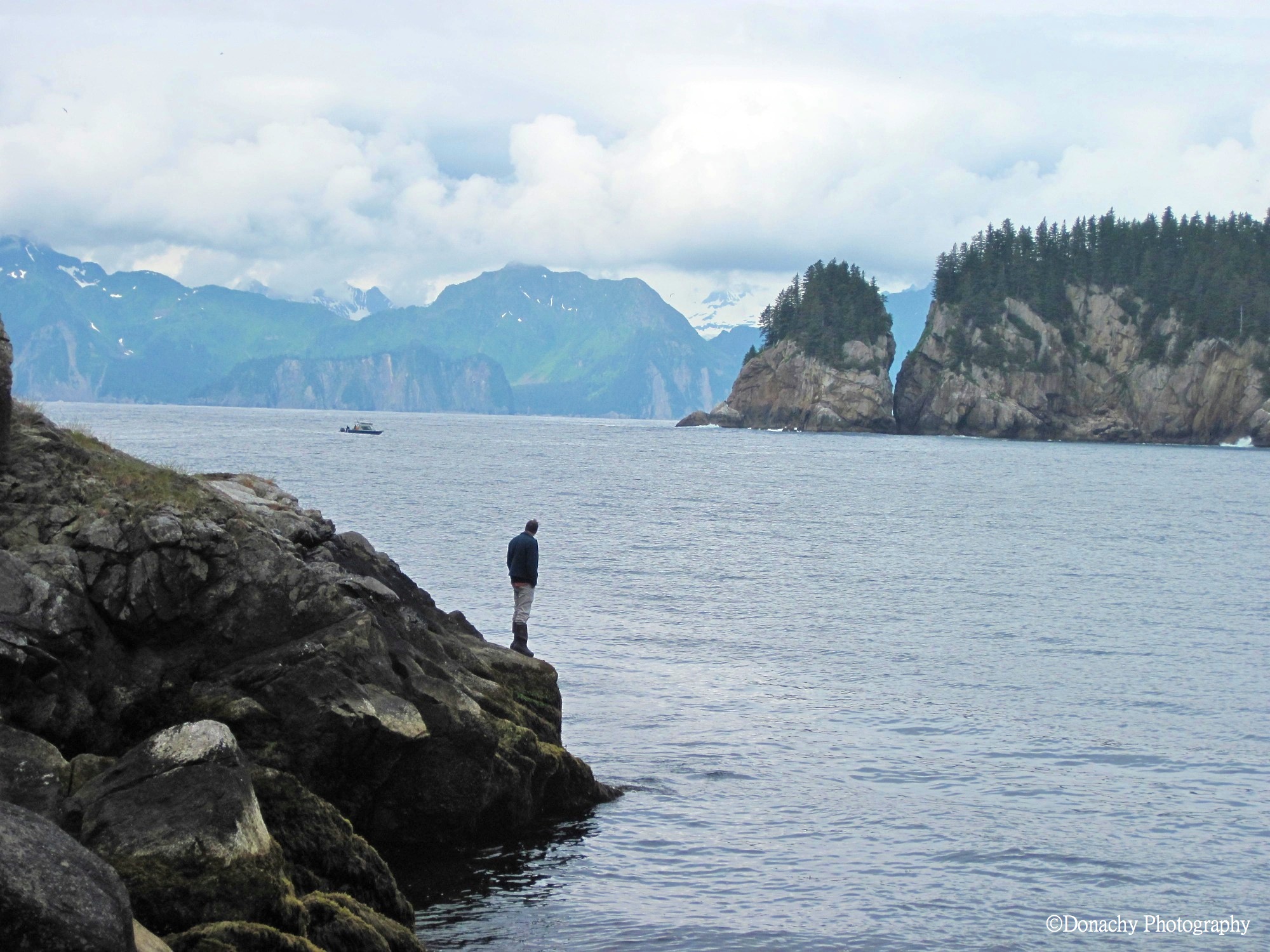
During our sailing class last summer, we took one of the sailboats out to this cove on Resurrection Bay where we anchored and then took the dinghy ashore to look around. Barbra caught me gazing wistfully across the water, contemplating the day we might have our own blue water cruising vessel. “We are tied to the ocean. And when we go back to the sea, whether it is to sail or to watch – we are going back from whence we came.” John F. Kennedy

This past week we made an offer on a sailboat. She was docked in Seward, where we took sailing lessons and were camping most of the summer. We went onboard to look her over a couple of times, and then, just before we left Seward, we saw her hauled out for a new coat of bottom paint. She’s a lovely vessel, neither too large nor too small by our sights, sea  worthy and sea kindly enough to take us to any destination we have the guts and gumption to chart a course for, well-appointed enough to allow us to live in comfort once we arrive.

For the past seven months we’ve been kicking it around, researching other vessels, researching blue water sailboats in general, running numbers and scenarios and…

And we finally came to the realize that this – sailing – is like most other things in life that are worth doing: at some point there is nothing left to do but make a decision, push your chips forward, and go all in.

Today we received word that our offer was accepted. So we’re all in. Guess we’re going to learn something about boats and sailing!

Perfect Pork Cutlet with Cowboy Rub & Roasted Raspberry Chipotle

When it comes to preparing pork loin cutlets, time on the grill – or under the broiler – is everything. We prefer cutlets cut thick – generally one-and-a-half to two inches. That translates to 16 to 18 minutes cooking time under a broiler or over fairly hot charcoal. The rub and attention to cooking time prevents these tender, lean cuts of meat from drying out. We purchase our cutlets in bulk from Costco and repackage them in pairs for freezing. In our experience, the quality of Costco meats is on par with that of specialty butcher shops.

The Perfect Pork Cutlet

  1. Pick a rub with some heat and thoroughly apply it to the cutlets. (I used The Spice Hunter’s Cowboy BBQ Rub this time.)
  2. Preheat a broiling pan under the broiler on high heat.
  3. When the pan is hot, spray or brush it with olive oil. (Refillable pump spray bottles are perfect for this.) Continue preheating another minute or two to get the oil good and hot.
  4. Place the pork cutlets on the broiler pan. They should sizzle.
  5. Set a timer for 16 – 18 minutes.
  6. After 8 minutes, use tongs to turn the cutlets over and continue broiling for remainder of time.
  7. Remove cutlets from broiler and let them rest for a few minutes to lock in the juices.
  8. Place a generous dollop of your favorite chipotle sauce (or apple sauce) – warmed – on a warm plate, place the cutlet on the sauce, and serve. (If you haven’t tried Fischer & Wieser Roasted Raspberry Chipotle Sauce… It’s delicious and has inspired me to create a cloudberry chipotle from berries we pick this coming summer. Look for that recipe on this blog in late summer, 2012.)

In winter, roasted vegetables go well with this dish. Add a Pinot Noir with lots of dark cherries or berries.