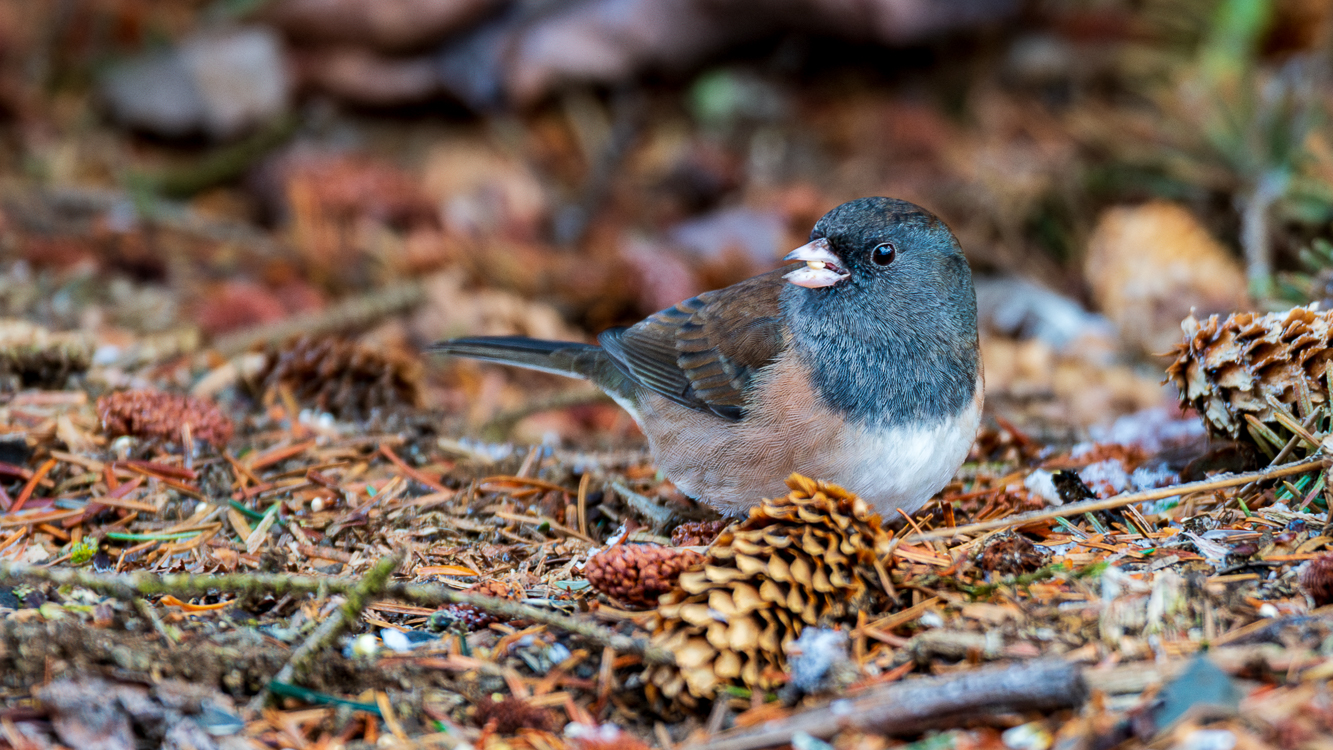
Oregon Race Dark-eyed Junco, Sitka Spruce Grove, Chignik Lake. As far as I’ve been able to determine, the Oregon Race specimens of Junco hyemalis we observed and photographed our first year at The Lake represent the first ever records of this bird on the Alaska Peninsula. We saw both Slate-colored and Oregon Race specimens of Junco hyemalis every year at The Lake from 2016 through 2023. It’s time for various authors and institutions to update their range maps.November 29, 2016.
“I’ve been hoping to see you!” Sam came out to intercept me as I was walking along the dirt road past his house on my way to Sitka Spruce Grove. It was an overcast, cold November morning, the tinny smell of snow in the air. “I’ve been seeing a bird I’ve never seen out here. Batman birds. They have a dark head, like Batman’s hood. Nick’s been seeing them too. We’ve been calling them Batman birds.”
“Yeah. I’ve been seeing them too. Just in the last few days, right?”
“Yeah. I’ve never seen them before. What are they?”
“Oregon Juncos. They’re not supposed to be here. I’ve checked my books and range maps on the internet. This might be the first time they’ve ever been out here.”
Sam, in his early 70’s and not more than five-six looked up at me as he rolled the burning cigarette he was holding between his thumb and his first two fingers. For a moment nothing was said. He lifted his arm to take a drag and looked out over the landscape as he let the smoke out. Winter-brown salmonberry breaks and willows, scrub alders an even more drab shade of brown covered the country all the way to the treeline on nearby snow-capped mountains, country that in Sam’s youth had mostly been tundra.
“Things sure are changing here,” he said.
There are still people in denial, people who not so very long ago dismissed Climate Warming as some sort of hoax, who refused to believe any scientists except those who work for the fossil fuel industry. Most of those hardcore deniers have given up the tack of total denial. But they haven’t gone away, and they certainly haven’t conceded their error. Instead, the refrain now is initial agreement, “Yes, it appears the earth is getting warmer,” followed by a deflating return to denialism with, “but the world has always been changing.”
Not with this rapidity it hasn’t – the occasional meteor strike notwithstanding.
The result is that almost anywhere one lives, change can be observed in real time. This might be manifested in new species of flowers and other plants, new birds, other vertebrates, insects… or the rather sudden absence of formerly familiar species. Anyone with a camera has a chance to contribute to real-time, meaningful documentation of the change that is occurring right now all around us.
It’s not just the natural world that is undergoing rapid change. As expanding urbanization follows an overpopulated species across the globe, historic buildings are being torn down, forests leveled, rivers rerouted, lakes and aquifers emptied. Things that had remained much the same for decades, for generations even, are suddenly in a state of upheaval.
Photography is used for many things: to capture holiday moments; family portraits; events of all kinds; and increasingly, to make fine art. But some of the most compelling photographic images have always been and continue to be well-composed, straightforward documentation.
Anyone with a camera can make a meaningful contribution. Get out and shoot.
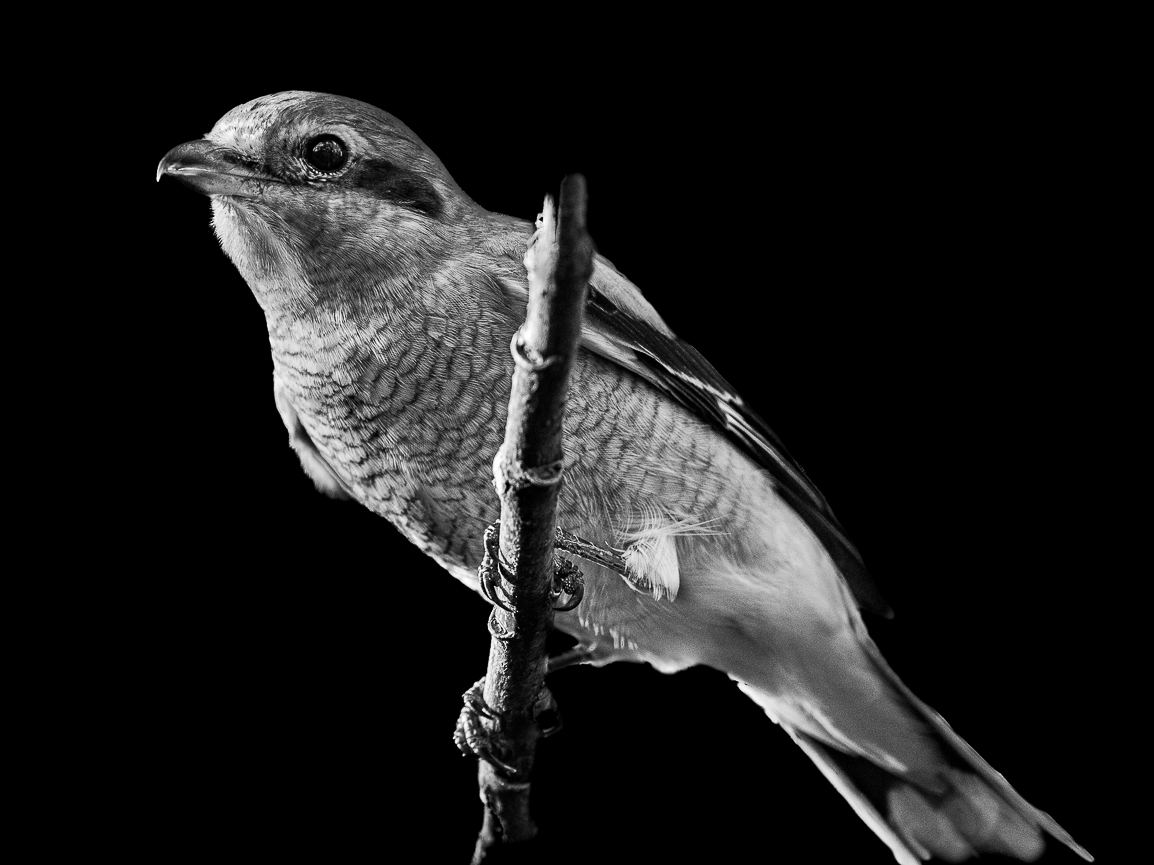
Spirit Bird– The day we arrived at The Lake, I heard the cry of a bird unlike I had ever heard. I’m not sure how I knew, but I knew. Shrike. I looked up to where it was perched on a utility wire. “Uncommon to rare,” according to Sibley. At the time I didn’t know much about photography or birds, but in that moment I understood that I was in a special place and that there was work before me. And so I ordered a new field guide and a copy of the Cornell Lab of Ornithology Handbook of Bird Biology (716 pages, more a tome than a handbook), acquired a long lens, and began.8/27/16
Sawbill: Red-breasted Merganser with salmon parr catch, Chignik Lake, Alaska, 12/31/16. One of my first photos of this species. Note the formidable serrations on the bill, hence the colloquial “Sawbill” sobriquet. The image, as it pertains to The Lake, is somewhat misleading as a piece of documentation. In my observation, our diving ducks were far more likely to make a meal of sticklebacks than of salmon parr.
It has been a daunting task, going through not merely thousands, but tens of thousands of photographs Barbra and I have taken during the 16 years of our marriage. In the early days, I did not shoot. It took Barbra’s coaching to instill in me the confidence to pursue a photography dreams I had set aside long before I met her.
Recollections grow blurry with time. Add to that the fact that we often didn’t see what we may think we saw; that frequently we didn’t experience what we thought we experienced. Anyone who has ever faithfully kept a journal and then gone back later to reread events recorded there will invariably think to themself, “Huh… that’s not the way I remember it,” a firmly held memory tripped up by one’s own written record. No one can accurately write about their own life and pretend that it is some sort of self-biography.
All memoir is fiction, and rightly belongs in that section of the bookshop or library next to other novels. It is folly to call memoir “autobiography” and tuck up next to the truer stuff of biography. With that understanding, we proceed.
Four months into my 12th year, the fall of 1971, I discovered on my father’s bookshelves A. J. McClane’s McClane’s Standard Fishing Encyclopedia and International Angling Guide a 1,057-page tome that changed my life and in retrospect provided a vital stepping stone along a path that led to The Chignik. Filled with angling lore, photographs, fish recipes, fly patterns, fly-rod theory, and species by species, state by state, country by country descriptive synopses it was, from the time it was published in 1965 on through the 1970’s, the one volume virtually every serious student of angling had on their shelves. The color plates featuring dozens of flies, accompanied by recipes for their patterns, made the book a must all by themselves. It was from that book, at the age of 11, that I learned to tie an Alaska Mary Ann, a fly of no meaningful application on the Brook Trout and stocked Rainbows and Browns of my Pennsylvania youth, but which I kept in my fly box as a kind of talisman holding within its wisp of white calf tail wing, jungle cock eye and silver tinsel ribbing a life I dreamed of.
I wasn’t permitted to be in the small library where McClane’s was shelved, but arriving home from school each day well before my parents returned from their teaching jobs at the local state college gave me an hour or so of privacy with this wonderful book before the sound of the kitchen door opening signaled me to spring up from the oriental carpet where I’d been kneeling over the book, return it to its place, quietly ease the den door shut, slip out of the room and sprint up the stairs to my bedroom. Minutes later, I would come back down the stairs and find my parents in the kitchen. All the while my younger sisters would have been in the downstair TV room, glued to and hypnotized by reruns of Gilligan’s Island and similar fare.
Anyway, at some point it came to me that 1) angling connected the world as did virtually no other pastime, far more widely and passionately practiced than anything else I could think of and that 2) A. J. McClane, editor-author of this massive compendium of angling expertise, angling editor of Field and Stream magazine, regarded as the foremost angling journalist of his time, would not live forever. Someone would become the next A. J. McClane.
Why not me?
My first mistake in attempting to embark on this journey was to share this dream with my parents. She put a needle in the balloon of my hopes with a single syllable laugh. He dismissed my aspirations with the same two-word opinion he voiced anytime I expressed a hope or goal. You’re delusional.
Nonetheless, when I mentioned to him the book I’d found and asked to borrow it, he allowed me to take it to my room. I doubt he had ever read more than a few pages out of it and probably hadn’t touched it in years. So the book became mine, and I pored over it. That Christmas, I once again engaged in the annual futility of asking for a for Christmas present. I wasn’t allowed to cook in her kitchen, so for the immediate future I had no means of beginning to acquire McClane’s culinary skills, but a friend of my father’s had recently taught me to tie flies and to cast a fly line and I was getting the hang of all that. I needed a camera. The little bit of money I’d made painting my godfather’s garage that summer had already been spent on clothing for school. So I asked my college educated, college teaching parents for a camera. “That’s all I want,” I told them. “I need a good camera. Don’t get me anything else. Just a good camera.” I supplied them with a specific model that was popular at the time. I suppose the term for what I was hoping for would be an “enthusiast’s” camera – something of sufficient quality to learn with.
I should have know better, having been through this charade with them every Christmas of my sentient life. That year, in addition to the usual packages of underwear (for Christmas… sigh… I should have given her a dusting cloth and a can of Pledge), there was the usual assortment of stuff I had no use for – enough of it that, added together, it would easily have paid for the camera I had pleaded for along with many rolls of film.
There was a camera… a Kodak Hawkeye Instamatic II… a ridiculous “all plastic” model from which it was impossible to coax a decent image. The camera was a promotional gimmick available for free at department stores. Purchase a couple rolls of film and a couple more of “magic cubes” flashcubes, and Kodak made money off of it. I have an image in my head of showing the camera to an uncle who was a skilled amateur photographer and the way he silently turned it over in his hand as though trying to make sense of it while searching for something positive to say, finally concluding that there was nothing to say before simply saying “Here you go,” as he handed it back to me and turning a quizzical look toward his sister. That spring, on a trip to Washington, D.C., I saw seven and eight year olds with the camera. It was of no use to me.
Lacking the means to pursue McClane-esque dreams on my own and with no support to be had from my parents, I honed my expertise in one of the great gifts I learned living with them: the art of turning my attention elsewhere. Along any path, on any journey, one is likely to encounter obstacles. The ability to find a path around those obstacles, to continue moving forward in life, cannot be overestimated in its value. Resilience. Head up, looking for an open window when a door is closed. My parents did not mean to teach me this art; I’ll never know exactly what their intent was. But the art of moving forward is the finest thing I learned while negotiating my way through life with them.
Years passed. Decades. I never completely got the idea of photography out of my head… but it seemed that the older I got, the more trepidation I had about picking up a camera and beginning to learn. When a friend invited me to attend a photography exhibit during a visit to L.A., the art I was looking at seemed so far beyond anything I might be capable of that, then in my 40’s, I concluded I would never by a photographer.
Enter Barbra.
When I began seeing her, she was shooting with digital bodies matched with an assortment of lenses. She’d taken classes at the college level, and in the pre-digital era had converted a closet into her own darkroom. It was all way beyond me, but I couldn’t conceal my curiosity. Cueing off my obvious interest, she repeatedly encouraged me to give it a go. With feelings tugging me in contradictory directions, initially I demurred. Months passed before I worked up the courage to finally ask her to show me how her D90 worked.
That seems like a lifetime ago. Year by year, new skills, new knowledge and growing enthusiasm have led to acquiring ever more sophisticated gear – and, in this digital age – an ever growing body of images. Using Lightroom (think of it as a digital darkroom with a searchable database and library) to retouch and catalog these images, I’d been doing a steady job of keeping up with our pictures till a disaster of the most fortuitous kind struck.
While transferring Lightroom files to a new computer, we wiped out all the key-working and all the edits. Countless hours of work vanished.
Turns out, that was a good thing.
Because my original key-wording was a mess. I didn’t initially understand that “key word” is best thought of as a, single, word. So I had photos tagged with long phrases, and hence a long list of keyword phrases which resulted in a headache of cluster and a difficult to search data base.
The photo retouching I had done in those days was subpar as well. Practice makes better. The more retouching I performed, the better I became at it. Not only that, my eye developed. Even before we lost all those edits, looking back on my files I was beginning to see that my early edits needed work – that in many cases, I would be better off resetting the photo to its original state and starting over.
So…
At this point, I’ve gone through our scanned photos, wedding photos, Sacramento Days, Alaska-Canada Highway, Seward Summers, Shishmaref, Point Hope, Mongolia, San Francisco. Along the way, I eliminated thousands of pictures, key-worded and retouched the keepers… and continued learning.
At last, I have reached the tens of thousands of images we created at The Lake. My view is that if a picture is worth keeping, it’s worth cataloging so that it can readily be located, and it’s worth retouching (cropping, adjusting exposure, hue, vibrance, contrast, sharpness) to bring out its best qualities. I have a friend whose father left behind, at death, thousands of photographic slides. “What am I supposed to do with this?” he said, mild exasperation in his voice as he motioned towards cabinet drawers jammed full of uncatalogued slides.
Either hire someone to go through and curate them or make a bonfire, I suggested.
I can’t bring myself to add up how many photos are yet to be finished. When climbing a mountain, a glance at the summit should be enough; after that, it is best to keep one’s eyes on the path just ahead.
Seven year’s of images from the Alaska peninsula, plus our bicycle trek in Hokkaido and other summertime adventures during those years. But it’s good work, the kind that puts a smile on my face as I revisit happy memories. I confess that I teared up when I opened the first image from our Lake years – an aerial landscape of endless, jagged, snow-capped peaks as we flew down the Alaska Peninsula for the first time to live among Alutiiq Native Americans in a tiny wilderness village along one of the world’s last, great, seldom-touched salmon rivers. The extraordinary fly-fishing that followed; the bird project; the flowers and wildlife and landscapes and people.
I’ll continue to post a photo each day or so from this massive library – a sample of those that I really like. My hope is to finish sometime this spring, at which point I’ll be ready to move forward with the next project.
A male White-Crowned Penduline Tit pauses bin front of the opening to his nest, Tuul River, Ulaanbaatar, Mongolia. June 13, 2015
Known as the Hatan Tuul or Queen Tuul, the Tuul River constitutes a vital greenbelt in Mongolia’s capital city of Ulaanbaatar, and thus an important refuge for a variety of birds. Noticing a couple of sock-like nests in leafless wintertime trees along the river, we set about to find an active nest the following spring. As the above photograph indicates, we were successful, and although shooting into dense foliage in a valley that only received decent light once the sun had cleared the surrounding tall buildings and mountains presented challenges, we managed to get several captures of both male and female White-crowned Penduline Tits. Only about four inches or slightly less in length (8 to 11 cm) and continuously in motion through leafy trees, they made for challenging subjects.
Woven of soft, cottony material from willows and similar trees, we were told that in former times the nests were occasionally used as children’s slippers. In the above photo, the entryway is mostly obscured behind the bird’s torso. Nest-making is primarily the male tit’s responsibility, and although I can’t at the present locate the source, I recall reading that they may make two or even three nests of which only one will be used. What a cozy home for the nesting female and her brood.
The sun hadn’t yet crested the horizon when we came upon a covey of these strikingly marked fluff balls – Daurian Partridges in Khustai National Park, Mongolia. December 30, 2014
I’d been shooting for about four years when I took the above photograph. Still not sure what I wanted to photograph, our Lightroom catalogue was becoming populated with images of wildlife, portraits, landscapes, fishing, food, family events and so forth. But no doubt about it, birds have always held a fascination – and, though I didn’t know it at the time, would become my pathway forward.
It may be that for most of us a general approach is the most logical entry into a new endeavor. But based on my own experiences as well as observations of others, it seems that it is not until we specialize that rapid growth begins. So the angler eventually finds her way into fly-fishing, and not just fly-fishing broadly, but a specific type of fly-fishing. A cook becomes a chef when he undertakes to master a specific culinary repertoire. And so on. The interesting thing is that as one specializes, broader skills and knowledge are acquired and sharpened. So that even catching bluegills or frying an egg is performed with greater proficiency… while simultaneously a leap into a new kind of fishing or cooking, launched for a base of expertise, is also made easier.
A generalized approach feels comfortable, particularly at the start of a journey. The broadness, the lack of pressure to get one thing right, feels safe. But if one truly wishes to master a vocation, it is sound advice to not linger overly long with as a generalist. Specialize. Pick an area and dive deep. Take what is in front of you. Doable. For a couple of years, the best angling available to me was carp fishing. Not my first choice of fish, but I lived within a short bicycle ride of a fine river with a good population of the cyprinids, and so I threw myself into it… and saw my skills in virtually all areas of angling improve. Surely this is the way it is with most things – photography, culinary arts, writing, art… Begin the journey with a broad approach, but with eyes open for a narrowing path.
Red-billed Chough, Mongolia. This was one among about a dozen choughs in an open field, gathered around the remains of one of their own – feathers, blood. It appeared that a raptor had made a kill; and the choughs were holding a funeral service.
I must’ve been around 13 years old, walking up the Route 322 hill to my summertime job at Martin’s Exxon Plant when I came upon a stunningly bright Indigo Bunting hovering and circling madly back on forth from nearby brush to the shoulder of the road. There on the stony berm, lifeless, was a brown bird of similar size and shape. His mate. The victim of an automobile – most of which, in this man’s opinion, are permitted to travel far too fast for anyone’s safety and sanity… this unending modern obsession with “getting somewhere.” I digress.
Male and female Indigo Buntings. Plate by Louis Agassiz Fuertes in Birds of America (1917) edited by Thomas Gilbert Pearson (1873-1943) et al.
It was my first encounter with the deeply rooted connection – emotions – birds can feel for one another. Fearing the frantic male’s behavior would result in him joining his mate as a victim of the traffic whizzing by, I picked her up and placed her in an open area in the brush away from the highway. So that he could mourn more safely.
As years went by I witnessed other examples of similar behavior among various species of birds: crows, magpies, a pair of Narcissus Flycatchers – the one fallen and the one who would not leave his or her mate’s or offspring’s side. A group of Magpies that would not leave an injured member of the flock. A family of Ravens appearing to search for a child that had gone missing.
But the behavior of these Red-billed Choughs was a first for me: not merely a pair of birds bonded through nesting and breeding, but a small flock, gathered on the ground, unwilling to leave a fallen brother or sister. I wish I had thought to make a video record of the event.
On the other side of the rock the chough in the above photograph is perched upon was a jumble of feathers, bony, disembodied feet, blood. The remains of a friend, a loose circle of other choughs pacing solemnly around those remains. I have since wondered what, if anything, the bird in the photo’s perch on the rock, slightly above the others, may have indicated about its status.
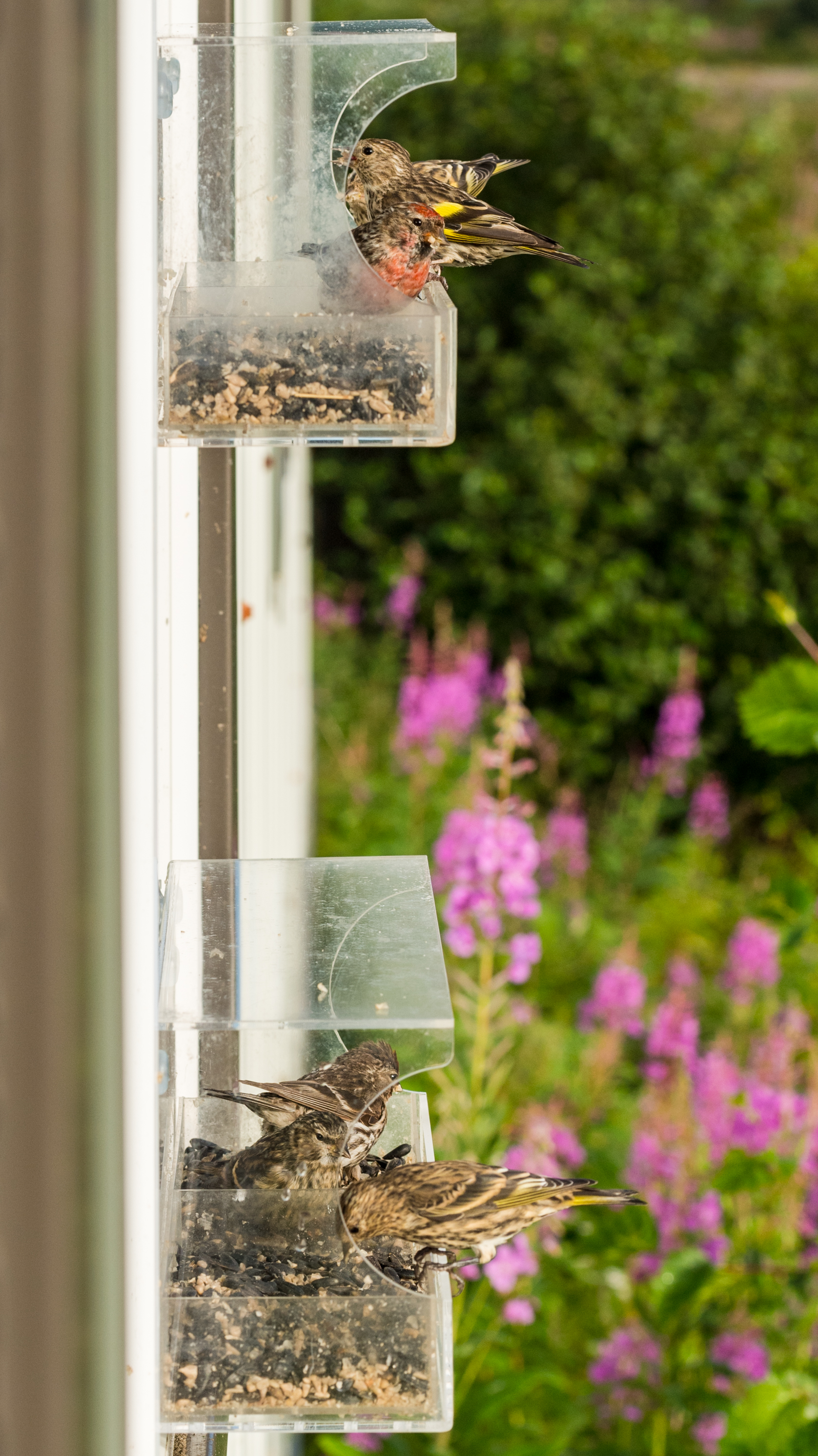
Their hard little feet feel cool on one’s fingers, and despite sharp bills they are gentle feeders. The large red bird is a male Pine Grosbeak. The golden-yellow one is a female. The smaller birds are Pine Siskins. Both species are finches and at times are abundant in the village of Chignik Lake.
This past summer we placed skepticism aside and purchased a couple of clear plastic window feeders – the kind that attach to a window by means of suction cups. We didn’t know whether our resident seed-eating passerines would take to the feeders. Our main source of reservation, though, was doubt that they’d stay up. We get some fierce winds here at The Lake as well as hard freezes, and UV rays can make short work of plastic that is constantly exposed to the sun.
The feeders drew customers within a few days of installation.
But here it is, the New Year on a windy, snowy, freezing January afternoon and our two feeders remain firmly in place. With occasional soap and water cleanings, they’re as good as new. As many as 60 or so finches come around at a time, impatiently waiting for a turn at the feeders. This has prompted us to order a third.
Thus far, the feeders have attracted 12 species of birds. In the feeders:
Pine Siskins
Common Redpolls
Pine Grosbeaks
Black-capped Chickadees
Golden-crowned Sparrows
Black-billed Magpies (which we generally shoo away)
A lone European Starling (the first – and last – of this species to be documented this far down the Alaska Peninsula)
Downy Woodpeckers
Taking advantage of seeds on the ground below:
Dark-eyed Juncos (both Slate-colored and Oregon races)
One or two White-crowned Sparrows
a Tree Sparrow
and one lonely Snow Bunting
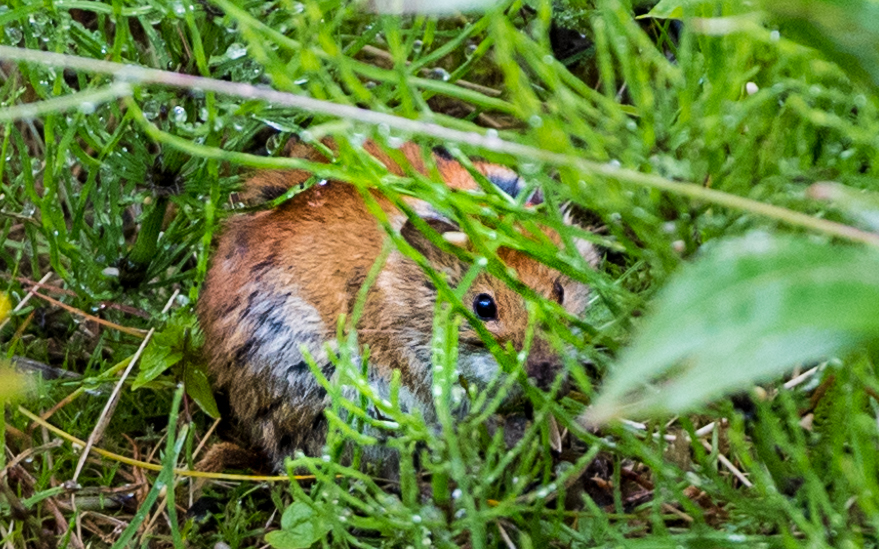
Oh! And Red-backed Voles and a lemming!
Shy little fellow, we often find voles – or signs of voles – where birds are being fed.
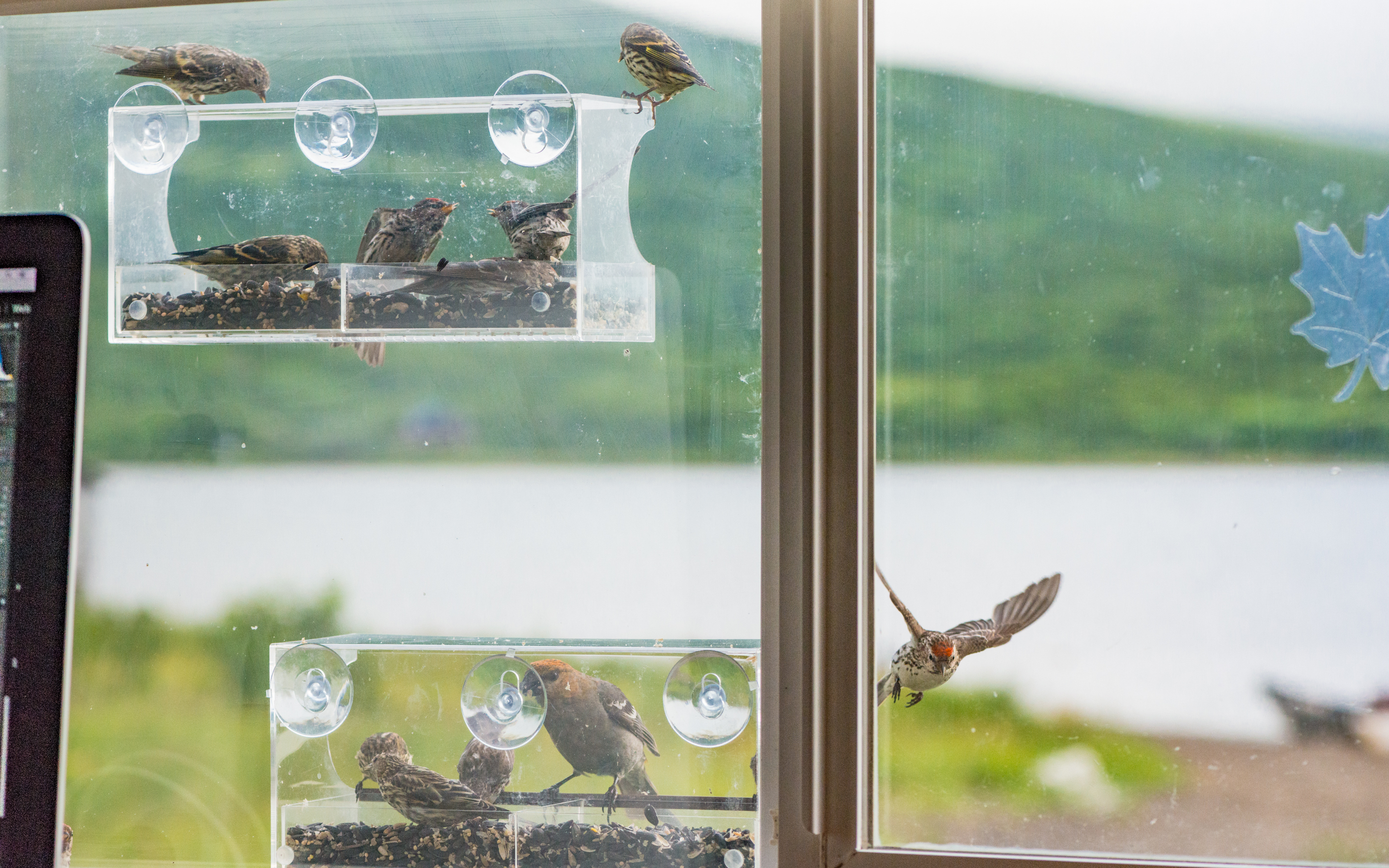
That’s my computer on the left side of this photo. While writing and editing photographs, I now not only have a view of Chignik Lake, I sit a mere three feet from constant avian activity. It has been fascinating to have such an up close and personal view of the birds and to witness behaviors and characteristics I’d never before noticed. For example, one could make a study of the various hues of Redpoll caps and beak shapes.
Our dining table – a three-foot tall, window-heigh pub table – sits just to the right of the photo. It’s been a pleasant part of our day, dining along with the birds and the birds dining along with us.
Notice the translucent maple leaf affixed to the window. All of our windows are adorned with similar leaves and bird silhouettes in order to help birds be aware of the panes of glass, thereby avoiding deadly collisions. We encourage everyone to install similar decals on any clear window – home, school and place of business.
With just a few days remaining for us in Chignik Lake, we continue to add to our project documenting bird species within a three-mile radius of this tiny, remote village on the Alaska Peninsula. With approximately 75 different types of birds observed – and good photographs of most of those species – much as been accomplished, including getting photographs of birds that, to the best of our knowledge, had never before been recorded out here. But, as with any project of this scope and complexity, much remains undone. We only now are getting into making videos and immediately have been intrigued by the unique possibilities this medium offers. With open invitations to return for future visits, we hope to make it back to this paradise by The Lake.
Aside from brief clips of a Fox Sparrow in song, Pine Siskins coming to Barbra’s hand for seed, and a Red Crossbill going to town on White Spruce cones, this is the only bird video we’ve made. It’s the first video we’ve planned out and edited.
For the past few days, dozens of finches – Pine Grosbeaks, Pine Siskins and Common Redpolls – have been foraging virtually nonstop on dandelion seeds in the unmown lawn outside our front door. We’d been enjoying watching this show (and listening to the constant, cheerful bird chatter) from our kitchen and from the boardwalk leading from our house to the school where Barbra teaches. The Pine Grosbeaks in particular have been quite tolerant of our presence – if not downright curious to the point of approaching us. (I once had a Pine Grosbeak land on my head as I was photographing them.) In fact, individual of all three species have approached so close at one time or another we might have reached out and touched them.
The siskins’ numbers appear to be populated by recently fledged members. Earlier this past spring, we saw a redpoll with nesting material and they, too, appear to have young among them. We’re not sure about the Pine Grosbeaks. At present there are about eight grosbeaks – an even number of male and female birds – and although this species might be seen in any season here in Chignik Lake, we’re not sure if these are individuals that overwintered here and filled the spring air with their beautiful song, or whether this a group that is merely passing through. In any event, although David Narver who, back in the early 1960’s compiled the only other detailed list of birds occurring in we’ve been able to find, reported redpolls as “uncommon” and made no mention at all of Pine Siskins and Pine Grosbeaks, redpolls and grosbeaks have been common during our entire three years here. Siskins showed up for the first time two winters ago and have been common since. At times, we’ve counted upwards of 60 birds in flocks of redpolls and siskins, and at least 40 in a flock of Pine Grosbeaks that spent a week or two in the village stuffing themselves on alder cones.
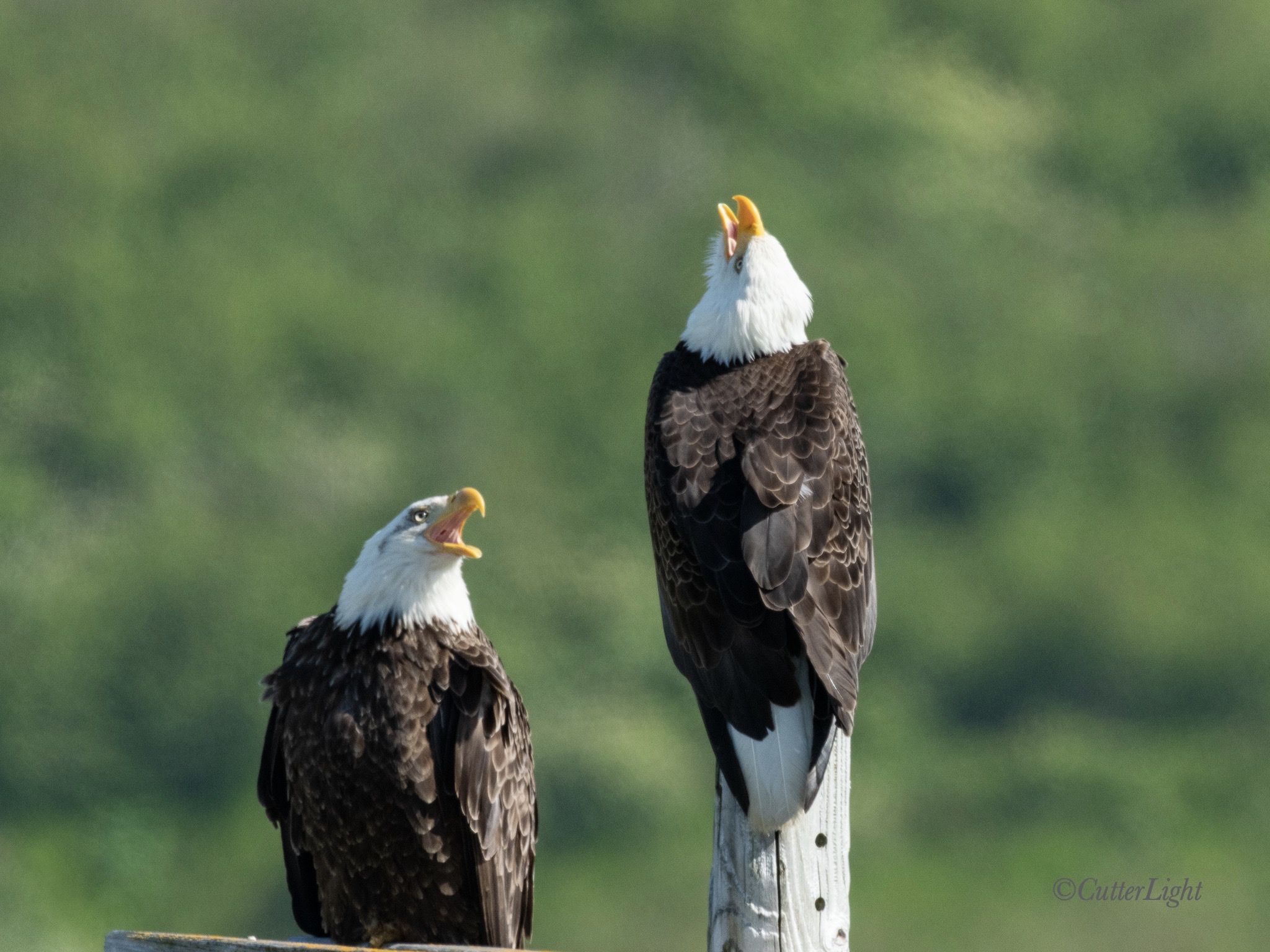
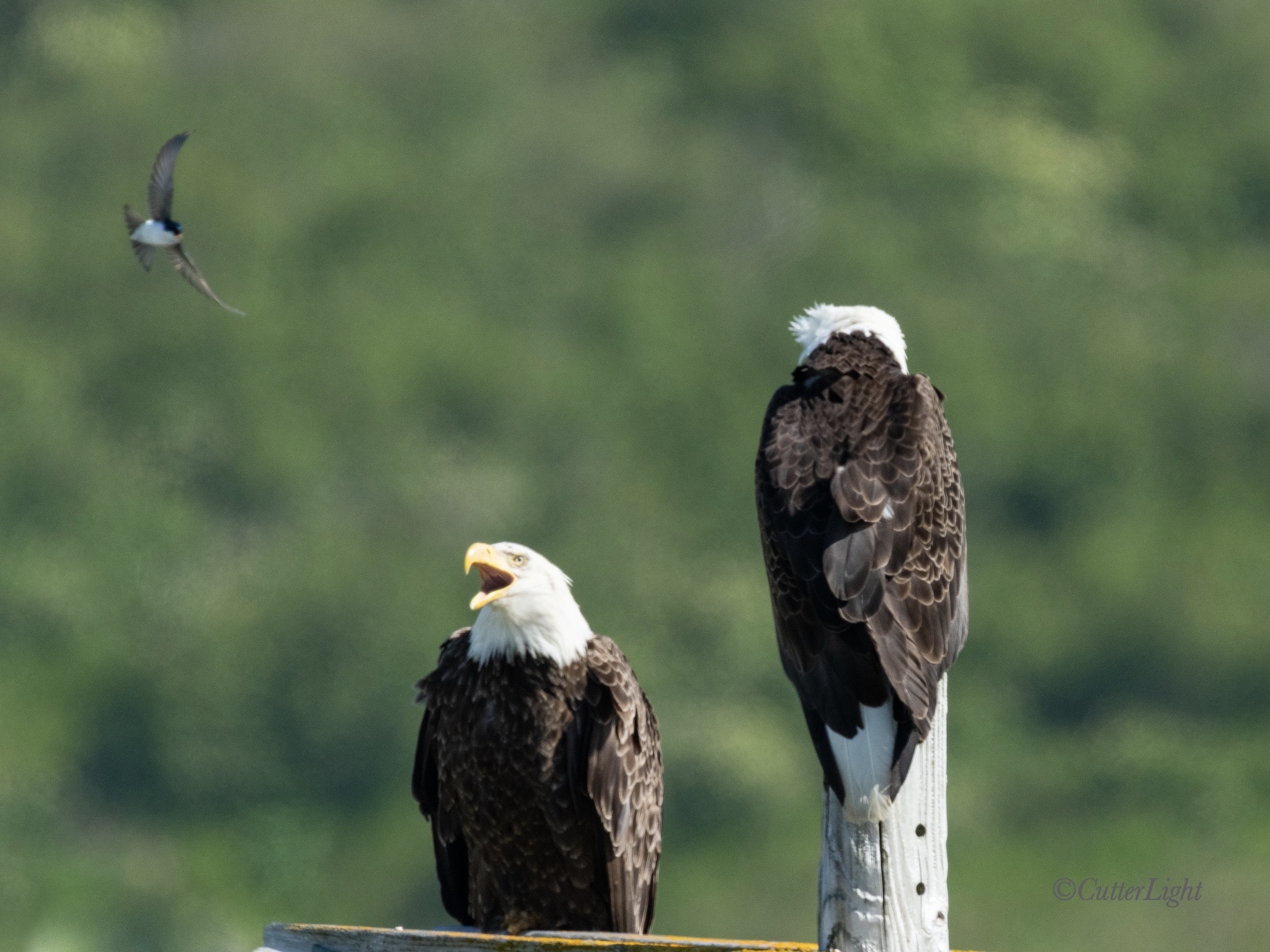
As swallows swooped and soared, this pair of Bald Eagles began a chorus of their characteristic high-pitched piping. The sunshine must’ve felt as good to them as it did to us.
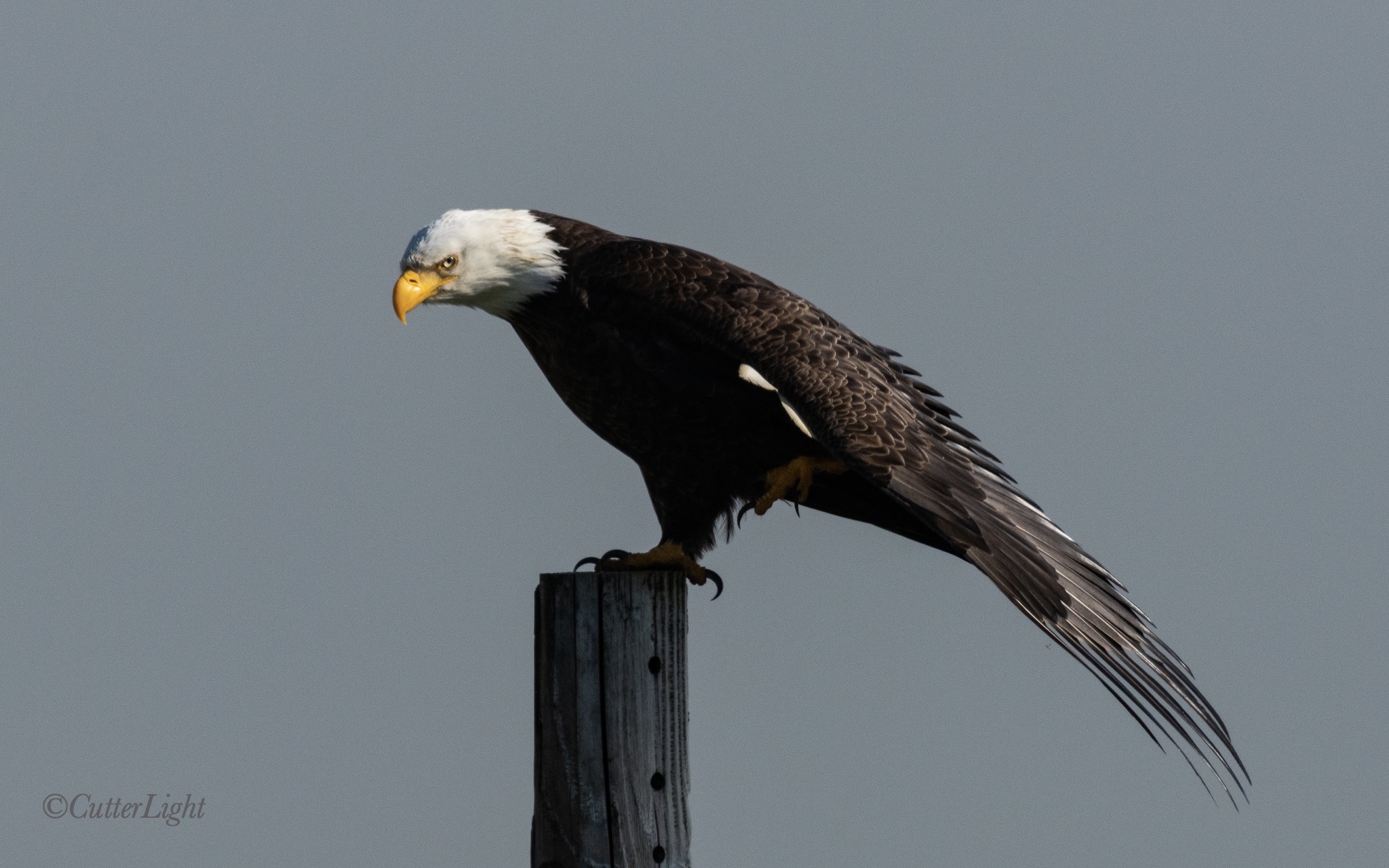
Two days in a row we’ve woken to heavy fog here at The Lake. It wasn’t forecast either day. Yesterday by mid-morning, the mist had burned off. When it did, the birds came out in force. From our vantage point on the deck outside my “office,” Barbra and I saw or heard Pine Grosbeaks, Pine Siskins, Redpolls, Wilson’s Warblers, Ravens, Magpies, Golden-crowned Sparrows, American Robins, Fox Sparrows, Violet-green Swallows, Tree Swallows and out on the lake a small group of Black Scoters and a few passing Glaucus-winged Gulls. But the stars of the morning were a pair of mature Bald Eagles that took up perches on a favorite utility pole near the lakeshore.
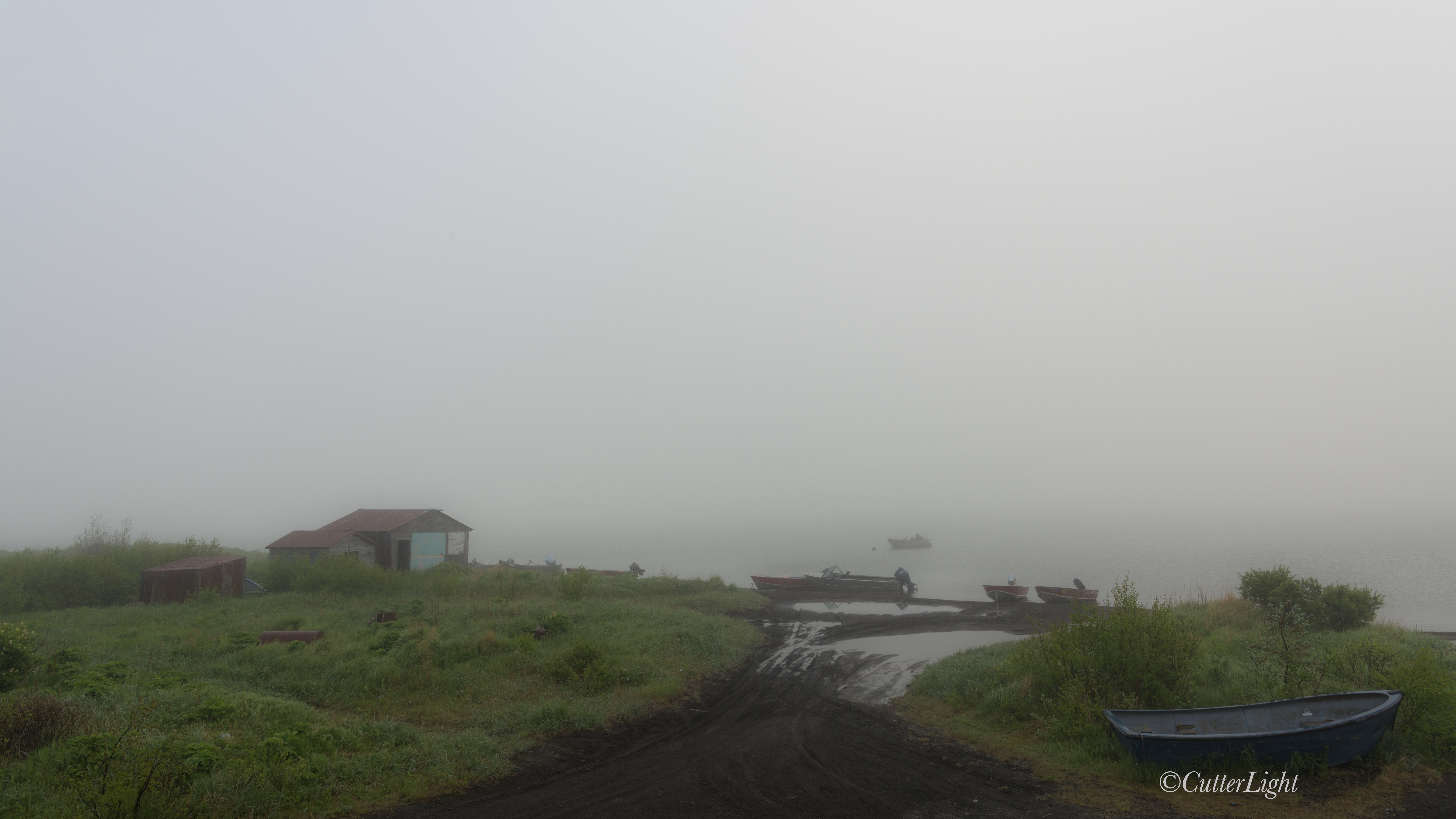
This was the view from our dining room window yesterday morning just after dawn. The village of Chignik Lake lies only a few miles upriver from a bay on the Alaska Gulf, so we get our share of wet weather.
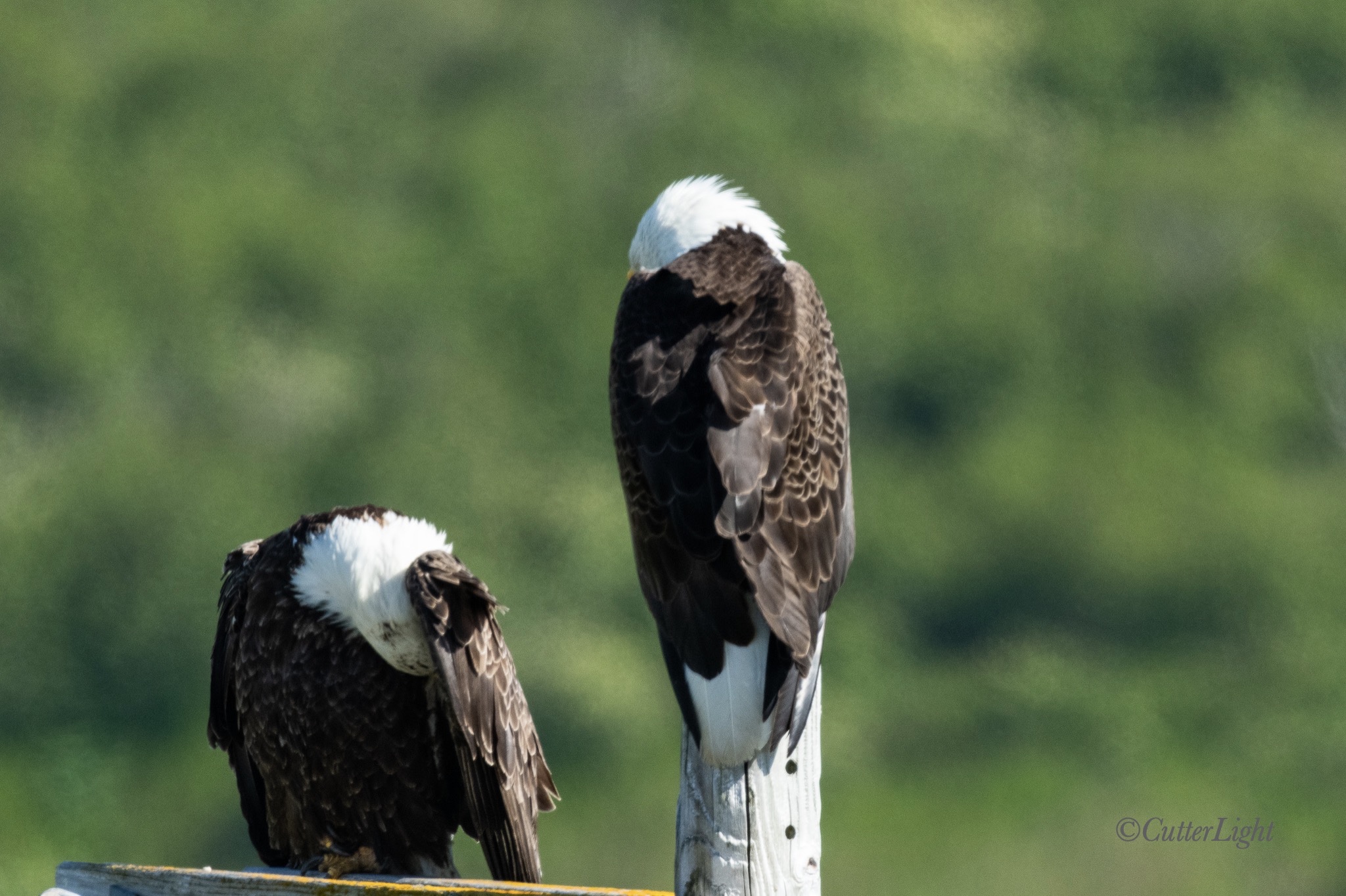
As the sun began peeking through the fog, the first eagle to arrive did its best to dry its soggy wings. Either that, or this is one of those rare Peacock Eagles.
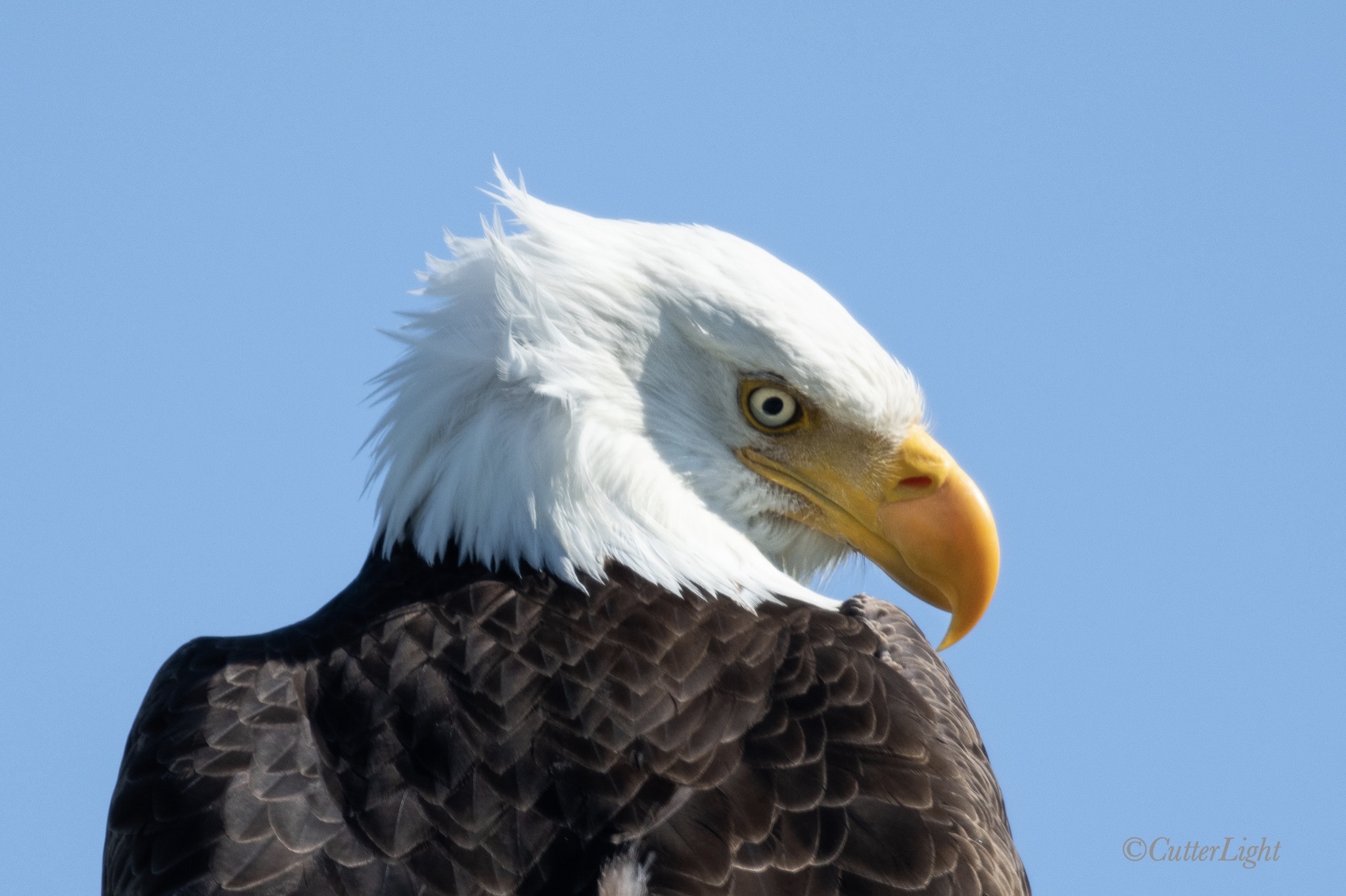
His (her?) mate hadn’t yet arrived and I moved a little closer to capture a portrait. Once the fog lifted, we had a day of blue skies. Temperatures climbed into the 60’s so we took the opportunity to work on our “Alaska Tans” – defined as tans that cover the backs of one’s hands, face and neck down to the level of a shirt or coat collar. But by early afternoon, it was warm enough (mid-60’s) to sit outside in a just a shirt, shorts and bare feet and read (Barbra) and play guitar (me).
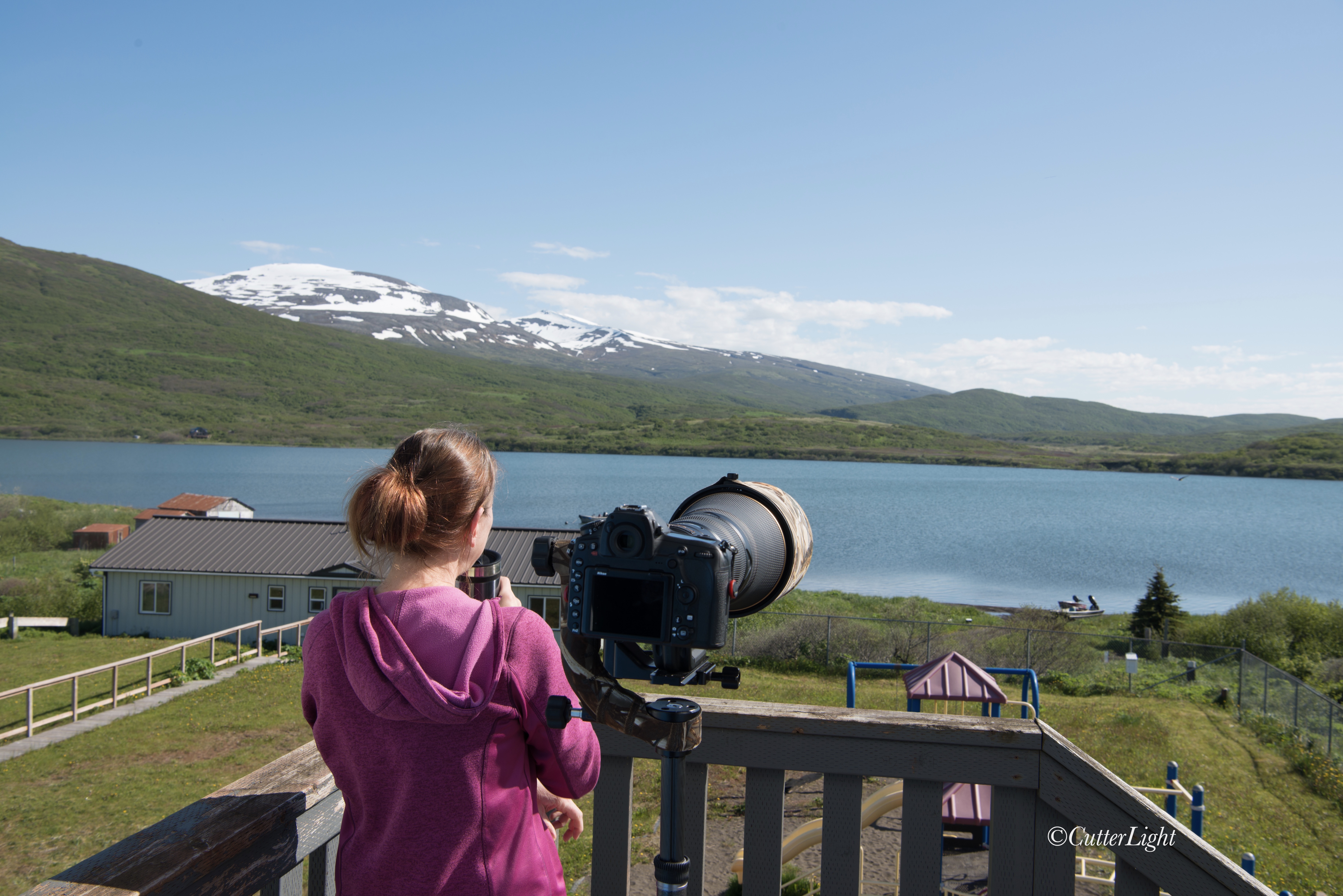
While I worked on photos, Barbra scanned for birds from the deck outside her former classroom. Off in the distance to the right, along the far edge of the lake, the second eagle can be seen soaring low. (You might have to enlarge this photo.) The duplex in front of Barbra is where we live – on the righthand side.
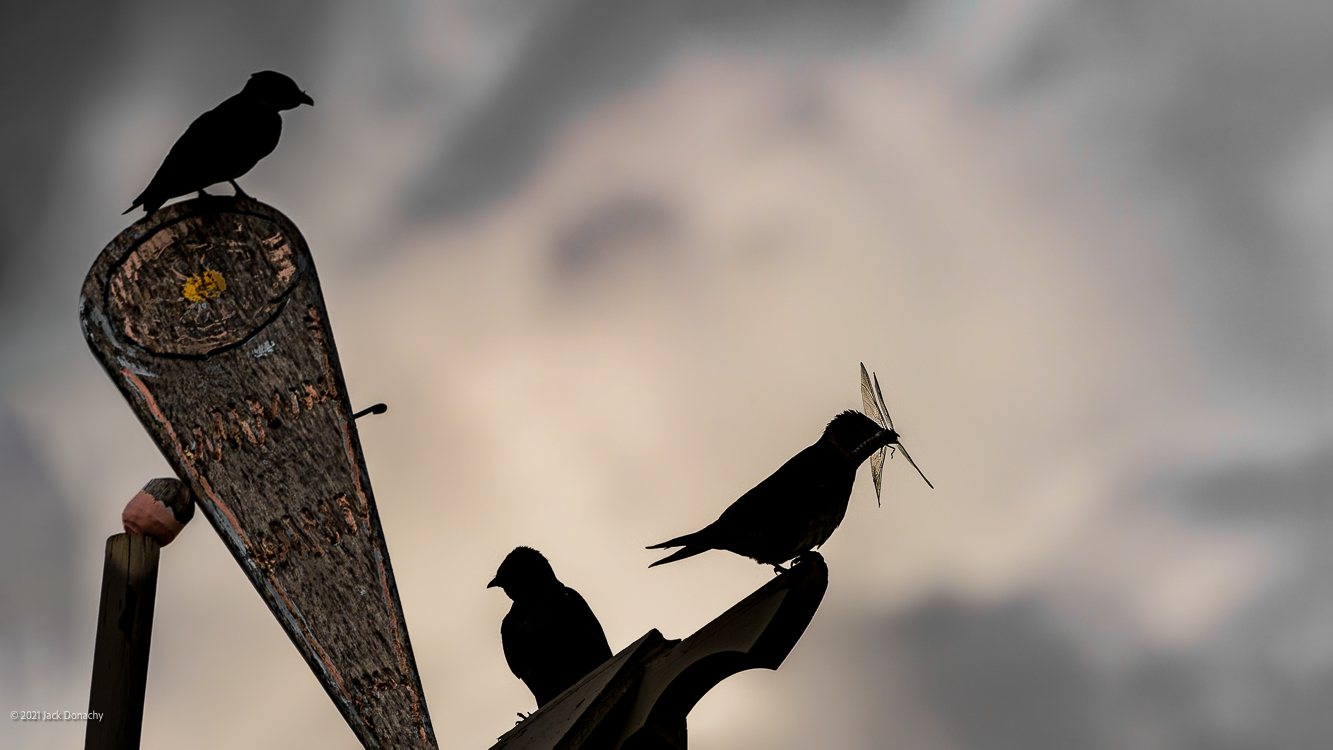
There are at least 50 nesting boxes in this bird-loving village of only about 50 to 70 residents. The boxes are occupied almost exclusively by either Violet-green or Tree Swallows. Both species seem inclined to investigate anything out of the ordinary in their neighborhood – us, eagles, other birds. The real threats to swallows are Chignik Lake’s abundant Magpies – notorious nest robbers. In years past, Merlins, Northern Shrikes and occasional Sharp-shinned Hawks have also posed a threat, but none of these species appear to be present this year – at least so far.
A mated pair? Siblings? Friends? (Do eagles have friends?) It was interesting to watch these two repeatedly mirror each other’s behavior. We’ve read about these dreaded Dracula Eagles – another rare sighting.
As I mentioned, we’ve had two consecutive mornings of heavy fog. Inspired by the way the morning cleared up yesterday, last evening we prepared our pack raft in anticipation of doing a three-mile river float today. Unfortunately, the weatherman got it completely wrong. The fog only grudgingly lifted late in the morning and instead of the calm that had been forecast, winds – the bane of rafting – kicked up. So I spent the morning working on photos. Yet hope springs eternal. The prediction for tomorrow morning is for partial sunshine and calm, so perhaps we can get in one last river float before we have to pack up the gear and mail it to Newhalen. Every hour of these final days at The Lake is a time to savor.
If you enjoyed this post and would like to see some of the birds mentioned and more of the landscape around Chignik Lake, check out the link below:



 CutterLight