I made this image from a picture I took at Mokoto Train Station in Hokkaido when I looked up into a mirror above the waiting platform and saw Barbra there looking at her phone. There’s something about the scene – populated with houses and rail, and yet eerily empty – and Barbra, alone, looking at her phone -, that seemed to imply something universal about loneliness and the fine line between expectation and disappointment. Compositionally, the frame within the frame here appeals to me… as do… exotic elements such as Barbra’s bright red hair, Japanese writing and the ambiguity suggested by rail that appears to be rusted and perhaps no longer in use.
I am happy to acknowledge the influences of others… here a nod to Stefanie Schneider and her Instant Dreams series, which I invite readers to check out on Instagram or elsewhere. I’m not sure that there isn’t a hint of the old Twilight Zone TV series in this image as well… I think virtually all of us of a certain generation carry within our psyches some lingering effect of Rod Serling’s creation.
Speaking of which… as I attempt to build more exposure for my own work, I’ve been regularly posting on instagram. At some point, I intend to build a website dedicated to photography. Until then, Instagram is a good place to see photographs in one place without needing to click around a lot. If you’re interested, here’s the link: jackdonachy. Be sure to leave a “like” if you like what you see. Thanks!
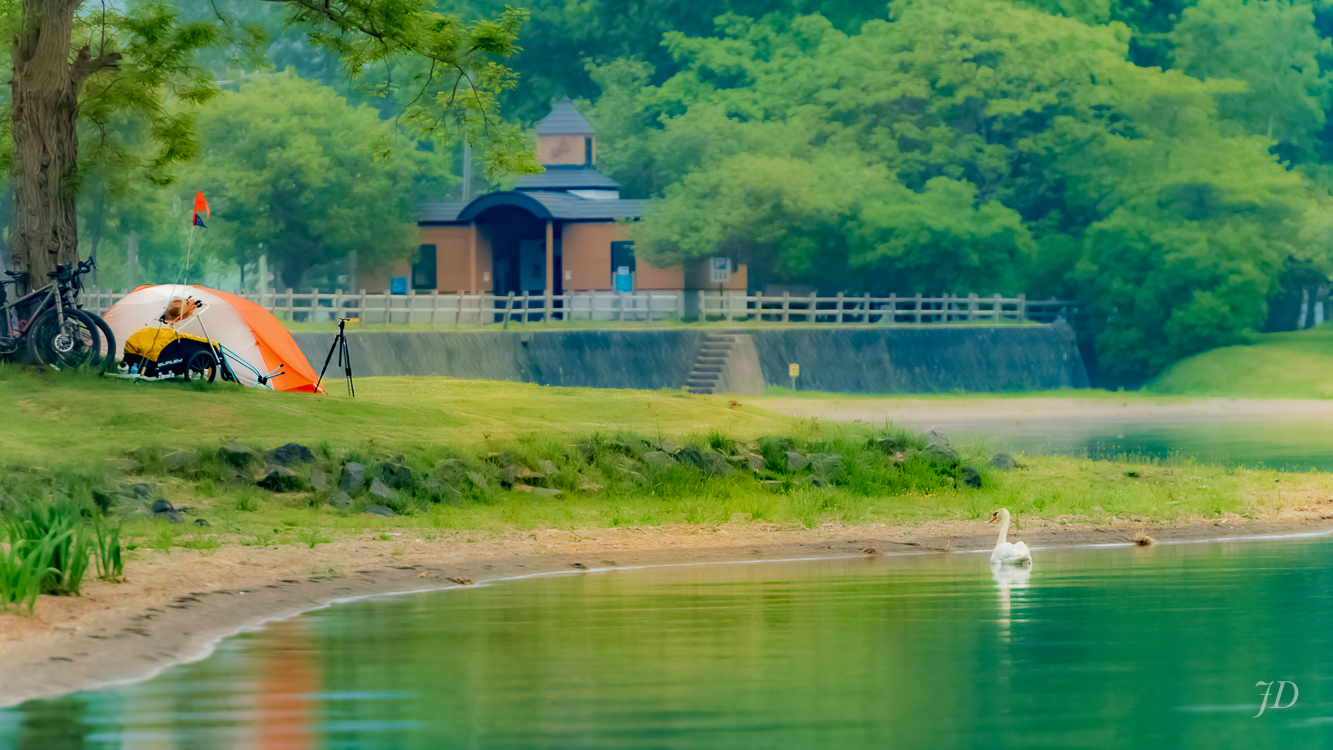
Thursday Morning Coffee Bar, Teuri Island Campground Teuri Island, Hokkaido Japan, June 21, 2018
Clean restrooms close by (to answer the first question on the minds of most casual campers), good clean drinking water, quiet, and the entire grounds to ourselves. I don’t imagine that the camping situation has changed much since we visited Hokkaido in 2018. Traveling to Teuri with our bicycles was easy via the ferry from Haboro on Hokkaido’s west coast. We only spent two days on Teuri, but agreed we could easily have enjoyed a week on this small, bird-rich island.
Scrolling down panels in lightroom as I brought up the above photograph, I decided to give a relatively new feature a try: Lens Blur. With a single click, this AI-driven feature isolated what it interpreted to be the subject and foreground and then blurred (decreased the clarity) of the background. It worked well – which is to say, I liked the result.
To be sure, a more competent photographer equipped with the right lens could easily have achieved similar results in-camera. But six years ago when I captured this image, I was a less competent photographer. Less competent not only from a technical standpoint, but also my eye was less well developed, and so I didn’t always appreciate the pleasing effect a bokehed background could add to a photograph.
While I could have used masks and clarity sliders to isolate the subject and achieve the same effect, this Lens Blur feature significantly speeded up the process. So…
I might have more to say about AI technology in future posts. It’s here, part of our world now. Lots to think about. JD
Rhinoceros Auklet Breeding Grounds, Teuri Island Hokkaido, Japan, June 18, 2018
Not a lot appears to be going on in the above daytime photograph taken on Teuri Island’s cliff-lined northwest. The 2.1 square mile island (5.5 square km) hosts the breeding grounds for several species of birds, most notably seabirds. The holes in the above photograph are the burrows of Rhinoceros Auklets, a species for which Teuri serves as the world’s largest breeding ground.
While it doesn’t appear that much is going on in the photograph – a few gulls milling around notwithstanding – at the end of each burrow, which may be up to six meters (20 feet) in length, a Rhinoceros Auklet chick is waiting for twilight when parents will return from the sea, stomachs, gullets and bills crammed with catches of sand lances and squid. Gulls – primarily Slaty-backed which also breed on the island – will intercept some of the returning adults, but most will make it past the parasitic phalanx. Recent estimates put the auklet population at around 400,000 breeding pairs. Add in the chicks and the species count rises to over a million. Perhaps you can imagine the sight and the cacophony as night gathers and hundreds of thousands of adult auklets return, evading squawking gulls, somehow locating the specific burrow each parent calls home.
Teuri is also an excellent place to see Spectacled Guillemots, Common Guillemots and other seabirds as well as passerines such as Blue Rock Thrushes and Siberian Rubythroats. Regular, bicycle-friendly ferries from Haboro make it easy to get out to the island, and if you don’t choose to stay at the lovely campground (which you’re likely to have to yourself) there are wonderful inns offering comfortable accomodations and truly some of the world’s best fresh seafood.
We found one terrific (often idyllic) campsite after another during our Hokkaido trek. Above is Nakatoya Campground on the shores of Toya-ko (Lake Toya). The lake formed in an ancient volcano caldera, complete with an island near the center – similar to Oregon’s Crater Lake. Overall, Hokkaido’s campgrounds were quiet, clean, and inexpensive. In fact, several were free and if memory serves even the most expensive site was only about $20 (in 2018). Most ranged from five to 10 dollars per camper per night.
In the past, language might have been a barrier to traveling in Japan. I speak some Japanese, which was immensely helpful, but these days with language apps right there on your phone, most locals eager to assist well-mannered visitors, and a lot of printed material such as highway signs, menus, national park information and so on written in English, even language differences need not impeded a tour of this wonderful, lightly-visited island. On a latitude approximating that of Oregon and Massachusetts, summertime biking in Hokkaido is pleasant, particularly along the coast.
I had forgotten that I’d softened so many of these Hokkaido images… Dreamy summertime bike trek.
On the morning of the sixth day of our Hokkaido trek, we passed through Date (dah-tā), a seaside town southwest of Sapporo on the shore of Uchiura Bay. The town is known for maricultural products such as scallops and sea urchins. This photo is another early experiment in softening rather than sharpening an image.
Seawall Foggy Morning with Fishermen Hokkaido, Japan, June 4, 2018
This photo is an early experiment with softening rather than sharpening an image… taken before I appreciated how important careful note-taking is… I think this is in the harbor of Hagino.
We arrived in Japan on May 28, spent three days in the Crown Prince Hotel in Chitose, Hokkaido getting acclimated – figuring out where we might purchase fuel for our camp stove, re-assembling our bicycles and so forth -, and then on June 1 we embarked on a 67-day, 1,300 mile bicycle-camping trek circumnavigating most of coastal Hokkaido. For both of us, the trek was a fulfillment of childhood dreams of a self-guided bicycle trek in a foreign country. It was quite possibly The Most exhilarating adventure either of us had ever undertaken.
I paid for a significant part of the trip when I published an article in Adventure Cycling Magazine, which if you’re interested you can find here. We also published several articles about this trip right here on Cutterlight. The easiest way to access those is to simply type Hokkaido in the search box in the upper right of any Cutterlight page.
As I go through the 1,342 photographs from this trip (that’s after the initial culling), I’m not sure how many new images I’ll have to post. But I will underscore the feeling Barbra and I came away with after the trip. Go! If you’ve ever thought that a bicycle trek is something you might want to experience – think back to when you were 12 or 13 or 8 or 58 and riding in a car passed a couple or a small group of bike trekkers and wondered what it was like… wondered if you could do something like that – our answer is Why not?
Heave Ho Fred Shangin, cigarette hangin’ as per, puts his back into a pot of Tanner Crabs from Castle Bay off the gulf side of the Alaska Peninsula. May 6, 2018
Going through these many thousands of photos from The Lake and beyond – while at the same time these past few days putting together a magazine piece paying tribute to a recently deceased mentor and friend from my Pennsylvania youth – I find myself recognizing that as photographers one type of image we might not capture often enough is portraits of friends. The best of these photos are often environmental-documentary portraits – my own hybrid category to describe pictures that capture the subject in an authentic act of life in a setting that tellsthe viewer about that person’s life. There’s an art to it… the photo that isn’t staged; that doesn’t depict the subject self-consciously looking into the lens (or self-consciously looking away from the lens); an image that captures an authentic moment rather than a pose.
For me, learning to make these types of images has been predicated on a lengthy process of growth toward freedom from my own limiting shyness. Coupled with the kind of confidence that enables a photographer to make such portraits is, I think, a necessary agreement – tacit or verbalized – that gives the photographer permission to shoot at will (with appropriate discretion).
Strictly environmental portraits are in most cases staged. In making such an image, the photographer might have the subject sit at her fly-tying table as she ties or gives the impression of tying a fly. Noticing clutter, the photographer tidies up the scene. Further compositional considerations prompt lighting manipulation – perhaps nothing more than slightly moving a lamp or opening or closing a curtain, but manipulation nonetheless. Clothing choices are given thought, a certain tilt of the subject’s head is decided upon as favorable, perhaps a few already-tied flies are placed in the foreground, a book arranged so that it’s title can be read. Images such as this have their place, but to me there’s a compelling cool in a real-time photograph – a moment frozen, captured, documented as is with no quick brush through the subject’s hair, the everyday jacket with its stains, imperfect lighting, maybe a little motion blur or grain.
And in the case of the above photograph, one hangin’.
Incoming Twice the male Orca swam beneath our small skiff, so near the hull we could see him plainly through the Alaska Gulf’s semi-clear water. Each time, he emerged on the other side very close, turning parallel with our watercraft, eyeing us. Using our 20-foot skiff as a comparison, I estimate his length at over 25 feet in length, shimmering, bulky, muscular, liquid, graceful. Was he simply curious? Cautiously keeping us in check while his mate and daughters practiced hunting with the still living seal she’d carried out into open sea to the left of this photo? Showing off? Warning us? Each time the male came in close our hearts rose in our chests, our breath stuck in our throats. I blew those shots, able to fit only a fraction of his massive body in the frame created by the 70mm lens, shutter speed too slow to freeze him as his movements always appeared slower than they actually were. But I did get this capture of him swimming in for one of those dives beneath our boat.
The light was in and out throughout the encounter, the sun at times obscured behind dark clouds, at other times breaking through clear blue skies. Here dappled light is filtered through thin clouds, creating a rainbow-like effect accentuating blues, mauves and purples. This image is interesting for the background landscape as well. The land mass to the left is Nakchamik Island. The smaller island to the right is the smaller of the two Kak Islands. On the right is (I think) Little Castle Cape on the mainland. JD, Chignik Bay, Gulf of Alaska, May 6, 2018
Located about four miles up from the salt estuary, this is the scene at the barge landing on the Chignik River during one of the big 11-foot tides that occur there when the gravitational pull of a full or new moon is at its peak. Upriver from here, the Chignik becomes unnavigable to large vessels, even at high-water. At low-water, this is a good place watch for bears, seals, otters and every so often moose. People have seen wolves here and, infrequently, lynx. This is where I once saw a nattily marked male Spotted Redshank, a bird that very rarely strays to North America from its native Asia and where on a different occasion a gyrfalcon swooped down and hovered just above me, as though to investigate. Occasional boat traffic notwithstanding, the landing is set in wilderness.
When the big tides roll up the river they bring salt scent and sea wrack, and even in the lake six miles and more up from the salt chuck the current pushes backwards and the receding water leaves behind eelgrass from the estuary. Depending on how you look at it, the landing is either the beginning or end of Chignik Lake’s lone road – three miles of dirt and gravel hugging steep hills as it winds above the river and then cuts through the village to connect the boat landing with the dirt airstrip. In fall, 10 and 11 foot tides are used to barge fuel up the river to the landing where it is loaded onto trucks that complete the short haul into the village. This is also how large equipment and building materials are brought into Chignik Lake which is otherwise accessible only by small plane.
You gotta watch where you park. These big tides come up awfully fast and will snatch a carelessly beached skiff in a blink – as just about all of us have learned through experience at one time or another. I would imagine the wheel bearings on the truck in this photo are pretty much shot… among other things.
Juvenile Black-billed Magpie The small pink patch at the base of this bird’s bill marks it as a youngster. This area on a mature bird is dark. Chignik Lake, Alaska January 2018
Among most humans (and perhaps among most of their fellow birds as well), magpies historically have had a low reputation. They rob nests and nesting boxes; their raucous calls grate; they bully other birds out of feeders; they assemble in packs, chattering in the manner of hoodlums planning their next escapade; and although their omnivorous feeding habits are generally focused on berries, seeds and scavenging (they love a good salmon carcass), a telltale hook at the end of their bill which grows more pronounced with age should be warning enough to small creatures that it is wise to give magpies a wide berth.
But I like magpies. In fact, I think I’ve grown to love and admire them – and not just cynically because they supply a steady source of prey to the Great Horned Owls at the Spruce Grove. (At times it’s a veritable boneyard of magpie skulls, femurs, bills and feathers beneath the owl roosts there). To establish a relationship with these intelligent beings, it is first necessary to ensure that they cannot prey on the eggs and young of passerines utilizing nesting boxes. To that end: 1. Make certain that nesting box entrance holes are no larger than what is recommended for the target species. 2. Never place a perching peg on the box. Nesters do not need such a perch, but predators will use it to get at eggs and young. 3. Take appropriate measures to limit these comparatively large birds from accessing feeders. (Suggestions can be found with a google search.)
Were one on vacation in, say, a tropical locale never having seen a magpie in the wild and an adult in elegant, iridescent breeding colors happened by it is likely the bird would be greeted with oohs and ahhs for its stunning beauty. In a future post or two, I’ll publish such photos of Chignik Lake magpies with summer sunshine lighting their regal emerald greens, glowing turquoise and royal purples. And if you listen, really listen, to magpies, you’ll soon begin to appreciate that there is a lot more going on in their language than harsh cries. It can be fascinating to watch a conventicle (the preferred collective descriptor for this species) gathered together, pacing about the ground, their soft utterances back and forth sounding very much like a secret language. And then, of a sudden, one takes flight. The others follow. To where and to what mischief or adventure? There is surely more on the minds of magpies than mere food, shelter and reproduction.
Magpies are one of the few nonhuman species able to recognize itself in a mirror. They can solve fairly complex puzzles – both under lab conditions and in life. They are remarkably attentive parents (even breaking up food into equal portions to ensure that all of their young are properly fed). They mourn their fallen fellows, attend to injured brethren and give all evidence of being able to distinguish among – to recognize – individual humans. Thus, they can be befriended – and no need to take away their freedom and make of them a “pet” to do so. Recently fledged magpies are typically curious and congenial. Show them respect and kindness. It may be surprising to discover what kind of relationship develops.






 CutterLight