Crazy for Biscuits

It’s official. The first snow came yesterday. We can now enjoy wintery comfort food without being scorned.

When I was a kid, my mom made all of our bread. Generally, she made whole wheat loaves and sometimes white braided breads for special occasions. Her home made breads were so good out of the oven. This must be where my love of breads originated. When I moved out on my own, I tried making biscuits that came out of a refrigerated can. Those were ok. That was the sum of my biscuit experience.

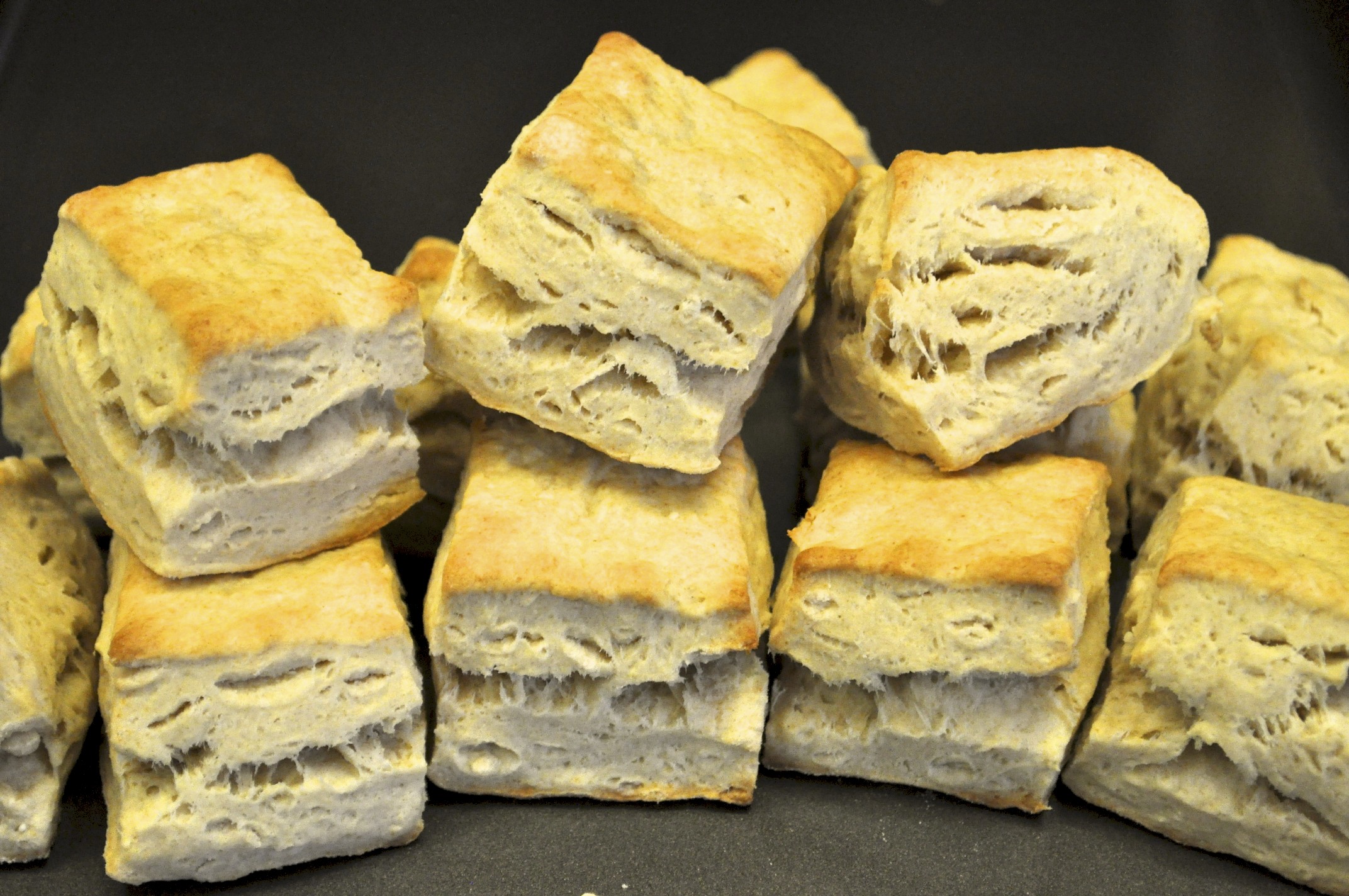
After a conversation about biscuits with my friends at work, I was inspired to try my hand at some. Who knew you didn’t need a box of Bisquick to make biscuits?! My first batch came out buttery and delicious. After cutting perfect round biscuits, I kneaded the leftover dough and cut the last batch. I learned that kneading them again caused them to not rise as well as the first batch. I’ve also learned that biscuits don’t have to be round. I cut the next batch into squares, and voila! a perfect batch of biscuits.

Since that experience, I’ve made batches of biscuits. They only take 1/2 hour and they taste wonderful with our homemade cloudberry jam. Yum!

I’ve read I can use the biscuit dough as a base in muffin cups and stuff the biscuits with anything my heart desires. If that isn’t enough, I can imagine what could get baked right into the biscuits…herbs, cheeses…oh, boy!

Caramel Apple Cookies

The inspiration? A granny smith apple and a bag of individually wrapped caramels.

The two items sitting in our kitchen made me think “wouldn’t an apple cookie with a caramel tucked inside taste like fall?”

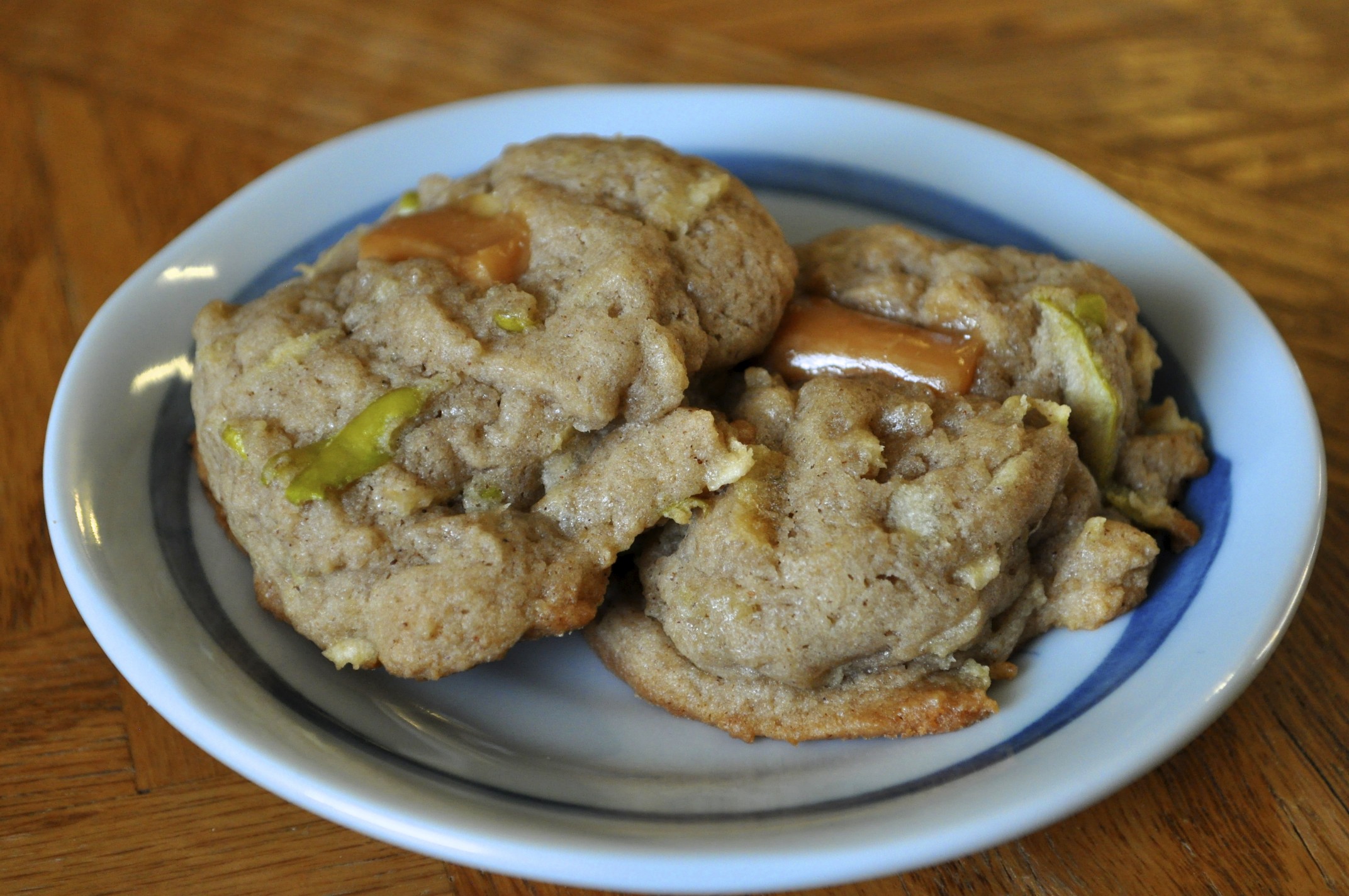
Let me tell you, it does! Hot cinnamon flavor dancing around toasty cooked grated apple pieces.  Make sure you take two bites so you can savor the caramel twice!

Here it is: Caramel Apple Cookies

1/2 cup butter, softened

1 cup packed brown sugar

1 tsp vanilla

1 egg

2 cups flour

1/2 tsp salt

1/2 tsp baking soda

1 tsp ground cinnamon

1 shredded granny smith apple

15 wrapped caramels

Preheat oven to 350F. Line baking sheet with parchment, or lightly grease sheet.

In a large bowl, stir together flour, salt, baking soda, and cinnamon.

In another bowl, cream together the butter and sugar. Add vanilla and egg and beat until light and fluffy. Add flour mixture and stir to combine. Fold in apple pieces.

Take caramels out of cellophane and cut in half.

Drop tablespoon sized drops of dough onto baking sheet with some space in between (they will spread). Push half caramels into center of cookie drop. Make sure to leave some dough under the cookie so the caramel doesn’t burn.

Bake for 12 minutes or until edges are set. Allow to cool slightly on baking sheet and finish cooling on a wire rack.

(I tinkered with the original recipe found on http://www.chewywaffles.blogspot.com/.)

Drifting and Dancing Wood


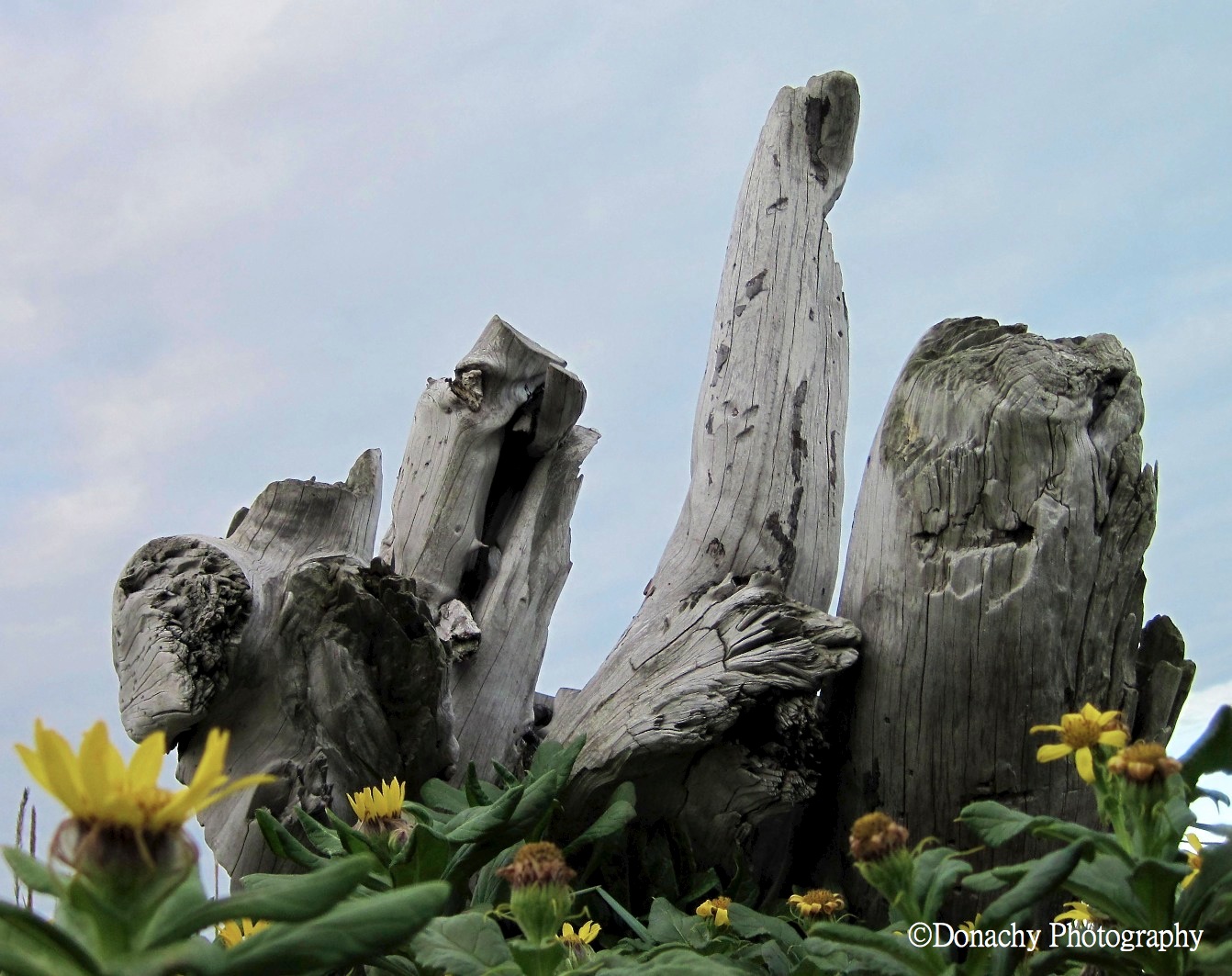
There are beautiful pieces of driftwood on our beaches here in Point Hope. The piece above looked like ocean animals doing a dance among the summer flowers. I never really thought about where driftwood might travel from until yesterday. I realized that this wood traveled in from the ocean, maybe hundreds or thousands of miles from my village. There are no trees here. The closest trees are small willows that grow up river some ways away. Each piece of driftwood, some as small as sticks and some as large as entire tree trunks, has a story. Maybe they came from Japan or Russia? Where have they come from? How did they come to be on this beach? What caused them to drift? What did they experience along the way?

Setting the Net

September 4: We’d be wanting to learn how to set a net from shore, so when a couple invited us to come fishing with them, we jumped at the opportunity. The way nets are set here is pretty ingenious.

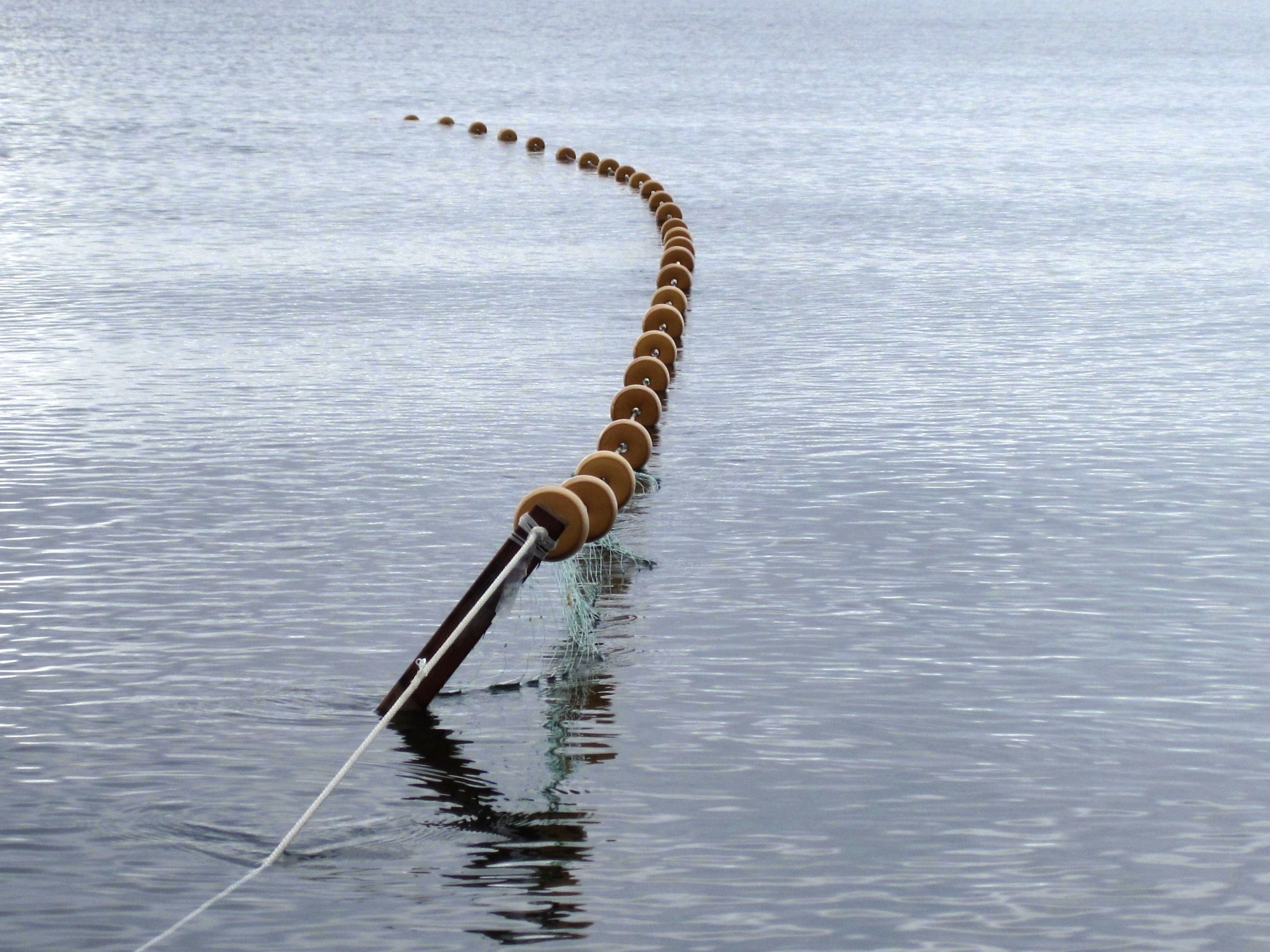
The first order of business is to get a big enough weight out from shore to securely anchor the far end of the net. In Shishmaref and lots of other places, they use small dingies or other watercraft to accomplish this. But the current runs strong near Point Hope, and high winds can come up quickly. In the past, lone anglers launching small boats off the beach led to drownings. So a different method for getting the cloth sacks of rocks which serve as weights out into deeper water was developed. Here fishermen use long poles–sometimes lengths of two-by-fours nailed together. The fish often run quite close to shore, so even 25 feet or so can be far enough and a 30 foot net set is all you need. The pole is threaded through a loop on the top of the weight, enough floatation in the form of plastic buoys is attached to the end of the pole to keep everything floating as its pushed out, and then the pole is pulled back and the weight drops to the bottom.

Meanwhile, a long line has been run through one end of the net, top to bottom along a piece of wood attached to the net and is also run through the weight. With the ends of the line tied together to form one long loops, and controlled from the beach, this line is pulled until one end of the net is snugged up against the weight. The top and bottom lines are adjusted so that the net is positioned upright, and the lines are tied off to two stakes on the beach. At the other end of the net–the one closest to the beach–another line holds the net in place and is similarly tethered. Corks keep the top of the net up, and a lead line keeps the bottom of the net down. It sounds a bit complicated, but in practice the whole process is fairly simple and intuitive.

Once the net is set, the fishing is much like any kind of fishing anywhere. You wait, hoping to see the tell-tale dancing of corks, or maybe a splash as a large fish entrapped in the net swims to the surface. Up here the quarry are salmon (pinks, silvers and Chinook), and the highly prized “trout,” i.e. sea-run Dolly Varden. While you wait for the fish to come along, you might see grey whales or even Orcas, seals, or maybe a walrus. Hundreds of thousands of seabirds nest and roost on the cliffs of Cape Thomson to the south, so the sea is usually alive with murres, gulls, puffins and more.

Where There’s Only Sky and Water


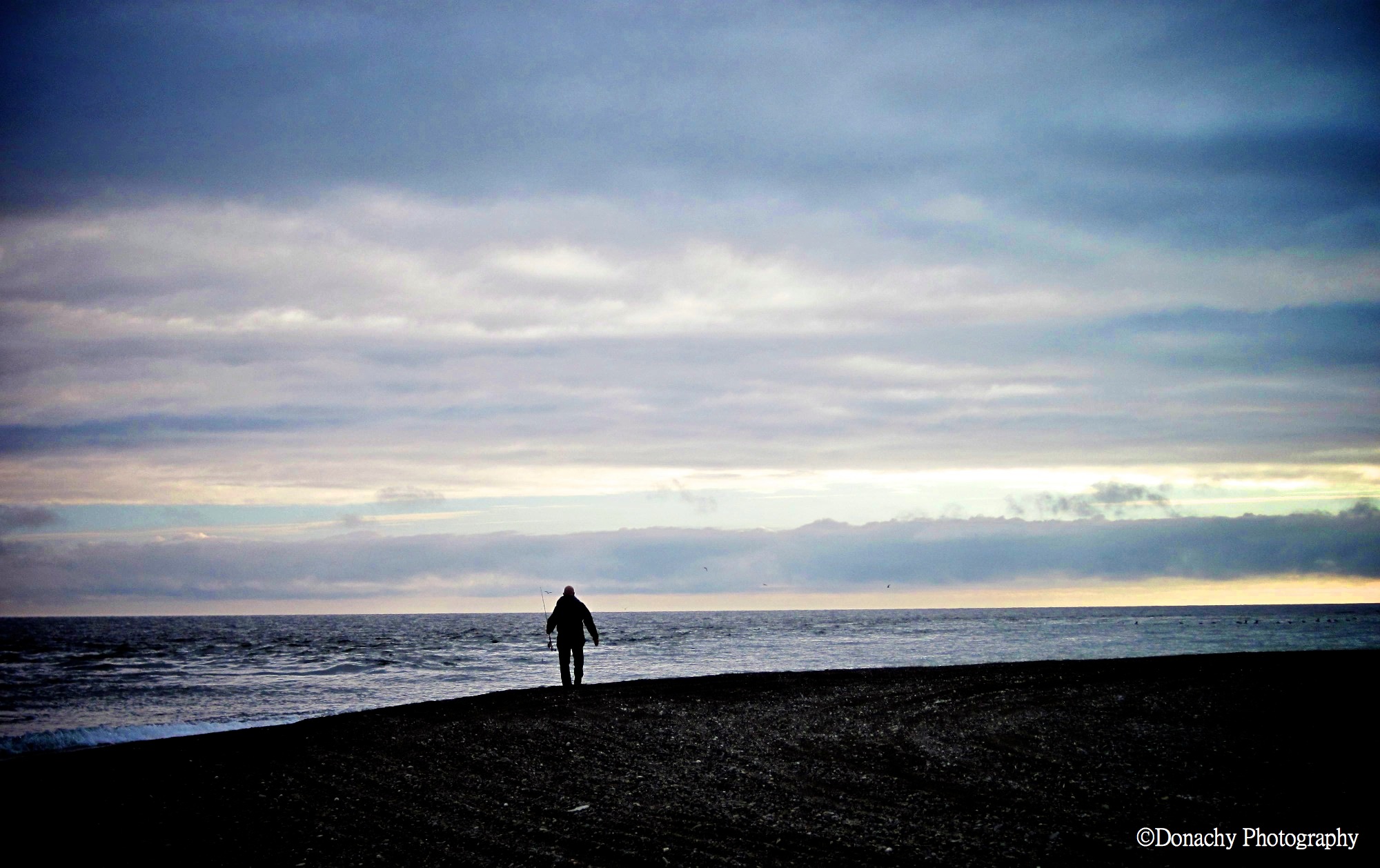
A solitary surf fisherman in late August hoping to intercept the last of the pink salmon or a roving school of Dolly Varden on the point at Point Hope, Alaska.

Surf fishing is addicting. Part of the magic lies in not knowing when or even if the fish will show up. So you fall into a rhythm, walking up or down the beach casting, waiting for the lure to land, and beginning your retrieve. As you fall into this rhythm, invariably your mind wanders… back to fish you’ve caught and fish you’ve lost on this beach or on other beaches, back to something your dad, or a coach, or a friend said to you a long time ago, back to places you’ve been and to people who have slipped into and out of your life. At other times, you find yourself looking into the future, forward to the day when your mortgage is paid off, or to a day when you are at last able to travel to some dream destination. Your feet are planted more or less firmly on sand or pebbles. Behind you are cities and towns, offices, classrooms, dinner parties, appointments, work, triumphs and regrets, small talk, clocks, calendars… Before you, stretching out as far as you can see, there is only sky and water and the possibility that on the next cast you’ll be woken from your reverie, everything suddenly solid, your rod bent into a graceful, lively arc.

The Bones of a Village

New enough to reveal steel and aluminum nails, old enough to be well-weathered by the Arctic climate, the bones of this seal-skin whaling boat were left behind when Point Hope (Tikigaq) relocated two-and-a-half miles inland in the 1970s. Point Hope is one of the longest continuously inhabited places in North America.

The Inupiaq name for Point Hope Village, Tikigaq (tick-ee-yahk) means index finger and described the way the gravel point once hooked into the Chukchi Sea. Time and tide long ago washed away the crook of the finger, leaving behind a triangular point near enough to deep water that the whales that first drew the Inupiat people here thousands of years ago still swim close to shore. The 2.3 mile hike from the current town out to the point gets a little tough once the road ends and the pea-to-chunk-size gravel begins, but it is well worth the effort. In addition to bowhead and other whales, which are frequently sighted, the collision of currents at the point holds large schools of finger-sized baitfish, which in turn draw flocks of Arctic terns, gulls, murres, puffins, jaegers, guillemots and ducks while various sandpipers patrol the shore. At times, the sea and sky are filled with hundreds–if not thousands–of birds. The small fish also attract roving schools of pink, silver and Chinook salmon and sea-run Dolly Varden which in turn are followed by spotted, common and bearded seals. Walruses show up from time to time as well.

The walk to the point passes through the Old Village, a ghost town of semi-subetranean homes made from sod, whale bone and driftwood as well as more modern, wood and metal houses. It’s fascinating to walk through the Old Village and contemplate what life would have been like up here before electricity, running water, guns and gasoline engines–when the only “grocery stores” were the great herds of caribou 25 or more miles to the east, bowhead whales swimming in the freezing Arctic Ocean, and the various fish, seals, berries and plants gathered in their seasons.

Alaskan Clam Chowder

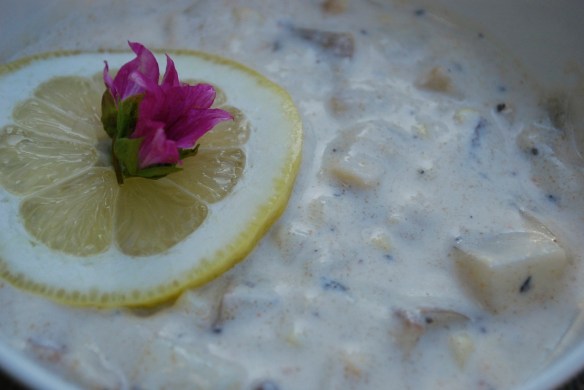
New England Style Clam Chowder garnished with a slice of lemon and salmon berry blossoms. All fruit blossoms are edible, and in addition to being beautiful, some are downright tasty.

These days, there seems to be a trend toward making New England Style Clam Chowders thicker and thicker. Unfortunately, to our taste, the thickness is achieved by adding lots of flour, resulting in a somewhat pasty if not downright bland bowl of soup. Our favorite chowders put clams and potatoes up front and emphasize flavor over thickness. We make both New England Style and Manhattan Style Clam Chowders in large pots, freezing the finished product in smaller containers and pulling them out on cold nights throughout the winter. While this is a great way to put to use all the razor clams we used to dig in Oregon and now dig in Alaska, it works well with other kinds of clams, too, as well as with canned clams such as the big, 51 ounce (3 pounds, 3 ounces) cans of SeaWatch chopped clams sold at Costco and other stores. The recipe is never the same twice. The one below is a recent version. One of the keys is to use not more than twice the potatoes, by weight, as clams.

Up here in bush Alaska, many of the communities are “dry” and I can’t use one of my favorite ingredients–sherry. If I could, I would add about a 1/4 cup of a quality dry sherry such as Dry Sack.

Ingredients: (We cook with dairy products from grass-fed cows, which research increasingly is showing is a significantly more healthful choice than dairy from cows fed on grain and processed feed.)

  • 3 pounds razor clams, chopped coarse (This is the weight of clams after they have been drained. But save and set aside their juice.)
  • clam juice you’ve set aside. The more, the better.
  • 4 1/2 pounds Yukon Gold or yellow potatoes. (These cook up creamier than Russets)
  • 2 sweet onions, chopped coarse
  • 1/2 pound bacon, cut into small pieces
  • water (as needed to cover potatoes while cooking)
  • 4 cups milk
  • 2 cups heavy cream
  • 6 cloves of garlic, chopped fine
  • 1/2 cup flour
  • 4 tablespoons olive oil
  • 4 tablespoons butter
  • 2 tablespoons sea salt
  • 1/2 tablespoon Italian seasoning (The Spice Hunter’s Italian blend is excellent)
  • 1 teaspoon freshly ground pepper (either black or rainbow)
  • 1 teaspoon dry tarragon, crushed (optional)
  • 1/2 teaspoon nutmeg (optional)
  • 5 – 7 very thin slices of lemon

1. Wash potatoes and remove any eyes, but do not remove the skins. Cut into ½ inch cubes and place in a large bowl. Set aside.

2. Fry the bacon pieces till tender. Do not crisp. Drain the grease and set aside.

3. In a large pot, add the olive oil and heat over medium-high. Add onions, stirring frequently for about five minutes until they begin to turn translucent. Add garlic and stir again.

4. Add flour and stir in thoroughly. Add two tablespoons of butter (or more olive oil) if necessary to completely mix in the flour.

5. Immediately add clam juice and milk. Stir.

6. Add potatoes, seasonings and salt and enough water to cover all. Slowly bring to a simmer and cook until potatoes become tender, stirring occasionally. About 45 – 60 minutes.

7. Add cream and lemon slices and return to just under a simmer or barely simmering.

8. Add the clams and the remaining butter and turn heat to low. On a propane stove, you may need a flame tamer. Continue cooking for 10 minutes.

Serve with a big hunk of toasted sourdough bread and a Chardonnay, a Pinot Gris, or a good ale.

Cloudberry Sorbet – Sublime!


Growing seasons here in the Arctic are short, and the cloudberries are at the end of theirs. Yesterday was our last opportunity to go picking. After a big pancake, egg and bacon breakfast at a friend’s house, our principal offered up the school’s suburban, so six of us drove out to the end of 7-Mile Road where the berries were rumored to be larger than those we’d previously found.

The thermometer read 50, but the chilly wind tugged much of the warmth away, making us happy to be dressed in warm layers. Small songbirds seemed to be everywhere, and a few jaegers patrolled the tundra looking for easy prey. Off in the distance, a majestic snowy owl glided from perch to perch, probably hoping to catch one of the incredibly fat ground squirrels that inhabit the tundra off-guard. Some of the berry patches were completely over, and others were full of fruit past their peak. But here and there we found berries that were just right, liquid amber in color and perfectly sweet. It took Jack and me about an hour to pick 10 cups.

Like everything else that grows on the tundra, cloudberry plants reach only a few inches off the ground. They grow in clusters on low mounds that rise a foot or so above the wet ground. Picking them requires lots of squats and bends making for a good workout. Jack was doing an uncharacteristic amount of berry eating while he was picking and finally came to a conclusion: “These berries would make really good sorbet.” Although I’d never made sorbet, I knew right away that he was onto something.

Back home, I processed the berries. The first step was to wash the berries. This proved to be much easier than my experience with other berries because there are virtually no bugs up here. The next step was de-seeding the berries. After unsuccessfully trying to smash the berries through two different sized strainers, I remembered I had cheesecloth. I loaded batches of pureed berries into the cheesecloth and squeezed the delicious fruit into a bowl until all that remained in the cheesecloth were bright pink seeds.

A couple of years ago, our daughter gave us a Cuisinart ice-cream maker. An electric ice cream maker may seem like an extravagant thing to ship to a home in the Arctic, but it has added a lot of enjoyment to our lives in both making and eating ice cream.

Sorbet is easy. Syrupy sugar water and a little lemon juice go into the freezer bowls along with the seeded, pureed fruit. This mixture is slowly churned for about 30 minutes. We love berries, but I think these are my favorites. The color is a rich salmon orange. The smell is sweet and tropical, with mango, papaya and peach flavors, and there’s a natural creaminess about them. Making one-quart batches, we ended up with a gallon of sorbet. We envision serving this in cookie bowls, with a few pieces of dark chocolate, or along with with homemade vanilla ice cream as a sumptuous 50/50 dessert.

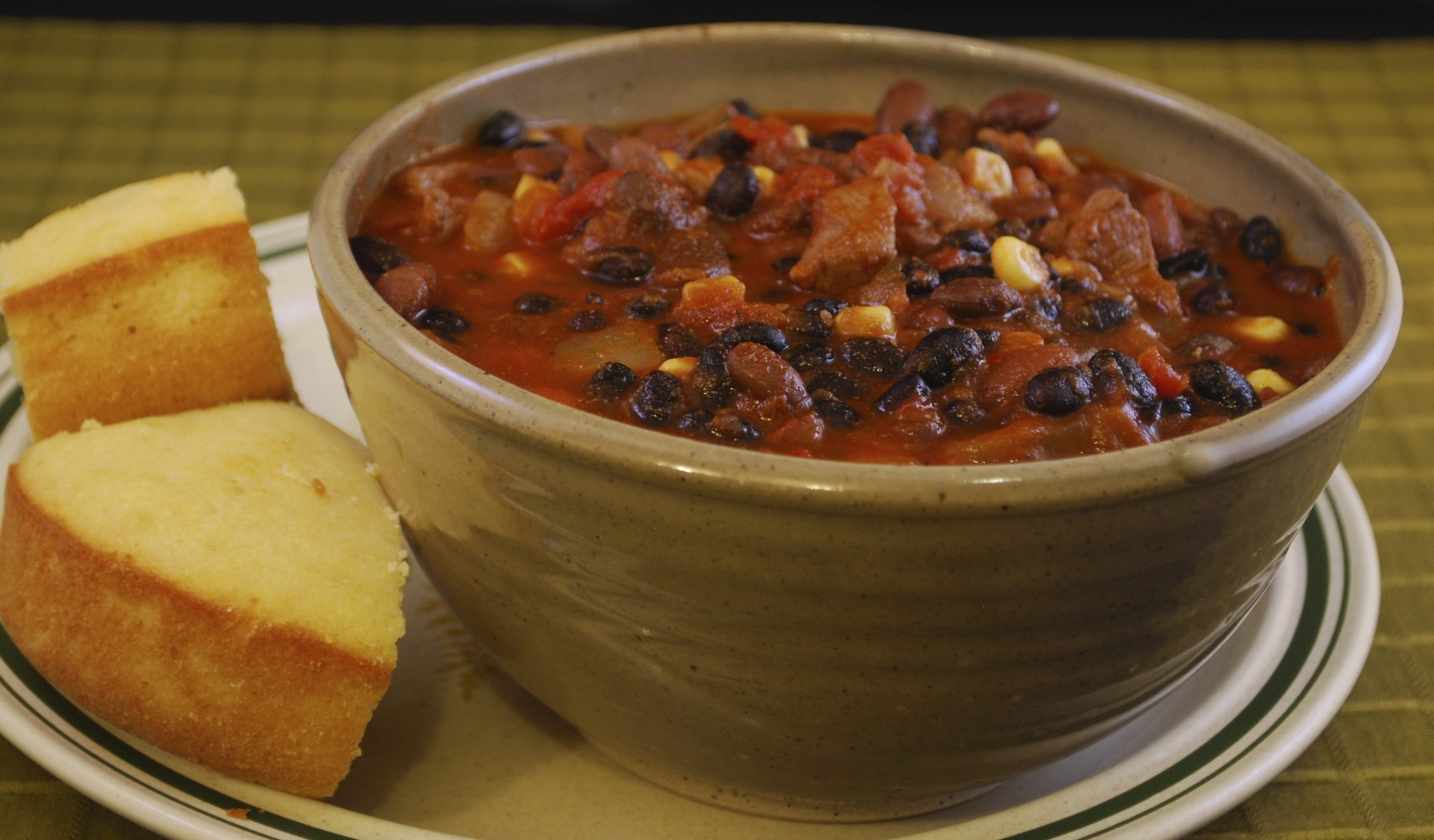
Chili Done Large

The end of summer and early fall are a time to cook big pots of winter food: chowders, soups, stews and chili to be canned or frozen and pulled out as needed over the coming months. We have a four-gallon, heavy-gauge stainless steel pot that is ideal for this kind of cooking. Three-and-a-half gallons equates to 56 cups, enough one-cup servings for 28 meals for the two of us.

No two pots of chili are ever the same. One year I might have three different kinds of beans to start with. Another year I might have only one kind. When we lived in California, I used fiery hot chili peppers we purchased at the Asian farmer’s market to give the chili a real kick. Other years, like this year, I’ve gone with a more mellow, savory blend of spices. There’s nothing like a hot bowl of chili and a hunk of fresh-baked cornbread slathered in butter when it’s negative 40 outside and the wind is howling.

*****Chili Done Large*****

  • 12 cups dry beans (equal parts pinto and black work well)
  • 3 1/2 pounds tri-tip steak cut into pieces that are approximately  1/2″ square and about 1/4″ thick.
  • 1/2 lb thick-cut bacon, cut into small pieces
  • 6 pounds diced tomatoes (with their liquid). Canned or fresh
  • 24 ounces tomato paste
  • 4 cups sweet corn
  • 4 cups water (approximately)
  • 10 cloves of garlic, chopped fine
  • 4 sweet onions (such as Mayan, Walla Walla or Vidalia) chopped coarse
  • 1 tablespoon cumin (to mix with the tri-tip)
  • 1/2 tablespoon cumin (to add to pot while cooking)
  • 2 tablespoons olive oil (for mixing in with the tri-tip and cumin)
  • 2 tablespoons olive oil (for pan-frying the tri-tip)
  • 3 tablespoons olive oil (for sautéing the onions & garlic)
  • 1 tablespoon dry, crushed oregano
  • 3 tablespoons chili powder
  • 1 tablespoon chili flakes
  • 1 tablespoon smoked sea salt
  • 1 tablespoon paprika
  • 2 tablespoons chili garlic sauce (find this in the Asian section of most grocery stores)
  • 1/2 tablespoon freshly ground black pepper
  • 1 teaspoon cayenne pepper
  • 1 teaspoon paprika
  • 1 teaspoon white pepper
  • 2 bay leaves
  1. Soak the dry beans in a large pot. A good way to do this is to add about 3 times as much water as beans and bring the beans to a boil for 10 minutes, then turn off the heat and let the beans soak for 6 to 8 hours. There’s nothing wrong with the thick, dark colored water this produces, but I pour it off to get a cleaner chili.
  2. Combine the tri-tip, 2 tablespoons olive oil and 1 tablespoon cumin in a large mixing bowl, mix thoroughly
  3. Heat 2 tablespoons of olive oil over medium-high heat in a large frying pan. Add the tri-tip mixture. Stir frequently until meat is cooked through. Pour the mixture back into the mixing bowl and set aside.
  4. Fry the bacon pieces over medium-high heat, just until done. (They should be tender, not crisp.) Remove from heat and drain on paper towel and set aside.
  5. In a glass (non-reactive) bowl, mix together the tomato paste and about 3 cups of water and set aside
  6. In a large, heavy-gauge pot, heat 3 tablespoons of olive oil over medium heat. Add the chopped onions. Stir frequently until onions just begin to turn translucent and stir in the garlic. Reduce heat to medium-low.
  7. Stir in the diced tomatoes and the tomato paste with the onions and garlic in the large pot.
  8. Stir in the beans and all the spices and seasonings. Bring to a simmer and cook for an hour on low heat.
  9. Stir in the bacon, the tri-tip and the sweet corn. Add a cup of water if the chili is too thick. Bring back to a simmer and give the chili a taste.
  10. Add additional seasonings as desired. Additional tomato paste will thicken the chili.

Chili is always better if you let it sit for a few hours or even a day or two before digging in. Ladle into bowls, top with shredded cheddar cheese, and serve with corn bread, sourdough bread, or crackers. Bring on the winter!

Cloudberries and Freezer Jam

Ball Jars filled with freshly-picked cloudberries (often locally called salmon berries). We’ll add a little lemon juice, pectin, and sugar to the crushed berries, mix and simmer this in our bread maker for an hour-and-twenty minutes, pour the mixture back into the jars and put them in the freezer to set. This will provide us with some of the most tantalizing jam imaginable. Cloudberry jam… 

The morning was cool and cloudy, with mist and banks of fog rolling across Point Hope. We’d been told that we’d find berries about three miles east of town along Seven-Mile Road, and so seven of us had gathered to make the hike out. Two of the men carried 12 gauge shotguns and a third carried a side arm. Bears are always a possibility.

The wildflowers which all but carpeted the tundra when we arrived here nearly a month ago are mostly gone now, though here and there a few tiny yellow Alaska poppies and beautiful blue but deadly monkshood and other flowers are still blooming. And then, right about at three miles just as we’d been told, there they were… cloudberries, growing together in small patches where mounds of earth were just high enough above the boggy tundra to allow roots to drain. The unripe cloudberries (Rubus chamaemorus) were deep red and beautiful. The ripe ones are the amber-orange color of Chinook salmon flesh, giving their close relatives, salmon berries (Rubus spectabilis), their names.

Wherever cloudberries grow across the upper latitudes of North America and Europe, they are a prized delicacy, agreeably tart when barely ripe, becoming creamy rich and sweet as they continue to ripen. They contain twice as much vitamin C as oranges. Growing very close to the ground, the berries were surprisingly inconspicuous at first. But once our eyes adjusted to what we were looking for, the tundra seemed to sparkle with their red, orange and amber glow.

We picked for about two hours, happy to have worn Muck Boots as we slogged through the soft, wet ground. By the time hunger caught up with us and it was time to head back, Barbra and I had about three pounds of berries between us–enough for a few jars of the freezer jam which would make the hike well worth the effort.

On the walk back, the sun began to push its way through the thinning clouds, lighting the land around us. It was then that Barbra and one of our friends spotted a large white bird perched motionless on a hump out on the tundra. “It’s got to be an owl,” I said. “Let’s see.” We made our way toward the white shape until there was no doubt we were looking at a large snowy owl. These owls are huge, the heaviest in North America. When it finally spread its magnificent wings and lifted off, it revealed an underside of almost pure white–a male in its prime, grown fat on ground squirrels.