Unknown's avatar

About Jack & Barbra Donachy

Writers, photographers, food lovers, anglers, travelers and students of poetry

New Favorite Appetizer: Ikura on Avocado

ikura on avadado n

With freshly cured salmon roe on hand and avocados just arrived from The Big City, we put one and one together. Wow! Perfect with a Sauvignon Blanc while grilling salmon. Click here for the ikura recipe.

And if you’re out in Bush Alaska and no Sauvignon is on hand, how about a home-brewed beer or a sparkling glass of Soda Stream fizzy water?

The Magic of Freshly Cured Ikura (Salmon Roe Caviar)

ikura fresh in clear glass n

In The Bell Jar, Sylvia Plath describes eating an entire bowl of caviar by herself. Which sounds a little piggish. Certainly we would never do such a thing. No, never. The happy little seal… well, he’s not talking.

Making your own ikura (salmon roe caviar) is easy.  The recipe, linked below, continues to be one of Cutterlight’s most popular.

Click here for the recipe: Ikura: Curing Salmon Eggs

This batch came from a Sockeye salmon, and although chum salmon eggs are the traditional choice due to their large size, the ripe eggs of any species of salmon or trout work well.

Bizarre Food or a Gourmet Delicacy? Sautéed Salmon Shirako on Polenta

Shirako on polenta n

This Japanese delicacy hasn’t quite caught on in America… yet. But as more and more people try it, they’re discovering what many residents of the Atlantic Gulf Coast have known for generations: this stuff is delicious!

Not long ago daughter Maia reported from Japan that she had just tried shirako. “What?!” I asked in astonishment. “Really? How was it?”

“Oshikatta yo!”

“Hontou ni?”

“Hontou ni!”

Translation: She had dined on the milt sacs of cod and found them to be delicious. “Really?”   “Really!”

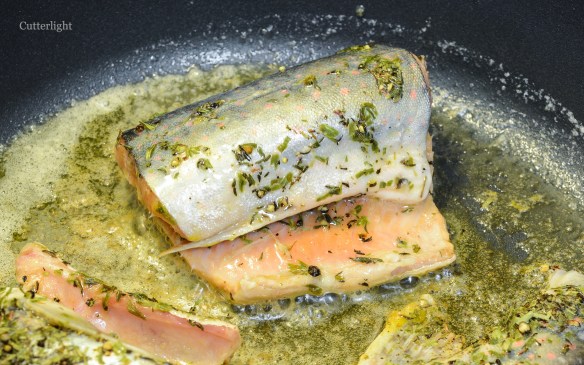
With this conversation in mind, I looked dubiously at the pair of milt sacs I’d just removed from a freshly caught Sockeye salmon. I’d done some reading and discovered that “white roe” – the milt sacs of mullet – are a traditional delicacy along the Gulf Coast of America. Packed with nutrition, they definitely belong in the Super Food category as well. “Well, why not,” I mused. “They look like they’re made to be rolled in corn meal, fried up and served with grits.”

That’s all there is to it. And yes, they were delicious. Really!

Sautéed Shirako

Ingredients

  • Fresh milt sacs from salmon, cod, mullet or similar fish
  • corn meal
  • freshly ground black pepper
  • salt or soy sauce
  • olive oil (or butter or bacon fat)

Directions

  1. Heat a tablespoon or two of olive oil, butter or bacon fat in a skillet over medium heat.
  2. Sprinkle a tablespoon or two of cornmeal on a cutting board or plate. Add a little freshly cracked black pepper.
  3. Rinse milt sacs in cold water. Pat dry but leave a little dampness (so cornmeal will attach).
  4. Rolls sacs in cornmeal.
  5. When oil hot enough to gently sizzle, carefully place the sacs in the skillet. Add a few dashes of soy sauce or sprinkle with salt. Lower heat to medium-low.
  6. Sauté for 3 minutes. Gently turn and sauté other side for two or three additional minutes, longer if the sacs are particularly large. Both sides should be crisp and golden.
  7. Serve piping hot with grits or polenta.

Purple Martins: The Highest-Flying Swallow

purple martins w draggonfly n

The Catch: Purple Martins, Kimiwan Lake Bird Walk, Alberta, Canada

Swallows are a favorite bird wherever they fly, and among them North America’s largest and most universally appreciated species is without a doubt the Purple Martin (Progne subis). Before Europeans ever came to North America, Native Americans in the South were known to hang hollow gourds as nesting boxes to attract these birds. The beneficial nature of Martins is well known: not only do they consume enormous quantities of insects that humans consider pests – among them horseflies, beetles, termites and grasshoppers -, they also aggressively drive away birds of prey as well as crows and thus were traditionally welcomed by farmers. Often soaring at altitudes of several hundred feet, Martins capture their prey exclusively on the wing; they quench their thirst on the wing as well, skimming the surface of ponds, lakes and rivers.

purple martin male gun metal n

Iridescent purples and gun metal blues mark the plumage of the male Martin.

Although the range of the three subspecies of Martins covers most of the U. S. and sections of southern Canada, they tend to be rather uncommon. This is due in part to their very specific nesting requirements and to the fact that invasive species – European starlings and house sparrows – frequently outcompete Martins for preferred sites. Formerly found in hollow trees, Eastern Martins have almost exclusively shifted their nests to human created housing: apartment-like complexes on poles, rows of houses side-by-side, or, particularly in the South, hollow gourds. Like Chimney Swifts and Barn Swallows, Eastern Purple Martins have become dependent upon humans for nesting sites.

purple martin female n

The plumage of females is lighter in color, predominated by shades of brown.

Writing in the early 1800’s, John Audubon observed the ubiquitous nature of Martin nesting boxes in America:

The… Indian is also fond of the Martin’s company. He frequently hangs up a calabash on some twig near his camp, and in this cradle the bird keeps watch, and sallies forth to drive off the Vulture that might otherwise commit depredations on the deer-skins or pieces of venison exposed to the air to be dried. The slaves in the Southern States take more pains to accommodate this favourite bird. The calabash is neatly scooped out, and attached to the flexible top of a cane, brought from the swamp, where that plant usually grows, and placed close to their huts. Almost every country tavern has a Martin box on the upper part of its sign-board; and I have observed that the handsomer the box, the better does the inn generally prove to be. 

All our cities are furnished with houses for the reception of these birds; and it is seldom that even lads bent upon mischief disturb the favoured Martin. He sweeps along the streets, here and there seizing a fly, bangs to the eaves of the houses, or peeps into them, as he poises himself in the air in front of the windows, or mounts high above the city, soaring into the clear sky, plays with the string of the child’s kite, snapping at it, as he swiftly passes, with unerring precision, or suddenly sweeps along the roofs, chasing off grimalkin, who is probably prowling in quest of his young. Birds of America, John J. Audubon, printed 1827 – 1838.

Purple Martin male wings n

Healthy Martin colonies indicate a healthy environment.

The next time you see a large flock of dark birds, look closely. Although often starlings, Martins, too, come together in the thousands and even hundreds of thousands, particularly in late summer as they prepare to migrate to South America.

For more information about Purple Martins, or to learn more about building a nesting complex of your own to attract them, visit www.purplemartin.org

For more information on the wonderful Kimiwan Nature Walk and Interpretive Center in McLennan, Alberta, please visit www.kimiwanbirdwalk.ca.


C’mere and give us a kiss

mountain sheep give us a kiss n

We’ve all been there – mornings when you’re out of cigarettes and reduced to digging through an overflowing ashtray; mornings when you can’t find your Scotch glass… or the sash for your robe. Your lipstick’s smeared from the night before, your head is pounding, you can’t even look at food and you just want to know that you’re still loved. (Stone Sheep Ewe on a rainy day in Alberta, Canada)

Where all the Raspberries are as Big as Your Thumb

“Pick me! Pick me!”

Anyone who knows Jack knows that he is a fisherman through and through. Moving to a village where the salmon are running so thick we can see them finning up the river and into the lake is beyond Jack’s wildest expectations. This is not his dream. This is our reality. He’s spent time every day walking the shore, sometimes with fishing rod in hand, other times just watching and listening to the music of river current and salmon jumping, splashing, sloshing their way upstream.

And so it’s understandable that it was left to me to spot the patch of raspberries Jack had walked right past on his way to the river. And such raspberries! The patch isn’t large, but this has been an exceptional year for berries and the vines are heavy with tart, sweet, jem-like fruit.

raspberries in bowl chignik n

And with green berries still growing in more shaded parts of the patch, we should be able to pick all we need. Jam, pies, syrups, fresh with morning cereal… How about a raspberry-chipotle sauce to go with fresh-caught salmon?

“Bigger than store-bought,” as Jack says. Tastier, too. I don’t know about them being as big as your thumb, but they’re the biggest we’ve ever seen. Can you believe he was so intent on the salmon that he walked right past the whole patch without even noticing?!

Nervous Water and Red Salmon


first salmon Chignik n

Looked out the window this morning and saw nervous water on the lake. Skipped breakfast. Three hens and a buck. I’ll cure eggs for ikura later today. Shioyaki salmon for dinner tonight. Beginning of our second week in Chignik Lake, Alaska.

And Then Gillie was Gone… Or… Intrepid C-Dory Thwarts Thieves!

Gillie and Canola_n

Gillie faithfully following her crew, enjoying the canola fields of Alberta.

July 18, 2016, Yukon Territory. In an incredible act of heroism, the fishing vessel Gillie, a 22’ C-Dory Angler freed herself from an attempted abduction. Following her captains north to Alaska on the Alaska-Canada highway, Gillie, along with Stanley the Chevy Silverado and Lance the Cab-Over Camper, had pulled off the highway for a driving break at the Smart Creek turn-out near the British Columbia/Yukon Territory border. Her captains were gone for mere minutes, looking for grayling and char in the trouty-looking river just out of Gillie’s view when the thugs attacked.

Armed with precisely the right tools, the perpetrators made short work of Gillie’s couplings, hitched her to their own criminal vehicle, and sped off. At this point, Gillie feared the worst. She imagined herself in a chop shop, her engines torn from her stern, her insides gutted. She shuddered, knowing she may never see her beloved captains again.

But when she shuddered, she noticed that in their haste, the thieves had neglected to properly secure the nut holding the hitching ball in place. Each time the speeding trailer hit a bump on the very bumpy Al-Can, Gillie put her own two tons of weight into the bounce. Bit by bit, the nut worked its way down the hitching ball shank.

“If I can just get free before they hit the chop shop…” She didn’t complete her thought. Not more than 50 meters up the road was a bright orange marker. She knew what that meant. Big Bump.

“This is it,” she thought, digging deep for the courage she’d need to withstand the crushing impact when the tongue of her trailer hit the pavement at 70 miles (110 kilometers) per hour. The front wheels of the thieves’ truck hit the bump, Gillie gave herself a mighty lift, the trailer wheels careened over the bump, Gillie slammed down hard on the hitching ball and, to her great joy, rebounded, catching just enough air to lift herself clear.

The tongue of the trailer came down with a heavy, metallic, grating crash! The safety chains holding the trailer to the truck went tight. Now, atop the trailer, still upright, Gillie was being dragged along while the tongue of the trailer cut a scar into the highway asphalt. From the cab of the truck, Gillie could hear loud shouting and words that can’t be printed here.

The next thing she knew, the truck was pulling off the highway. “Yea!” Gillie exclaimed in thought. But the shoulder was steeply canted. “If they go any further, I’m going to roll!” She thought in a panic.

Just in the nick of time, the whole rig skidded to a halt. The thieves burst out of their truck, cursing their “bad luck” and accusing each other. They had little choice and they knew it. Already, police between Watson Lake and Teslin were looking for the most unmistakable boat on the Al-Can. Gillie didn’t know it, but her captains had already supplied the Royal Canadian Mounted Police (who always get their boat) with a photo of Gillie and a description of a possible suspect vehicle. Gillie didn’t know this, but thanks to their friends who listened to police scanners, the thieves did know it. With a hot boat atop a disabled trailer and police on the lookout, the thieves had no choice but to cut and run.

Her captains were in the midst of a rather quiet, pensive dinner at the Yukon Motel and Restaurant in Teslin when Officer Stelter of the Royal Canadian Mounted Police entered the establishment and confidently strode toward their table, barely able to suppress a grin.

“She’s on the road, down at marker 1168. It looks like they abandoned her.”

The restaurant hostess quickly packed the dinner “to go.” The captains climbed into the Chevy, fueled up and hustled to the site, 42 miles to the east. By the time they arrived, Officer Stelter had already secured a brand new 2” hitching ball to the trailer – held fast in place with a properly tightened nut.

You never saw a bigger smile on a boat. Her captains were smiling pretty hard, too.

Bull Fight on the Al-Can

Bison Bull Fight n

Nearly a ton each, when wood bison decide to take over a piece of the Alaska-Canada highway, they do. Shooting from the deck of our C-Dory, we found ourselves surrounded by leathery thuds of muscle smacking muscle, the crack of horn on horn, hooves pounding pavement and turf as animals the size of small trucks worked themselves into sprints, snorts, grunts, bellows and the thick odor of bison. We’d been photographing more placid scenes in a herd of about 100 animals – cows and nursing calves, young bulls, grandpa bulls and The Kings – the taut-muscled mature males that stood hands higher than the other members of the herd. Aside from a few younger males occasionally testing each other with head-butts, all was tranquil. The older bulls, hump-shouldered, muscle-ripped massive beasts, grazed peacefully along with the cows and calves or rolled in dust wallows.

The dynamics changed in the blink of an eye. A couple of the big boys started snorting at each other, then locking horns hard and kicking up dust. Suddenly every big bull in the herd, including the largest bull, was on high alert, tails held high, heads lowered as they zeroed in on the point of conflict. Kicking up grass, shrubs, sand and dust, these muscle-sculpted kings moved with impressive speed in their attacks which were aimed at bellies and buttocks as well as heads and shoulders.

Vehicles on the road cautiously edged backwards to give the sparring bison sufficient berth. The motorcyclist seen on the left side of this photo turned around and headed in the opposite direction as the fight edged closer to him.

Still Life with Woodpecker

pileated woodpecker n

Traveling up Highway 1 through Oregon, heading back home to Alaska, reading Tom Robbins’ Still Life with Woodpecker along the way. Saw this pileated woodpecker in Bullards Beach State Park.

Lots of wildflowers and butterflies, too, and a herd of Roosevelt elk.

Still Life with Woodpecker