Unknown's avatar

About Jack & Barbra Donachy

Writers, photographers, food lovers, anglers, travelers and students of poetry

A Merry Christmas with Linzer Cookies

Happy Holidays!

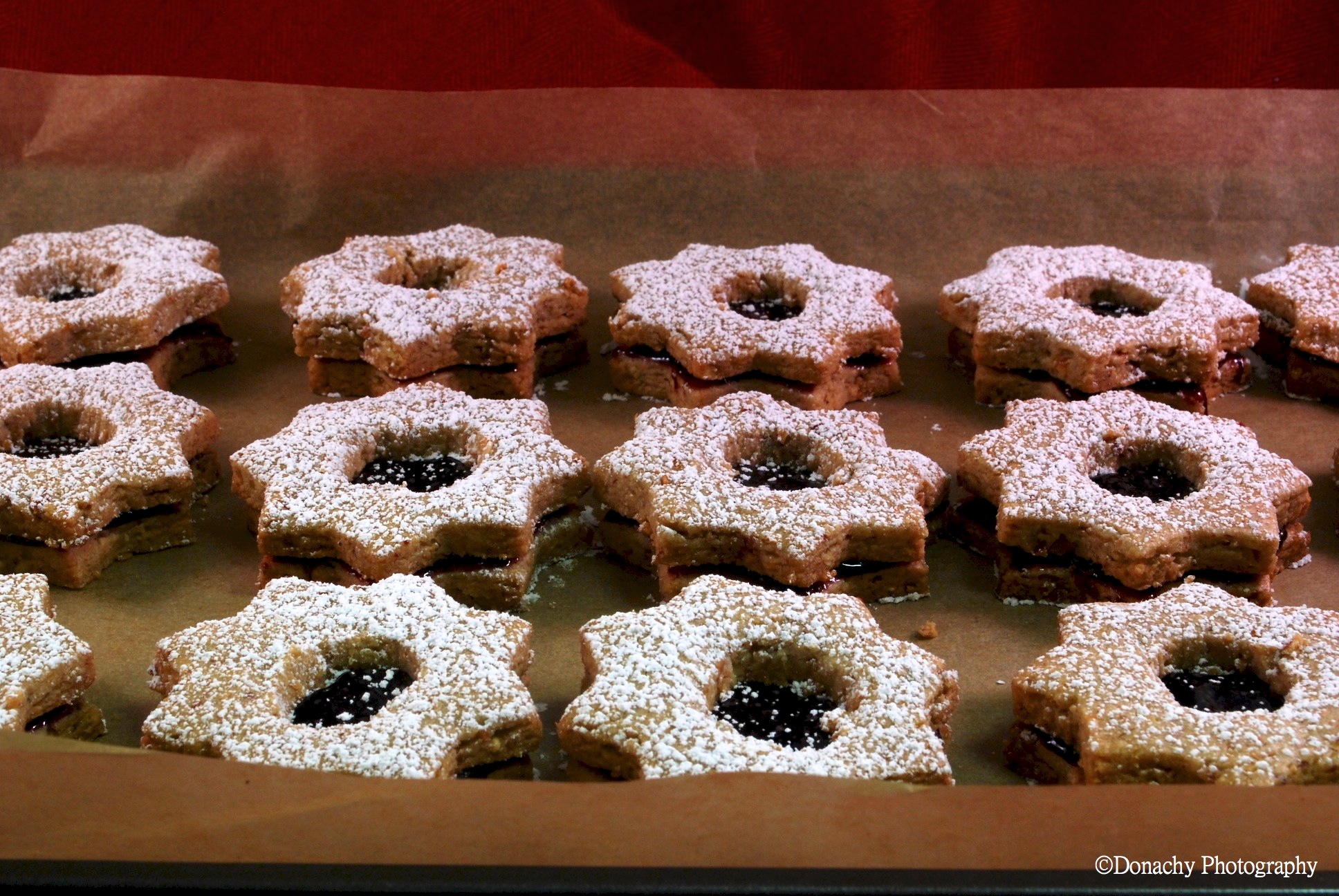
Tired of cookies yet? We’re not. I’m still baking through memories from my youth. Linzer cookies remind me of visits to my family in Switzerland. My aunt would take me to Swiss bakeries with shelves full of tasty choices. Linzer was a regular choice.

I knew that sandwich-type cookies were going to be more effort than others that I’ve made, and I was right. My kitchen has limited gadgetry which makes for a really hands-on experience. I followed this recipe from the Williams-Sonoma Baking Book. The first step is toasting the almonds and then chopping them fine. I did this with a hand-powered nut chopper. I probably should have prepared this before my Insanity workout; it seemed to take a really long time to chop with wobbly muscles. Zesting an orange means carefully peeling off the outside layer and mincing the peel with a large sharp kitchen knife. When the chilled dough came out of the fridge, it felt too crumbly. I worked with it anyway, following the advice to roll the dough between sheets of waxed paper. The whole process took several hours. All in in, the cookies turned out wonderfully. Jack’s review, “The finest tea cookie I’ve ever tasted.” Today, they will go to a Christmas cookie exchange. Hopefully the recipients will enjoy them, too.

Gather some elves (preferably the kind that make cookies), put on some good music, and here’s the recipe:

Linzer Cookies (courtesy of The Wiliams-Sonoma Baking Book p. 12)

Makes about 1 dozen cookies.

Ingredients

  • 1 cup almonds, toasted
  • 1/2 cup unsalted butter, at room temperature
  • 1/2 cup granulated sugar
  • 1 large egg yolk
  • 1 tsp finely grated orange zest
  • 3/4 tsp pure vanilla extract
  • 1/4 tsp pure almond extract
  • 1 cup all-purpose flour
  • 1/2 tsp ground cinnamon
  • 1/4 tsp salt
  • 1/4 cup seedless raspberry jam
  • Confectioners’ sugar for dusting

Toast almonds by spreading them in a single layer on a baking sheet and bake them in a 350 degree oven for about 8 minutes. In a food processor, finely grind the cooled toasted almonds using short pulses. Set aside. In a large bowl, using an electric mixer on high speed, cream the butter until fluffy and pale yellow. Add the granulated sugar and continue beating until combined. Add the egg yolk, orange zest, vanilla, an almond extract and beat on low speed until well blended.

Sift flour, cinnamon, and salt together into another bowl. Add the ground almonds and stir to blend. Add the flour-nut mixture to the butter mixture and mix on low speed or stir with a wooden spoon until blended. The dough should be soft. Turn the dough out of the bowl, divide into 4 equal portions, and wrap each in plastic wrap. Refrigerate until chilled, about 1 hour.

Preheat the oven to 350 degrees. Lightly grease 2 baking sheets or line them with parchment (baking) paper. Remove 1 portion of the dough at a time from the refrigerator, place between 2 sheets of waxed paper, and roll out to 1/4 inch thickness. Using a cookie cutter about 2 1/2 inches in diameter, cut out the cookies. Cut a hole in the center of half of the cookies with a 1 1/4 inch cutter. Repeat to roll out remaining dough portions, then reroll the dough scraps as needed to make 24 cutouts in all, cutting holes in half of them. If the dough becomes sticky, wrap it and chill in the freezer for about 10 minutes before rolling out.

Using a thin spatula, carefully transfer the cookies to the prepared pans, Bake until firm to the touch, about 12 minutes. Transfer the pans to wire racks. Loosen the cookies from the pans with the spatula, but leave in place on the pans until cooled.

To assemble, spread the solid cookies with about 1 teaspoon of the raspberry jam to within about 1/4 inch of the edges. Using a fine-mesh sieve, dust the cookies with the center cut-out (the cookies that go on top) with confections’ sugar. Top the solid cookies with the cutout cookies.

Enjoy these cookies with a steaming cup of hot tea.

Bowhead Whale Stew

An original caribou antler and walrus ivory carving by Edwin Weyiouanna guards a bowl of bowhead whale stew.

Outside it was -11 degrees Fahrenheit. The steady 25 mile per hour wind brought the chill down to negative 40, making it a good day to stay inside and cook a big pot of comfort food.

I could feel the frigid north wind seeping in around the edges of the window over the kitchen sink as I stared apprehensively at the three, one-pound cubes of thawed whale meat draining in the stainless steel basin. The odor of the dark red meat was decidedly un-beef-like, but it was mild and agreeable nonetheless – not at all gamey or fishy. The texture was a bit like that of fresh halibut – soft and dense. The meat of the bowhead whale, the largest genus of right whale, might be compared to especially tender filet mignon. I had no idea what cooking would do to the texture, or what the meat would taste like. “Good beef,” I hoped as I rinsed the meat and considered my next move.

For the past 27 years, Craig Claiborne’s The New York Times Cookbook has been a faithful companion – my go-to reference when I’m not sure what to do next in the kitchen. I turned to Claiborne’s basic recipe for beef stew, made a few modifications to take into account what we have on hand and our own tastes, and proceeded from there. The end product was probably the best meat stew we’ve ever had (allowing for the fact that our creation would have been improved with the addition of three cups of good red wine, which is, of course, unavailable up here.) The meat was wonderfully tender and no more strongly flavored than, say, strip steak, and complimented the seasonings and other textures in the stew beautifully. I served three piping hot bowls of stew with freshly baked cornbread muffins while daughter Maia cued up the film The Triplets of Belleville on our big movie screen – the perfect recipe for staying warm north of the Arctic Circle.

The Perfect Bow-ties

Freshly-made farfalle pasta, sprinkled with flour to prevent it from sticking, ready for a pot of salty boiling water.

Two months ago, I was going to throw the pasta machine out the window and be done with the whole homemade pasta idea. But those who know me, know I am tenacious (ok, stubborn). With each new attempt at spaghettis, angel hair, fettuccine, lasagna and ravioli I figured out another piece of the puzzle. From the frustrating beginning of sticky or crumbly dough, I pressed on until my fettucine strands no longer stuck together and the lasagna noodles no longer crumbled apart. And yesterday, Jack’s favorite: farfalle! I turned out a double batch cut from lasagne noodles and pinched together in the center to form perfect little bow ties.

Then Jack upped the ante. The farfalle were boiled for three minutes and topped with a mix of sautéed onions, garlic and pine nuts and served with rockfish a la meunière. Oven-roasted brussels sprouts, orange slices and steaming cups of honeybush tea complimented the main entrée. Cloudberry sorbet made from berries we’d picked in late summer ended the meal perfectly.

Rugelach with Cranberries and Pecans

I’ve always enjoyed rugelach. After discovering that the primary ingredients in the dough are butter and cream cheese, it is obvious why these cookies are so good. I found several recipes that had the same premise for the dough and a variety of different fillings. Armed with different recipes and ingredients that were in my pantry, I created a version of rugelach with ingredients we’d brought with us to the bush.  It came out delicious! The filling is a fruity complement to the soft and flaky crust.

Arctic Rugelach

Ingredients:

Dough

  • 1 cup unsalted butter, softened
  • 1 (8 ounce) package cream cheese, softened
  • 1/4 cup white sugar
  • 1 teaspoon vanilla extract
  • 2 cups all-purpose flour
  • 1/4 teaspoon salt
Filling:
  • 1/2 cup fruit preserves (I used apricot, peach, and mango preserves)
  • 1/4 cup packed light brown sugar
  • 1/2 teaspoon ground cinnamon
  • 3/4 cup chopped dried Craisins
  • 1 cup finely chopped pecans
  • 6 tablespoons white sugar
Coating (applied just prior to baking):
  • whites from two eggs
  • 2 tablespoons white sugar
  • 1 teaspoon ground cinnamon
 Directions
  1. In a medium bowl, cream together the butter and cream cheese. Beat in 1/4 cup of sugar and the vanilla extract. Combine the flour and salt; stir until well blended. Turn out dough onto a piece of plastic wrap and press together to form a ball. Divide the ball into 4 portions. Shape each portion into a flat rectangle, so it is ready to roll after being chilled. Wrap each rectangle in plastic and refrigerate for at least 2 hours or overnight.
  2. Preheat the oven to 350 degrees F (175 degrees C). In a small bowl, toss together the brown sugar, 6 tablespoons white sugar, craisins and finely chopped pecans. Set aside.
  3. Take the 2 tablespoons white sugar and mix with the one teaspoon cinnamon in a small bowl. Set aside. This will be used to sprinkle over the top of the cookies before baking.
  4. Roll out each portion of dough into a rectangle about 1/8 inch thick. Spread about 2 tablespoons of the fruit preserves over each rectangle, then sprinkle each one with some of the Craisins & nut mixture. Roll up the rectangle, jellyroll-style, so you have a long log shape. Brush log with egg whites and generously sprinkle with the sugar & cinnamon mixture. Using a knife, cut each log into 12 pieces and set on parchment-lined or greased baking sheet.
  5. Bake for 16 to 18 minutes at 350 degrees F in the preheated oven, until golden. Rotate the cookie sheet halfway through to ensure even baking.
  6. Remove cookies from baking sheet to cool on wire racks.
  7. As tempting as they will be hot out of the oven, let the cookies cool before you enjoy them. They’re better cool.

Yields: 48 cookies

Mailanderli (Swiss Butter Cookies)

Growing up, my favorite Christmas cookie was Mailanderli. This Swiss recipe yields buttery, crunchy golden cookies with a citrus essence. As a kid, I loved making the dough and cutting shapes with shiny metal cutters. After the cookies were baked, we kept them in a brightly colored Christmas tin. I remember eating them by the dozen. Christmas is here again and this year I was inspired to bring this tradition back into my own home.

Mailanderli

Ingredients

  • 4 eggs
  • 1 1/4 cups white sugar
  • 1 1/8 cups butter, melted and cooled to lukewarm
  • 1 pinch salt
  • 4 cups all purpose flour
  • 1 1/2 teaspoons grated orange (or lemon) zest
  • 2 egg yolks, beaten

Directions

  1. Beat the two egg yolks and set aside. These will be used to brush to the tops of the cookies later.
  2. Whisk eggs in a large bowl. Blend in sugar and beat until mixture is thick and pale, about 10 minutes. Mix in the melted butter and salt. Gradually fold in the flour and orange zest. Cover and refrigerate for at least one hour or, preferably, overnight.
  3. Preheat oven to 325 degrees F (165 degrees C). Lightly grease cookie sheet.
  4. On a floured surface, roll out dough to 1/4 inch thickness. Cut into desired shapes using cookie cutters. Place cookies on greased cookie sheet and brush with beaten egg yolks.
  5. Bake in preheated oven until golden at the edges, 15 to 20 minutes. Cool cookies on racks.
Yields about 50 cookies

This recipe was slightly modified from Cindy’s. See original recipe at: http://allrecipes.com/recipe/mailaenderli/detail.aspx

Wild Alaskan Salmon Lox

Something like necessity inspired us to try our hand at making lox, although “necessity” might be a bit strong. On the other hand, there is no kosher deli in Point Hope… so where to obtain a freshly baked bagel topped with cream cheese and deliciously salty cold-cured salmon? Growing up, it was always a treat on those rare occasions we could afford it. Someone had to know how to make it at home, right? To the internet!

After perusing foodie blogs, recipe pages and YouTube videos, we were ready to give it a try. Jack put together a blend of natural coarse sea salt, smoked sea salt, brown sugar and cracked pepper which we then packed onto the fillets before pressing them together and placing them in the refrigerator. At the allotted five days of curing time, we were thrilled  at how our first lox came out. Cut thin, the beautifully translucent slices of wild salmon were appropriately dense, salty and imbued with the freshness of the Alaskan sea. Although Internet recipes cautioned against using frozen fish, ours came out nicely, probably because our fish had been kept on ice before being filleted and then vacuum packed and flash-frozen shortly thereafter. In that regard, our frozen fish is fresher than most “fresh” fish.

We made cream-cheese-and-lox-roll-ups for a party (they vanished in no time),  scrambled some into eggs, and have been enjoying it on crackers and cream cheese. As satisfying as each of these dishes have been, we both craved bagels for our new delicacy.

I accepted the mission and searched out different recipes and techniques. I started the dough in the bread machine–a wonderful tool for making sure the temperature is right–and after shaping the dough into bagels I finished them on the stove and in the oven. The first batch turned out eight beautiful bagels–golden brown on the outside, agreeably chewy, and the perfect texture on the inside.

The thing we like most about living off the beaten path is the time we have (and take) to do things we would have been unlikely to do in our previous lifestyle. There’s a sense of accomplishment that has become a regular part of our lives… lox and bagels…from scratch! When it comes time to move back to a road system–whether we end up on the Kenai Peninsula, Oregon, Washington, California, Belize or some place we haven’t fully considered yet–, I can’t imagine that we will go back to buying the things we’ve learned to make. We agree we don’t ever again want to be so busy that we don’t have time to make things ourselves.

P.S. In an ironic turn of events, our little Native Store in Point Hope recently got lox! I didn’t even bother to look at the price. I did see people go in with gold bars and polar bear furs to trade. Ha ha.

New Traditions

Our driftwood Christmas tree and all the decorations–including the German-made blown glass ornaments–made it to Point Hope intact. 

There’s a lot about living up here that is decidedly not easy. It’s cold and dark and although we fill our days with work and  projects, we miss things like bike rides downtown, walks through forests, evenings out and daughter Maia and  friends. On the other hand, living up here has led us to new ways of doing things that we’ve come to fully embrace. I can’t imagine us ever again buying store-made bread or baked goods with any regularity. (We’re trying our hand at our first-ever homemade bagels as I write this.) The same goes for pasta–doubling the amount of semolina flour we brought with us this year is already on the list for next year. The best lox we’ve ever had is the lox we made ourselves from the Chinook we caught this past summer. And we can imagine that there will always be a place in our home for the Christmas tree we made from driftwood we found on the shores of Sarichef Island when we lived in Shishmaref.

Sunday Brunch

Sunday Brunch

Eggs scrambled with English cheddar, crimini mushrooms, pan roasted tomatoes & shallots, topped with homemade wild Alaskan salmon lox

Oven roasted brussels sprouts

Hearty rustic Italian bread, toasted and topped with butter and cloudberry jam

Satsuma mandarin slices

Orange juice & hand poured French roast coffee

(We recently benefitted from friends cleaning out their refrigerators as they head south for the holidays.)

A Perfect Night

Full moon over Prince William Sound near Whittier, Alaska

Summer days in Alaska are long–near midsummer, they are nearly endless. In our home states of California and Pennsylvania, fall is the season we like best. Up here, it’s summer.

We were camping on our boat in the marina at Whittier one summer in early August. The fishing had been only so-so, but with massive glaciers spilling into protected bays and rafts of sea otters in the nearby waters, the nature viewing was spectacular. On our last day, at about 6:00 p.m. with the sun out and clear skies above, Jack and I decided to take the C-Dory out for an evening cruise. We motored out as the last of the boats of fishermen and sightseers were heading in. We didn’t really have a plan. We just wanted to be out on the water.

Once we got a few miles beyond the harbor, we found a spot to fish and so we cut the motor. There was not another boat in sight. It was as if no one else in the world existed. Surrounded by mountain peaks dusted in the remainder of last winter’s snow, the sea was glassy-calm. Gillie barely rocked as we drifted silently with the current. The slowly setting sun, lit up the few low clouds. As the sun slipped below the horizon, the full moon glowed against a dark blue sky.

We began to pick up fish here and there–mostly small lingcod. The moon climbed higher in the sky and shone brighter and brighter, it’s reflection dancing across the water as our own movements caused the boat to rock. At times we broke the quiet with talk about different possibilities for the future. But for long stretches we were quiet, lost in our own thoughts, washed in this phenomenal night.

The shaker lings continued to periodically attack our jigs, and then Jack connected with something that fought differently. He worked the fish up from 160 feet down and I did net duties on a beautiful yelloweye rock fish. With a fish in the cooler that would provide for a gourmet breakfast the following morning, it was a good place to call it a night. I started up the engine and guided us home across the moonlit water.

A Point Hope Thanksgiving or Do You Have Turkeys North of the Arctic Circle?

Translucent pink Muktuk (whale skin and blubber), whale meat, and whole Arctic grayling were passed out to guests at the Point Hope Thanksgiving feast.

Like Shishmaref, the residence of Point Hope generally don’t have big family Thanksgiving celebrations at home. It is a community event. Turkeys and hams flood into the village in preparation for the big feast. (Yes, we do get turkeys north of the Arctic Circle.) Anyone who volunteered an oven received either a turkey or a ham to prepare. We received a 22 pound ham which we cooked and delivered to the school gym. Large quantities of traditional dishes such as stuffing, candied yams, corn and cranberry sauce were brought in to the school pot-luck style. By 4 p.m., volunteers had carved turkeys and hams and all the side dishes were readied to be served.

After key community members gave speeches expressing thanks, the village was ready to share the meal. The first course? Muktuk (the layer of whale skin attached to the pink blubber shown in the above photo) and chunks of frozen whale meat. Many people brought out sharp knives and small containers of seasoned salt and immediately carved into their frozen chunks of whale. Others, like us, had brought Ziplock bags in order to save the pieces to eat later at home. Both muktuk and whale meat are traditionally eaten raw, boiled, or fried. We talked to the owner of the local restaurant who suggested slow cooking the whale meat in a stew. Sounds like a good idea. Tune in later for that culinary feat. The community also shared whole frozen grayling, dolly varden, and big chunks of salmon. Of course, the elders were served first, but there was plenty to go around to everyone.

The next course featured platefuls of traditional Thanksgiving fare. Seated around the perimeter of the school gym on the floor and in chairs brought from home families and friends engaged in conversations. There were probably 500 people altogether. At one end of the gym, tables covered with huge sheet cakes were waiting to be cut and served for dessert.

Obviously, Thanksgiving is not a traditional Inupiat celebration. In our readings of Alaska history and in conversations with history buffs, we’ve learned that the Inupiat people had celebrations and traditions similar to many of the traditions that the missionaries introduced several decades ago. The similarities made it easy for the Inupiat to adopt new holidays. For example, the divvying up of whale meat was already a fall tradition. Folding Thanksgiving into this tradition was logical.