A Little Can Go a Long Way: A Testament to Mentorship

Paradise Sunrise – Salmon water on the Chignik River

It wasn’t so long ago that I was at the stage in life where a number of iconic figures in the art and entertainment world had begun to pass out of this life. I am far from being a celebrity hound, but as I scanned the news headlines each morning, it was always a sad and somewhat mildly shocking thing to see that an actor, singer or other icon I’d long admired had been admitted to a hospital for the kinds of illnesses that portend the end, or that indeed the end had come. The mild shock in such moments stems no doubt from the reminder that in fact we are all, all of us, “in the queue.”

More recently, feathered in among these iconic entertainment artists, the mentor-friends of my boyhood have been departing. The deaths that have hit closest have been among the men with whom I had the honor of hunting and fishing, men who I studied closely and learned from. The lessons included the proper handling of firearms, where to look in a pool for trout, various forms of woodcraft and the like, of course, but more importantly my association with these men provided vital guideposts along my own path toward – and into – adulthood.

Bill Kodrich 1933-2024

I doubt that there was anyone who had a greater influence on my young life than did Bill Kodrich. The winter when I was 12, he taught me to tie flies, the very first of which was a white-winged Coachman… I can still remember my clumsy fingers fumbling to tie in matched sections of Mallard wing. That spring at the small pond on his property, Bill let me borrow one of his fly rods as he showed me how to cast a fly line. Later, he brought me into the fold of Trout Unlimited, an organization in which my wife and I are proud to be life-time members. (Bill, who was a biology professor at Clarion State College/University, served as Pennsylvania’s TU President and in 1991 received TU’s Distinguished Service Award.

As important as those early lessons were, it has been Bill’s example that has had the greater impact. Were one to glance at my various tools, fly boxes, cookware and so forth, one might notice every drill bit accounted for and in its proper place, flies arranged in tidy rows, cookware stored thoughtfully, clean and cared for. “This is the way Bill would do it,” I’ve said to Barbra or thought to myself countless times – and will continue to do so, a fly rod wiped clean and returned to its proper place on wall pegs after a day’s fishing bringing back fond memories of Clarion and of hunting and fishing with Bill and studying his example. In fact, I find that as I pass by vegetable gardens here and there, compared with the impeccably well-ordered rows Bill attended to, all are somewhat wanting. And it’s seldom that I have a really good piece of pie and he doesn’t come to mind. “We’ve got to fuel up if we’re going to be spending the day…” hunting or fishing.

The testament of Bill’s life – of the lives of all of these mentors from my youth – is that even a little attention cast to a young person can have an impact that lasts a lifetime. It is a legacy grander and more meaningful than the largest mansion, a pile of money to the sky, or fame in any measure.

JD, Cordova, Alaska

Under a Broken Sky

Under a Broken Sky – Barbra swinging a Rocket Man streamer for Silvers at Paradise Bend, October 7, 2018

During the several years we fished the water at Paradise Bend (our name for an expansive area of tidally influenced braided runs and gravelled, vegetated islands), we only encountered other anglers on one occasion. Their guide had them casting in the wrong places – unproductive water unlikely to hold salmon. In due time their casts became listless, eventually gave way to billed caps lifted and head-scratching, and then to searching glances at each and beseeching looks toward the guide. They left fishless, and that was the only time we encountered anglers on “our” pool.

Paradise is a very special place, often beautifully lit by morning light, frequented by some of the world’s largest Brown Bears, traversed by moose, mink, fox, otter and wolf, shorelines decorated in season by magenta fireweed, sunflower-like arnica, marsh marigold and a dozen other showy blooms. At any time of year the water is free of ice you might hear the ratchety call of a kingfisher, and all summer long there are the songs of thrushes, sparrows and warblers to cheer the day. Gulls and eagles scavenge the islands when the fish are in, and in spring the wide, weedy shallows load up with Tundra Swans and hundreds of ducks. The ducks, particularly Mallards and Green-winged Teal, return en force in fall, and it was near Paradise that I encountered a brilliantly marked male Spotted Redshanks – a rare stray from Asia.

Tucked back in a bend off the main channel where boats never ran, it was easy to lose oneself during a morning at Paradise. Schools of newly arriving Coho pushing up tidal-bore-like bulges of smooth water as they arrived in the main pool were a thrill, and the fishing could be agreeably challenging in the clear, shallow water where we could watch the fish come to our flies. At the take, we would strip-set and then brace for long runs punctuated by cartwheeling acrobatics. There were more productive pools on the river, but none more enjoyable to fish.

Maybe even more satisfying than these periods of activity were the times in between, the water temporarily empty of salmon, the big sky, the vast landscape, bird song, rushing water and quiet… a place to let thoughts find their own way and perhaps to visit with a friend or love from the past who, for whatever reason, is now absent. There are a lot of reasons to take down a fly rod from its wall pegs and go to the water. There is the fishing, of course… but there are times when the promise of uninterrupted thought is the more compelling motivation.

Wilderness Camp – but What Is Wilderness?

Wilderness Camp
Denali National Park, 6/7/17

We procured a backcountry permit at the park office, took a shuttle bus a ways into the park, debarked and backpacked into the landscape in this photo to spend a couple of nights. The only sign of people we came across was a plastic lens cap from a camera – something accidentally lost, not littered. Caribou and Dall Sheep, Wolf prints and Wolverine tracks… A Grizzly Bear caused us to change our course… Short-eared Owls cruising low, nesting Willow Ptarmigan hens – the males waking us at first light with their call of Potato! Potato! Potato. Tree Sparrows flushing from tiny ground nests where clutches of blue-green & brown eggs were crowded together. We came across Caribou antler sheds; a moose rack attached to a skull suggested a successful hunt by wolves. In 1846, Thoreau needed only to travel from Concord, Massachusetts to Maine’s Mt. Katahdin* to immerse in the vital contact with wilderness he sought. During the 2022-2023 season, 105,000 tourists traveled to Antarctica – up from just 5,000 only a few years prior… which was up from somewhere near zero not so long before that. Even Alaska’s remote, far-north rivers are typically floated by multiple parties each year. Not long ago I came across a recent piece of video depicting an unimproved campsite I overnighted at on youthful floats down my native Clarion River. The site was seldom used in those days, nearly pristine, and you could nice-sized large trout in the pool and the riffle water that flowed by. The contemporary video showed trampled vegetation, fire pit scars, bags of trash…

There are no doubt as many definitions of wilderness as there are human expectations of what might be present or absent in such a place. The one certainty is that wilderness is becoming more difficult to find, to immerse in, to discover and explore. My recollection of reading Thoreau’s account of his attempt to ascend Katahdin is that at some point the climb (or was it the descent?) was terrifying. Perhaps therein lies a piece of what wilderness means… a place cut off from civilization, where things could go wrong, and if they do, you’re on your own. There’s something liberating in it.

*Thoreau’s account of his journey to Mt. Katahdin can be found in his book The Maine Woods.

Downward Fox – The New in the New Year & Life a Little Closer to the Quick

Downward Fox – There’s nothing quite as satisfying in the moment as a good stretch at the beginning of a day. Wherever you are, we hope your day is going well.

Between the two camps regarding testing new ideas at the beginning of each new year – the one camp advocating for trying new things, the other camp taking Eeyore’s “What’s the point?” position -, we are firmly in the camp advocating for trying out new things. I emphasize here trying out new things. We are not fans of New Year’s Resolutions. The very term, “resolution,” feels like a lead weight – leading to the even weightier prospect of “failure.”

Simply giving something a try – a gentle approach to change – is more suited to us. And so for the year 2024 I’ve begun (nearly) daily morning meditation. A few minutes of calm stillness, seated/kneeling on a low, cushioned wooden meditation bench, doing my best to empty my mind for a little while, sometimes allowing a selection of Mark Isham’s light orchestral arrangements to play in the background, other times keeping things as quiet as I can, is proving to be refreshing.

Additionally, we’ve both decided to go alcohol (and marijuana) free. It’s been about two months now. So far, so good. Surprising to both of us is that we haven’t missed the beers, wines and spirits that have often been integral to our gustatory and social lives. Of course, there is money to be saved by such a venture. And increasingly the scientific/medical consensus is recognizing that there is no health benefit to alcohol, that even modest consumption appears to be somewhat harmful. In good health but older now, having recently purchased a home (and imagining new art for this home), we’re mindful of both of those factors. But they weren’t the primary motivations behind this decision.

One of the happiest moments in our shared life these past few years occurred toward the very end of our bicycle trek in Hokkaido. We had just pushed up a long hill – a small mountain, actually – and then had the reward of the effortless sunshine summer day warm breeze on our faces coast down the other side.

In that moment, we were transported back to sheer joy of freedom total immersion in a moment childhood memories. Way leads to way. Thought to thought. We embraced and enjoyed experiencing wines and other drinks in that season. But all of that had become a distraction, on several levels. Time to experience something else. It has been an enjoyable two months… completely sober in every moment, and thus, at least for us, living more in the moment, a little closer to the quick of Now.

The Swans at Broad Pool

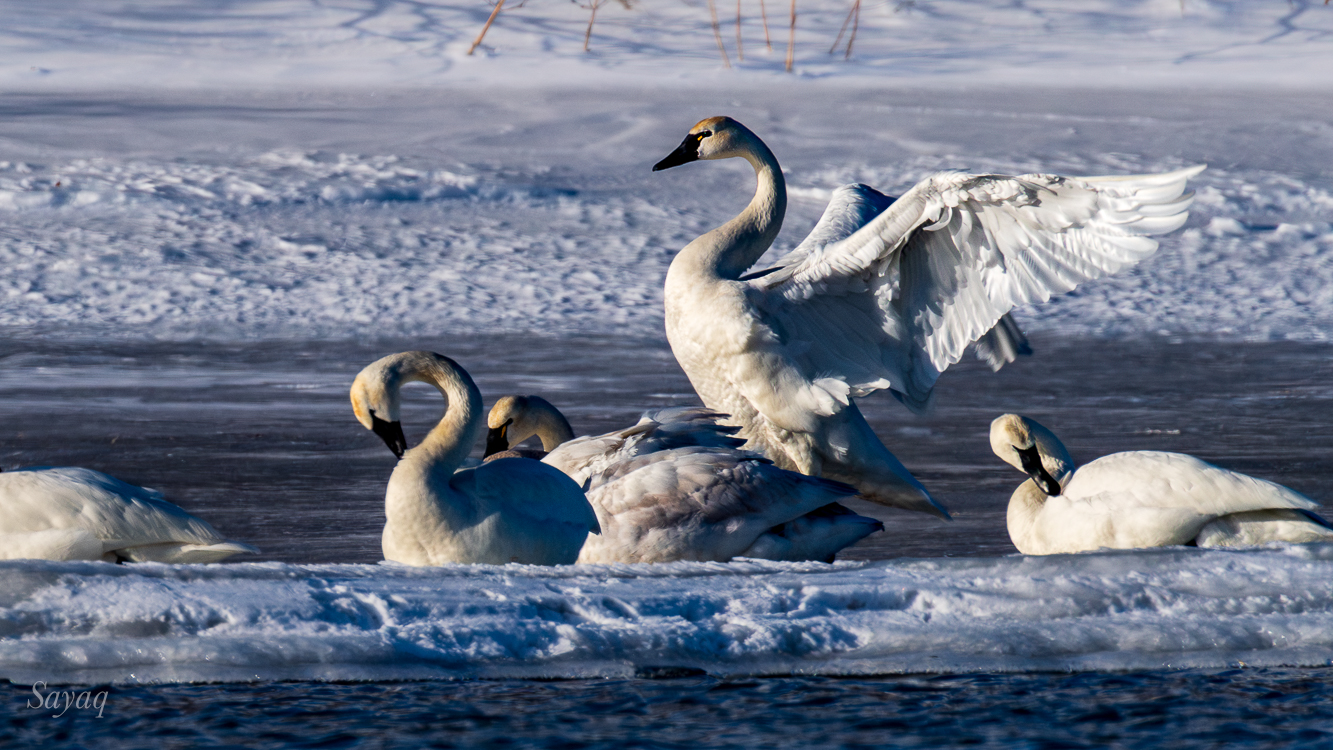
The Swans at Broad Pool Chignik River, 3/16/17
Each March, residents of Chignik Lake begin checking Broad Pool for early signs of spring – arriving flocks of Tundra Swans. The best swan viewing occurs in years when the river is partially iced over and therefore closed to boat traffic. This expansive pool has abundant Water Crowfoot, an aquatic vegetation preferred by swans and dabbling ducks. The swans, which mate for life and can live to be over 20 years old, will rest here and in other quiet water in the Chignik Drainage for up to a few weeks before breaking off in pairs and heading to tundra nesting sites on the Bristol Bay (northwest) side of the Alaska Peninsula. As human activity continues to cause the planet to warm and years of ice become fewer on the Chignik, Broad Pool may no longer provide a suitable resting place for returning waterfowl. Things are changing… fast. Get out and observe, photograph, document.

Tommy Woodpecker

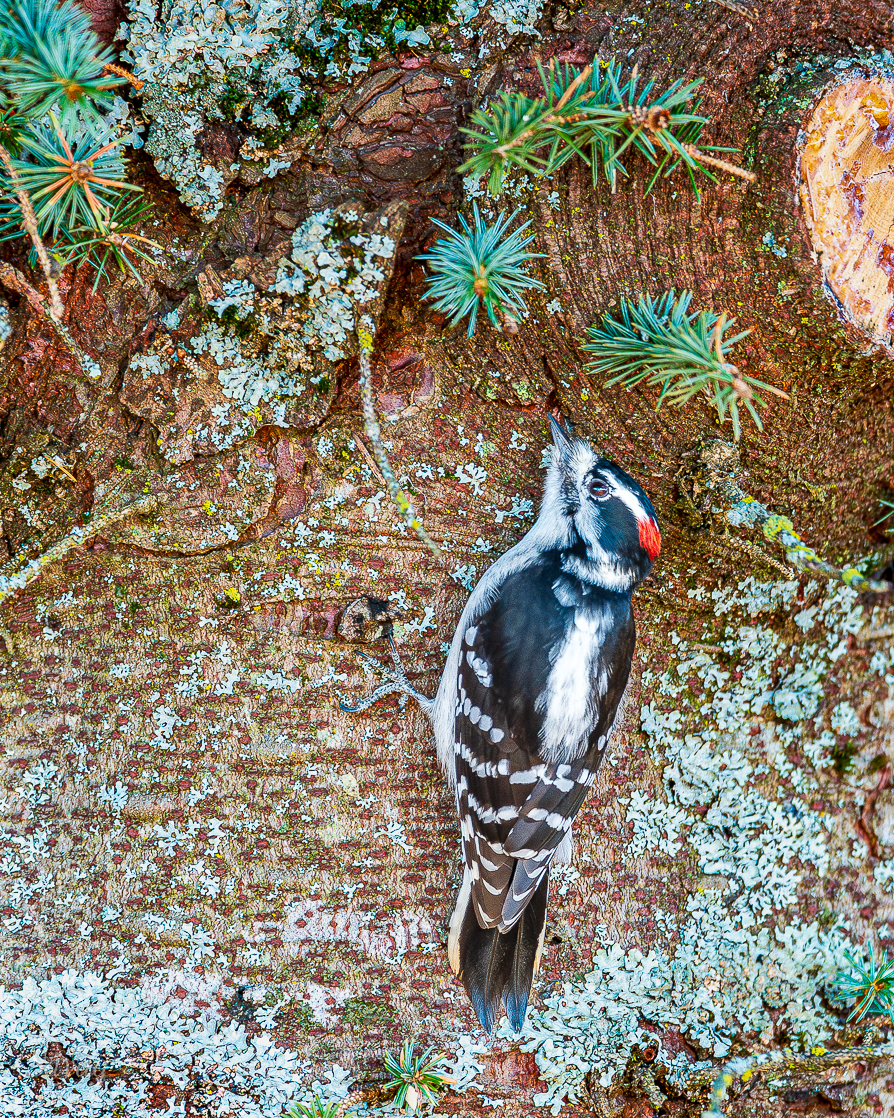
Down Woodpecker, Sitka Spruce Gove, Chignik Lake, AK, 12/30/16
The red crown distinguishes this specimen as a male. Note the blue tint on the tips of his tale, an iridescence not often so easily observed in Downies. Like other woodpeckers, Downies use their stiff tail feathers as a kind of third leg to provide leverage is they drum or search tree trunks for insects.

It is suggested in T. Gilbert Pearson’s Birds of America (1917) that the moniker Tommy Woodpecker would better suit North America’s smallest member of the woodpecker tribe “…for his boyish, buoyant disposition makes friends for him wherever he goes.” Perhaps for a moment we can set aside the sexism and celebrate an era and it ornithologists who took such a personal and personified approach to avian studies. I’d like to see any number of birds renamed, starting with discarding all those appellations that are essentially slave names applied by the person who “discovered” a given species – Wilson’s Warbler; Audubon’s Oriole; Steller’s Jay; etcetera. But Downy seems apt for this six-inch bird with its soft breast feathers.

No woodpeckers appear in David Narver’s study of the Chignik River Drainage conducted in the early 1960’s. Range maps have historically placed the Three-toed Woodpecker on the Alaska Peninsula – with no mention of Downies -, but this is surely in error as historically there was essentially no suitable habitat for spruce-and-pine-loving Three-toeds in that part of the world. My guess is that someone conducting an early biological survey got a glimpse of a woodpecker, made a guess, and that became the text for the peninsula. Very recently, I’ve noticed that the Cornell Lab of Ornithology and other authorities have begun to make corrections.

Though they are often common – the woodpecker one is most likely to encounter throughout much of North America – even in the most suitable habitat Downies are seldom abundant. And although the above photograph was recorded in the Sitka Spruce Grove at The Lake, Downies are equally likely to be found in the peninsula’s alder thickets and occasional cottonwoods. Though they are generally listed as uncommon or rare on the Alaska Peninsula, they are in fact regularly seen along the length of the Chignik River. It is probably a lack of nesting cavities rather than a shortage of food that limits Downy numbers on the peninsula, so as the land becomes more forested and trees mature and die and cavities are created their numbers will increase. Listen for their distinctive Peek! Peek! call and then for tell-tale light tapping.

Plant a Sitka Spruce, Get a Finch… or when is a new species an invasive species?

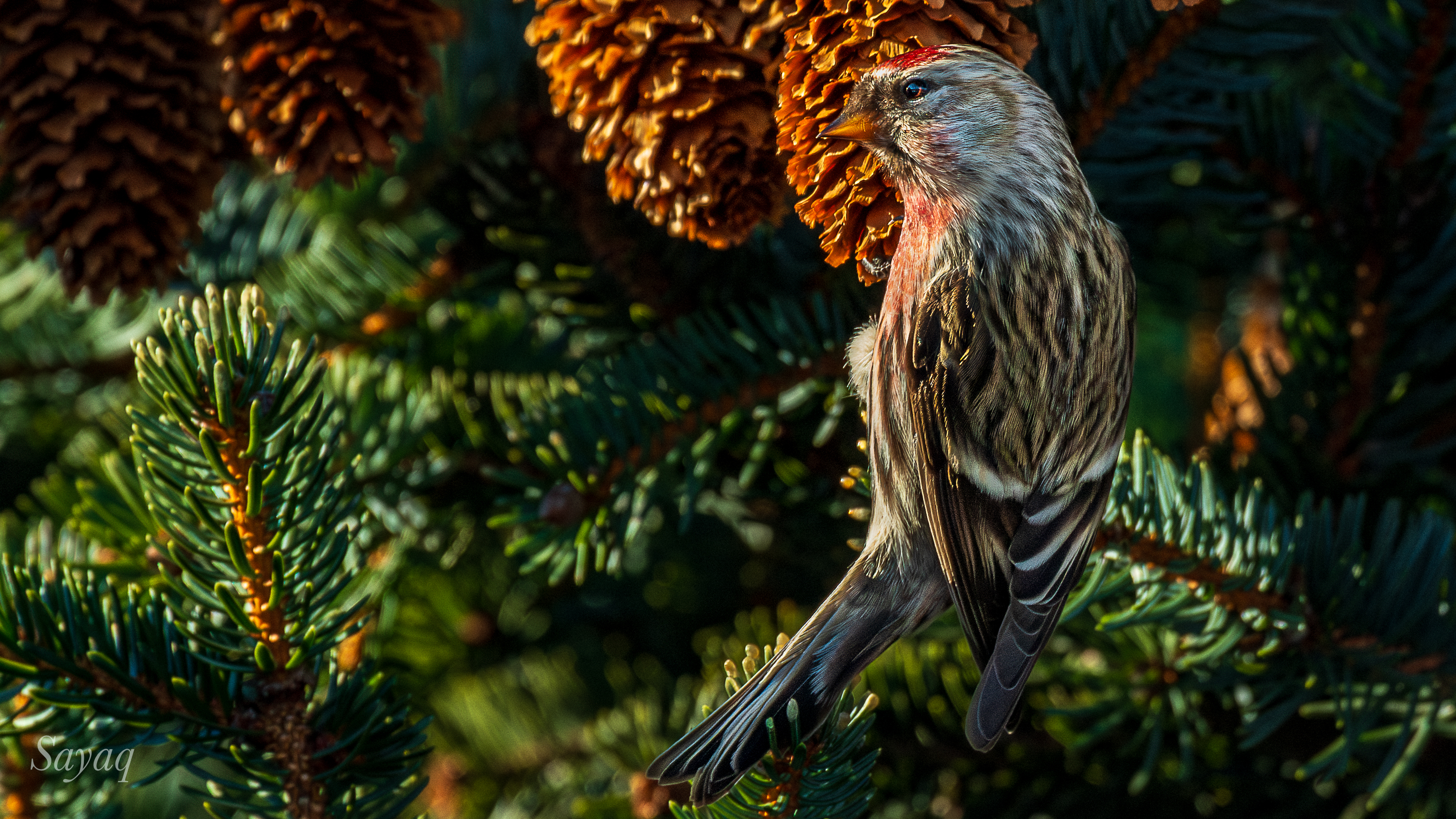
Common Redpoll, Sitka Spruce Grove
Chignik Lake, February 3, 2017

Up and down Southwest Alaska’s Alaska Peninsula, Redpolls, Siskins, Crossbills and Grosbeaks – all members of the finch tribe – have typically been marked as uncommon, rare or absent, breeding in small numbers here and there but generally not species one expects to encounter on the windswept peninsula. However, as trees – particularly alders -, have become increasingly abundant in that part of the world, so too have the finches. Seeds of the tiny alder cones are relished by Redpolls; the tender leaf buds by Pine Grosbeaks. But nowhere has the recent emergence of trees more dramatically impacted avian life than in the village of Chignik Lake where 70-some years ago Sitka Spruce trees were transplanted from seedlings gathered on Kodiak Island.

Some of the spruce trees at The Lake now tower over the landscape, producing both shelter and food for a wide variety of birds. The seeds of mature cones draw Pine Siskins, Hoary and Common Redpolls, White-winged and Red Crossbills, Black-capped Chickadees, Black-billed Magpies and several species of sparrow. While they’re still soft and reddish-purple, immature cones are feasted on by Pine Grosbeaks. Meanwhile, the variety of invertebrates that have moved into the little groves of spruce trees provide sustenance for Downy Woodpeckers, Pacific Wrens, Golden-crowned Kinglets and Yellow Warblers. Great Horned Owls roost and nest in the dark shadows of spruce bows and Northern Shrikes, Merlins and an occasional Sharp-shinned Hawk hunt the songbirds attracted to the trees. My guess is that it’s only a matter of time – and not too distant time – before the first Steller’s Jays are reported at The Lake. In fact, based on a description a now deceased resident reported to me, I’m not sure they haven’t already been there.

But here’s a question: Are these trees actually an invasive species… like the Orange Hawkweed that only very recently has begun showing up at The Lake? Or, for that matter, the dandelions which have taken over the school yard (and also, in some years, provide food for the finches as they go to seed)? And what about the above-mentioned alders that are steadily crowding out what remains of the peninsula’s tundra?

For decades, the transplanted Sitka Spruce trees did not propagate themselves in the Chignik Drainage. But about five years ago that began to change when seedlings suddenly began volunteering themselves throughout the village. One might argue that even without human intervention it was only a matter of time before Picea sitchensis made its way down the peninsula. But couldn’t the same be said of the Orange Hawkweed, dandelions and even the Kamchatka Rhododendron that has naturally, over time, found its way to The Lake from its native grounds in far eastern Russia?

Dumping a bucket of carp or pike into a lake where they never before existed is one thing…

On the other extreme are dandelions and hawkweed, which seem to to have devised strategies to show up wherever environmental conditions suit them.

Somewhere in between are a vast array of flora and fauna that – with or without humankind’s assistance – are finding their way into new niches.

So, what do you think? Where is the line between happily-received newcomer and dreaded invader?

The Tiny Kings of the Sitka Spruce Grove

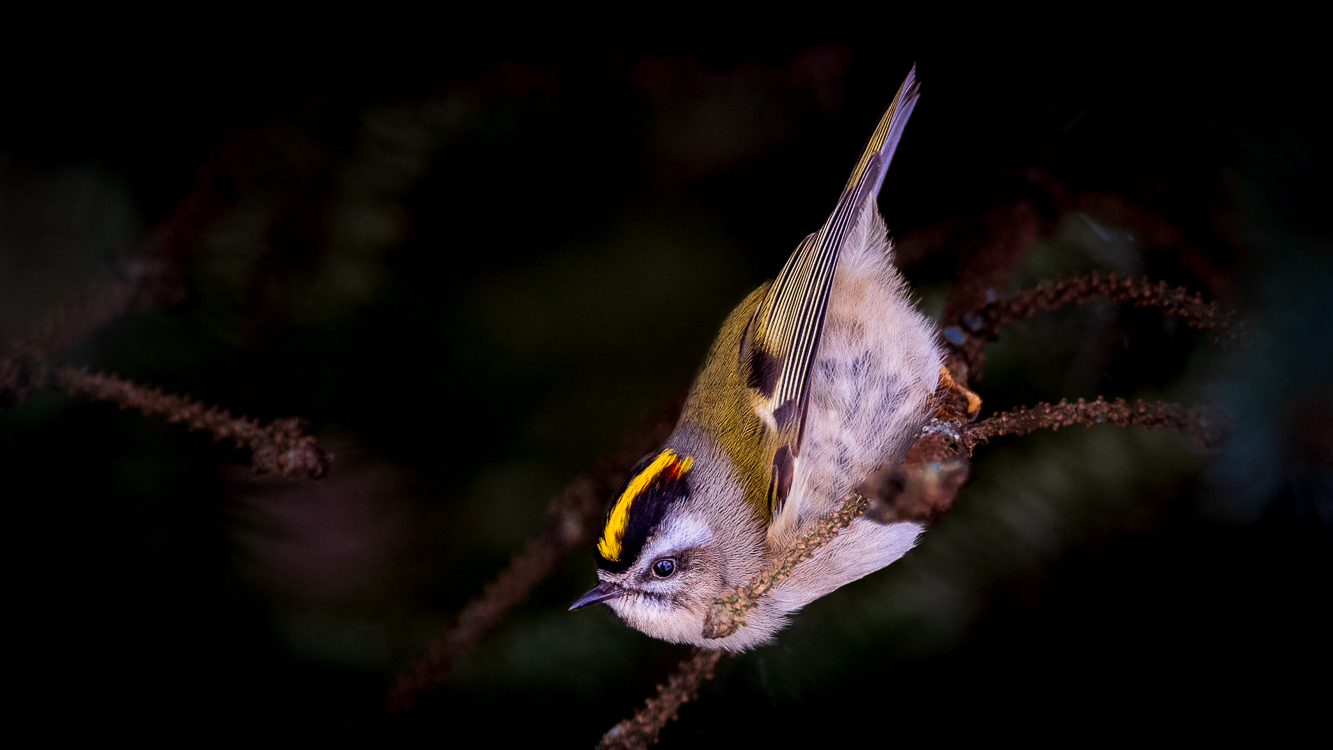
The Tiny King of Sitka Spruce GroveAt only about three or four inches (8 – 11 cm) in length from tail-tip to beak, other than hummingbirds there probably isn’t a smaller bird in North America than the Golden-crowned Kinglet. But they’re sturdy little beings, able to survive temperatures as low as -40° F (-40° C). The splash of scarlet identifies this fellow as a male; the female’s crown is pure yellow-gold.

Every autumn coinciding with the peak of the Coho run on the Chignik River, we’d begin to hear a new voice as we pushed through thick stands of alders or walked by the village’s scattered spruce trees. By this time, there weren’t many other passerines around, and so there was no mistaking the high, almost cricket-like call of returning Golden-crowned Kinglets. They were a new species for for us, always in motion, difficult to locate in the dense alders and dark spruce boughs they prefer, and they are not indicated on the Alaska Peninsula on any of the range maps we checked – Cornell, Audubon, Sibley – so we were very happy when we finally got binoculars on them and could make positive identification. Kinglets tended to remain at The Lake throughout winter. At some point, they presumably had cleaned all the invertebrate eggs and dormant insects they could find and moved on to other grounds, but they were there every year in those fall and winter months and should be added to peninsular checklists and range maps.

Red-breasted Merganser at Dawn with Char and Scaup – 2 versions: Which do you like better?

Red-breasted Merganser at Dawn with Char and Scaup: monochromeDecember 19, 2016
Red-breasted Merganser at Dawn with Char and Scaup: color

All summer and well into fall, we could often see salmon and char from our dining table window as they migrated along the lakeshore beach. The char could be there in any season, following the salmon to gorge on eggs and then making their own spawning run. At other times the char would cruise the lake shoreline chasing down the fry, parr and smolts of Sockeye and Coho Salmon. At that time they would readily come to streamers, and even in winter you could sometimes get a couple of fresh fish for the evening meal.

More interesting than fishing for the char was watching the mergansers and otters go after them. The diving ducks often worked cooperatively, cruising along the shoreline with purpose reminiscent of soldiers on patrol. When they found a school of Dollies they’d herd them against the shoreline or sometimes against ice sheets. The otters behaved in a similar manner, and when there were a lot of char around the otters and the mergansers would set aside some of their natural caution and you could find yourself pretty close to the action if you sat still and waited.

Although it was late in the morning when I took the above photograph, the sun was just barely beginning to emerge over the mountains south-east of the lake. At first it was too dark to shoot, so I positioned myself behind a natural blind of tall, winter-brown grass and waited. There were about half-a-dozen merganser hens, or a hen and her first-year offspring, patrolling the shoreline, catching fish. Then this one came up with the catch of the day just as a flock of Greater Scaup were passing behind her.

So, what do you think? Black and white, or color?

Things are changing. Fast. Get out and shoot.

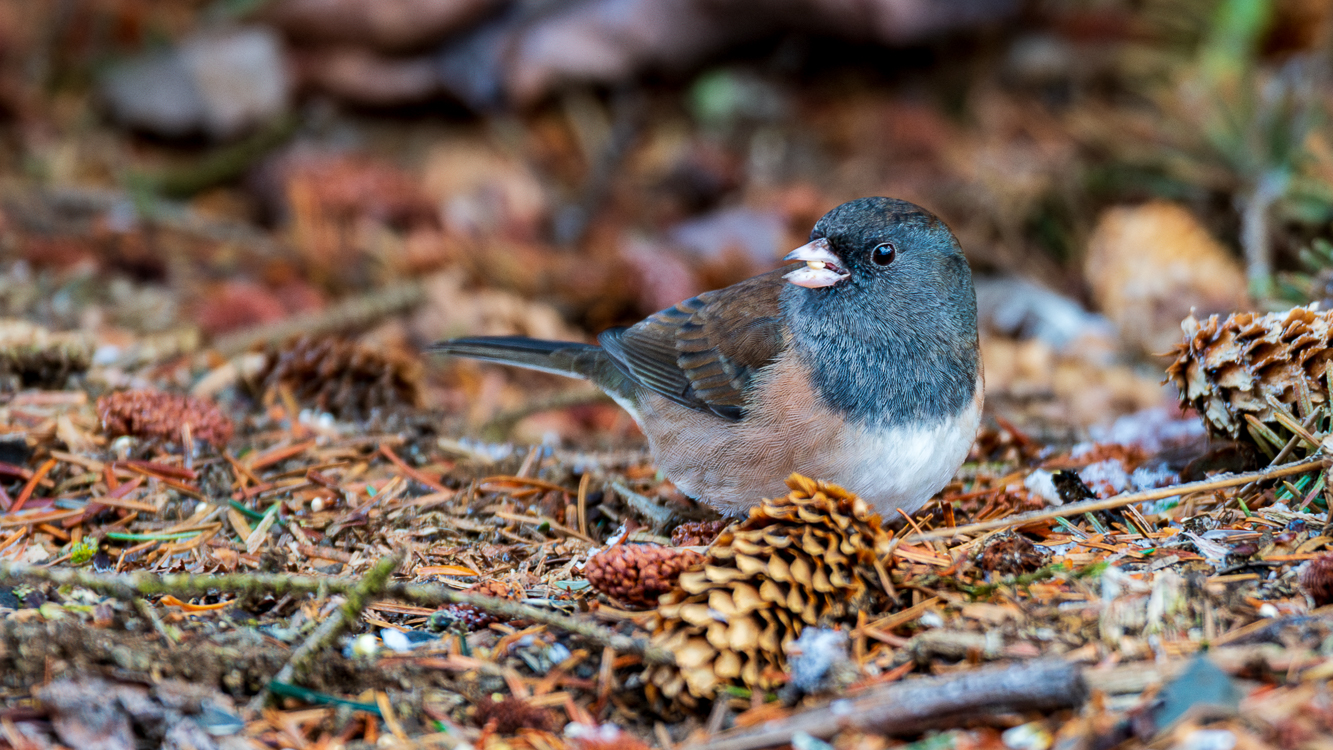
Oregon Race Dark-eyed Junco, Sitka Spruce Grove, Chignik Lake. As far as I’ve been able to determine, the Oregon Race specimens of Junco hyemalis we observed and photographed our first year at The Lake represent the first ever records of this bird on the Alaska Peninsula. We saw both Slate-colored and Oregon Race specimens of Junco hyemalis every year at The Lake from 2016 through 2023. It’s time for various authors and institutions to update their range maps. November 29, 2016.

“I’ve been hoping to see you!” Sam came out to intercept me as I was walking along the dirt road past his house on my way to Sitka Spruce Grove. It was an overcast, cold November morning, the tinny smell of snow in the air. “I’ve been seeing a bird I’ve never seen out here. Batman birds. They have a dark head, like Batman’s hood. Nick’s been seeing them too. We’ve been calling them Batman birds.”

“Yeah. I’ve been seeing them too. Just in the last few days, right?”

“Yeah. I’ve never seen them before. What are they?”

“Oregon Juncos. They’re not supposed to be here. I’ve checked my books and range maps on the internet. This might be the first time they’ve ever been out here.”

Sam, in his early 70’s and not more than five-six looked up at me as he rolled the burning cigarette he was holding between his thumb and his first two fingers. For a moment nothing was said. He lifted his arm to take a drag and looked out over the landscape as he let the smoke out. Winter-brown salmonberry breaks and willows, scrub alders an even more drab shade of brown covered the country all the way to the treeline on nearby snow-capped mountains, country that in Sam’s youth had mostly been tundra.

“Things sure are changing here,” he said.

There are still people in denial, people who not so very long ago dismissed Climate Warming as some sort of hoax, who refused to believe any scientists except those who work for the fossil fuel industry. Most of those hardcore deniers have given up the tack of total denial. But they haven’t gone away, and they certainly haven’t conceded their error. Instead, the refrain now is initial agreement, “Yes, it appears the earth is getting warmer,” followed by a deflating return to denialism with, “but the world has always been changing.”

Not with this rapidity it hasn’t – the occasional meteor strike notwithstanding.

The result is that almost anywhere one lives, change can be observed in real time. This might be manifested in new species of flowers and other plants, new birds, other vertebrates, insects… or the rather sudden absence of formerly familiar species. Anyone with a camera has a chance to contribute to real-time, meaningful documentation of the change that is occurring right now all around us.

It’s not just the natural world that is undergoing rapid change. As expanding urbanization follows an overpopulated species across the globe, historic buildings are being torn down, forests leveled, rivers rerouted, lakes and aquifers emptied. Things that had remained much the same for decades, for generations even, are suddenly in a state of upheaval.

Photography is used for many things: to capture holiday moments; family portraits; events of all kinds; and increasingly, to make fine art. But some of the most compelling photographic images have always been and continue to be well-composed, straightforward documentation.

Anyone with a camera can make a meaningful contribution. Get out and shoot.