Tufted Puffins, a Name Change and Best Wishes for 2013

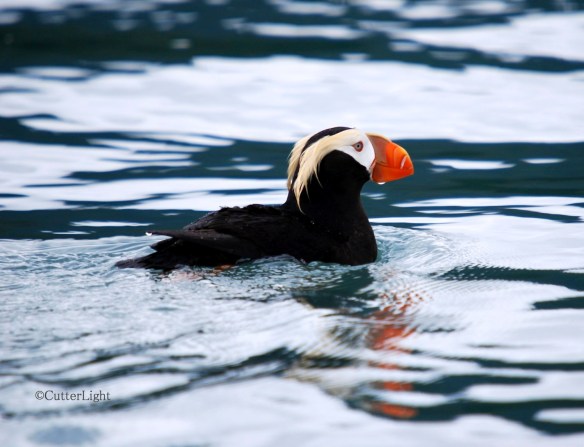
Tufted puffin near Homer I_nUnmistakable with their toucan-like bright orange beaks and combed back white tufts of head feathers, tufted puffins (Fratercula cirrhata) are among Alaska’s most familiar ambassadors.

When we began this blog a little over two years ago, it was for ourselves. The blog was to be a place to catalogue our recipes and keep a photographic record of our travels and adventures. And so we named it Frozen Moments and didn’t think too much about it. It seemed an appropriate name for a blog where photographs are highlighted (frozen moments) and especially so since our home nine months of the year is in Arctic Alaska (frozen months).
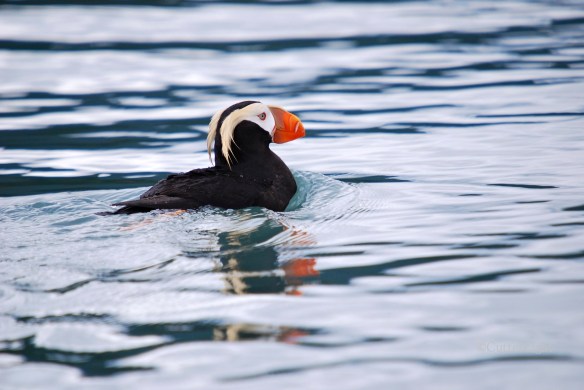
Tufted puffin near Homer II_nBut as we got more into it, we discovered that Frozen Moments was a little too obvious. Others were already using the name. We realized we’d eventually want to make a change. CutterLight has its origins in two sources. Cutter derives from our summer home in Seward – our cutter-rigged sailboat. To us, the term evokes images not just of sailing, but of travel and adventure in general, as well as a spirit of being willing to learn and experience new things.

Tufted puffin near Homer III_nLight, too, holds multiple meanings for us. There is of course the “light” which all photographers are concerned with. As our skills and interest in photography grow, we are finding that we are becoming, inevitably perhaps, obsessed with light. It permeates our world now in ways it never did before, and this newfound awareness affects everything from the way we watch movies to how we perceive the world around us to how we deal with the deceptively elusive basic elements of photography.

Tufted puffin near Homer IV_nBut Light holds a second meaning – one which is perhaps even more central to our lives. As we move forward toward fulfilling our goals as writers, photographers and sailors, we have pared away much of what we once considered necessary. Not much fits on a 35-foot sailboat. A succession of yard sales and donations to thrift shops allowed us to part with most of our possessions before we moved to Alaska three years ago. Since then, every new item we add to our lives is carefully evaluated for the value it brings in terms of utility and pleasure. Few items make the cut. We are moving forward with a life that feels lighter yet stronger. It is a wonderful feeling.
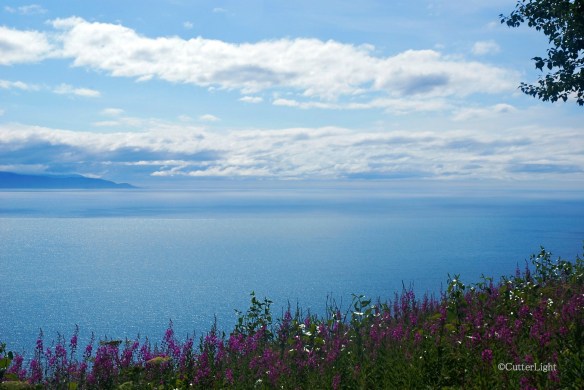
Lower Cook Inlet near Homer_nLooking out over lower Cook Inlet from the bluffs above Homer, Alaska.

As we look back on 2012, it is with a deep sense of appreciation. Many new friends came into our lives this year, and we also were fortunate to have had some really special reconnections with people from our former lives. We are happy, too, that our blog is finding an appreciative audience. We wish one and all fair winds and following seas in the coming year.

Jack and Barbra Donachy
Last Light: Arctic Foxes, the Coming Dark

Arctic Fox on Point Hope Beach_n

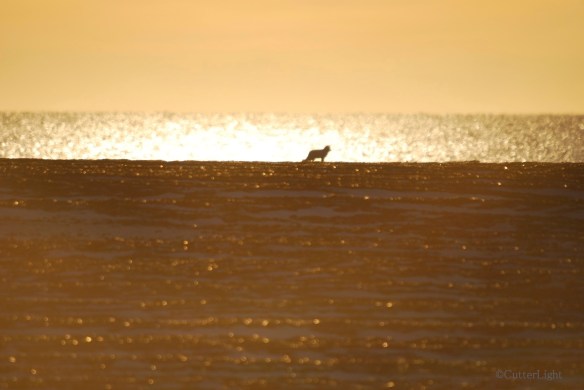
Point Hope, Alaska, along the south beach: An Arctic fox is silhouetted in the gold of a late fall sunset.

On Wednesday, December 5, the sun will rise at 1:37 pm. It will climb for just 19 minutes and 30 seconds before it begins to descend. At 2:16, it will sink beneath the ice-sheeted sea. It will not rise above the horizon again for 28 days. During this time, afternoon twilight will be the extent of our natural light. Cold and darkness will clamp down hard on our village. The Arctic winds this time of year can make a well-built house shudder.

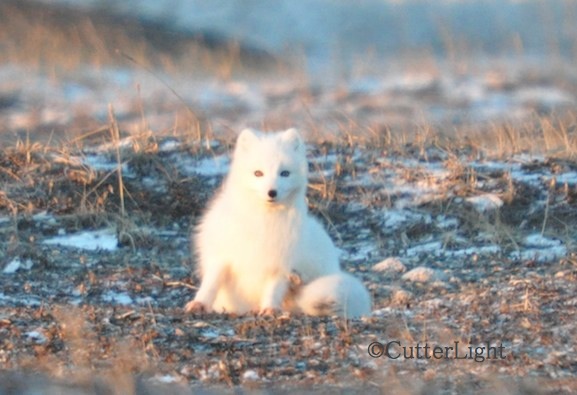
Arctic Fox near old Tikigaq, Alaska. Nikon D90

The photo above and the next two are of an Arctic fox we found hanging around the deserted Old Town site of Tikigaq a mile or so west of Point Hope three weeks ago. They’re intelligent, inquisitive animals and will sometimes approach quite close.

In mid fall, foxes and snowy owls show up in numbers near the village. They patrol the beach for fish and whatever else may have washed up and they hunt the tundra for voles and squirrels. As the days grow short and the real cold sets in, they scatter.

Arctic Fox 2_n

This one is very likely out on the sea ice now, scavenging the remains of seals killed by polar bears. These foxes often travel vast distances during the course of a winter in search of food.

Arctic Fox 3_n

Caribou have moved down from the hills, and sometimes we see them now out on the tundra a few miles east of town. Wolves follow the caribou, and a few hardy ravens manage to scratch out a living throughout the winter. Every so often, we see a flock of murres – seabirds – heading out in search of open water.

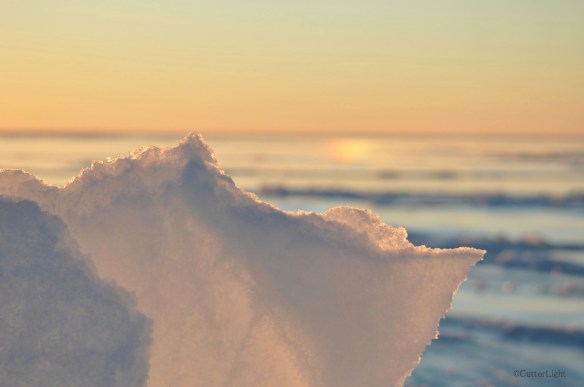
The Light before the Fire (First Sea Ice, Point Hope)

There’s not much sun now –

three hours or so from dawn to dusk

and in those three hours, the sun doesn’t climb very high

so that on clear days the world is bathed 

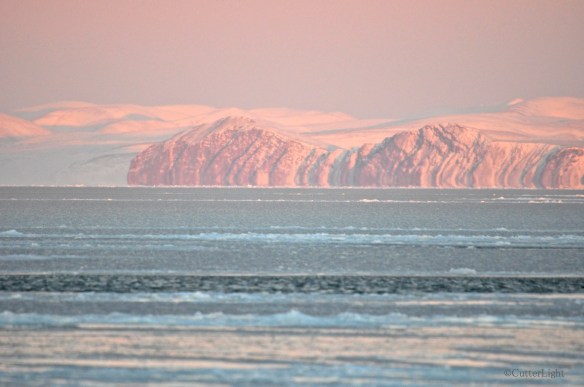
in soft pink and lavender and gold

the horizon rimmed in turquoise

beneath a pale sky

until one day the wind shifts,

and gathers sheets of ice

already formed at sea,

and pushes the ice to shore

where it gathers the light,

and you forget about the things you thought you missed…

the life you left behind

in that moment

before the sun sinks to the ice-covered sea

and everything turns to fire

The Night Sky at Point Hope (A Whaler to His Son)

The northern lights have been out nearly every night lately. Here they frame two umiak – seal skin boats used for the spring whale hunts.

A Whaler to his Son

This poem is

an empty sigluaq

a seal skin boat

a lookout camp

on a new lead

This poem is

your grandfather’s parka

a snow squall on the horizon

a polar bear’s track

imprinted in the snow

This poem is

a fluke flipped and sounding

in a silk-white wake

like stars

washed over the Chukchi

This poem is

our village

carved like scrimshaw

on an ivory dawn

the dim Arctic sun

small and perfect

as a bowhead’s eye.

.

*A sigluaq is an ice cellar dug into the tundra used to store whale meat (and other meat)

Jiro Dreams of Sushi: A Philosophy of Life and Sushi

Yanagiba (sushi knife), ohashi (chopsticks) properly resting on an ivory spotted seal hashioki, and David Gelb’s documentary of world-renowned sushi chef Jiro Ono. Let the feast begin.

The shots of sushi will wow you. Segments depicting 85-year-old Jiro Ono magically transforming rice and fish into pieces of art that are at once too beautiful to be eaten and yet must be eaten will mesmerize you. The manner in which he and his 51-year-old son run Sukiayabashi Jiro, a 10-seat sushi restaurant in the underground subway system in Tokyo’s ritzy Ginza District will, perhaps, prompt you to make subtle (or not so subtle) changes in the way you run your own kitchen. At the very least, you are likely to come away from the film with a heightened appreciation of tamagoyaki – the grilled egg dish frequently served on nigiri sushi menus. Sukiabashi Jiro is the only sushi restaurant in the world to earn Michelin’s top rating – the coveted three stars. The simple definition of a three-star restaurant is this: a restaurant that by itself makes a trip to that country worthwhile.

As a self-taught chef, as a father, as a person who is seeking to perfect my own path in life, and as one who lived in Japan for nine years and came to deeply appreciate the Japanese sensibility toward life, this film profoundly moved me. Jiro Ono embodies the characteristics of the shokunin – a master craftsman or artisan who, while possessing superb technical skills in his field, is also aware of his responsibility to model an honorable life and to look out for the welfare of others. In the film, Masahiro Yamamoto, one of Japan’s leading food critics,  identifies the five attributes of a great chef. These attributes are no doubt valued by all shokunin.

1. A serious attitude toward one’s work

2. Aspiration to improve – to strive for perfection

3. Cleanliness (which includes a proper order in one’s life and work)

4. Lead rather than collaborate

5. Bring passion to one’s work, (and through that passion to discover moments of ecstasy)

I’m going to add a sixth element to Yamamoto’s list. If Jiro’s life is about striving for perfection, the question is begged, “Perfection to what end?” To what purpose are the above five attributes?

It is this: They are all aimed toward providing others with an ultimate experience. Jiro dreams of sushi, yes. But what he really dreams of is providing his customers with a perfect dining experience. That is the sixth attribute: The desire to provide others with a penultimate experience.

Some of these attributes are, perhaps, antithetical to current western thinking. Therein lies the core of the criticisms of this film. Aren’t we supposed to value collaboration? Is the emphasis on cleanliness really so important? Is Jiro truly interested in others, or is he merely a shallow, self-inflated ego with no meaningful connection to other human beings – including his wife and his two sons? Doesn’t taking one’s work too seriously lead to imbalance in life?

I think this much is fair to observe: The path Jiro Ono has chosen in life is not a path that would suit everyone. But it is a path I admire. In the director’s cut, it is mentioned that a regret is that Jiro’s wife was unable to be in the film. This seems to be owing to the health of a woman in her 80’s, not about a failed partnership. His sons are both key players in the film, and speak of their father with honor, respect and love. They have both chosen to follow in his line of work, to embrace his teaching and have become highly respected sushi chefs in their own right. In turn, Jiro speaks with pride and admiration of both of his sons. As a father, I can very much relate to Jiro’s philosophy regarding child-rearing. You spend your life teaching and guiding, and in the end you hope a good bit of it takes root. In both of Jiro’s sons, his teaching did stick, his guidance payed off, and because his sons worked for many years in his restaurant, he ultimately spent more time with them than most fathers ever spend with their children.

As to taking one’s work too seriously and carving out one’s own path rather than collaborating, I grew up in a family wherein, not just in my nuclear family but in all the uncles and aunts in my extended family, the life philosophy most frequently espoused was an admonition to not take work (or anything else) too seriously. It was a philosophy that did not work for me, and ultimately inspired an opposing philosophy.

At the age of 4o, I began the long, sometimes arduous, deeply satisfying process of remaking my life. Part of the remaking has been rooted in a newfound freedom – a self-given permission to pursue life with renewed passion, dedication and a commitment to honor and excellence.  As I move forward with this life as a sailor, chef, writer, photographer, father and husband, this film that so eloquently captures the life and spirt of a true shokunin resonates.

The Gentleman Angler

Before we moved to Alaska, we’d never seen fog flowing down mountains. I’m sure it happens elsewhere… This was one of those days of sunshine and patchy fog. Fog encircling the horizon. Fog pouring like a river through mountain gaps on Resurrection Bay. 

I like foggy days. Fog means you can start late and not miss the bite. When it’s foggy, sometimes, big things happen late in the day.

By the time Barbra and I got our C-Dory fueled up and heading out into the bay, it was 10:30 A.M. Most of the fleet – both the charters and recreational boats – had long since left the docks. There was a time when I would have been with them – when I had to be on the water early. Dawn. Before dawn. Early early. Trout streams in Pennsylvania, striper rivers in South Carolina, sea bass beaches in Japan….

Most days, the early morning bite is the best.

Fog changes that.

Laid out on the dock are six silver salmon, eight rockfish, a couple of greenling, three small halibut, and a 35-pound lingcod. A couple of the salmon and the halibut didn’t make it into this photo. All of the fish were filleted, vacuum-packed and flash-frozen, ready to travel with us to Point Hope. I asked Barbra to name her favorite on the dinner table. “The variety,” she answered, without missing a beat. We didn’t get up early for these fish, and we didn’t run far.

We could get up earlier. We could run further. We could catch more fish and larger fish.

We know that.

At some point in my life, numbers and size stopped mattering so much. I still like to fish. But most of the time, most days, the fish that interest me the most are the ones that are still biting after I’ve had a good night’s sleep, breakfast, a leisurely mug of coffee (not in a to-go mug, but in my favorite mug at my breakfast table) and have read the news.

“We’re gentleman anglers,” my older friend and mentor Bill Kodrich explained to me. Forty years ago, we were in a cafe, me with a slice of blueberry pie, Bill with a slice of apple pie and a cup of coffee. It was about ten in the morning. We were headed for Spring Creek. I’d never been. I was eager to go. I thought we should have been there four hours ago.

“We don’t need to hurry,” Bill said with a characteristic smile. “There’ll still be trout in the stream when we get there.”

I get it now.