Philosophies for Learning to Play the Guitar at 60: Reading Fluency

Philosophy #19

Learn to read fluently. Music, that is. With the guitar, this means acquiring the skill to effortless sight read every note starting three spaces below the treble clef with the low E all the way up to the highest C on your fretboard. It also means fluency with tablature and the ability to instantly recognize chords. It is true that there are many examples of guitarists who never learned to read music. It can definitely be done. But my guess is that having come to the goal of learning to play later in life, you’re looking for the fastest, surest, most efficient way to learn. That path lies through reading fluency. 

Mel Bay’s Modern Guitar Method Grade 1 is an excellent resource in this regard. The book is driven in part by a string by string, note by note acquisition of reading literacy. In the long run, if you follow this approach and learn to sight read, you’ll be further ahead than had you played by ear or learned only tablature notation. There’s also a dark side, so to speak, to skipping the literacy process. It is almost certain that if you stay with the guitar that at some point you will wish you had learned to read. This often happens to younger musicians who were trained to play by ear. The process of going back and learning to read after you can already play can be laborious and even downright painful. Another way to look at it is like this: I doubt anyone has ever said, “I’m sure glad I never learned to read music.”

And who knows? You may eventually want to write down songs of your own creation.

Good luck and keep practicing!

Philosophies for Learning to Play the Guitar at 60: Embrace Difficulty

Philosophy #18

Embrace Difficulty: At the outset, any complex task might appear daunting. Overwhelming even. Keep in mind the proverb that a mountain is climbed one step (or handhold) at a time. Chord changes are initially difficult for everyone. No one begins with a beautifully cascading fingerpicking style or a rapid tremolo. These things take practice. With practice, things that once seemed unattainable will become achievements.

Keep a journal. Record dates and make brief notes about improvement and achievements. Use a metronome to measure gains in speed. Occasionally make video recordings of yourself for comparison to past and future performances. Keep track of how many scales you’ve learned, how many songs you’ve memorized, how many chords you know and so forth.

The goal of reaching your first 500 hours of practice is, by itself, a fairly daunting objective. In the room where I do most of my practice, I’ve hung a calendar on the wall where each day write down how much I’ve practiced. I’ve also put a goal thermometer on the wall – a more visual means by which to show the same thing. Measuring in increments of 10 hours, it starts at 0 and goes to 500. Every 10 hours, I color in the space and write a date. Three-hundred 340 hours to go.


Philosophies for Learning to Play the Guitar at 60: Form

Philosophy #17: Be Mindful of Form.

I hesitate to use the word “proper,” but there it is. To maximize your comfort, stamina and capacity to grow as a musician, study and emulate proper posture, proper guitar positioning, proper hand positioning, and standard fingering for notes and chords. This comes under the broad heading of following the lead of those who have been there and achieved success. The time to develop your own style is after you’ve mastered the basics.

(Photograph: Snow Dancers)

Philosophies for Learning to Play the Guitar at 60: Play for Yourself

Philosophy #16

Play for yourself and trust yourself. Acquiring the skills of basic proficiency with a guitar is not a competition. Avoid comparing yourself with the progress peers are making. And don’t  worry about what others might think about your musicianship, your guitar, your song choices and the rest of it. You’re on your own journey. 

Philosophies for Learning to Play the Guitar at 60: Don’t Quit

Philosophy #15

Don’t quit. All else being equal, the most important factor in any type of skill acquisition is simply showing up ready to work hard and learn. Michael Jordon was cut from his high school basketball team. And was spurred to develop a work ethic that had him first to arrive and last to leave practice. Jack London vowed to write at least 1,000 words a day. Legend has it that his early work was rejected hundreds of times. He kept writing. By all accounts, Roberto Clemente always excelled at baseball. And by all accounts, he was among the hardest-working players in the game. We wouldn’t know his name if he had quit – at least not as a ball player.

It’s almost impossible to look at where someone is in terms of developing a skill and to then predict how far they’ll go, yet the world has no shortage of put-down artists who act like they have a crystal ball in terms of what other people “can’t do.” Don’t listen to them. And never bet against someone who is in possession of a solid work ethic and optimism.

Longitudinal studies have revealed that there is virtually no correlation between where one begins their musical journey and where one ends up. Young learners who begin with great promise often quit, leaving the field wide open for those who initially showed less promise but who are willing to stick with it. In the end, the path to accomplishment lies not with initial talent, but with a commitment to practice. Along the way you’ll have days when everything falls into place and you play beautifully. Keep practicing. You’ll also hit plateaus and slumps. Keep practicing. 

Philosophies for Learning to Play the Guitar at 60: Visualize

Philosophy #14

Visualize. Athletes anticipate and mentally map out desired outcomes such as the phases necessary to go through in clearing the bar in pole vaulting or in pulling in a football for a catch. This works for musicians too. Get into the practice of “seeing” ahead in a song to anticipate musical passages and chord changes. Practice chord changes by accurately and smoothly moving back and forth with your left hand without even playing. Picture the chords in your mind. Silently practice. These activities build brain synapses and muscle memory.


The Lake – for a Moment

The Lake – for a Moment
Chignik Lake, Alaska, Dawn March 26, 2019


Philosophies for Learning to Play the Guitar at 60: Listen

Philosophy #13

Listen. Listening well is a skill, and therefore as with any skill it can be developed through practice. A person new to birding may know only a few bird songs – perhaps not even a few. (Hollywood directors frequently – almost ubiquitously – place Blue Jay calls into film settings where no Blue Jay has ever flown; those same directors dub in hawk cries when the birds are eagles.) But with practice, anyone can learn to recognize dozens of bird calls and songs – a skill that seems almost magical at first. Similarly, as a young fly-fisherman I remember an older mentor directing my attention to the sound of bluegills feeding among lily pads along a calm lakeshore. The gentle popping-kissing sound was unmistakable, and my ears became trained to listen for it when I’m on a springtime or summertime lake where these sunfish might be patrolling the shoreline. 

With just 153 hours of practice under my belt since January 1, I cannot yet answer the question, Is it even possible for someone in their 60’s to learn to play the guitar with any meaningful degree of proficiency? But what I can say is that after even a few hours of focused practice, you will probably notice that you are hearing notes and music in a new way. Familiar songs on your iPod or Spotify playlists will suddenly sound new as chords, riffs and even lyrics that have always been there suddenly seem to leap out of the speakers. And on your own guitar you’ll probably begin to notice when strings are even slightly out of tune.

Regardless of what you play, listen carefully, for as you practice, so you will learn and eventually so you will play. Make certain your instrument is always in tune. Sound notes with care so that they ring true. Test the chords you’re learning by playing each string individually. Train your ear to expect beautiful tones.


Singing His Heart Out: A Pleasant Morning at White Spruce Grove

Resplendent! This male Pine Grosbeak came down from a tree crown to forage beneath one of the feeders at White Spruce Grove.

When we stepped out the door yesterday morning, the first thing we noticed was a new song in the air. A spring song. Returning Fox Sparrows have been the first to begin this each year we’ve been in Chignik Lake, but the warbling melody didn’t sound like a Fox Sparrow’s riff. We could see the bird, a plump silhouette atop a spruce tree near the church and since we were on the way to the White Spruce Grove to top off bird feeders anyway, the obvious choice of walking path was the one that would bring us nearer to the singer.

The female grosbeak briefly joined her mate.

Pine Grosbeak, brilliant red and singing for all he was worth. Quite a change from the brief but distinctive Peek Peek! we hear from this species throughout fall and winter. It wasn’t a new bird, but it was new behavior. We continued on the half-mile to the spruce grove with anticipation.
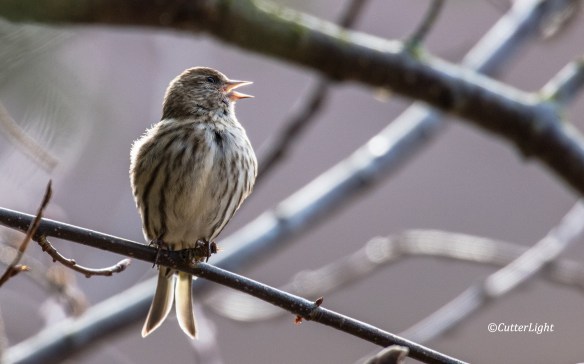
Our Pine Siskins were their usual raucous selves, singing, squabbling, gorging on seeds, darting from tree to tree.

Along the way scattered flocks of Pine Siskins buzzed and called from the sky and from a neighbors’ house where they sometimes take refuge in a few spruce trees while visiting the feeder there. Magpies, common here at The Lake, made their presence known, as did a woodpecker, almost certainly a Downy though we couldn’t find it. Further along a pair of Black-capped Chickadees gave a couple of their various calls from willows, the branches of the scrubby trees suddenly having turned bright yellow-green and beginning to bud.
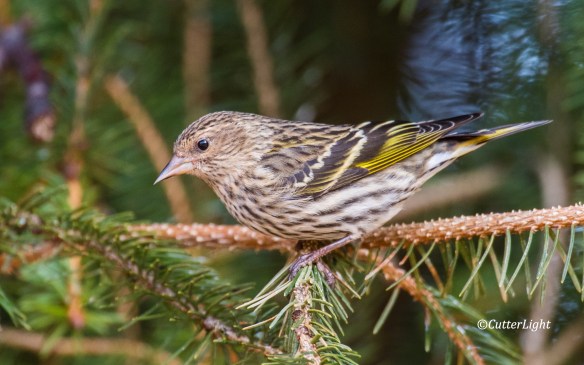
My guess is that when the time comes, the siskins will head up the peninsula to the denser spruce forests around Lake Iliamna and similar places to nest, but they’ve been welcome winter visitors the past two years.

At the White Spruce Grove the usual Siskins, which showed up last fall and have spent the winter, were busy at the feeders as well as prying the last seeds from cones. But there were a few larger, rounder shapes foraging on the ground as well. We didn’t get our binoculars up in time to have a look, but as we were filling the feeders we heard the unmistakable plaintive song of Golden-crowned Sparrows.

There’s just a touch more gold in this Golden-crowned Sparrow’s crown than there may have been a month ago. He’s still a ways off from full breeding plumage though.

Sure enough, once we scattered a little seed along the brushy edge where they like to feed, they began to show up, and they brought a Dark-eyed Junco with them. Seldom observed out on the Alaska Peninsula – and absent altogether or marked with a question on most of the region’s birding lists – Juncos have shown up in small numbers each of the three winters we’ve spent here. In fact, we think we have the only documentation on the peninsula of Oregon race juncos.
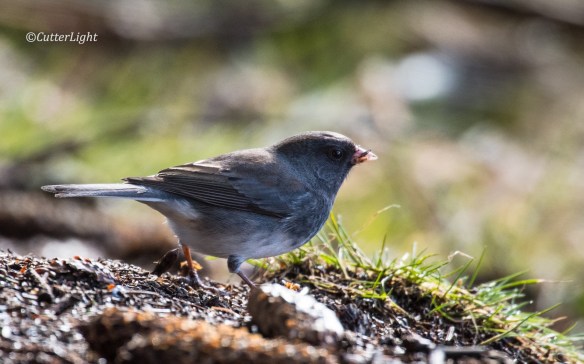
While there have been fewer Juncos at the Lake than there were last year, every so often we see one or two or three.

The Golden-crowned Sparrows appear to have just begun growing in their breeding plumage. Some of the male Siskins though are already there, showing off brilliant canary yellow in their primaries. At one point a Belted Kingfisher rattled by, most likely a male getting things ready for the females that will soon return. Ravens called in throaty croaks from a far hill. No ducks on the water and no eagles on their usual perches, which is a little unusual. Perhaps the ducks are already up at Black Lake where most of the nesting occurs. Gulls will begin returning any day.
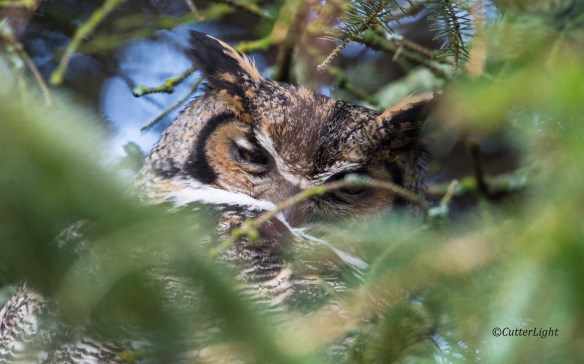
Sleepy but looking well fed, she lost both of her fully-fledged chicks last year, one to an electrical box on a utility pole and the other to some other cause. We’re hoping she nests again this year with much better luck.

We aren’t always lucky enough to see one and we rarely see both of them, but this was a red letter day as both of our Great Horned Owls – the female and the slightly smaller, more lightly colored male – were perched where we were able to find them. As is usually the case, they were buried in shadows behind thick evergreen boughs, aware of our presence but seemingly unconcerned. The ground beneath their favorite roosts is littered with bits of hair, feather, bone and beaks and oblong balls the size of two thumbs placed together packed tight with the remains of the various voles, Magpies, ermine, lemmings or whatever else constitutes one of their meals. Last year the female spent several days perched atop a winter-white Snowshoe Hare – several meals.

Discernibly smaller and with brighter plumage, we feel fairly certain that this is the male. The Ainu – Japan’s indigenous people – believed that owls protected their villages. They are certainly regal animals.

Frost on the ground this morning, but if you look closely at the photos, you can see other signs that spring is coming to Chignik Lake. Hopefully I’ll be posting a video of a Fox Sparrow singing in the near future.

With their uplifting songs and stunning plumage, if birds didn’t actually exist I don’t think we’d believe that they even could exist. They certainly brighten our world.

Philosophies for Learning to Play the Guitar at 60: Choose the Right Guitar

Philosophy #12

Take a Tip from Harold Crick:
Choose a Guitar that Makes You Want to Play.

I once owned a 2005 Toyota Tacoma pickup that was in every way so perfectly customized to suit my preferences that had I been given an assortment of the best vehicles in the world – Lamborghinis, Mercedes, Jags, whatever – they’d have sat untouched. That Tacoma was the only ride for me.

I feel that way about my guitar.

If you’ve ever watched the film Stranger than Fiction, you’ve seen what is probably the best way to choose a guitar. Harold Crick, played by Will Ferrell, has decided to finally act upon his oldest desire – to learn to play the guitar.

Like you, Harold already knows what kind of music he wants to play. And like you, he knows how much he’s willing to spend on a guitar. And so, like you, he doesn’t really need a lot of advice from the staff at the guitar shop, friends or online experts. What he needs to do is go to a store with lots of guitars, look at them, and pay attention to which one he wants to pick up and play.

And since he can’t play… not yet anyway… there’s no need to embarrass himself or anyone else by taking an instrument down and strumming it.

It doesn’t matter that when he finally made his decision, Harold chose a guitar that I wouldn’t choose and that perhaps you wouldn’t choose either. He picked the guitar that spoke to him.  Here’s a link to the minute-and-a-half clip.

Stranger than Fiction: Harold Chooses a Guitar

If you’ve made a commitment to learning to play the guitar, get one you really like now rather than later. A rose is a rose is a rose… until you get to know roses and every subtle difference among them pops out.

Although I had an inexpensive but perfectly serviceable Fender acoustic steel string when I began this experiment, I knew after two weeks of practicing on it that I wanted something else. Since I live in the Alaska bush and don’t have access to a guitar shop, I did my looking online. I knew next to nothing about guitars, but it wasn’t long before I found exactly what I was looking for – the guitar that spoke to me. 

I called Mammoth Music in Anchorage, paid a nominal fee to have the guitar delivered to Lake Clark Air (our bush plane service) and in short order I was playing the guitar of my dreams.

I love this guitar.

I love that it was crafted in my home state so that there is a connection with a place I love.

I love that the top is Sitka Spruce, and that I can follow my memory to spruce forests in Oregon, British Columbia and Alaska where I’ve hiked and camped and that I can almost smell the loam and trees, hear thrushes singing, see sunlight streaming through spruce boughs when I pick up my guitar.

I love that my very first musician hero, Johnny Cash, played this model. So did Jimmy Page, Bob Dylan and a long list of other musicians I admire.

I love that the rosette design is modestly understated, so that one’s eyes are drawn to the grain of the wood rather than distracted by embellishments.

I love the way this guitar resonates when I hit a note just right – and the fact that it doesn’t punish me too severely when I hit a string wrong.

So, go find the guitar (or fly rod, cookware, camera, or whatever it may be) that’s right for you. It can make a big difference as you continue on your journey.