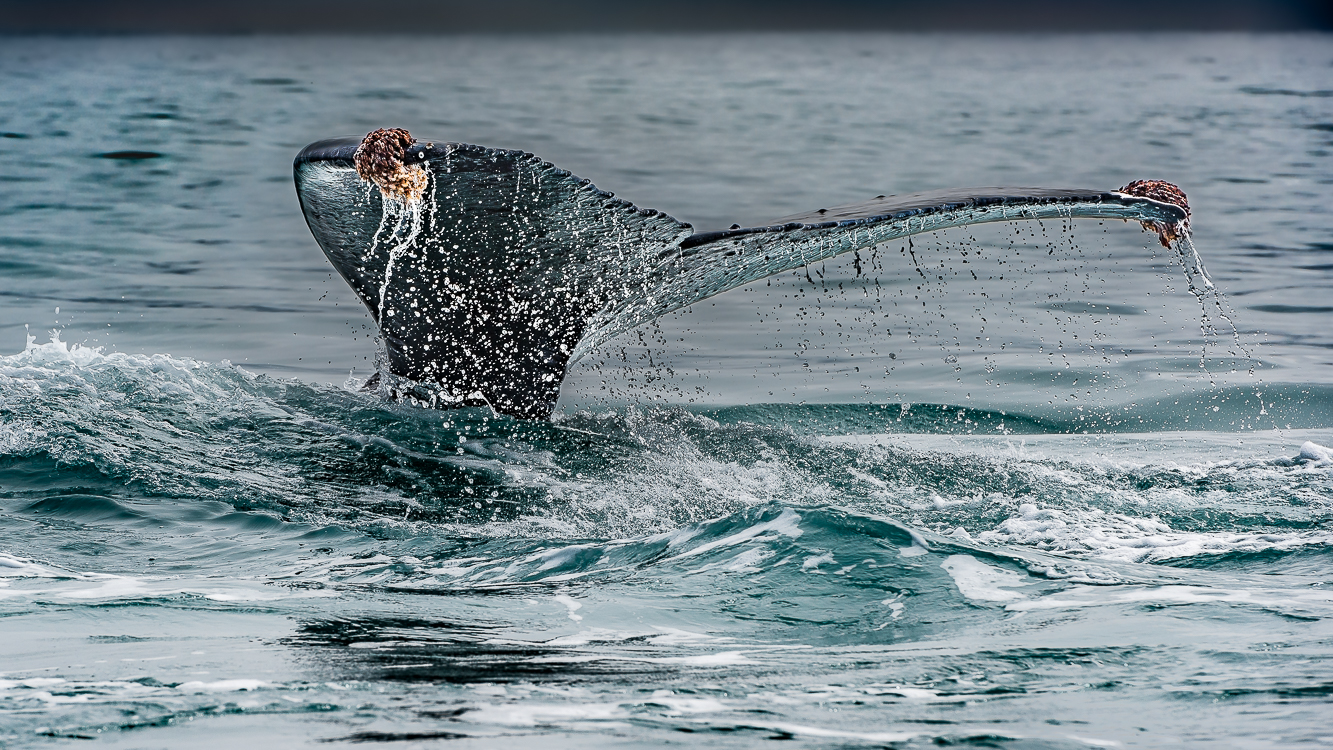
Seward Summers: Sea Shower
Reply


Growing up, I didn’t have many of what might properly be called “toys.” When I was young, friends would come over, look around, and complain, “There’s nothing to do.” And thereafter find reasons to not come over.
But I did have books. A few. And among those few were a handful of treasures I read over and over. They included Volume I of the Reader’s Digest Best Loved Books for Young Readers series. The volume was comprised of a four-story collection of abridged books which included Treasure Island and Call of the Wild, the latter tale so riveting I read it 13 consecutive times the year I was in third grade – with a flashlight under my blankets long after I was supposed to be asleep, in the backseat of the car, on my lap (second row, fourth seat) during Mrs. Dull’s third-grade math lessons. Other books included Our Amazing World of Nature, The Golden Book of The Civil War, a book titled something along the lines of George Washington and the Revolutionary War, all 20 volumes of the Pictorial Encyclopedia of American History, and Digging for Dinosaurs which included a Panorama slide show and a 33⅓ rpm vinyl record featuring Walter Cronkite’s resonant narration. Of course, there were other books, most treasured among them field guides for children – Golden Guides to fish and insects and a Peterson guide to seashells.
The funny thing – strange funny – is that for the most part these books either seemed to have always been there, on shelves in my room, or were presented to me with little ceremony. I never asked for any of them that I can recall, but they became a significant part of my world in a home in which I didn’t fit in and subsequently spent a great deal of time by myself in the forest that extended for limitless miles behind our home and upstairs in my bedroom stretched out on the bed or the floor, chin in palm, lost in the dream-world of a big-hearted dog going home to his wolf-roots in Alaska, battlefield maps, fascinating and fantastic stories about wild animals, pirates and their ships, and the lost world of dinosaurs. And whereas my parents subjected me – and themselves – to an unhappy annual ritual of ignoring whatever I’d asked for on Christmas and birthday wish lists, instead presenting me with things entirely unexpected, and then, after family friends and relatives saw that I had received a very fine gift indeed, taking away that gift when eyes were no longer on us, the books remained. Thus they were among the very few things I could think of as “mine” in a home where I was admonished by my father that “everything” belonged to him and to her, that nothing was mine, and that I needed to understand that “if you’re going to live here.” But the books were mine. None were ever taken back. They became a source of… safety. Peace. Comfort.
In the dinosaur book, there was a photo of fossilized eggs arranged as on desert earth as though in a nest – the first dinosaur eggs ever discovered, an incredibly important and exciting find. Text placed the nest in the Gobi Desert’s Flaming Cliffs. And so I grew up dreaming of sailing ships and seashells, of a world where, like Reddy, I might be freed from my present circumstances to go and live with my grandmother and know what love is. Alaska was mixed in with those dreams, along with a fascination with fish and insects, and though my interest in battlefields and wars has flagged, early reads in history brought with them an awareness of Native Americans, leading to my discovery of Dee Brown’s Bury My Heart at Wounded Knee on my parents’ shelves the year it was published. I was 12. I pored over the book, fueling dreams of experiencing life among Native Americans. Feathered in among all this was the thought that maybe one day I would go to the Gobi Desert and find fossils on my own.
And so it came to be. Not eggs. But we found fragile fossilized remains of something large and dinosaur-like.
Two thoughts:
There is nothing like a well-written book in the right hands and the good fortune of being left alone for shaping dreams.
and
The problem with so-called bucket lists – a list of this and that to be chased down or “accomplished” before one “kicks the bucket” – is that the very name makes too great a nod to death. Experiences should not be guided by sand funneling through an hourglass. So here’s a different way to look at our dreams and the experiences we might wish to have.
No lists, and none of the randomness and disconnection between items implied in the term “list.” Milk, celery, double AA batteries, nail polish… randomness is fine as a prompt when grocery shopping, but that’s no way to live a life. No grail-chasing. No doomed-to-failure race against mortality.
Instead, imagine the coolest version of yourself you can imagine… and then go be that person.

Known as the Hatan Tuul or Queen Tuul, the Tuul River constitutes a vital greenbelt in Mongolia’s capital city of Ulaanbaatar, and thus an important refuge for a variety of birds. Noticing a couple of sock-like nests in leafless wintertime trees along the river, we set about to find an active nest the following spring. As the above photograph indicates, we were successful, and although shooting into dense foliage in a valley that only received decent light once the sun had cleared the surrounding tall buildings and mountains presented challenges, we managed to get several captures of both male and female White-crowned Penduline Tits. Only about four inches or slightly less in length (8 to 11 cm) and continuously in motion through leafy trees, they made for challenging subjects.
Woven of soft, cottony material from willows and similar trees, we were told that in former times the nests were occasionally used as children’s slippers. In the above photo, the entryway is mostly obscured behind the bird’s torso. Nest-making is primarily the male tit’s responsibility, and although I can’t at the present locate the source, I recall reading that they may make two or even three nests of which only one will be used. What a cozy home for the nesting female and her brood.

Although colloquially called “wild” it is a misnomer, technically speaking, to refer to the free-roaming mustangs of North Carolina’s Outer Banks and the American West as such. In both cases, the horses in question are escapees from from domestic stocks and therefore, biologically speaking, are feral, not wild. But neither a 10-year-old boy nor a 64-year-old man is as likely to eagerly crane his neck from a car window to look at merely “feral” horses as for a glimpse of wild horses, and so in most cases the colloquial “wild” stands. In any regard, the distinction matters to some, less so to others.
The word “takhi” translates to spirit or spiritual in English, a fitting appellation for these noble beings – far more so than the alternative, Przewalki’s horse, applied as though the person who “discovered” them for Western Europe has the right to enslave them with his clunky name in perpetuity in an illusory pursuit of his own immortality. Just as all humans have a right to a name of their own choosing, should not all beings be distinguished with their own, unique, noble title.
The above having been accounted for, there is in fact one truly wild species of Equus still remaining in our world – the Takhi of Mongolia. The species was on the very brink of extinction by the 20th century and in fact became extinct in the wild by mid-century, having been hunted for meat. The few remaining Takhi were scattered in zoos in Europe and the United States, their outlook bleak. But in 1990, at the same time Mongolia became a Democracy, a breeding program was established and a few horses were reintroduced to Mongolia’s steppelands – perhaps the world’s greatest remaining uninterrupted grasslands.
And so now, in the year 2023, one can travel to Mongolia’s Khustai National Park and to a few other places and see for themselves these beautiful animals.

There are several examples of singing sands around the world. Not to be confused with the pleasant squeak sand sometimes makes as one walks along a beach, these dunes really do sing, producing a range of eerie, harmonious and lovely tones as the wind reshapes the peaks and ridges, causing individual grains of sand to rub against each other. Even the mini avalanches of sand caused by walking can produce music.


This was a challenging image for me to create. The scene occurred in a poorly lighted, poorly staged school auditorium. And at the time, my understanding of how camera’s work was still quite imperfect. A fundamental misapprehension I was laboring under was regarding ISO. No need here to lumber through all the incomplete and inaccurate information I subjected myself to. Instead, let’s take a quick dive into the subject.
First this: ISO is both an acronym and a word. In that way, it is akin to the word-acronym ASAP. I-S-O stands for International Organization for Standardization. According to this organization, the correct pronunciation of ISO is eye-soh, not eye-ess-oh. On that authority, (there is no higher), Barbra and I treat ISO as a word, pronounce it eye-soh, and since despite its capitalization it isn’t a proper noun, we play it in Scrabble. Similarly, during my entire enlistment in the United States Navy, I don’t think I ever heard anyone pronounce ASAP spelled out as A-S-A-P. Instead, ASAP was treated as a word, pronounced A-sap, and was used to mean something like “five minutes ago.” As in, “Petty Officer Donachy! Where is the report I asked you to type up? I need it A-sap!” Thus eye-so and A-sap it is, at least in our house.
Second, allow me to suggest this: It is a wise policy to take with a grain of salt manufacturers’ and marketers’ claims regarding the high ISO levels their cameras and “handle.” I suppose it comes down to what is meant by the word “handle,” but a general truth is that the higher the ISO value, the greater the risk for noise in your images. Noise… graininess, strange lines, aberrant coloration.
If you take a picture in fairly decent light, and you get the exposure right, and you don’t do much retouching, you might get away with a fairly high ISO setting. Since ISO sensitivity varies from camera to camera, I won’t provide an exact number here. “High” means whatever “high” means for each camera. Don’t think too much about specific numbers. It’s the concept here that matters.
Problems associated with high ISO settings will begin to manifest themselves when you a) significantly retouch an image, or; b) attempt to make a large print. Noise will appear as you attempt to darken an overly bright sky, lighten shadows, or sharpen subjects. As a serious photographer, once you begin to notice noise you will start looking for it. You won’t be able to help yourself. That’s good. Because magazine editors, gallerists, clients and others you hope to build relationships with will be looking for it too.
Not advice, but an observation: If you strive to keep ISO settings low, you will find that you have more flexibility in retouching and enlarging images. These days, shooting primarily with a D850, I find myself carefully considering making any image where I have to push the ISO past about 400. If I could make all my images at ISO values of 100 or less, I would. In most cases, I will sacrifice depth of field and shutter speed rather than push the ISO past 800.
Of course, there are times when there isn’t much choice in the matter. I have images of bears and owls that were captured in very low light. In order to maintain shutter speed and avoid motion blur, I had to go with a fairly high ISO. No real choice.
The above photograph? No flash, shutter speed 1250, aperture 2.8, ISO 4000. Were I making this image now, I’d reduce the shutter speed which in turn would allow me to reduce the ISO. Reduced shutter speed might also have given me room to increase the depth of field by closing the aperture a bit. The picture probably looks pretty good on a phone, a tablet or a small computer… but beyond that, I’m limited in what I can do with it.
As always, comments and questions are welcome.
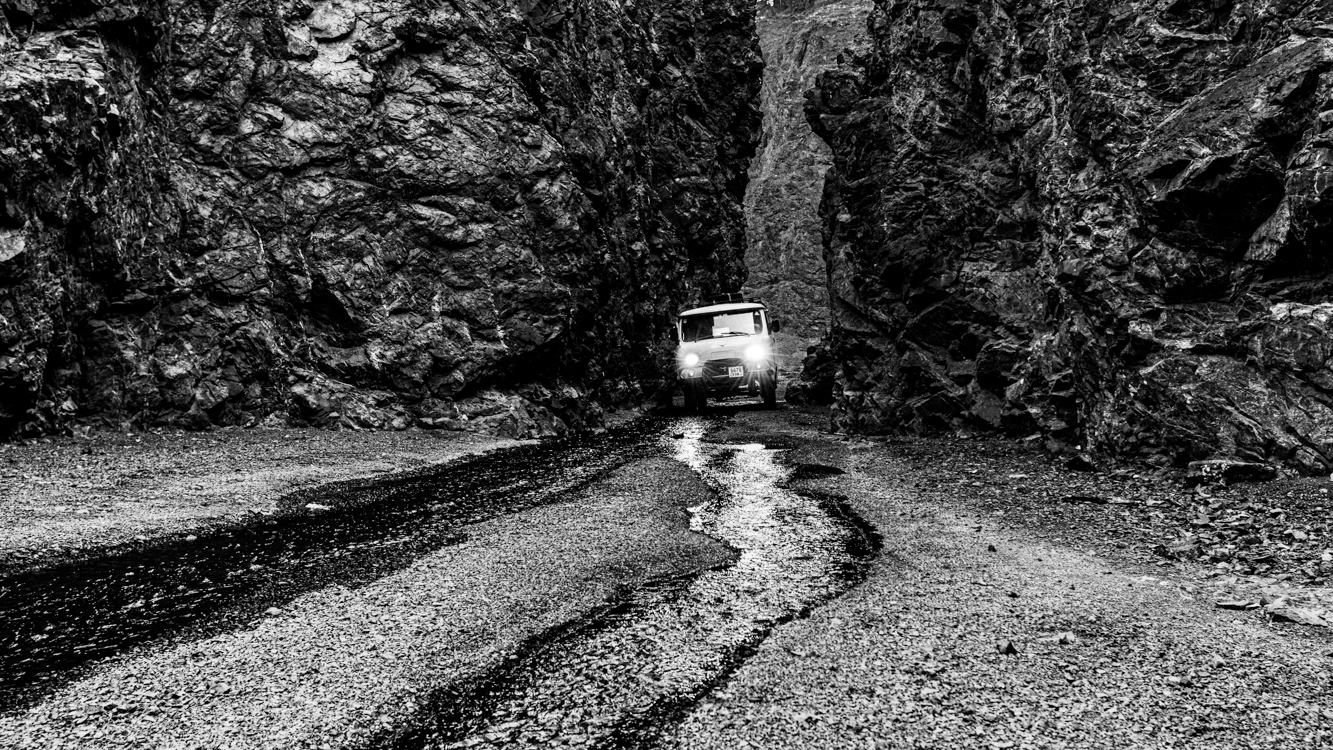
Our brief time in Yolan Am, a narrow gorge in the northern Gobi Desert, was a highlight of our two years in Mongolia. We encountered a number of Siberian Ibex there – the Eurasian wild Mountain Goat, the males of which sport massive, backward curving horns -, a Central Asian Pit Viper, raptors including eagles and Lammergeiers, Red-billed Choughs, Chukars and other birds, Mongolian Pikas, gerbils and other wildlife. We stayed in a nearby ger, a yurt-like home common in the Mongolian countryside, and kept our energy up on traditional Mongolian fare (goat meat and mutton are commonly featured).
The Yolan Am Ice Field, which formerly became several meters thick over the course of each winter and remained throughout the year, now becomes a small stream by early fall. If you get the opportunity, by all means go. The entire Gobi Desert region is fascinating. And things are changing. Quickly.
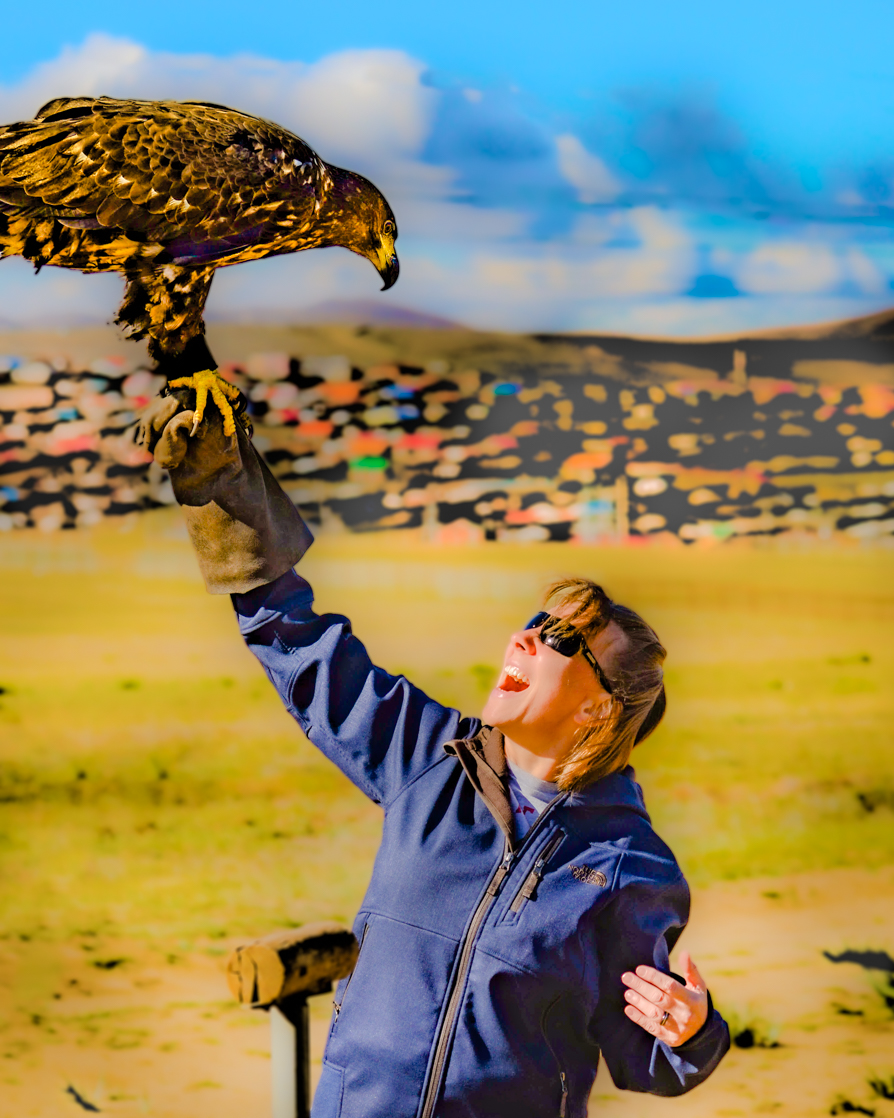

To imagine Shishmaref, begin with Sarichef Island where the village is situated. Sarichef is one of several low-lying barrier islands running for about 70 miles along the northwest shore of Alaska’s Seward Peninsula. If you’ve ever been to North Carolina’s Outer Banks, you have some idea of such islands. Sand is everywhere. The above photo depicts a section of the main thoroughfare traversing this village of about 570 residents. There are no roads connecting Shishmaref with the larger world. Vehicles and building materials arrive primarily by ocean barge. Groceries are freighted in by plane. Because of the added freight costs, everything in the small local store is quite expensive. Pink salmon and Dolly Varden Char which migrate along the beach, seals taken from the nearby sea, and Musk Oxen, Caribou, an occasional Moose and waterfowl along with blueberries and Cloudberries taken from the mainland supplement most diets.
In 2010-2011 when we lived there, virtually the entire community was without the kind of city plumbing considered necessary in most of North America. The white plastic container near the middle of the street is where “honey buckets” are emptied into. These containers are then taken to a settling lagoon. Most houses have large water tanks of up to about 300 gallons which must regularly be refilled. The closest village is Wales, population about 145, over 70 roadless miles down the coast.
 CutterLight