
It feels very much that when this is finished, America will continue as a democracy, or embark on a far more perilous course.
It feels very much that when this is finished, America will continue as a democracy, or embark on a far more perilous course.

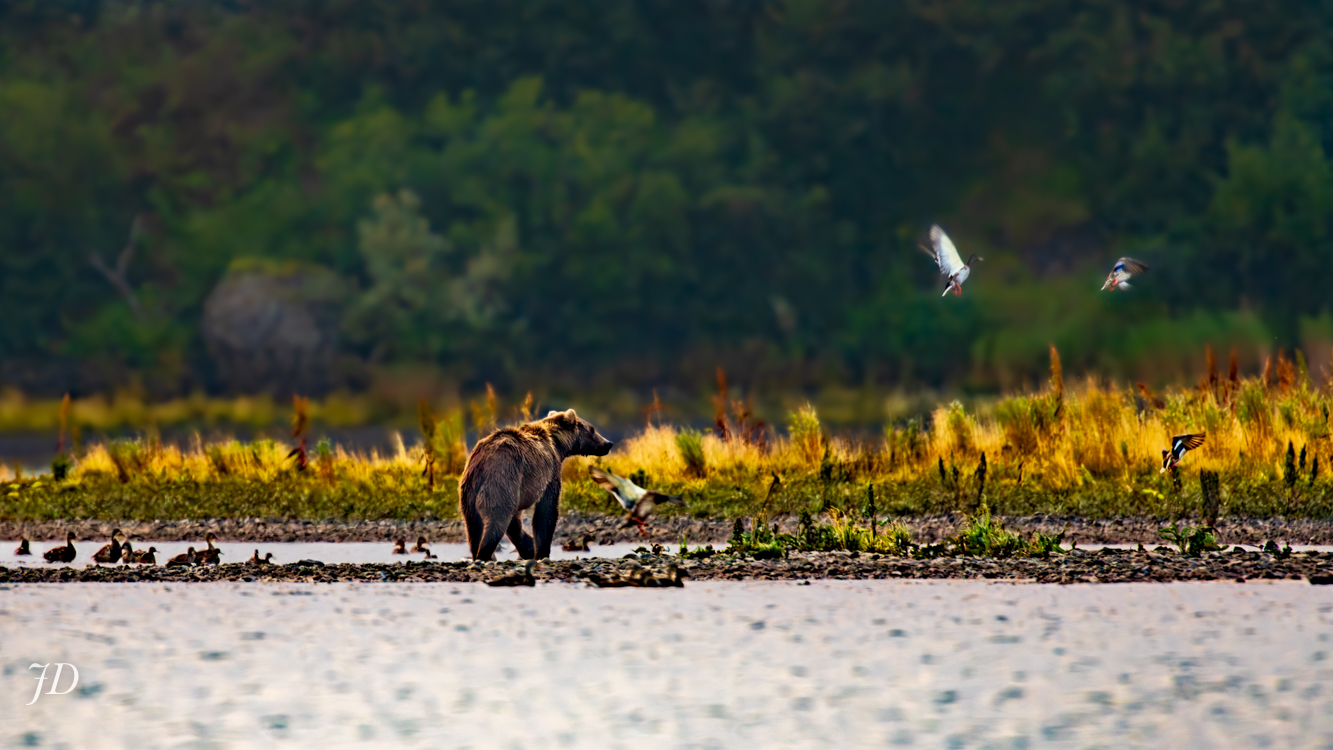
We didn’t get a lot of days like the one depicted above out on the cloudy, windswept Alaska Peninsula. Blue skies reflected in the river, sunshine casting everything it touched in a patina of gold. I hurried through breakfast, donned waders and a camouflage jacked, packed my camera into its soft case and bungee-corded it to the front rack of my honda. Two-and-a-half miles down the Top Road I parked near the boat landing, slung 20 pounds of tripod, camera and long lens over my shoulder and followed a trail to the broad, seldom-visited collection of braided water and islands we called Paradise Bend – the best place on the Chignik to catch morning light. Along the trail there were bear and moose tracks in soft mud, the last Wild Geraniums and Yarrow barely holding onto their purple and white blooms respectively. A snipe exploded from a little swale – late in the year for that species to be hanging around. Curious Black-capped Chickadees called from alder thickets and approached on either side to examine the intruder striding through their world and from the river I could hear the ratchety cry of a kingfisher. Further out gulls squawked and chattered – Glaucous-winged and Short-bills -, and I could just barely hear the soft, murmuring quacks of Mallards and Green-winged Teal. A pair of eagles began piping.
As I reached the bend, the wary ducks rose and repositioned themselves further downriver. There were more bear tracks in the sand along with a set of wolf prints, fresh, probably from the previous night. I waded across a river braid out to an island covered in graywacke, set up in front of small wall of autumn-yellow willows and waited. The morning sun poured over my left shoulder, a light breeze touched my right cheek. Salmon splashed in the channel in front of me as well as in shallows two hundred yards downriver to my left. My eyes were drawn to the sky as I became aware of steady, high-pitched honking growing closer – a pair of Tundra Swans winging south.
What a day. All I needed now was for a bear to come by.

Behind me from where I stood as I composed this photograph, a dirt and gravel road travels a winding path along steep hillsides for about three miles to the Chignik Lake airfield, a bouncy dirt airstrip capable of handling the nine-seat bush planes and smaller aircraft that regularly travel the Alaska Peninsula. For the first two-and-a-half miles from the boat landing the road hugs steep hills, often within view of the river. Traveling the road from June through November, it’s common – at times almost a given – that you’ll see one of more of the Chignik’s massive brown bears. Sandhill Cranes, Tundra Swans, eagles and any number of passerines are frequently encountered in summer, and at any time of year a glimpse of foxes, moose, wolves and even wolverines is possible. Take note of the local hares you might catch sight of – Tundra Hares, the largest hares in the world.
The road is the road… the road to The Pad… the Top Road. Three miles. On one end, unless you are on a Honda (an ATV), you would need to board a plane to travel further by vehicle. On the other end, you need a skiff. There is no overland connection with any other community. Mountains, rough terrain and jungle-thick alders make travel by foot even to the village of Chignik Lagoon – just six miles down the peninsula from Chignik Lake – impractical. Whether one travels by air or by sea, it is 353 miles to Homer, Alaska – the closest place a road connecting with the North American mainland can be joined.
Is “wilderness village” an oxymoron?
I went to the woods because I wished to live deliberately, to front only the essential facts of life, and see if I could not learn what it had to teach, and not, when I came to die, discover that I had not lived. Henry Thoreau, Walden


One hundred twenty-five miles north of the Arctic Circle, on this date there still remained four hours and three minutes of daylight in Point Hope’s sky. This late in the year the Chukchi Sea was blanketed in ice, the sun barely ascending above the horizon. From November 18 to 19, nine minutes and 52 seconds of daylight were lost. The following day, ten minutes were lost – an additional eight seconds. The next day, 10 more seconds of light disappeared. And so it continued, darkness gathering momentum toward December 6 when the sun vanished, leaving only a glow on the horizon. The sun remained down for 30 days until January 6 when it peeked above the frozen sea at 2:03 PM and remained barely visible for 19 minutes and 20 seconds.
I first encountered art in the style of Mark Rothko’s colorfield paintings (a painting by an art student at the local college) in my teens. Like many others, I was fascinated by the juxtaposition of colors. I would shoot this scene differently now… but will most likely never get the opportunity. Happy to have been there, seen it, and come away with this photograph despite its imperfections.
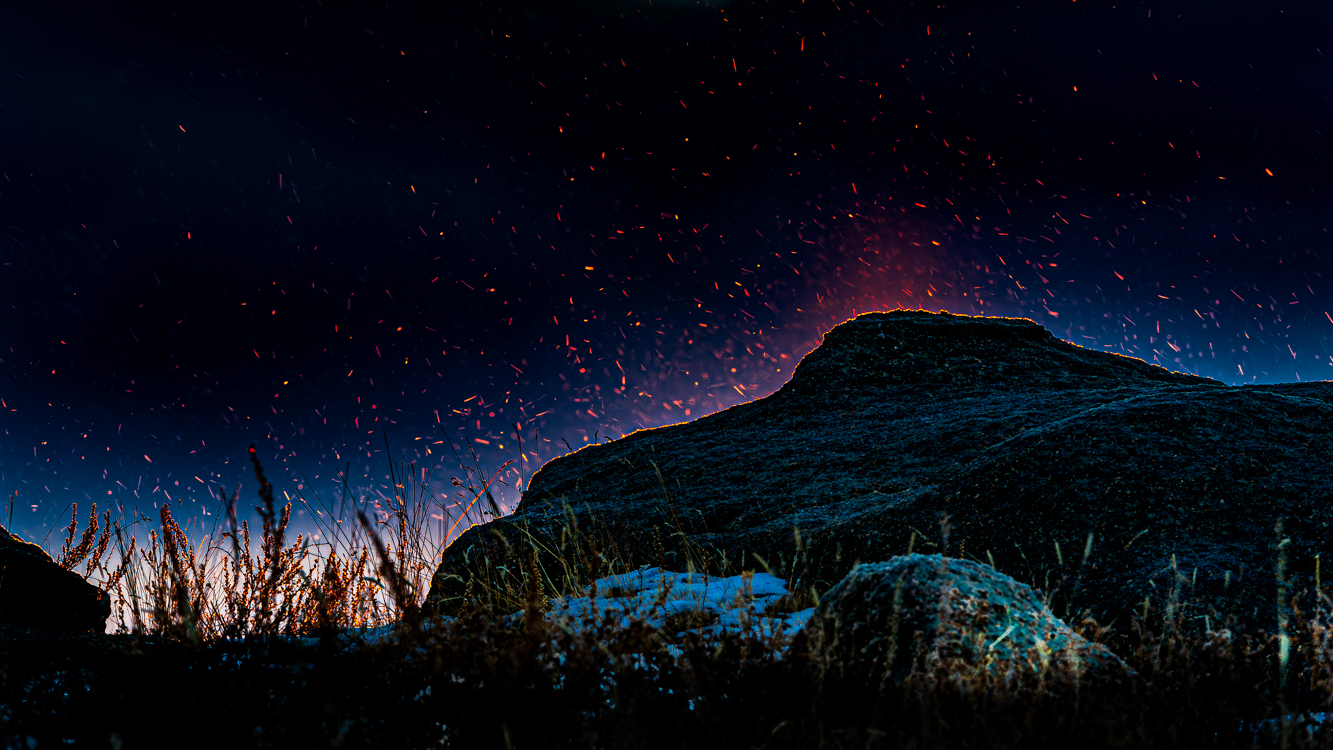

Five degrees, calm, a raven’s throaty croak echoing across the ice. Gaining about four minutes of light each day now, the earth moving into position to give us back our beautiful sunrises.
After a big Sunday morning breakfast we hiked across the lake and up into the foothills for a couple of miles. Otters, mergansers, other ducks and a pair of Pacific Loons in the little bit of open water where the lake empties into the river. The acres of tundra where we picked berries this past summer locked beneath two or three inches of hard ice, the result of snow melt and rainwater accumulating atop frozen ground and another cold snap. Icy snow firm as hardpan. Soft crunch under our boots. Easy hiking.
Once in a while a Red Fox trots across the lake or along the frozen shoreline. Arctic Hare tracks everywhere the snow is soft enough to show them. Yesterday I counted 80 birds at the window feeders – Pine Grosbeaks, Redpolls, Black-Capped Chickadees, Oregon-race Juncos, a couple of Pine Siskins. Bears denned up two months ago. Gulls and eagles gone. Wolf tracks lacing trails just beyond the village. We keep watching for a wolverine in the place we’ve seen them before. Tomorrows forecast says rain. Hope not.
 CutterLight