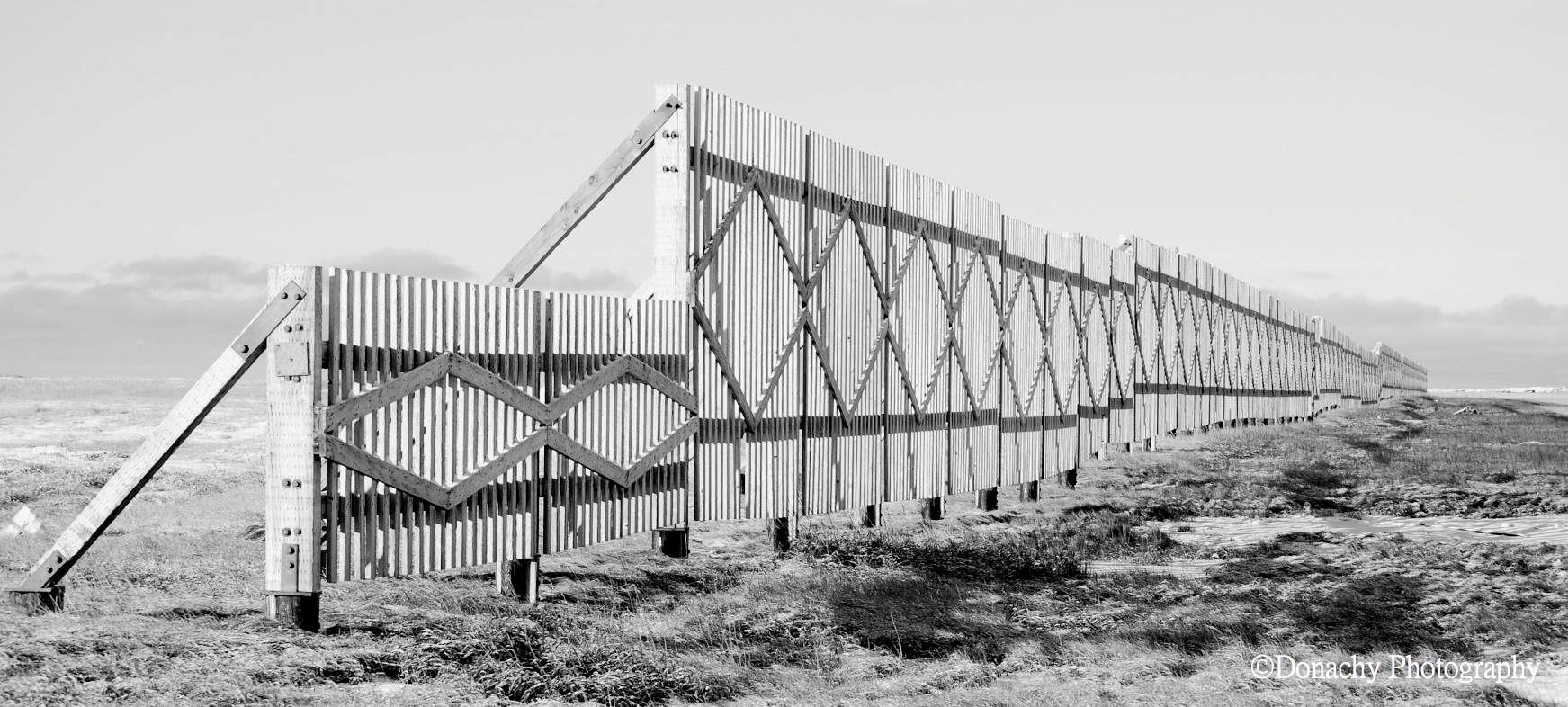
Ice scraped past in the form of a glacier, high above the ground and left this beautiful rock pattern.
Shot taken at the top of Exit Glacier on the edge of the Harding Ice Field.
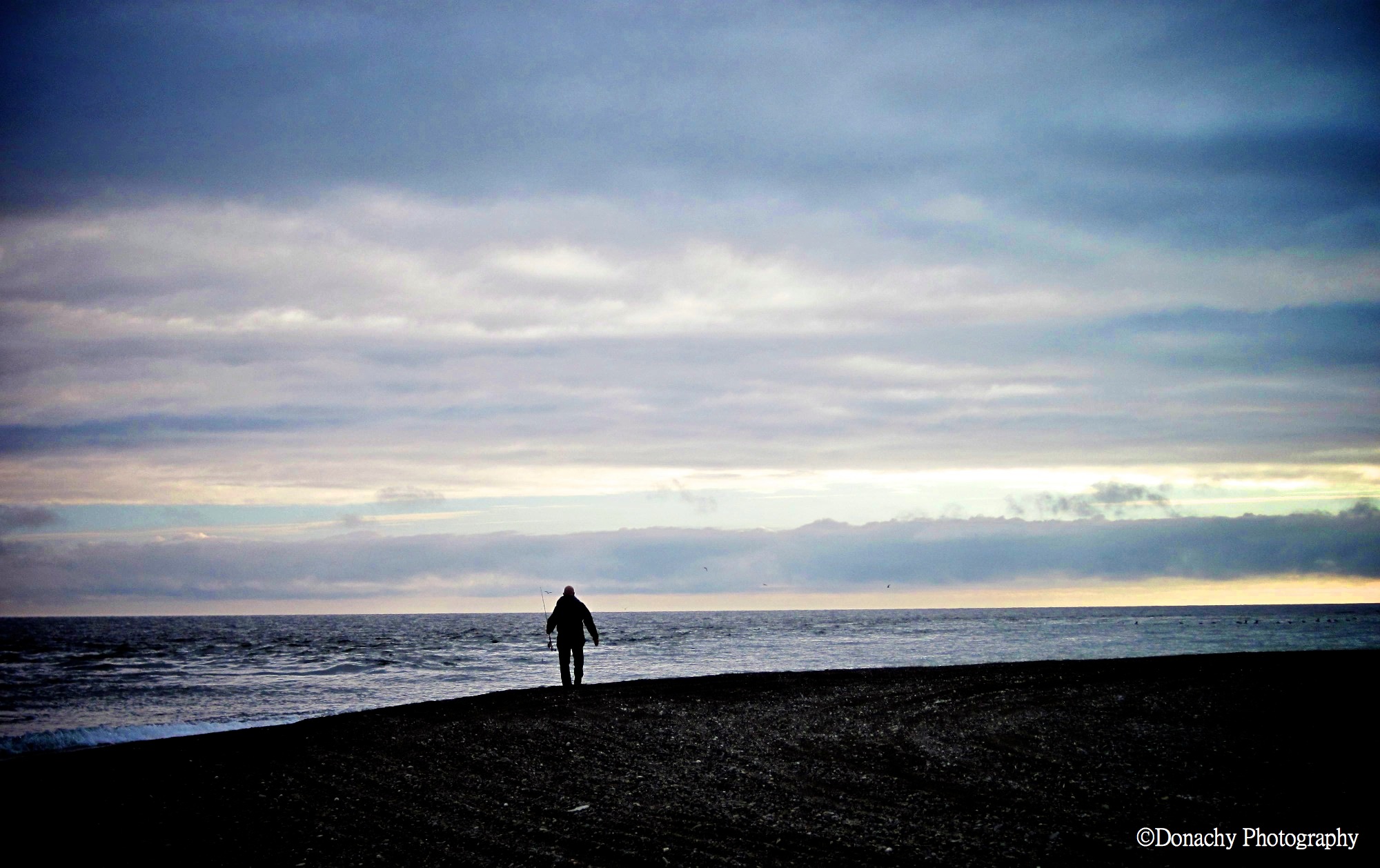
A solitary surf fisherman in late August hoping to intercept the last of the pink salmon or a roving school of Dolly Varden on the point at Point Hope, Alaska.
Surf fishing is addicting. Part of the magic lies in not knowing when or even if the fish will show up. So you fall into a rhythm, walking up or down the beach casting, waiting for the lure to land, and beginning your retrieve. As you fall into this rhythm, invariably your mind wanders… back to fish you’ve caught and fish you’ve lost on this beach or on other beaches, back to something your dad, or a coach, or a friend said to you a long time ago, back to places you’ve been and to people who have slipped into and out of your life. At other times, you find yourself looking into the future, forward to the day when your mortgage is paid off, or to a day when you are at last able to travel to some dream destination. Your feet are planted more or less firmly on sand or pebbles. Behind you are cities and towns, offices, classrooms, dinner parties, appointments, work, triumphs and regrets, small talk, clocks, calendars… Before you, stretching out as far as you can see, there is only sky and water and the possibility that on the next cast you’ll be woken from your reverie, everything suddenly solid, your rod bent into a graceful, lively arc.
New enough to reveal steel and aluminum nails, old enough to be well-weathered by the Arctic climate, the bones of this seal-skin whaling boat were left behind when Point Hope (Tikigaq) relocated two-and-a-half miles inland in the 1970s. Point Hope is one of the longest continuously inhabited places in North America.
The Inupiaq name for Point Hope Village, Tikigaq (tick-ee-yahk) means index finger and described the way the gravel point once hooked into the Chukchi Sea. Time and tide long ago washed away the crook of the finger, leaving behind a triangular point near enough to deep water that the whales that first drew the Inupiat people here thousands of years ago still swim close to shore. The 2.3 mile hike from the current town out to the point gets a little tough once the road ends and the pea-to-chunk-size gravel begins, but it is well worth the effort. In addition to bowhead and other whales, which are frequently sighted, the collision of currents at the point holds large schools of finger-sized baitfish, which in turn draw flocks of Arctic terns, gulls, murres, puffins, jaegers, guillemots and ducks while various sandpipers patrol the shore. At times, the sea and sky are filled with hundreds–if not thousands–of birds. The small fish also attract roving schools of pink, silver and Chinook salmon and sea-run Dolly Varden which in turn are followed by spotted, common and bearded seals. Walruses show up from time to time as well.
The walk to the point passes through the Old Village, a ghost town of semi-subetranean homes made from sod, whale bone and driftwood as well as more modern, wood and metal houses. It’s fascinating to walk through the Old Village and contemplate what life would have been like up here before electricity, running water, guns and gasoline engines–when the only “grocery stores” were the great herds of caribou 25 or more miles to the east, bowhead whales swimming in the freezing Arctic Ocean, and the various fish, seals, berries and plants gathered in their seasons.
New England Style Clam Chowder garnished with a slice of lemon and salmon berry blossoms. All fruit blossoms are edible, and in addition to being beautiful, some are downright tasty.
These days, there seems to be a trend toward making New England Style Clam Chowders thicker and thicker. Unfortunately, to our taste, the thickness is achieved by adding lots of flour, resulting in a somewhat pasty if not downright bland bowl of soup. Our favorite chowders put clams and potatoes up front and emphasize flavor over thickness. We make both New England Style and Manhattan Style Clam Chowders in large pots, freezing the finished product in smaller containers and pulling them out on cold nights throughout the winter. While this is a great way to put to use all the razor clams we used to dig in Oregon and now dig in Alaska, it works well with other kinds of clams, too, as well as with canned clams such as the big, 51 ounce (3 pounds, 3 ounces) cans of SeaWatch chopped clams sold at Costco and other stores. The recipe is never the same twice. The one below is a recent version. One of the keys is to use not more than twice the potatoes, by weight, as clams.
Up here in bush Alaska, many of the communities are “dry” and I can’t use one of my favorite ingredients–sherry. If I could, I would add about a 1/4 cup of a quality dry sherry such as Dry Sack.
Ingredients: (We cook with dairy products from grass-fed cows, which research increasingly is showing is a significantly more healthful choice than dairy from cows fed on grain and processed feed.)
1. Wash potatoes and remove any eyes, but do not remove the skins. Cut into ½ inch cubes and place in a large bowl. Set aside.
2. Fry the bacon pieces till tender. Do not crisp. Drain the grease and set aside.
3. In a large pot, add the olive oil and heat over medium-high. Add onions, stirring frequently for about five minutes until they begin to turn translucent. Add garlic and stir again.
4. Add flour and stir in thoroughly. Add two tablespoons of butter (or more olive oil) if necessary to completely mix in the flour.
5. Immediately add clam juice and milk. Stir.
6. Add potatoes, seasonings and salt and enough water to cover all. Slowly bring to a simmer and cook until potatoes become tender, stirring occasionally. About 45 – 60 minutes.
7. Add cream and lemon slices and return to just under a simmer or barely simmering.
8. Add the clams and the remaining butter and turn heat to low. On a propane stove, you may need a flame tamer. Continue cooking for 10 minutes.
Serve with a big hunk of toasted sourdough bread and a Chardonnay, a Pinot Gris, or a good ale.
Ball Jars filled with freshly-picked cloudberries (often locally called salmon berries). We’ll add a little lemon juice, pectin, and sugar to the crushed berries, mix and simmer this in our bread maker for an hour-and-twenty minutes, pour the mixture back into the jars and put them in the freezer to set. This will provide us with some of the most tantalizing jam imaginable. Cloudberry jam…
The morning was cool and cloudy, with mist and banks of fog rolling across Point Hope. We’d been told that we’d find berries about three miles east of town along Seven-Mile Road, and so seven of us had gathered to make the hike out. Two of the men carried 12 gauge shotguns and a third carried a side arm. Bears are always a possibility.
The wildflowers which all but carpeted the tundra when we arrived here nearly a month ago are mostly gone now, though here and there a few tiny yellow Alaska poppies and beautiful blue but deadly monkshood and other flowers are still blooming. And then, right about at three miles just as we’d been told, there they were… cloudberries, growing together in small patches where mounds of earth were just high enough above the boggy tundra to allow roots to drain. The unripe cloudberries (Rubus chamaemorus) were deep red and beautiful. The ripe ones are the amber-orange color of Chinook salmon flesh, giving their close relatives, salmon berries (Rubus spectabilis), their names.
Wherever cloudberries grow across the upper latitudes of North America and Europe, they are a prized delicacy, agreeably tart when barely ripe, becoming creamy rich and sweet as they continue to ripen. They contain twice as much vitamin C as oranges. Growing very close to the ground, the berries were surprisingly inconspicuous at first. But once our eyes adjusted to what we were looking for, the tundra seemed to sparkle with their red, orange and amber glow.
We picked for about two hours, happy to have worn Muck Boots as we slogged through the soft, wet ground. By the time hunger caught up with us and it was time to head back, Barbra and I had about three pounds of berries between us–enough for a few jars of the freezer jam which would make the hike well worth the effort.
On the walk back, the sun began to push its way through the thinning clouds, lighting the land around us. It was then that Barbra and one of our friends spotted a large white bird perched motionless on a hump out on the tundra. “It’s got to be an owl,” I said. “Let’s see.” We made our way toward the white shape until there was no doubt we were looking at a large snowy owl. These owls are huge, the heaviest in North America. When it finally spread its magnificent wings and lifted off, it revealed an underside of almost pure white–a male in its prime, grown fat on ground squirrels.
One of the privileges of living in Shishmaref this past year has been the opportunity to sample various Eskimo foods. Last night a friend came by and asked if we would like to try muktuk. Shishmaref is not a whaling community; her family had come into the whale skin and blubber delicacy by trading caribou meat with another village. We eagerly accepted her offer, which she advised us to slice thin and eat with seasoned salt.
Jack sliced the raw muktuk sashimi-style and served it with soy sauce and wasabi. The contrast of the almost translucent, light pink fat with the dark, marbled skin was beautiful. With his razor sharp sashimi knife, Jack first removed the outer layer of skin and then cut out the tough, dark strip next to the blubber. Dipped in the soy sauce and wasabi combination, the blubber melted away as we chewed it. Jack relishes anything that is fresh from the sea and loved it. My favorite part was the skin. Like the blubber, it was slightly sweet, delicately flavored and pleasantly chewy.
Incidentally, raw muktuk is high in vitamin C, which, along with other raw meat and fish that traditionally make up the Inupiat diet, explains how people in this extreme environment historically were able to avoid scurvy.
At 18, when I moved out of my parents’ house and moved to San Francisco, I had my first taste of feeling really alive. I remember days when I would walk around the city and I felt this incredible high. I didn’t know it then, but it would be a taste I would always crave…life. When I moved away from the city, I let myself fall into a rut some might call “The American Dream.” Marriage, large house, child, career track and decades down the road a retirement plan hanging like a piece of magical fruit that would make the hours, days, weeks and years slogging through a job I didn’t particularly like all worth it.
From time to time I, experienced flashes of the feeling I’d experienced in San Francisco. But hemmed in by the walls of the rut I was in, these flashes only left me feeling antsy. I needed to do something. I thought it was an itch to travel. So I quelled the feeling by planning little trips. I distracted myself with little projects and little classes. The choice of the diminutive word “little” is with purpose. The activities were small gestures designed mainly to let me avoid looking at the larger sense of dissatisfaction with my life. The BIG need.
Up here in Shishmaref, Sundays are devoted to tasks like laundry and baking–tasks that allow me to engage in reflective thinking. Lately I’ve begun to notice that the antsy feeling is gone. The need for something vibrant in my life is satisfied. When I saw Shishmaref from the sky for the first time, tears came to my eyes. I felt alive. I felt like I was doing something. Over the past few weeks, I have realized that I have always felt I was meant to live an extraordinary life. The life I initially chose for myself as a young adult couldn’t have been a worse fit. I was not meant to live a life of safe routines. This is not to say I’m an extremist and want to live on the edge. But it does mean that I enjoy doing things off the beaten path. Generations ago, living in Shishmaref would have been hard. Living in Shishmaref now is extraordinary–not extreme, but out of the ordinary. I am experiencing a life that isn’t usual. I still walk my laundry to the machines every weekend (today I had to plow through fresh, powdery, knee-high snow), and take out the trash (and then burn it at the dump every couple of months) and shop for groceries (in a sparsely appointed store that would fit many times over in the Safeway where I used to shop)…This life is very un-rut like. I feel like I’m living the life that I was intended to live.
We took a big risk moving up to the Alaska bush. We (foolishly) accepted the first two jobs we were offered without doing much research. Our haste contributed to a year that at times has been rocky. But in taking this risk, we discovered that we love living in the bush. We feel alive here. Moreover, working up here puts an infinite number of summer adventures at our fingertips.
With risk comes the chance to lose, and to lose big. But by taking a risk, there is the opposing chance…the chance to win, and to win big. I feel like I am winning…really big.
That taste I had of life many years ago in San Francisco is now part of my regular diet. It manifests itself in feelings of happiness, freedom, adventure and love. There is a contentment that penetrates to the marrow of my bones. It almost feels as though my heart has struck a new rhythm. A smile comes to my face more often. I feel lucky to finally be living an extraordinary life.
Chronology is the only thing that snow blindness and pizza have in common.
The sun making its way across the sky now has an incredible effect when it’s overcast. I was told to make sure I had good sunglasses. I was also told the snow is really bright. This week, it was snowing and overcast. Who needs sunglasses, right? As Jack and I headed to the store and back, I had to literally pull my hat down over my eyes and take his arm like a blind person. I couldn’t see! And it actually hurt my eyes to have them open. The moral of the story – NEVER go outside without my sunglasses, regardless of the weather.
The pizza part of the week has no pain, nor any lesson attached. We tried making pizza a few times…experimenting with different recipes with varying results. As our peanut butter dwindles, we decided to make pizzas for lunch. Using the best of our dough experiments, I settled on a recipe using the bread machine. Then the culinary genius is turned over to Jack.
The pizza sauce and delicious toppings were easy for him. The pizza above pictured has a sauce infused with garlic and herbs. The toppings were seasoned chicken, sun-dried tomatoes, and olives. The part he is beginning to master is the whole throwing it up in the air and spinning it in order to stretch it. So far, so good. None of the crusts have landed on the floor…
The cafeteria food is pretty good, but we still make the kids jealous when we pull out our delicious pizza slices from our lunch sacks!
We were at a friend’s house watching movies last night. Pink streaks of soft light brushed with gold appeared on the wall. At nearly 10 o’clock at night, that could only mean one thing–a beautiful sunset. The snow drifts in the foreground indicate where the ocean shore starts. The ice just below the drifts covers the beach. From there out to as far as the eye can see is the Chukchi Sea still locked in ice.