Looking out across the Chukchi Sea from the very tip of Tikigaq Peninsula. Near Point Hope, Alaska, August 12, 2012.
It was a two-and-a-half mile walk from our home in Point Hope to the terminal point of Tikigaq Peninsula where it hooked into the Chukchi Sea. Cape Lisburne lay to the north; other rocky sea cliffs lay to the southeast. Dense colonies of seabirds – murres, puffins, various ducks, gulls and other birds – nested in these natural sanctuaries, and if you stood at the tip of the peninsula you could watch the adult birds fly back and forth all day long in the summer, in one direct bills and bellies empty, on the return their bellies crammed full of food and what they couldn’t fit in their bellies hanging from their bills. Sand Lances and other fish to be presented to nesting mates and offspring. It was a difficult hike out, a good bit of it along a pebbled beach. At that time in our lives we hadn’t yet made a study of wildflowers, but they were abundant and brightened the path. And you never new when you might come across an Arctic Fox, a Snowy Owl or something else of interest.
Hiking for any distance along a sand beach becomes work, and If you’ve ever walked far along a pebbled beach you know that pebbles make for an even more arduous hike. The ocean breeze was almost always cold at that latitude above the Arctic Circle.
Wishing at times to travel light, we did not always take camera gear.
Which was, of course, a mistake.
One morning in early fall, we arrived at the point and – not knowing what we were in for – found ourselves looking out at more birds than we had ever in our lives seen. Quite probably, more than we will ever see again. Wave upon wave of puffins, murres, kittiwakes, shearwaters and I don’t know what else were streaming out from the cliffs and capes, chicks fledged, the season over. Most of these seabirds would not return to land again until the following spring when they would begin a new nesting season. We had seen films depicting African migrations of wildebeests and other ungulates, and in Alaska of great herds of caribou, and those films were called to mind. I once, in Kentucky, found myself amidst a late spring migration of Box Turtles; I pulled my car to the shoulder and assisted over a dozen of them safely across the country road I was traveling. If I had that to do over, I’d have stayed for as long as it took and helped more…
Surely that morning on the tip of Tikigaq, Barbra and I were witness to one of the world’s greatest migration events. We felt, suddenly, a deep connection with… something… overwhelming. Thoreau’s contact, or a final couplet from Wordsworth:
To me the meanest flower that blooms can give Thoughts that lie too deep for tears.
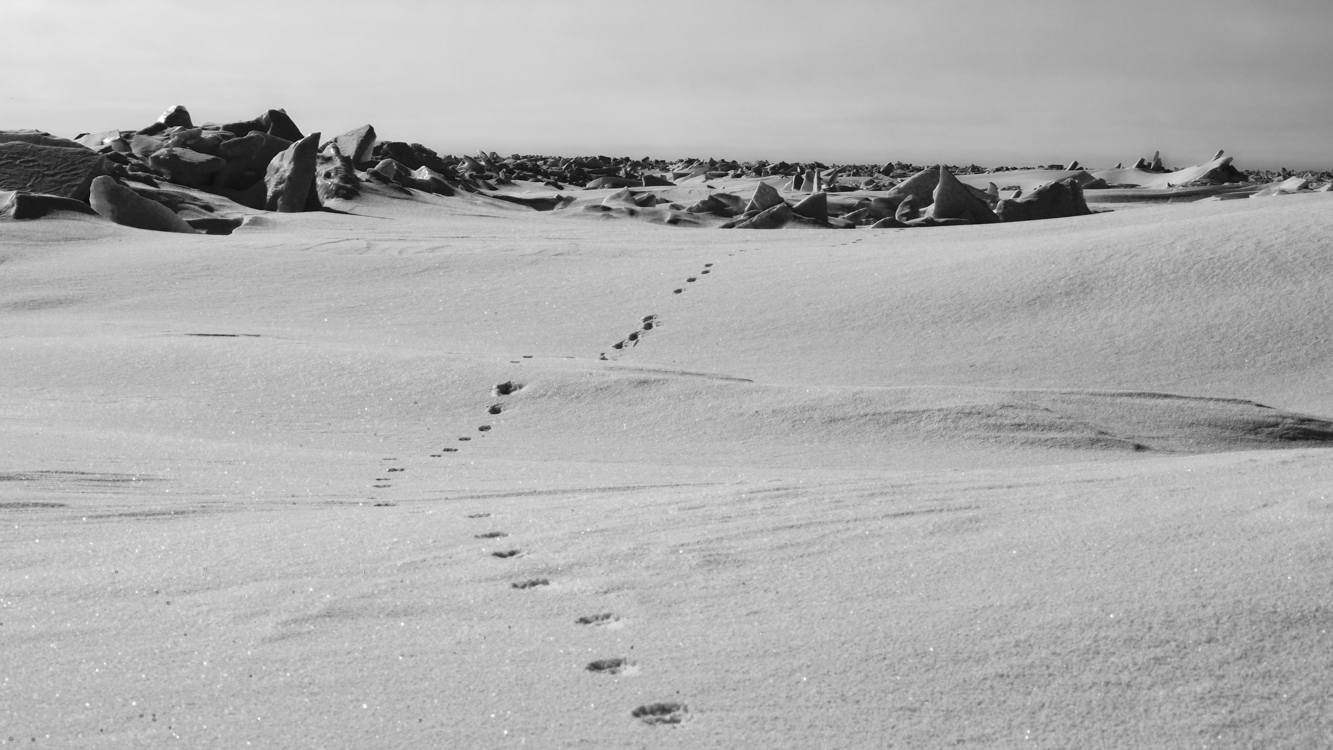
Polar Bear tracks disappear into the other worldly landscape of ice and snow on the frozen Chukchi Sea near Point Hope. The great bears continuously roam the ice in search of seals and the remains of whales that have been caught. By average weight, Polar Bears rank as the world’s largest bear. However, the Coastal Brown Bears of Kodiak Island and the Chignik River drainage on the Alaska Peninsula can weigh as much and stand taller. April 26, 2012
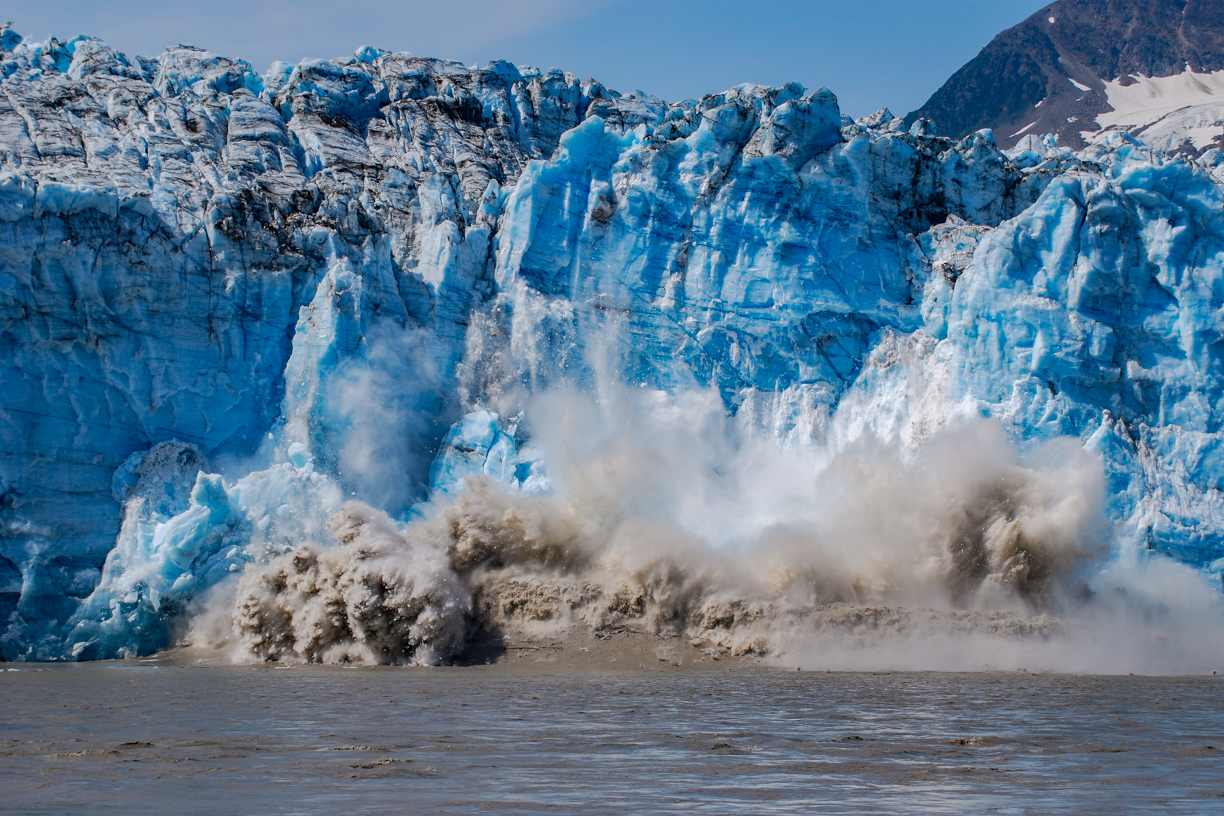
When we first came to Alaska back in 2009, you could still make the 49 mile drive from Cordova to the Million Dollar Bridge (the Bridge to Nowhere). Across the broad, swift, roily Copper River, massive Childs Glacier towered. We had just completed the Salmon Jam half-marathon. Along with another couple, we rented a car and made the drive out through the vast delta wetlands along a mostly unpaved rough, pot-holed road – Trumpeter Swans, other waterfowl, beaver lodges, bear scat and even a couple of moose along the way, distant mountains, our eyes wide with Alaska wow.
Barbra was our primary photographer in those days. We had identified an area that was active, popping and cracking, sloughing off showers of ice. “That entire face is going to go,” I predicted. Barbra set up the camera on a tripod and programmed it to take a shot every second. (The result was like a stop action film.) Shortly after the above shot was made, a wave of five or six feet came barreling toward us with a speed that caught us off guard. I grabbed the tripod as we scrambled for higher ground. Back in Cordova, upon seeing the photos on our camera a Forest Service Ranger told us we had witnessed a “once in every five years or so event.”
I found a jar upon a mountain and thought to open it it smelled of moonshine and spring winds upon that mountain top It gathered in the village below the lake and river and distant sea
I found a jar upon a mountain near the village where I lived it caught the light a certain way and seemed to hold it there It gathered in the autumn day the sky, the mountains, the distant sea
A landscape seen by fewer than 100 living people….
The Hike Up Flattop
There’s a small mountain behind our village. We call it Flattop, though once you reach the peak you find that it is somewhat rounded. Although reaching the summit constitutes an elevation gain of only about 1,200 feet (a quarter of a mile; four football fields), because it is the foreword-most mountain facing the village, the summit provides an unobstructed 180 degree view sweeping from the corner of Chignik Lake to one’s left where Clarks River enters, down the lake and through the village, and then down the Chignik River all the way across the estuary to the next village, Chignik Lagoon, a vista encompassing about 12 miles. But in fact, the view is more grand even than that, for one can see mountains 20 miles beyond Chignik Lagoon where a portion of the Alaska Peninsula curves out into the Alaska Gulf, and while gazing across Chignik Lake the landscape disappears in haze over Bristol Bay. Keeping in mind that a few steps beyond the last house in the village one is entering a landscape fewer than 100 living people have seen, the view from Flattop is even more exclusive.
The roundtrip hike from our home to the summit and back is fairly rigorous. We begin by following the community’s main thoroughfare, a dirt road that curves along the lakeshore, crosses a small, willow-crowded stream inhabited by char, and then branches off to the left past a few houses beyond which is a honda trail. For about two miles, the trail alternately cuts through stands of scrub alder and willow, open tundra, and shoulder-high grasses, fireweed, ferns and salmonberry brakes.
The trailhead leading up Flattop is easy to miss if you don’t know where to look. People – young men who are hard on their machines – very occasionally take their quads up the mountain, though scarcely often enough to beat back the jungle-thick vegetation waiting to reclaim any seldom-used path in this part of the world. Not long ago, a neighbor was lucky to get clear in time to avoid injury when the mountain took control of his honda. His quad is now somewhere on Flattop’s steep flanks, hung up in alders, unrecoverable. One’s own two feet are the more prudent – and satisfying – option for ascent.
In the early morning of September 17, we entered the trailhead through a field of tall grasses and fireweed gone to downy seed, colored with autumn, made dripping wet with low fog. As we gained elevation, the grasses, ferns and flower stalks gave way to thick stands of salmonberry bushes. It wasn’t long before our pants were soaked and our water-resistant boots were saturated through to squishy socks. Sunshine in the forecast promised dry clothing once we climbed beyond the vegetation.
Landmark by landmark, salmonberry brakes began to thin. Alders grew smaller and more wind-twisted. We ambled through openings where, back in early June, we’d come across patches of heathers and wildflowers – vaccinium, geranium, yarrow, paintbrush, candle orchid, fireweed. At times we lost the faint trail, the path buried in tall, thick grasses or barely discernible through tangled tunnels of gnarled alders. Just as the sun broke free from mist and crested the summit we emerged onto the first treeless scree, the sudden warmth and open landscape a joy, handfuls of lingonberries, tart, sweet, energizing.
As we continued up the slope, I studied the loose scree for signs of the Weasel Snout, lousewort, Alpine Azalea, Alp Lily, Pincushion, Moss Campion, Roseroot, avens, saxifrage and Purple Oxytrope I’d photographed in June, but aside from a few lupine still clinging to periwinkle-colored blooms, the rest were gone, the few remaining leaves various hues of yellow, red and orange. Near the top we were surprised to find blueberries, wind-stunted bushes hugging thin soil, leaves crimson, berries big and frost-nipped sweet.
We had chosen a day when the forecast predicted calm air, offering the hope of mountains mirrored in a glassy lake and pleasant loafing at the top. We scanned the lakeshore and flats for moose and other wildlife, but aside from a few Black-capped Chickadees, Pine Grosbeaks, a sparrow or three and clouds of midges dancing in filtered sunlight, animals were scarce, though near the summit my spirit bird, a Northern Shrike, materialized from out of nowhere to hover a few feet above my head in order to puzzle me out. Bear tracks all the way at the top. Moose tracks and fox tracks along the way. Lynx scat… maybe.
The video is best viewed on a large screen. As you watch, notice the round, snow-crowned summit just barely peaking out from behind foreground mountains in the view across the lake. That’s Mount Veniaminof, an occasionally active volcano 24 miles southwest of Chignik Lake. The earth’s curve over that distance causes it to appear to be only as tall as the closer 3,000 foot peaks. But in fact, Veniaminof touches the sky at 8,225 feet. We hear it rumble from time to time and have occasionally woken to a smoke-clouded sky or a fine dusting of volcanic ash on new snow in the village.
The corner of the lake to the left, in front of those mountains, is where Clarks River debouches. A major salmon spawning tributary, in September Clarks offers spectacular, nearly untouched fly-fishing for returning Coho Salmon.
Then, looking up the lake through the gap in the hills and mountains, the landscape disappears into haze. Black River flows into Chignik Lake here, beyond which is miles of Black River itself, and then the upper lake, Black Lake. Past that is a vast area of boggy tundra and kettle ponds all the way across the peninsula to the ghost village of Ilnik and the coast where sandy barrier islands, The Seal Islands, front Bristol Bay.
Following the landscape to the right, the lake narrows as it flows past the village of Chignik Lake, a community of about 50 to 55 people, most of whom are of Alutiiq heritage. The large white buildings in the middle are the school gym (left) and the school itself (right) where Barbra teaches. Just as the village ends, the lake narrows further, picks up speed and becomes Chignik River. A narrow dirt road follows the river downstream and terminates at a boat landing across from the fish-counting weir, the buildings of which are just barely visible. There are no roads beyond this one, which terminates on its other end at the airfield.
I included a photograph looking downriver and across the estuary, locally referred to as the lagoon. The image zooms in on the village of Chignik Lagoon, the community closest to Chignik Lake. With no roads nor even trails linking the communities, the river and estuary serve as the highway. Virtually everyone in The Chigniks owns a skiff or two.
The end credits roll over a black and white photograph I made from Flattop’s summit in early June.
Hiking with us on this day were school faculty members new to The Lake: Melody Wiggins, Jacob Chapman and Melody’s son, Micah. Barbra is on the right in the group photo.
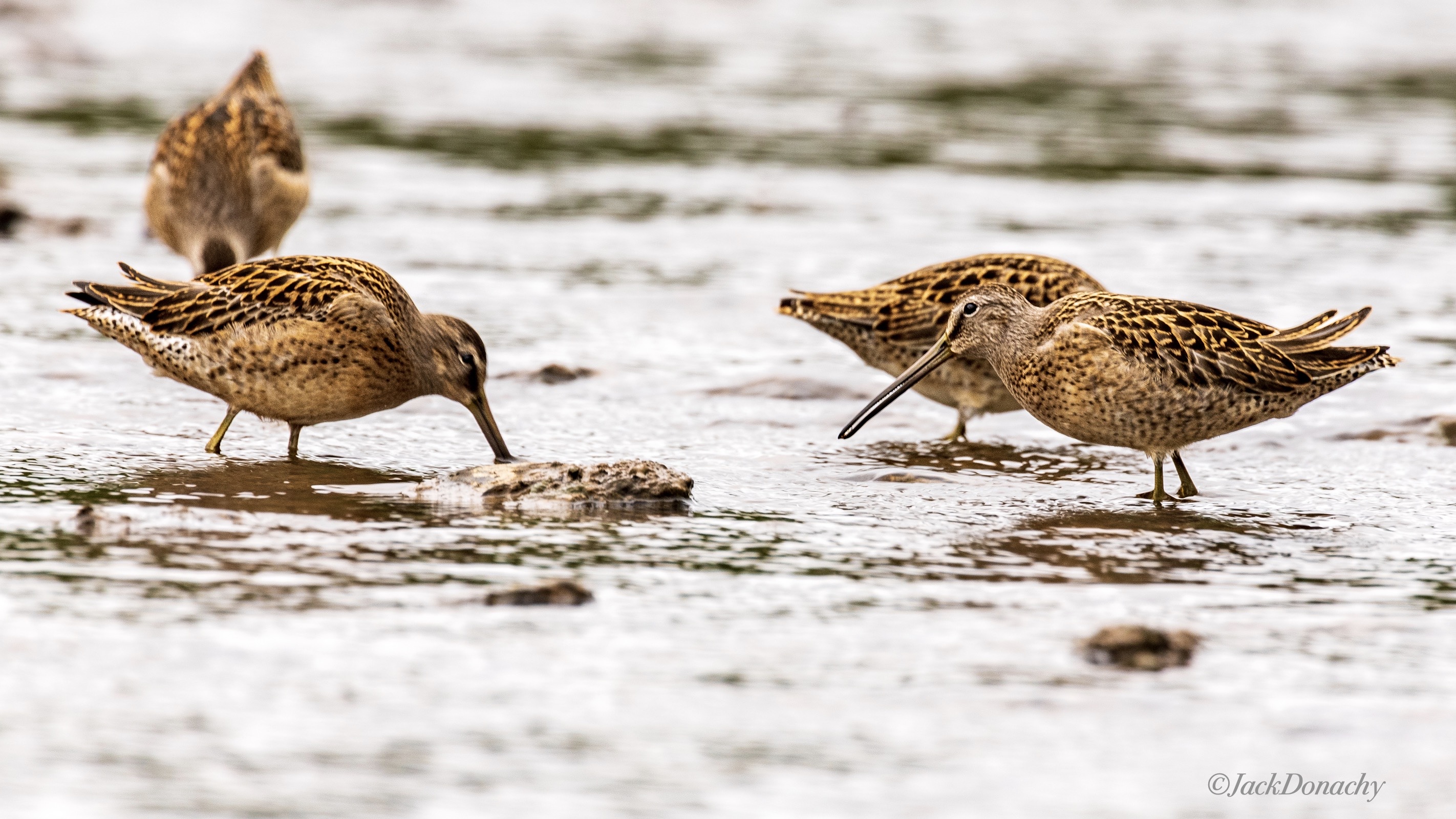
Having encountered them only once on the Chignik River in the past five years, Short-billed Dowitchers would have to be considered a rare species here. I was happy to be surprised by a small flock of them one late-summer day while looking for teal.
It’s a bit difficult and somewhat sad to think that not so long ago, shorebirds such as dowitchers were considered fair game by many shotgun-toting sportsmen. Ernest Hemingway mentions this in a couple of his books, noting (happily, I think) in his posthumously published Islands in The Stream that he loved watching the little plovers and other peeps and could no longer think about shooting them. Perhaps the early American ornithologist Elliot Coues said it best in a passage he wrote in the 1917 edition of Birds of America:
“(The dowitcher’s) gregarious instinct, combined with its gentleness, is a fatal trait, and enables gunners to slaughter them unmercifully and sometimes to exterminate every individual in a ‘bunch.’ To turn a 12-gauge ‘cannon’ loose among these unsuspicious birds, winnowing in over decoys with friendly greeting, is about as sportsmanlike as shooting into a bunch of chickens. To capture them with a camera requires skill and patience, and herein lies the hope for future existence of our disappearing wild life – substitution of the lens for the gun!”
Note the bill serrations on this dowitcher which has just come up with a tidbit of some sort – perhaps the larval stage of an insect or a mass of invertebrate eggs. The tip of the bill contains sensitive receptors called Herbst corpuscles which aid it in searching for food. Short-billed and Long-billed Dowitchers both have exceptionally long bills, and as the bill lengths fo the two species vary and overlap, it is not a reliable diagnostic. In fact, unless the birds are vocalizing, distinguishing Long-billeds from Short-billeds in the field is quite difficult. The flock of over a dozen dowitchers I encountered were in freshwater on the Chignik, several miles above the estuary – habitat where one might more likely encounter Long-billed Dowitchers. They were not vocalizing, but I believe these are Short-billeds based on more overall spotting than barring, a more sloped forehead, and the fact that Short-billeds are more common than Long-billeds on the Alaska Peninsula. But I am happy to have someone with more experience with these peeps offer a correction. It is also entirely possible that both dowitcher species were represented in this flock.
In recent years, dowitchers have experienced rather steep population declines. According to the Cornell Lab of Ornithology All About Birds website, reasons include sea level rise, loss of habitat due to development and other factors, and hunting. Regarding the latter reason, I have to agree with Messrs. Coues and Hemingway. With the species in decline, it would seem the better part of discretion to stow the shotgun and opt for chicken breasts.
It’s common for shorebirds to travel in mixed flocks with each species taking advantage of slightly different feeding strategies. Here a pair of Least Sandpipers get in on the action.
The dowitcher’s needlelike bill probes silt, mud and sand with an astonishing speed that has been compared to that of a sewing machine. I’ve recently begun broadening my documentation to include video and was happy to have had the presence of mind to do so with these birds. The “sewing machine” feeding style is well demonstrated – as is the challenge of getting a good, clear still capture of these frenetic birds in typical Chignik low-light conditions.
Dowitchers feeding at Devil’s Flats on the Chignik River, Alaska
Partially concealed behind tall grasses, sedges and Arctic Dock, camera at the ready, its long lens wrapped in a camouflage sleeve, Barbra and I watch as a group of shorebirds bank in unison, the white of their underwings flashing. A short way upriver, they wheel and come back, pass overhead, bank and wheel again a little ways down river, and then return to settle in over the shallows we’ve been watching. I look at Barbra and she smiles. New birds. Our 99th species in the freshwater portion of the Chignik Drainage between Chignik Lake and the estuary. Hemingway was right. They are wonderful to watch.
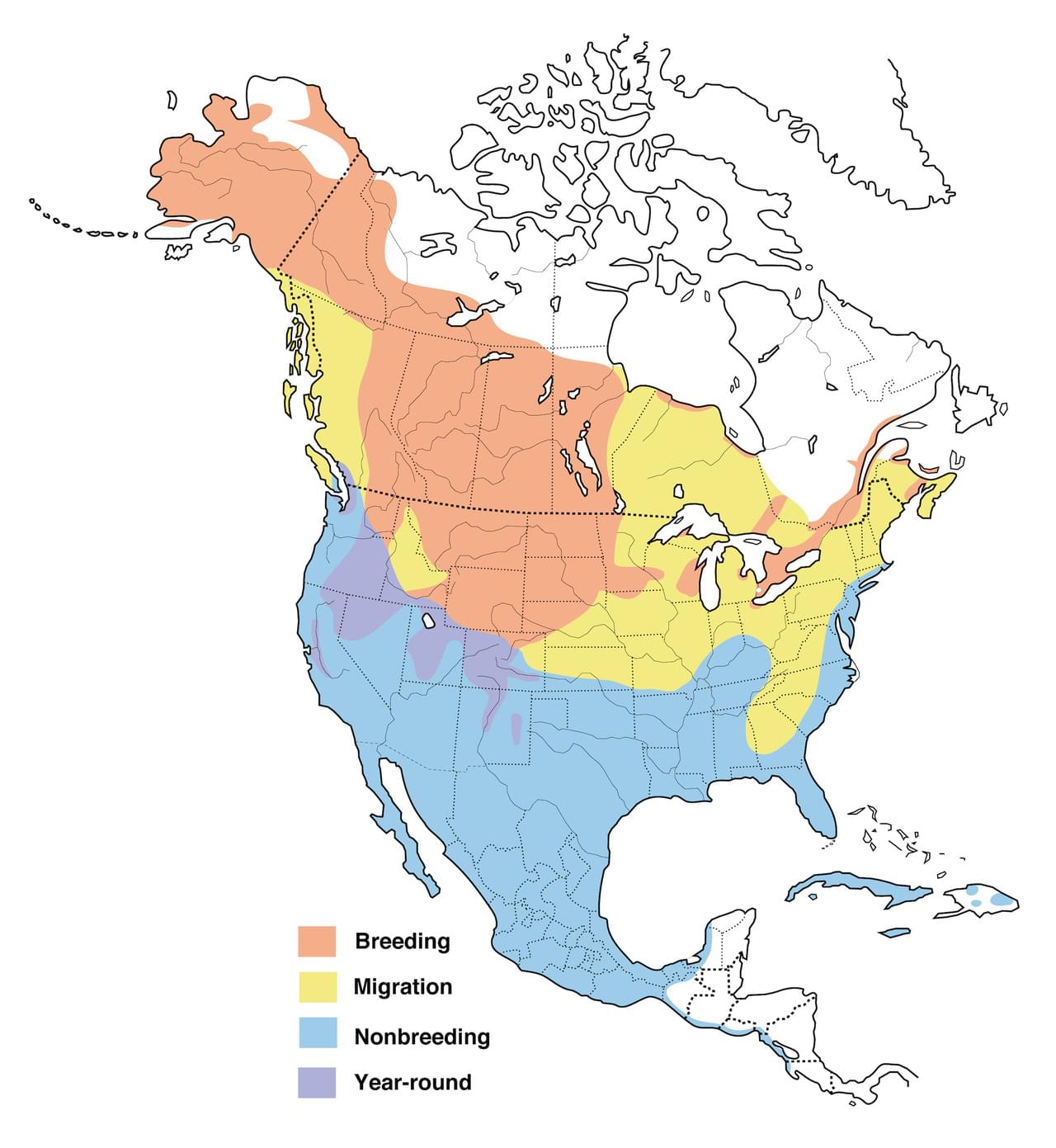
Although the range map below does not indicate the presence of Short-billed Dowitchers on the Alaska Peninsula, David Sibley includes the peninsula on the range map in his field guide as does the Audubon website.
Short-billed Dowitcher, Limnodromus griseus Order: Charadriiformes Limnodromus: Ancient Greek limne = marsh, and dromos – racer. marsh racer griseus: Medieval Latin for gray
Status at Chignik Lake: Only one sighting in five years, however it is likely that this species is a regular if brief late summer migrant in the drainage and may even nest in nearby areas of tundra or marsh.
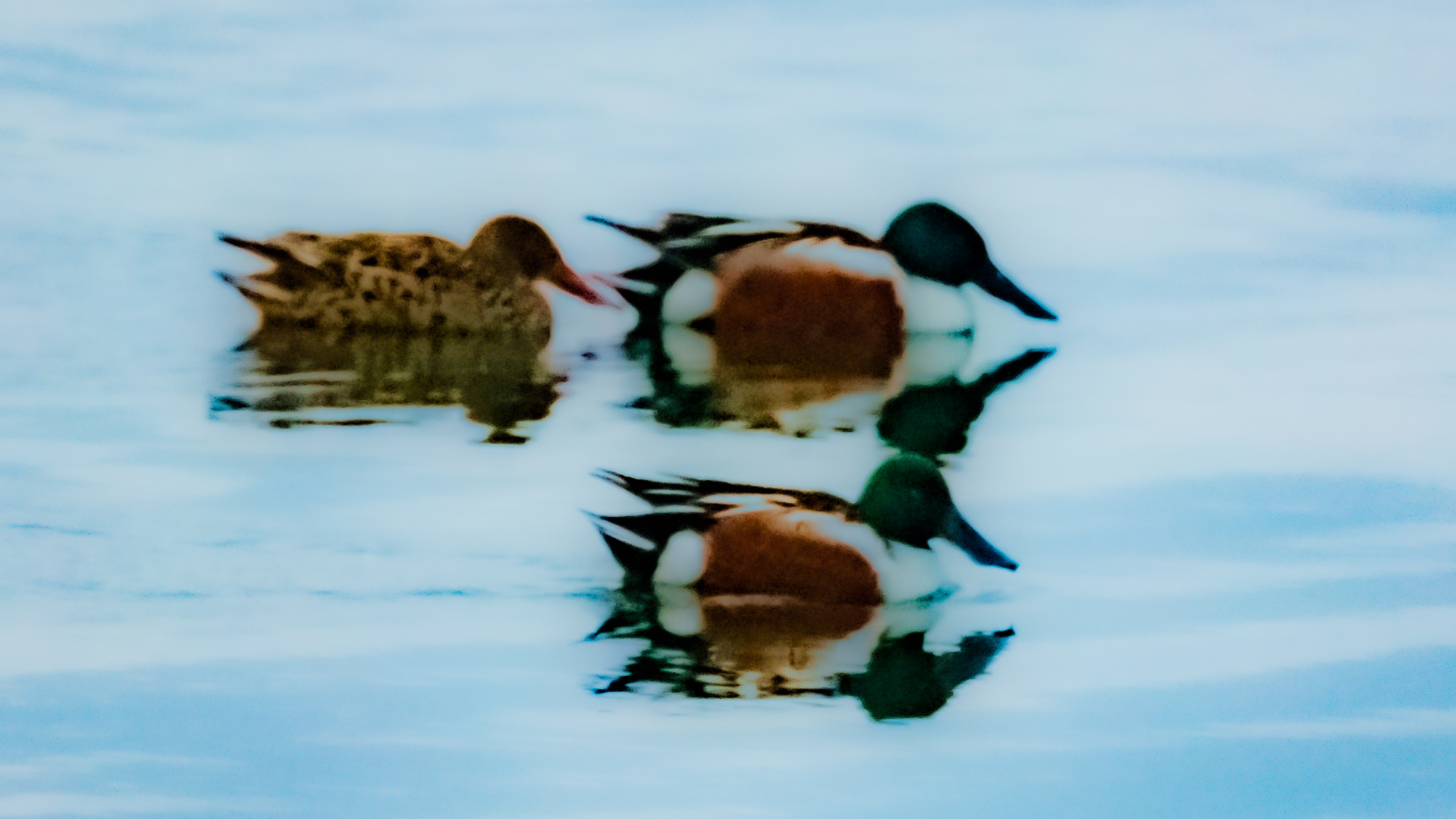
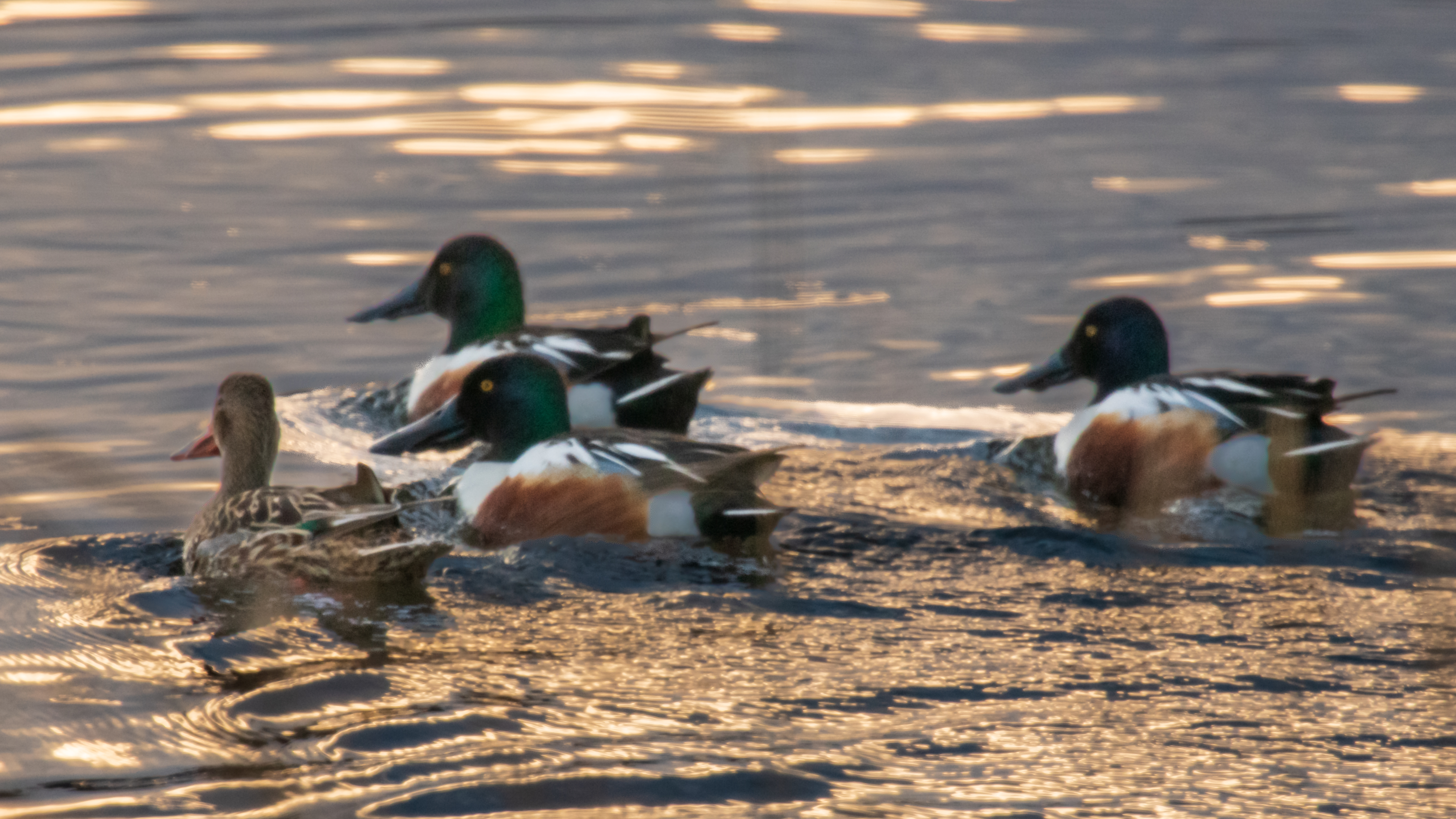
Strikingly marked with blues, iridescent greens, russet flanks and contrasting white, Northern Shovelers are a beautiful bird. And that bill…(Photo taken April 28, 2021, Chignik Lake)
Two decades have passed since the days when I used to ride my bicycle in wintertime and spring to the Hanamizu River in Hiratsuka, Japan to look for birds there. I did not consider myself a birder then, but I liked to look at the water and I carried binoculars and sometimes a bird field guide with me. There were herons and egrets, and it was a good place to see turquoise-colored kingfishers, a favorite, and to find shrikes which left worms and other small creatures impaled on barbed wire fences around gardens along the river. There were startling, parrot-like green woodpeckers, redstarts and other birds in the forested hills nearby, and sometimes I’d go there to look for those as well as owls, which I never did find. My favorite place was the river, though, and I’d often pack a lunch and find a place to sit and watch the ducks. There isn’t much hunting done in Japan, and so the birds were neither tame nor particularly wary. I was often closer to species such as teal, wigeons, mallards and pintails than I’m ever able to get here on the Chignik.
Drake (left) and hen Northern Shovelers, Chignik Lake, April 28, 2021.
Perhaps the most approachable of the Hanamizu’s waterfowl were the Northern Shovelers. Quiet as ducks go, they’d busily and rapidly swish their bills back and forth through stiller portions of the river, managing by means of their unique bills and a feeding strategy unlike the other ducks to avoid competition. As it turns out, their spatula-like bills are equipped with over 100 very fine, comb-like structures shovelers use to sift out small organisms. In both appearance and effect, these lamellae are similar to the baleen of certain species of whales. So, while shovelers are dabblers (non-diving ducks), they do more swishing and churning with their bills than tipping butt up as do teal and mallards.
In four years of living at Chignik Lake and looking at various species of ducks up and down the Chignik drainage, I’d never seen shovelers here. David Narver didn’t record them in his avian study of the Chigniks conducted in the early 1960’s, and a quick check of this species on the Cornell Lab of Ornithology’s All About Birds site indicated very few sightings on the Alaska Peninsula and none at all on the Gulf of Alaska side where Chignik Lake is located. So I was astounded to look at my window in the predawn of April 28 and see the unmistakable silhouettes of ducks sporting those bills. Three drakes and a hen, milling near shore along the beach where many of us park our skiffs and scows. I knew I had to make my pictures quickly. It wouldn’t be long before people headed down to the beach to launch their crafts, at which point the ducks would surely take flight and continue their migration across the peninsula.
Among ducks, Norther Shovelers are particularly known for lifelong monogamous pairings. (4/28/21)
The problem I was facing was that what little light there was shone from behind the birds. Given that encountering this species is at best a rare event on the Chignik, my best option was to turn up the ISO, keep the aperture as open as practical, and at the very least make some decent “record” or documentation pictures and deal with image noise and softness later. The pictures in this article are all from photos I took in the pre-dawn light that morning.
As I feared, just as the sun began peeking over the snow-capped mountains rimming the lake, a honda engine pierced the morning calm. As it drew closer, the quartet began hurriedly paddling for deeper water. Suddenly they broke, sent the water into a froth as they took wing, and were gone. (4/28/21)
The Lake is the kind of place where, at any given moment, an interested person might take a closer look and see a species of bird never before recorded here. But in what part of the world isn’t that true? Regrettably, I cannot remember the author’s name, but there is a very short piece of Japanese Zen poetry that reads,
Tend the garden any size
Those words might be paraphrased to read,
Make a study anywhere
It seems that the closer one looks – at anything – the more there is to see and to learn and to marvel at.
Northern Shoveler, Spatula clypeata Order: Anseriformes Family: Anatidae Spatula: Latin for spoon or spatula clypeata: Latin for shield bearing or shield
Status at Chignik Lake, 2016 to present: Rare or perhaps even accidental. Most likely to be encountered as a spring migrant. However, as shovelers are known to breed on the Alaska Peninsula, this is a species to be on the lookout for in any likely habitat, particularly at Black Lake at the head of the drainage.
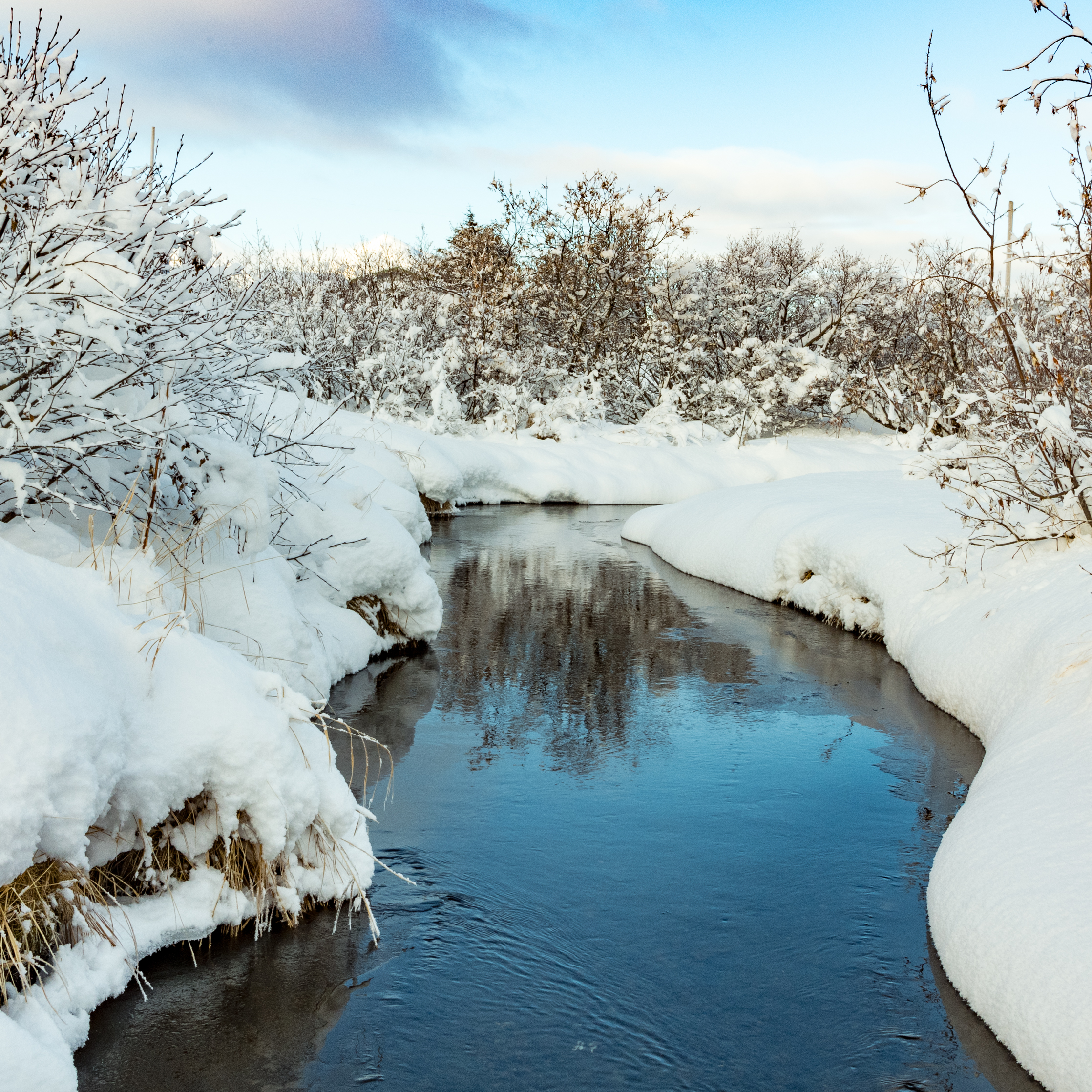
Barbra and I call the stream in the above photo Post Office Creek for its proximity to the former post office here in Chignik Lake. The post office has since relocated, but during the first three years we lived here, we regularly crossed this creek on foot as we traveled back and forth. Although our home sits just 60 paces from a lake full of water, this tiny creek holds an especial appeal and anytime I am near it, I find myself drawn to it, approaching stealthily for a careful look into its deeper pools.
From mid-spring through fall, there are char and sometimes salmon parr and one year a pair of Pink Salmon spawned in a riffle below the culvert where the road crosses. The char are wary, but by approaching quietly and giving one’s eyes a few moments to adjust, fish a foot long and even larger might be found. A cottonwood overlooking the mouth is a favorite perch for kingfishers, and when salmon are in the lake eagles can also be found there. Loons and mergansers regularly hunt the lake’s waters outside the creek mouth and yellowlegs can often be found wading and catching small fish along the shore.
During wintertime, there generally isn’t much evidence of life in the creek’s clear waters, but it’s there – char eggs waiting to hatch, caddis larvae along with mayfly and stonefly nymphs clinging to the undersides of rocks, a visiting heron catching small fish where the creek enters the lake, fresh otter and mink tracks at the mouth some mornings.
In summertime snipe nest in a marsh that seeps into the creek, and bears use it as a thoroughfare so that even in the village, you’re wise to carry bear spray if you’re walking that way. The dense thickets of willow and alder near its banks are a good place to look for warblers and thrushes. In fall Coho gather just below the creek’s mouth, resting before traveling to larger tributaries further up the lake. As Roderick Haig-Brown observed, a river never sleeps. Nor does Post Office Creek. I made this picture on January 13, 2021. (Nikon D850, 24-70mm f/2.8, 1/50 @ f/22, ISO 400, 24mm)
Right down to his black-gloved claws, male redpolls are strikingly handsome fellows. The species is a regular wintertime visitor at the lake, though they’re unpredictable and irruptive flocks or a few individuals or none at all might be encountered in any season here. Two springs ago, Barbra saw one carrying nesting material. That same late spring we saw a number of what were surely brand new fledglings. In recent years they’ve joined Pine Siskins and Pine Grosbeaks in what has become the annual late-spring Feast of the Dandelions. As the little yellow flowers go to seed, these finches descend on the school yard and elsewhere to gorge on the tiny seeds. This occurs in large part due to Clinton, the school’s grounds-keeper, whom I’ve convinced to put off mowing till after the main part of the dandelion season is over.
I’m hesitant to say with certainty that the bird in the above photo is a Hoary Redpoll, but he’s got the smallish bill, light side streaking and pinkish breast associated with that species. There is a lot of morphological variation among redpolls. The matter brings up what is to me one of the most interesting questions in biology:
What is a species?
When do two groups of similar flora or fauna differ from each other enough to merit taxonomic separation? The question creates divisions between “lumpers” who advocate for leaning toward the simple “can they interbreed and produce viable offspring” test and “splitters” who observe that even though two types can successfully breed, it may not be useful to group them together as a single species.
My interest in ichthyology has led me to place myself firmly in the “splitters” group. Applying the simple “can they breed and produce viable offspring” test, fisheries managers of bygone eras decimated genetically unique stocks of salmonids (char, trout and salmon) through nearly indiscriminate hatchery breeding policies and stocking programs. What was learned – the hard way – is that although, for example, Chinook Salmon from two different rivers might seem to be the same thing, biologically they aren’t. Each population of Chinook represents a unique genetic strain, specially adapted to the conditions of its own home river. A strain of salmon transplanted from one river to another is unlikely to thrive. Thus, the best approach to ensuring healthy salmon populations is to protect their habitat – river by river, right down to individual spawning tributaries.
Which brings us to the matter of redpolls and the question as to whether there are two species in North America, Hoary and Common, or whether a redpoll is a redpoll is a redpoll. Based on what I’ve read, in addition to any phenotypic or genotypic differences that might exist between the two types, they tend to nest it different areas. Hoaries prefer tundra or other open areas; Commons like more brushy habitat. Which suggests to me that they are different enough that we need to protect both types of habitat if we want to continue to have both types of redpolls. (Nikon D5, 600m f/4 + 2.0 TC, 1/1000 @ f/8, ISO 1600, 1200mm
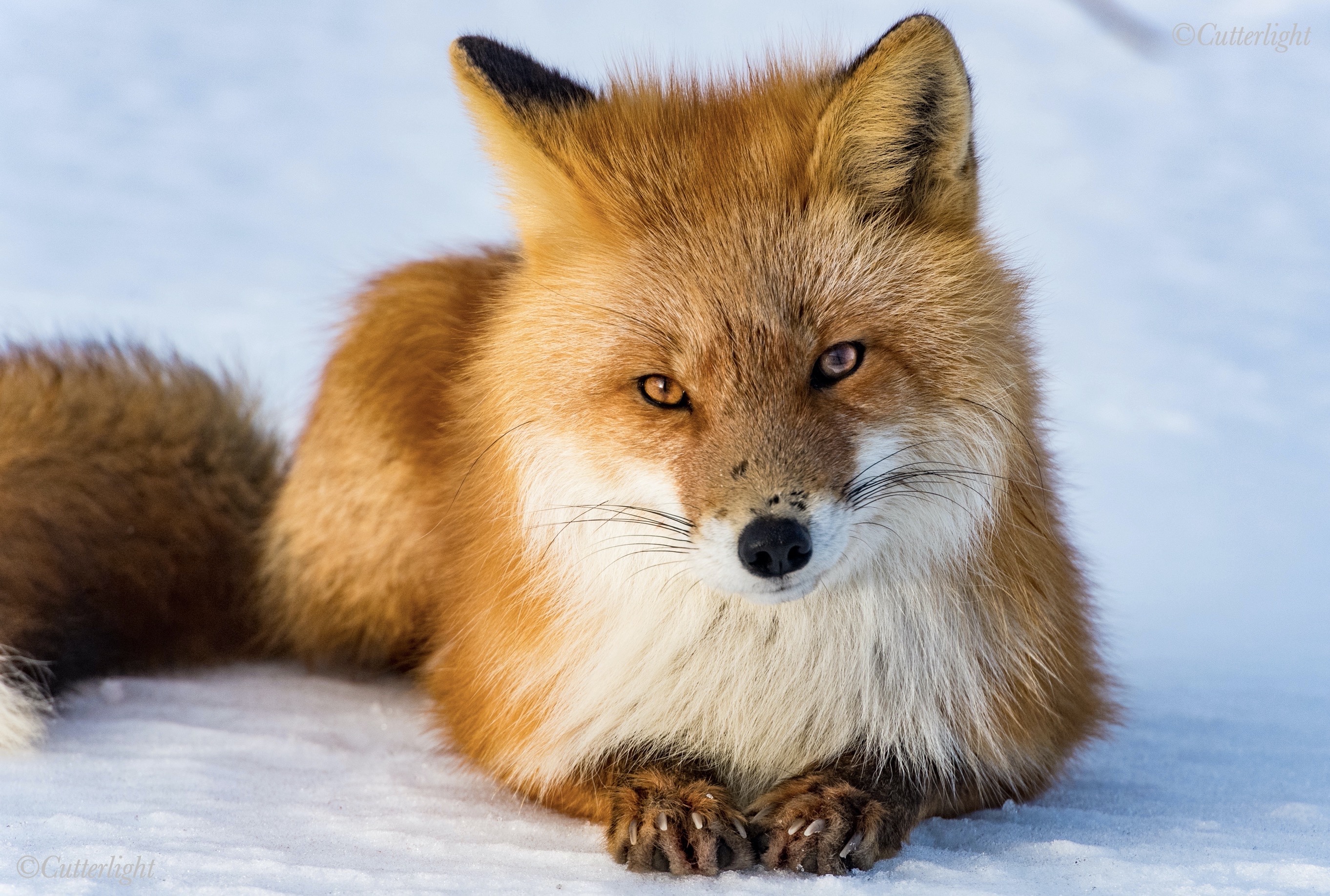
By the calendar, this isn’t strictly speaking a winter shot. But on April 1 of 2017, there was still lots of snow with more to come. Ice had only just begun to relinquish its hold on Chignik Lake. No one was seriously trapping that year, and the inhospitable landscape had driven several foxes into the village where food was easier to find. Several of us at The Lake are happy to occasionally oblige these visitors with a handout of fish or whatever else we might have in the fridge. So, full disclosure, the fox in the above photo, whom we named Speck, had long ago dropped his guard in favor of scoring an easy salmon head dropped from our living room window.
We learned quite a lot about Red Foxes that winter, starting with the fact that each is an individual, distinguishable by both physical features and character traits. In all, we came to recognize (and subsequently name) five different foxes that year: Speck, Frost, Kate, King and Skit. Each had its own unique personality, and each had some special physical trait, such as the spots on Speck’s face. He was a favorite, and along with a little female (we think she was a female), Frost -named for the white on her face -, he could often be found sleeping and loafing below our window.
Is it ethical to feed wild animals? It depends. Certainly it’s a bad idea anywhere the species in question is being hunted or trapped. It’s an equally poor practice in parks or other areas where animals might become a nuisance. No one wants to sit down at a picnic table only to be besieged by squirrels, gulls or jays. And we oppose the practice of baiting animals – that is, feeding them in order to shoot them, whether with a rifle or a camera. But we feed birds in order to help them and because we enjoy their company, and in the depths of winter we sometimes put out a salmon head or something similar for foxes. Here at The Lake, most fishermen will leave salmon and trout carcasses on the beach for the benefit of eagles and bears – a practice that is illegal most other places. Foxes have evolved so that an encoded part of their behavior is to follow larger animals – bears, humans – in hopes of obtaining a few scraps of food. People have undoubtedly been sharing with them for as long as there have been foxes and humans. (Nikon D5, 70-200mm f/2.8 + 2.0 TC, 1/1250 @ f/10, ISO 1600, 400 mm)









 CutterLight