They truly are this colorful – Sockeye Salmon in peak spawning colors, undisclosed stream, Alaska, 7/20/12
If you are single and want to keep things that way, start by making certain that you have only one really nice place to sit in your house. Have only one good wine glass in your cupboard, one decent dinner plate, one nice place setting. Strive, also, to have single-subject art – a lone person in any photographs, one carved bird alone on a shelf, only of any souvenirs or keepsakes. People will get the message.
If, on the other hand, you wish to communicate to the universe that you are desirous of and ready for a commitment to another person, populate your home in pairs. Two fine bourbon glasses, two equally comfortable places to sit, pairs of items on shelves, paired subjects in paintings, photographs and other artwork, a second bath towel that is every bit as luxurious as the one you yourself use. And when you find a special pair of beautifully crafted chopsticks, purchase a pair for yourself… and a second pair. The mere act of approaching life in this manner will begin to prepare you for an other person.
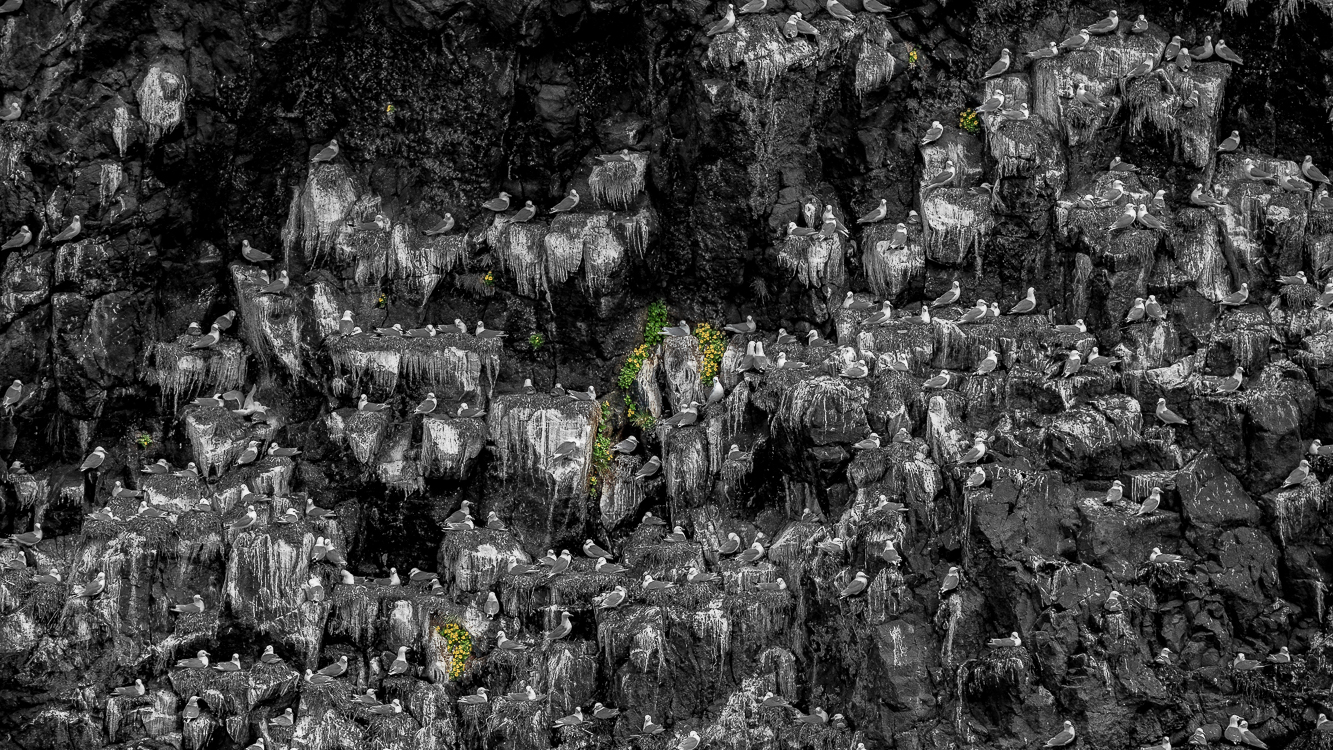
Nesting Black-legged Kittiwakes with Yellow Monkeyflower, Resurrection Bay, Gulf of Alaska, June 22, 2013. This is an example of spot-color photography.
We miss our C-dory. A lot. Photographs such as the one above can’t be made without a boat, not to mention the role Gillie played in filling our freezers with tasty halibut, lingcod and rockfish. And for a pleasurable day of leisure, it’s difficult to top fair weather on a calm sea.
While we lived on the Chignik River, we found a shallow-draft welded-aluminum scow to be more practical than the larger fiberglass dory, and so we sold Gillie. Regrets followed. She would be perfect here at our new home on the shores of Prince William Sound. In the peripatetic lives Barbra and I have lived both prior to and during our marriage, with each move we’ve effortlessly let items pass through our lives: beautifully crafted Christmas ornaments, artwork, cherished pieces of furniture, treasured books… even valued fishing tackle. The few items we take pains to keep in our possession mainly come down to cookware, photography gear and fly-fishing equipment. After all, most things are replaceable, and so the metaphor of the bookshelf constitutes an important element of our life philosophy.
The metaphor of the bookshelf is our way of thinking of… things… in a life where we find benefit in living slim and where we appreciate each move as an opportunity to pare down. The idea is to always leave room for the new, and if there is no room, to create it. So rather than fill up shelves with books we’re unlikely to read again, we don’t. Because if your shelves are full, there’s nowhere to add new items to your life – unless you keep adding shelves till your home is crammed full of shelves. It’s lovely to move to a new place and find that you have abundant blank spaces to populate with new treasures. Most things are easy to replace (a first edition copy of A River Runs Through It I allowed to slip through my possession being a noted exception).
Norman Maclean’s classic fly-fishing memoir, Gillie… it’s a short list. Art is replaced by other art. Souvenirs from one place have been let go of to make room for new keepsakes from new places.
We also let go of our aluminum scow when we left the Chignik, and so, taking the optimist’s view and embracing the metaphor of the bookshelf, it appears we now have a space in our life begging to be occupied by a new – or new to us – seaworthy vessel. Something to look forward to.
Hard to say where this bear, a mere dot on this icefield, was coming from. Somewhere across that vastness, heading toward Exit Glacier, down to salmon rivers. To a place I suppose he thinks of as home. 6/13/2011
The hike to Harding Icefield is a little over four miles up a mountain trail, more or less following a ridge above Exit Glacier. Patches of snow, wildflower meadows, birds, bears, maybe other wildlife along the way. There are many vast landscapes in Alaska. The view out over the Harding Icefield, the great mother ice lake that feeds Exit and dozens other glaciers is… otherworldly. We were on a rock outcrop overlooking part of Harding’s eleven hundred square miles. I was preoccupied with alpine flowers when Barbra noticed a trail across the snow-covered ice. It didn’t make sense. Till we spotted the bear.
Moving on from the photos we took in Mongolia, I’m now going through “Alaska Summers.” Some of these catalogues predate our trip to Mongolia. As I come upon images I really like – such as the above composition – I’ll share them here and on Instagram. jackdonachy, if you’re interested in following there. I also put most of these photos on Facebook – Barbrajack.
I like this photograph for the way it recalls a quote by Bob Dylan that describes Barbra, and me, and maybe this bear, and maybe you.
I was born very far from where I’m supposed to be, and so, I’m on my way home…
A favorite “us” photo: At the Flaming Cliffs in Mongolia’s Gobi Desert. October 23, 2014
Growing up, I didn’t have many of what might properly be called “toys.” When I was young, friends would come over, look around, and complain, “There’s nothing to do.” And thereafter find reasons to not come over.
But I did have books. A few. And among those few were a handful of treasures I read over and over. They included Volume I of the Reader’s Digest Best Loved Books for Young Readers series. The volume was comprised of a four-story collection of abridged books which included Treasure Island and Call of the Wild, the latter tale so riveting I read it 13 consecutive times the year I was in third grade – with a flashlight under my blankets long after I was supposed to be asleep, in the backseat of the car, on my lap (second row, fourth seat) during Mrs. Dull’s third-grade math lessons. Other books included Our Amazing World of Nature, The Golden Book of The Civil War, a book titled something along the lines of George Washington and the Revolutionary War, all 20 volumes of the Pictorial Encyclopedia of American History, and Digging for Dinosaurs which included a Panorama slide show and a 33⅓ rpm vinyl record featuring Walter Cronkite’s resonant narration. Of course, there were other books, most treasured among them field guides for children – Golden Guides to fish and insects and a Peterson guide to seashells.
The funny thing – strange funny – is that for the most part these books either seemed to have always been there, on shelves in my room, or were presented to me with little ceremony. I never asked for any of them that I can recall, but they became a significant part of my world in a home in which I didn’t fit in and subsequently spent a great deal of time by myself in the forest that extended for limitless miles behind our home and upstairs in my bedroom stretched out on the bed or the floor, chin in palm, lost in the dream-world of a big-hearted dog going home to his wolf-roots in Alaska, battlefield maps, fascinating and fantastic stories about wild animals, pirates and their ships, and the lost world of dinosaurs. And whereas my parents subjected me – and themselves – to an unhappy annual ritual of ignoring whatever I’d asked for on Christmas and birthday wish lists, instead presenting me with things entirely unexpected, and then, after family friends and relatives saw that I had received a very fine gift indeed, taking away that gift when eyes were no longer on us, the books remained. Thus they were among the very few things I could think of as “mine” in a home where I was admonished by my father that “everything” belonged to him and to her, that nothing was mine, and that I needed to understand that “if you’re going to live here.” But the books were mine. None were ever taken back. They became a source of… safety. Peace. Comfort.
In the dinosaur book, there was a photo of fossilized eggs arranged as on desert earth as though in a nest – the first dinosaur eggs ever discovered, an incredibly important and exciting find. Text placed the nest in the Gobi Desert’s Flaming Cliffs. And so I grew up dreaming of sailing ships and seashells, of a world where, like Reddy, I might be freed from my present circumstances to go and live with my grandmother and know what love is. Alaska was mixed in with those dreams, along with a fascination with fish and insects, and though my interest in battlefields and wars has flagged, early reads in history brought with them an awareness of Native Americans, leading to my discovery of Dee Brown’s Bury My Heart at Wounded Knee on my parents’ shelves the year it was published. I was 12. I pored over the book, fueling dreams of experiencing life among Native Americans. Feathered in among all this was the thought that maybe one day I would go to the Gobi Desert and find fossils on my own.
And so it came to be. Not eggs. But we found fragile fossilized remains of something large and dinosaur-like.
Two thoughts:
There is nothing like a well-written book in the right hands and the good fortune of being left alone for shaping dreams.
and
The problem with so-called bucket lists – a list of this and that to be chased down or “accomplished” before one “kicks the bucket” – is that the very name makes too great a nod to death. Experiences should not be guided by sand funneling through an hourglass. So here’s a different way to look at our dreams and the experiences we might wish to have.
No lists, and none of the randomness and disconnection between items implied in the term “list.” Milk, celery, double AA batteries, nail polish… randomness is fine as a prompt when grocery shopping, but that’s no way to live a life. No grail-chasing. No doomed-to-failure race against mortality.
Instead, imagine the coolest version of yourself you can imagine… and then go be that person.
The sun hadn’t yet crested the horizon when we came upon a covey of these strikingly marked fluff balls – Daurian Partridges in Khustai National Park, Mongolia. December 30, 2014
I’d been shooting for about four years when I took the above photograph. Still not sure what I wanted to photograph, our Lightroom catalogue was becoming populated with images of wildlife, portraits, landscapes, fishing, food, family events and so forth. But no doubt about it, birds have always held a fascination – and, though I didn’t know it at the time, would become my pathway forward.
It may be that for most of us a general approach is the most logical entry into a new endeavor. But based on my own experiences as well as observations of others, it seems that it is not until we specialize that rapid growth begins. So the angler eventually finds her way into fly-fishing, and not just fly-fishing broadly, but a specific type of fly-fishing. A cook becomes a chef when he undertakes to master a specific culinary repertoire. And so on. The interesting thing is that as one specializes, broader skills and knowledge are acquired and sharpened. So that even catching bluegills or frying an egg is performed with greater proficiency… while simultaneously a leap into a new kind of fishing or cooking, launched for a base of expertise, is also made easier.
A generalized approach feels comfortable, particularly at the start of a journey. The broadness, the lack of pressure to get one thing right, feels safe. But if one truly wishes to master a vocation, it is sound advice to not linger overly long with as a generalist. Specialize. Pick an area and dive deep. Take what is in front of you. Doable. For a couple of years, the best angling available to me was carp fishing. Not my first choice of fish, but I lived within a short bicycle ride of a fine river with a good population of the cyprinids, and so I threw myself into it… and saw my skills in virtually all areas of angling improve. Surely this is the way it is with most things – photography, culinary arts, writing, art… Begin the journey with a broad approach, but with eyes open for a narrowing path.




 CutterLight