

Barbra and a young friend cheese it up for the camera at Yagishiri’s ferry port.
A cool ocean breeze drifted in across the Sea of Japan and the sun was shining brightly as we set up our tent on Yagishiri Island. Brilliant orange-yellow Day Lillies speckled the green, gently rolling countryside around us. It was easy to imagine the Suffolk sheep the island is known for tucking their black faces into tufts of rich grass and quietly grazing a few hillsides away.
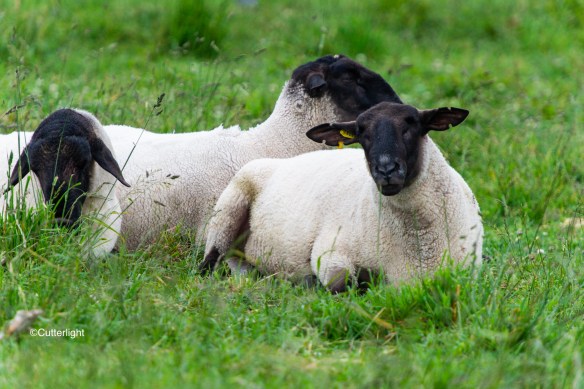
Yagishiri is home to Suffolk Sheep. Brought over from Scotland, they grow cute and tasty on the island’s lush grass.
The campsite was ideal. Our tent was nestled into a flat between hills and protected from coastal gusts by a small building. The campsite featured cold running water, an immaculate restroom, and even an outdoor shower.

We stowed our bike bags beneath the tent’s fly and headed down an inviting pathway to what the map boasted as a swimming beach. Although the sun was high in the sky, I wasn’t prepared to take a chilly Sea of Japan swim. I noticed that the beach was covered with countless tiny treasures – blue, green and amber beach glass polished smooth, crab husks, miniature clam shells, dried sea urchin shells- some with their spines still attached, and colorful small rocks with interesting patterns. Larger flat rocks offered perfect surfaces on which to create found art displays with favorite finds from the beach. What a lovely, relaxing way to spend part of an afternoon.

Yagishiri-to (Yagishiri Island) is a short ferry ride from the town of Haboro on Hokkaido. There is one main road that follows the island’s perimeter which is only 12 kilometers (just over seven miles). After exploring the beach and with our bike bags stowed at the campsite, we hopped onto our now feather-light bikes and went out to discover the rest of the island.
As the sun moved in and out from behind a few gathering clouds, I couldn’t help but smile. When I was young, my family traveled a good bit. During those trips, I fantasized about having my bike with me so I could explore those places at a bike’s pace – slow enough to catch all the details around me but fast enough to actually get somewhere. It’s exercise up the hills, the coast back down a pleasantly earned reward.
Off in the distance we began to hear the rumble of thunder. We had nearly reached the opposite side of the island from our camp. Looking out to sea, we tried to discern which way the thunder was coming from. Toward the sea, the clouds were thin and light. Looking toward Hokkaido’s mainland, the clouds were thick with rain.
Rather than turn back, we decided to continue around the island. We guessed the lighter clouds were coming our way. However, a few minutes later, big splats of rain hit us. Seems we are not meteorologists! Near the top of a hill, we spied a path leading into a small forest which, according to our map, would lead to a shrine. We decided a quick side trip there might give us shelter from a burst of rain. We found the shrine in a state of some disrepair. Tall grass grew around the gate-keeping statues and stone lanterns, and scattered ladders and work tools gave the site the look of a place that was on someone’s to-do list.
Suddenly the clouds ripped open as a torrent of rain poured down. We sat on the dry steps of the shrine enjoying the sounds of rain drumming on the forest canopy while birds chittered complaints in the forest and tree frogs sang in celebration. It was lovely to wait out a squall with no appointments to attend to and no plans for the afternoon. As squalls do, it passed. We got back on our bikes and continued our tour of the island.

A treasure trove of glass floats filled this small fishing boat to the gunwhales.
As we neared the highest elevation on the road, lightning flashed in the distance. This time, it seemed clear the angry cloud mass was heading straight for us. There was no more leisure in this ride; it was time to get back to camp. The flashes and booms were still over ten miles away according to our primitive counting measurement system – one one thousand, two one thousand, three one thousand… The race was on.
As we neared our campsite, the clouds opened up and once again began to unleash sheets of rain. We hurriedly parked our bikes, grabbed our water bottles and rushed to the tent. As we did, we noticed something strange: the side of the building we were camped by was now open. It seemed magical. We hadn’t noticed any type of opening when we set up the tent. It turns out there was a rolling door, like a garage door. While we were gone exploring, some kind person had come along and opened the building for us. The opening revealed a friendly space with a dry concrete floor, kitchen sinks and stainless steel countertops – a perfect place to duck in out of the rain and cook our dinner!
We positioned our camp chairs near the opening and watched our poor tent get pounded by rain. Soon the thunder and lightening passed directly over us. I’ve always loved watching lightening storms. It was exciting and wild to have the strikes pass close by. We counted them as close as two miles away! Eventually the storm faded across the hills, across the sea and into the distance.
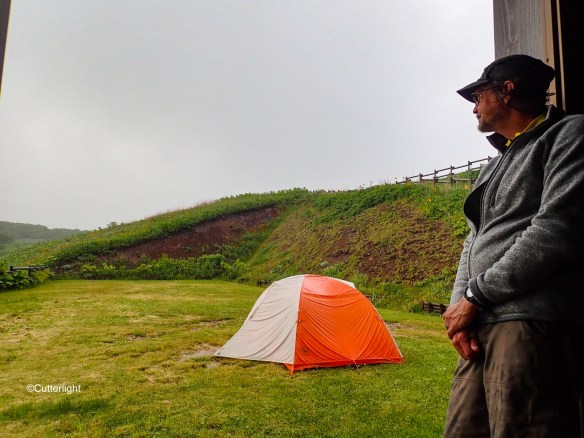
Rain, rain and more rain – waiting for a lull in a series of squalls on Yagishiri-to.
By now it was getting late. Our bellies were full of a hot soba concoction Jack had whipped up and our bodies were warmed by the last sips of peaty, smoky whiskey from a purchase at the Nikka Whiskey distillery. With the rain waning, I t was time for bed.
Our little tent is amazing. It had been thoroughly doused. Yet the fly had held out through the worst of it and our sleeping bags and all of the gear inside the tent was snug and dry. Nestled inside our cocoon, we both quickly drifted to sleep.
Then –
Flash! Crack! Boom! The lightning and thunder came in nearly simultaneous sequence, jolting us awake.
While we had been soundly asleep, another intense squall had crept upon the island. This time the lightning strikes were practically on top of us. Two in a row where there wasn’t time to count to one thousand-one between the nearly blinding flash and the earth-shaking boom had our eyes wide open. A tent previously described as “tough” and “sturdy” now seemed to be but a flimsy piece of nylon separating us from the elements. “Give me your hand!” I demanded of Jack. I grabbed his hand as another Flash! Crack! Boom! pounded down from the heavens. I squeezed my eyes shut but couldn’t keep out the blinding flashes. I plugged my ears to muffle the thunder’s roar. I wondered about people who’d been struck by lightening and had survived. What did that feel like? Were we going to be one of those stories?
“We’re in a low place,” Jack assured me. “We’ll be fine.”
The next blinding flash lit up the tent. This time the roar of thunder came after “one one thousand.” Maybe it was moving away? I still clung to Jack’s hand. Another blinding flash. I buried my head in my sleeping bag and counted – one one thousand. Then, right away, another flash – one one thousand, two one thousand. My heart was still racing. While this squall seemed to be passing, I wondered if another set of storm clouds would move in.
A few minutes passed and another flash came – one one thousand, two one thousand, three one thousand, four one thousand.
As the thunder and lightning slowly drifted further away, I finally released my grip on Jack’s hand. My heart slowly returned to its normal rate as the drumming of rain on our tent softened. For the remainder of the night it rained and rained, but the thunder and lightning had ceased. The next morning, I woke up wondering where exactly the lightening had struck. A moment later, I felt grateful that I didn’t know.


 CutterLight