The Catch: Bringing a Whale up on Sea Ice in Arctic Alaska

Inupiat whaling on the frozen Chukchi Sea near Point Hope, Alaska. April 26, 2012

As Bowhead Whales go, this was a small one – perhaps 10 tons or so. We had hiked approximately three miles from the village of Point Hope across the frozen Chukchi Sea to the camp where we had heard a whale had been caught. Locals had traveled by snowmachine and honda (snowmobile and ATV). There is always the danger of encountering a Polar Bear in this environment, and so we were armed. After snapping this picture I handed the camera to Barbra and took a place on the rope.

The open water in this picture is called a lead – an opening between two sheets of ice. You can see, across the water, the jumble of ice along the edge. Sea ice is often not the smooth sheet of white one might imagine. It continuously buckles, pushes up along pressure ridges, drifts apart and then presses back together. In a way, it behaves like the Earth’s tectonic plates, buckling, heaving, colliding, lifting. And so in order to make a whaling camp, trails must first be made through these places where jagged ridges of ice, individual chunks the size of cars, some much larger, must be broken through and smoothed out.

It is a lot of work to take a whale.

The Bones of Tikigaq: Whaling Festival Site, Point Hope, Alaska

The Bones of Tikigaq
Whaling Festival Site, Point Hope, Alaska. The larger bones presented as arches are the jawbones of Bowhead Whales. Traditionally, the skull is returned to the sea so that the whale’s spirit is properly released. Point Hope, Alaska, August 12, 2012

The Bones of a Village

New enough to reveal steel and aluminum nails, old enough to be well-weathered by the Arctic climate, the bones of this seal-skin whaling boat were left behind when Point Hope (Tikigaq) relocated two-and-a-half miles inland in the 1970s. Point Hope is one of the longest continuously inhabited places in North America.

The Inupiaq name for Point Hope Village, Tikigaq (tick-ee-yahk) means index finger and described the way the gravel point once hooked into the Chukchi Sea. Time and tide long ago washed away the crook of the finger, leaving behind a triangular point near enough to deep water that the whales that first drew the Inupiat people here thousands of years ago still swim close to shore. The 2.3 mile hike from the current town out to the point gets a little tough once the road ends and the pea-to-chunk-size gravel begins, but it is well worth the effort. In addition to bowhead and other whales, which are frequently sighted, the collision of currents at the point holds large schools of finger-sized baitfish, which in turn draw flocks of Arctic terns, gulls, murres, puffins, jaegers, guillemots and ducks while various sandpipers patrol the shore. At times, the sea and sky are filled with hundreds–if not thousands–of birds. The small fish also attract roving schools of pink, silver and Chinook salmon and sea-run Dolly Varden which in turn are followed by spotted, common and bearded seals. Walruses show up from time to time as well.

The walk to the point passes through the Old Village, a ghost town of semi-subetranean homes made from sod, whale bone and driftwood as well as more modern, wood and metal houses. It’s fascinating to walk through the Old Village and contemplate what life would have been like up here before electricity, running water, guns and gasoline engines–when the only “grocery stores” were the great herds of caribou 25 or more miles to the east, bowhead whales swimming in the freezing Arctic Ocean, and the various fish, seals, berries and plants gathered in their seasons.

Parki

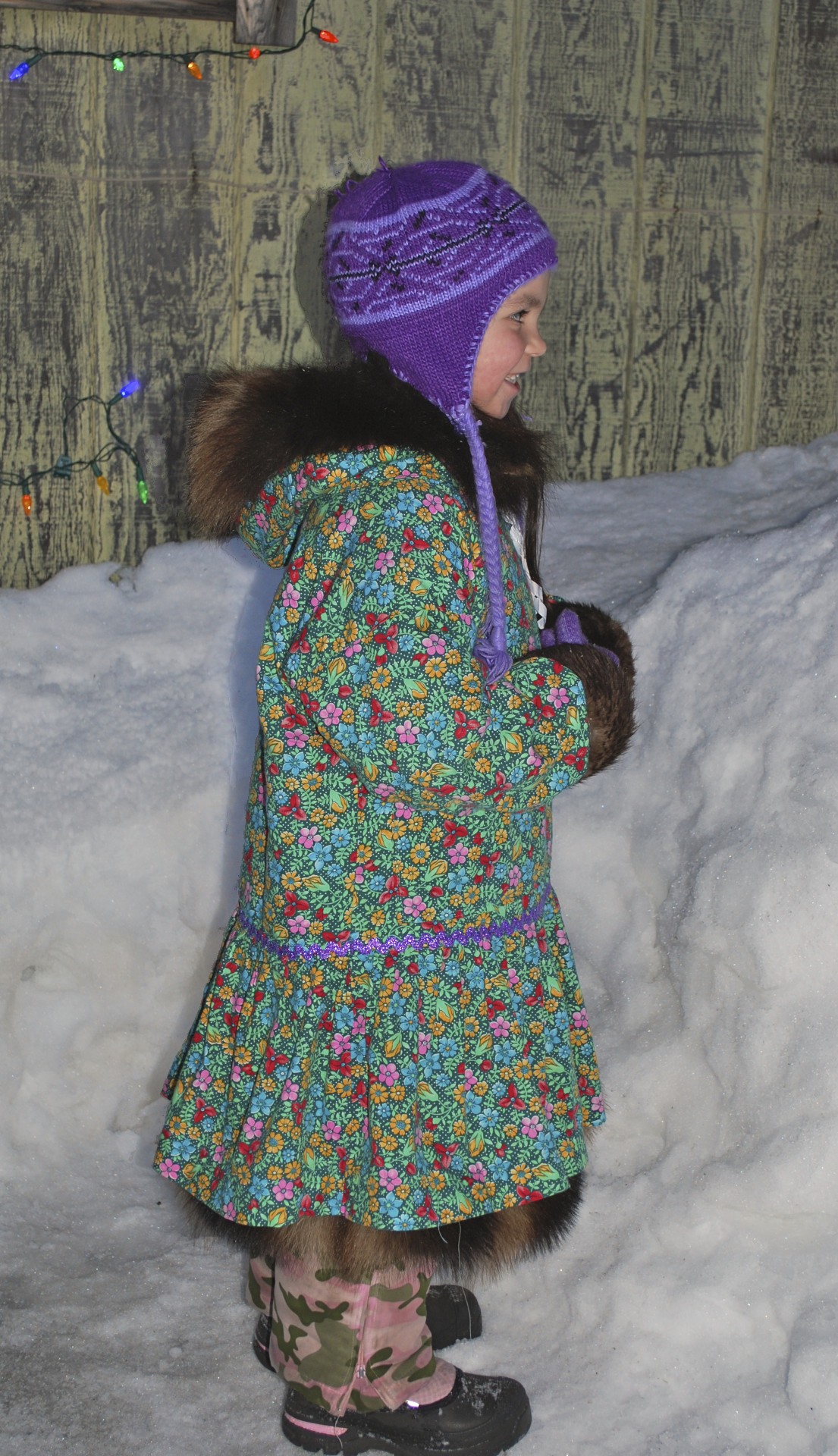
The Inupiat Eskimos in Shishmaref wear these beautiful coats. Up here, they call them “parkis.” At first glance, they look like brightly colored, thin, pullover-style coats, trimmed in fur. As I have gotten my hands on a few (I have literally petted several), and talked to people, a more interesting coat was revealed.

While it’s true that the outer layer is colorful and sometimes is made of very thin fabric, it is actually only an outer layer. Underneath is a very heavy layer made of animal skin. In many cases, it is spotted seal or caribou. The bottom of the skin is ruffed in a more ornate fur, like beaver. You can see my young model’s parki is ruffed in beaver. The cuffs and hood are also ruffed with fur designed to be attractive and also designed to keep the wind and cold away from the face and hands. I’ve spoken with a few people about different animal furs. It seems wolverine and polar bear are very warm and shield well from the wind and blowing snow. The creation of the parki is definitely women’s work. I understand that some women teach their daughters to pass the skill down and other women take classes that are offered in the community.

(I did get permission from my young friend’s guardian to post her picture. But because of the insanity of the world, that is as much as I will share about her.)