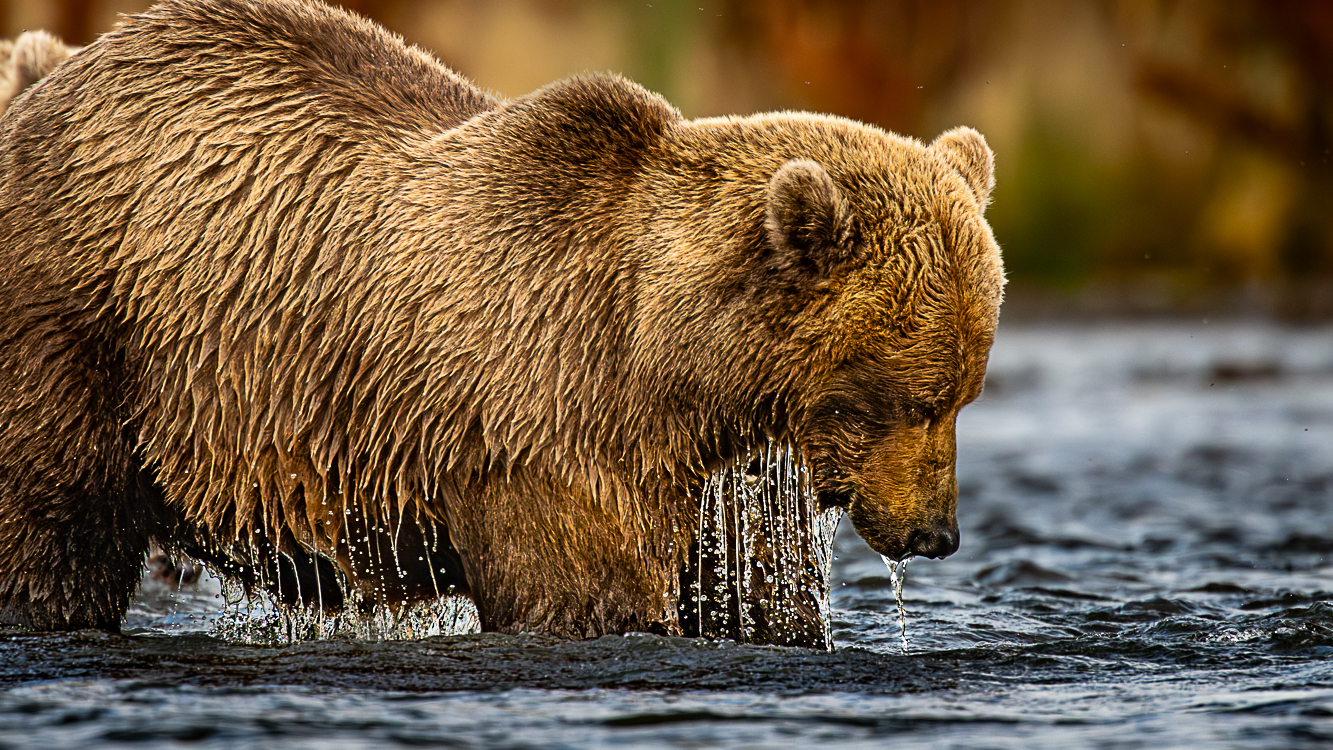
A second bear is just barely visible in the upper left of this photograph of a healthy sow that has trapped a spawning Sockeye Salmon in her forepaws beneath the water. Anytime the salmon are running from July through November, bears can be expected along the river and lake.
Under a Broken Sky – Barbra swinging a Rocket Man streamer for Silvers at Paradise Bend, October 7, 2018
During the several years we fished the water at Paradise Bend (our name for an expansive area of tidally influenced braided runs and gravelled, vegetated islands), we only encountered other anglers on one occasion. Their guide had them casting in the wrong places – unproductive water unlikely to hold salmon. In due time their casts became listless, eventually gave way to billed caps lifted and head-scratching, and then to searching glances at each and beseeching looks toward the guide. They left fishless, and that was the only time we encountered anglers on “our” pool.
Paradise is a very special place, often beautifully lit by morning light, frequented by some of the world’s largest Brown Bears, traversed by moose, mink, fox, otter and wolf, shorelines decorated in season by magenta fireweed, sunflower-like arnica, marsh marigold and a dozen other showy blooms. At any time of year the water is free of ice you might hear the ratchety call of a kingfisher, and all summer long there are the songs of thrushes, sparrows and warblers to cheer the day. Gulls and eagles scavenge the islands when the fish are in, and in spring the wide, weedy shallows load up with Tundra Swans and hundreds of ducks. The ducks, particularly Mallards and Green-winged Teal, return en force in fall, and it was near Paradise that I encountered a brilliantly marked male Spotted Redshanks – a rare stray from Asia.
Tucked back in a bend off the main channel where boats never ran, it was easy to lose oneself during a morning at Paradise. Schools of newly arriving Coho pushing up tidal-bore-like bulges of smooth water as they arrived in the main pool were a thrill, and the fishing could be agreeably challenging in the clear, shallow water where we could watch the fish come to our flies. At the take, we would strip-set and then brace for long runs punctuated by cartwheeling acrobatics. There were more productive pools on the river, but none more enjoyable to fish.
Maybe even more satisfying than these periods of activity were the times in between, the water temporarily empty of salmon, the big sky, the vast landscape, bird song, rushing water and quiet… a place to let thoughts find their own way and perhaps to visit with a friend or love from the past who, for whatever reason, is now absent. There are a lot of reasons to take down a fly rod from its wall pegs and go to the water. There is the fishing, of course… but there are times when the promise of uninterrupted thought is the more compelling motivation.
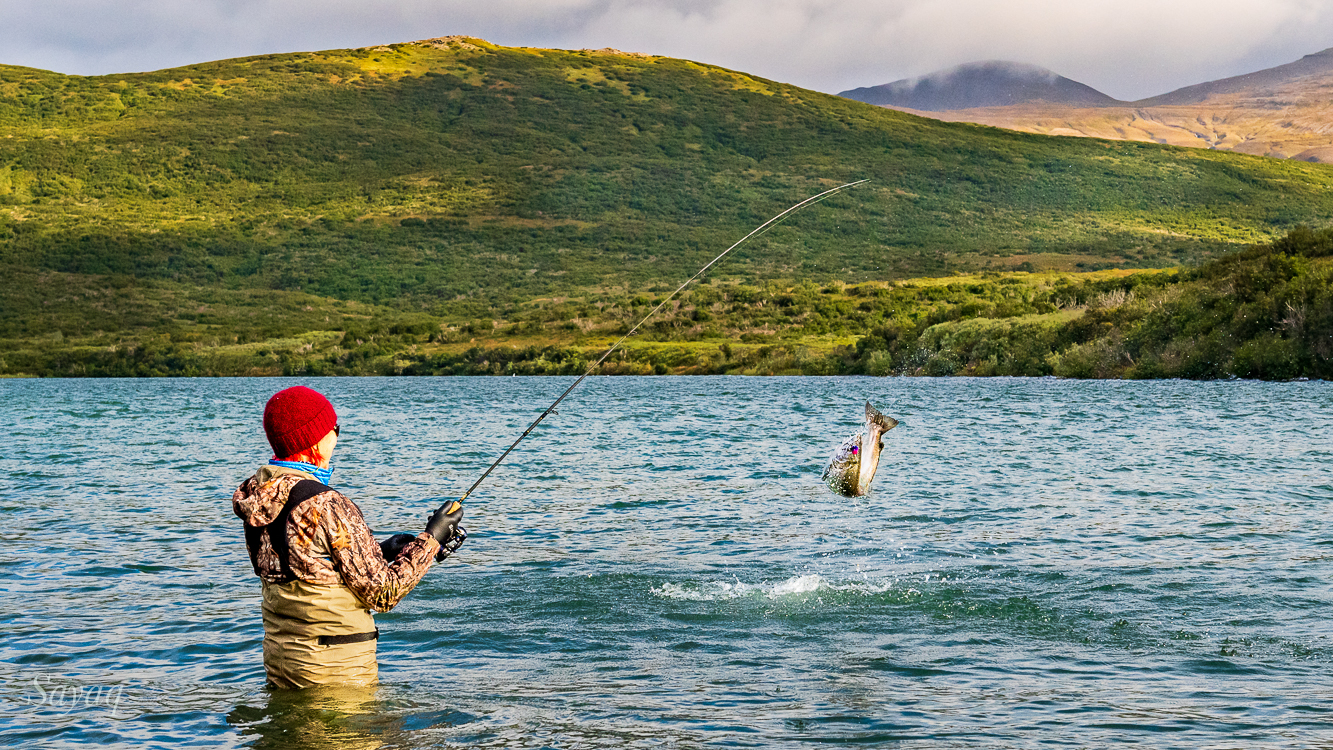
Leaper at The Bend – Ten Pounds of Silver two feet in the air at the juncture where Chignik Lake, to Barbra’s left, necks down and becomes Chignik River, to Barbra’s right. The village of Chignik Lake is on this near shore, less than half a mile up the lake. Approximately six miles from this spot, the river enters the salt waters ofthe estuary at Chignik Lagoon. Here at the early peak of the Coho Salmon run in early September, though most of the flowers are finished and summertime nesting birds are gone, low along the water alders are still wearing summer green; higher up the slopes, vegetation is autumn gold.
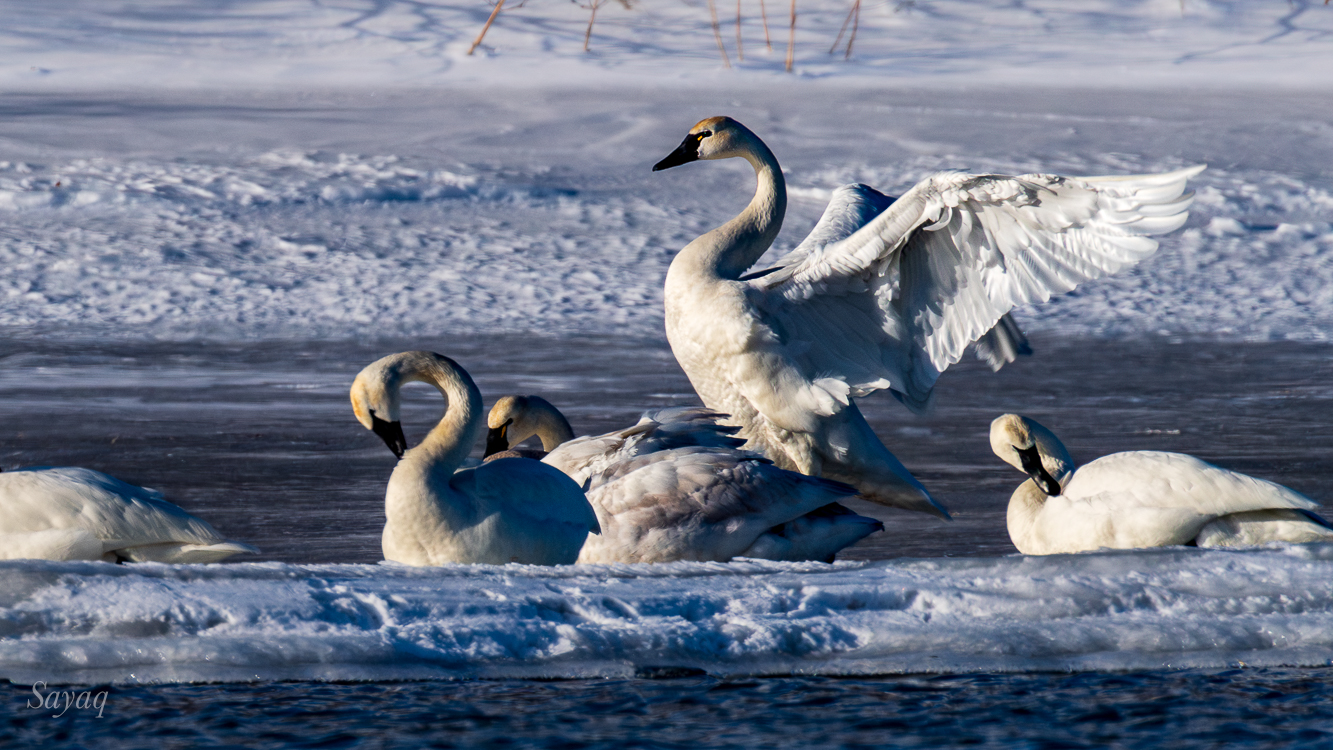
The Swans at Broad Pool Chignik River, 3/16/17 Each March, residents of Chignik Lake begin checking Broad Pool for early signs of spring – arriving flocks of Tundra Swans. The best swan viewing occurs in years when the river is partially iced over and therefore closed to boat traffic. This expansive pool has abundant Water Crowfoot, an aquatic vegetation preferred by swans and dabbling ducks. The swans, which mate for life and can live to be over 20 years old, will rest here and in other quiet water in the Chignik Drainage for up to a few weeks before breaking off in pairs and heading to tundra nesting sites on the Bristol Bay (northwest) side of the Alaska Peninsula. As human activity continues to cause the planet to warm and years of ice become fewer on the Chignik, Broad Pool may no longer provide a suitable resting place for returning waterfowl. Things are changing… fast. Get out and observe, photograph, document.
Spring Green Female in the lead and the trailing drake’s head lit up in the iridescent green that has earned the species the vernacular sobriquet “greenhead,” a pair of Mallardscoast in for a landing on the Chignik’s Broad Pool.About a mile downriver from the village of Chignik Lake, the pool covers over 16 acres – approximately the size of 13 football fields including the end zones. Shallow and weedy, it is gathering place for returning springtimemigrants such as Tundra Swans and genus Anus ducks (Mallards, Green-winged Teal, American Wigeons and Pintails). Slowly going through The Chignik Files, if and when I come across a good picture of Broad Pool, I’ll be sure to publish it. Since I’m in a March file right now, I am certain there will be photos of Tundra Swans, so look for a photo or two of these regal harbingers of spring in the near future. (March 14, 2017)
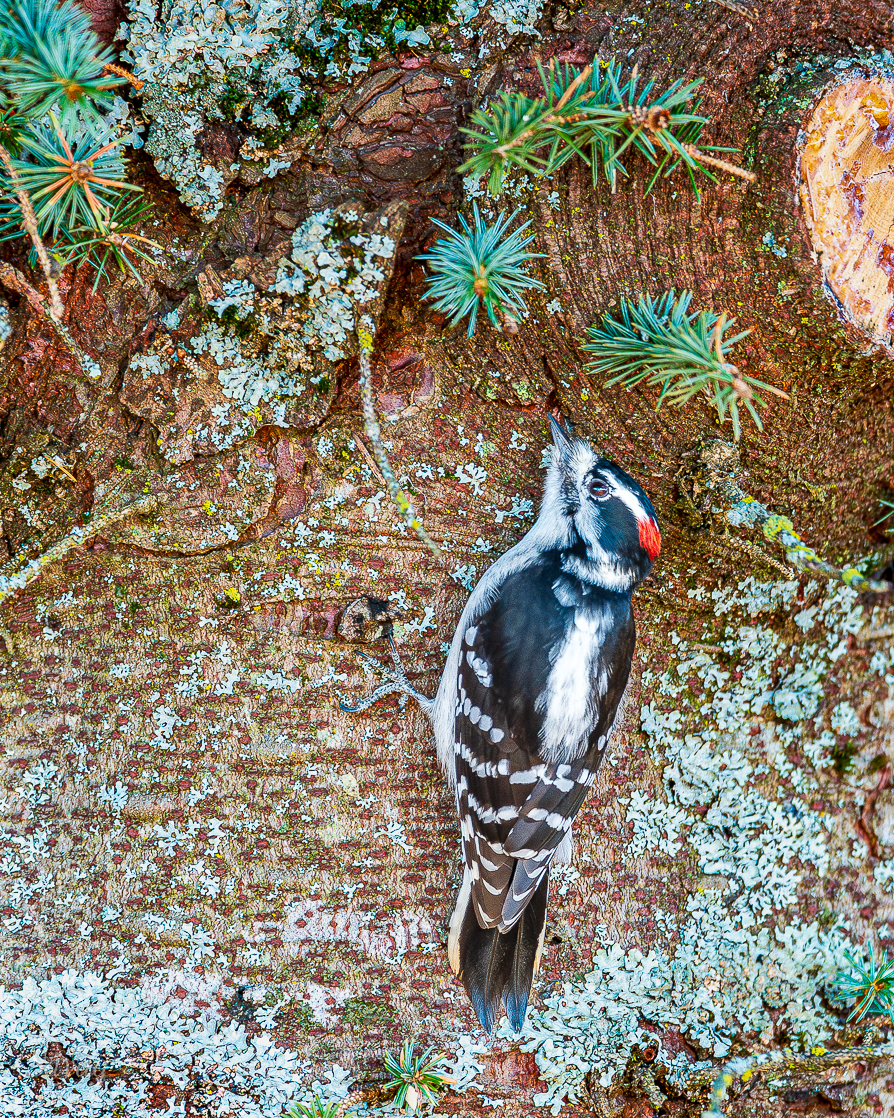
Down Woodpecker, Sitka Spruce Gove, Chignik Lake, AK, 12/30/16 The red crown distinguishes this specimen as a male. Notethe blue tint on the tips of his tale, an iridescence not often so easily observed in Downies. Like other woodpeckers, Downies use their stiff tail feathers as a kind of third leg to provide leverage is they drum or search tree trunks for insects.
It is suggested in T. Gilbert Pearson’s Birds of America (1917) that the moniker Tommy Woodpecker would better suit North America’s smallest member of the woodpecker tribe “…for his boyish, buoyant disposition makes friends for him wherever he goes.” Perhaps for a moment we can set aside the sexism and celebrate an era and it ornithologists who took such a personal and personified approach to avian studies. I’d like to see any number of birds renamed, starting with discarding all those appellations that are essentially slave names applied by the person who “discovered” a given species – Wilson’s Warbler; Audubon’s Oriole; Steller’s Jay; etcetera. But Downy seems apt for this six-inch bird with its soft breast feathers.
No woodpeckers appear in David Narver’s study of the Chignik River Drainage conducted in the early 1960’s. Range maps have historically placed the Three-toed Woodpecker on the Alaska Peninsula – with no mention of Downies -, but this is surely in error as historically there was essentially no suitable habitat for spruce-and-pine-loving Three-toeds in that part of the world. My guess is that someone conducting an early biological survey got a glimpse of a woodpecker, made a guess, and that became the text for the peninsula. Very recently, I’ve noticed that the Cornell Lab of Ornithology and other authorities have begun to make corrections.
Though they are often common – the woodpecker one is most likely to encounter throughout much of North America – even in the most suitable habitat Downies are seldom abundant. And although the above photograph was recorded in the Sitka Spruce Grove at The Lake, Downies are equally likely to be found in the peninsula’s alder thickets and occasional cottonwoods. Though they are generally listed as uncommon or rare on the Alaska Peninsula, they are in fact regularly seen along the length of the Chignik River. It is probably a lack of nesting cavities rather than a shortage of food that limits Downy numbers on the peninsula, so as the land becomes more forested and trees mature and die and cavities are created their numbers will increase. Listen for their distinctive Peek! Peek! call and then for tell-tale light tapping.
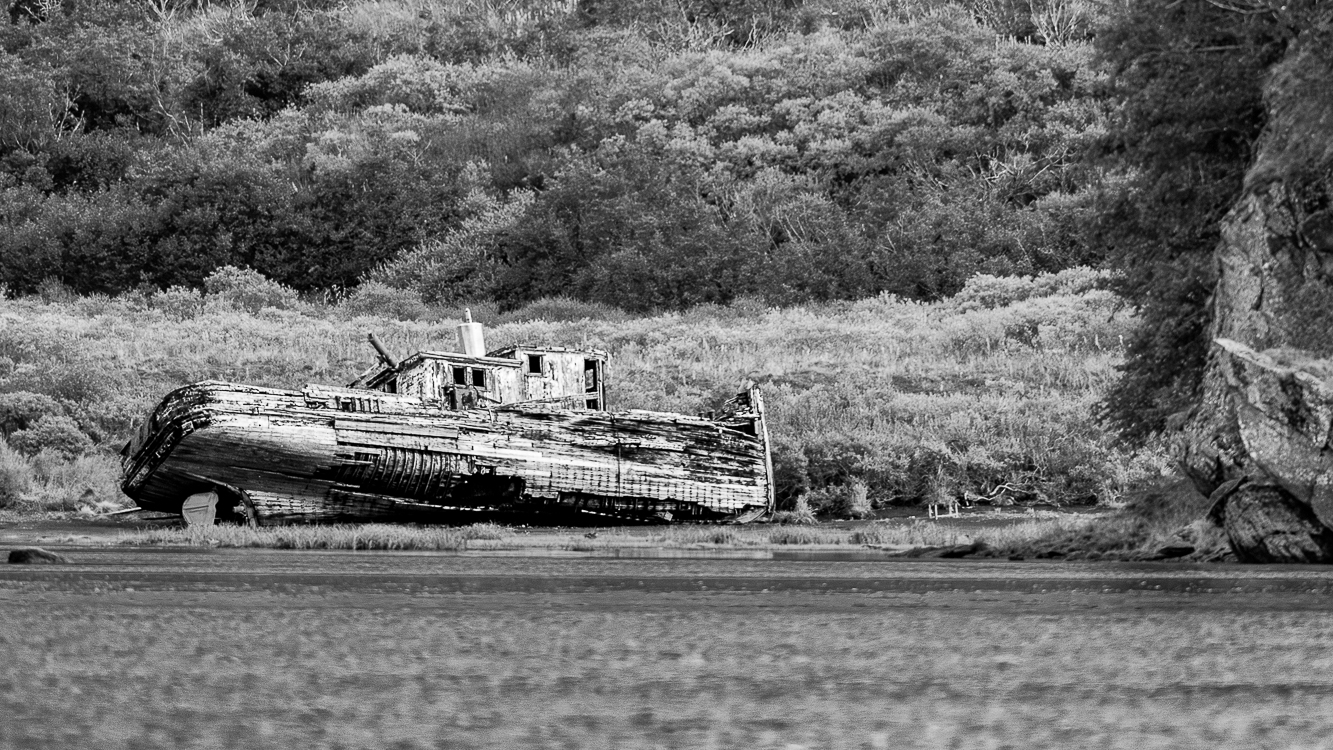
Back in the DaySalmon Seiner from the wooden boat era in the Chigniks Chignik River, September 23, 2016
Concurrent with publishing this photo, I’m putting out a request on other social media asking my Chignik friends for more information on this vessel. I don’t know a lot about boats, but I’m fairly certain that this is a salmon seiner, perhaps built sometime in the 1940’s or 1950’s. It was aground, as you see here, about two miles up from the salt chuck when I noticed it tucked into the back of a wide river cove accessible only on high tides. The tide was out, the person whose skiff I was riding in was in a hurry to get down to Chignik Bay, so I settled for this passing shot. I always intended to go back and get additional photographs, but it never worked out. Years later, I saw what appeared to be the same vessel on a beach at Chignik Bay – perhaps towed there by someone who valued its history.
The lesson here, such as a lesson exists, is to be careful… mindful… about passing up shots – even if the composition is imperfect. No doubt every serious photography has in their memory banks a list of pictures that theypassed on and later came to regret not getting. You arrive at a new locale, note a species of bird that is new to you, assume that they must be abundant there, pass on the shot and never see another bird like it. You keep telling yourself you’ll make a portrait of that special friend – and never create the right moment. Or you tell yourself that you’ll come back to make a photo of the stunning landscape before you. But way leads to way and you never return.
While no one can get every shot they’re presented with, some of the ones we pass on haunt us. They become very much like those big fish that got away, growing larger over time… until all those photos and fish meld into a single image of a monster of a Japanese Sea Bass emerging from the surf, shaking her massive head, and then dark tunnel vision as the white jig breaks free from her jaws and comes springing back through the air as your knees turn to rubber – that Sea Bass my own personal metaphor for In my life as a photographer: a rare Spotted Redshanks flitting around me as I cast flies to Chignik River Salmon, assuming the bird to be more common than it is; a Parasitic Jaeger stuffed so full of fish it could barely fly perched near me on shore the first time I hiked out to Tikigaq Point, again, making the assumption that this would be a regular occurrence I’d have other opportunities to capture; portraits of my friends and neighbors at The Lake… the “some other day” I was going to photograph them never arriving.
So, imperfect as this photograph is, I’m glad I got it when I had the opportunity. A boat like this will never again be seen on the Chignik.
I’ll update this post if I discover additional information.




 CutterLight