Sandhill Cranes Foraging and Vocalizing – Alaska Peninsula

Barbra’s school year ended on May 1st. With a new home waiting for us in Newhalen, Alaska, we could have left Chignik Lake the following day. But bears are waking, buds are bursting and springtime’s migrant birds have begun to return, so we’ll remain at The Lake till late June. We’ve been loving our decision. In the past few days we’ve scored photo upgrades of several Chignik species including Northern Pintails, American Widgeons and Harlequins. We just missed adding photos of a skittish dark morph Rough-legged Hawk as well, but we got nice American Robin photos (the ones that pass through the Chigniks are considerably more wary than the suburban birds we’ve known) and…

…our first really good photos of Chignik’s Sandhill Cranes.

The more we photograph birds, the more we appreciate how difficult it can be to predict their behavior. Years ago, we had a photo op with a pair of Sandhill Cranes foraging on a lawn in Homer. While Barbra crept around the yard with our “fledgling” camera gear snapping photos, the cranes very casually walked off a few paces to let her know when she got too close. After that, Barbra tucked in and shot away. We left before the birds did. We weren’t birders in those days. The encounter was one of our first with cranes, and so we concluded that cranes must not be particularly wary.

Years later and multiple mind’s eye images of Sandhills that saw us long before we saw them gliding off toward the horizon on six or seven foot wingspans have prompted revisions of our earlier ideas about these magnificent birds. Cranes are hunted, and like most species that are hunted, they can be exceedingly wary. Unless the cranes have located themselves in a refuge of some sort, it seems that your best chance of getting close enough for a decent look at them is to a) stay quiet and b) don’t look like a human.

The other day while birding, we lucked out. Using a truck as a blind, we were able to observe a pair of foraging cranes for about 15 minutes – plenty of time to add quality photographs to our library and to make a short video which, happily, caught them vocalizing. The male in this video stands over four feet tall. From now till September, their brassy, ratchety calls will echo through the Chigniks, carrying as much as two-and-a-half miles. In addition to the full-throated vocalizations, listen for the little croak the male gives early in the video. And incidentally, the songbird in the background is one of our recently-returned Sooty Fox Sparrows. (The chirping is the modified sound of Jack’s camera shutter.)

Singing His Heart Out: A Pleasant Morning at White Spruce Grove

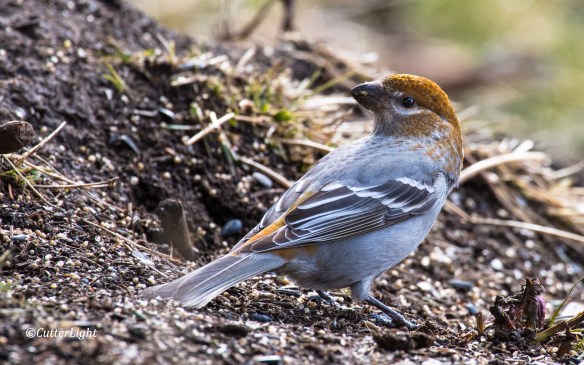
Resplendent! This male Pine Grosbeak came down from a tree crown to forage beneath one of the feeders at White Spruce Grove.

When we stepped out the door yesterday morning, the first thing we noticed was a new song in the air. A spring song. Returning Fox Sparrows have been the first to begin this each year we’ve been in Chignik Lake, but the warbling melody didn’t sound like a Fox Sparrow’s riff. We could see the bird, a plump silhouette atop a spruce tree near the church and since we were on the way to the White Spruce Grove to top off bird feeders anyway, the obvious choice of walking path was the one that would bring us nearer to the singer.

The female grosbeak briefly joined her mate.

Pine Grosbeak, brilliant red and singing for all he was worth. Quite a change from the brief but distinctive Peek Peek! we hear from this species throughout fall and winter. It wasn’t a new bird, but it was new behavior. We continued on the half-mile to the spruce grove with anticipation.

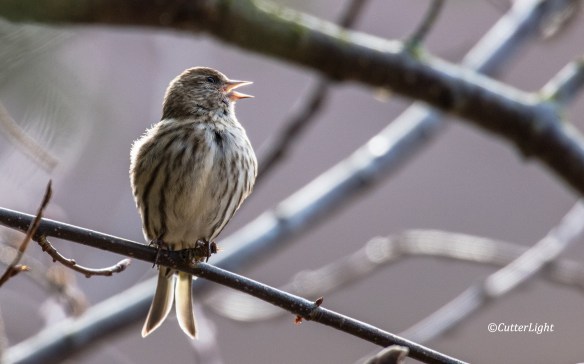
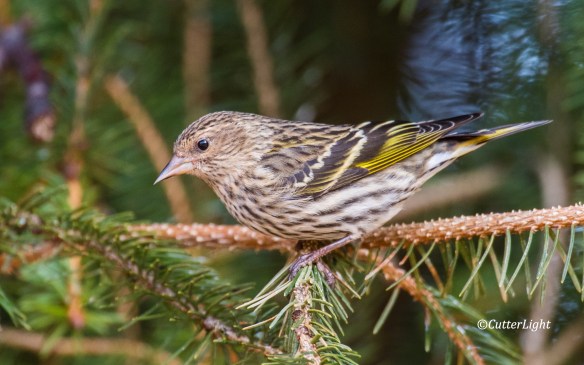
Our Pine Siskins were their usual raucous selves, singing, squabbling, gorging on seeds, darting from tree to tree.

Along the way scattered flocks of Pine Siskins buzzed and called from the sky and from a neighbors’ house where they sometimes take refuge in a few spruce trees while visiting the feeder there. Magpies, common here at The Lake, made their presence known, as did a woodpecker, almost certainly a Downy though we couldn’t find it. Further along a pair of Black-capped Chickadees gave a couple of their various calls from willows, the branches of the scrubby trees suddenly having turned bright yellow-green and beginning to bud.

My guess is that when the time comes, the siskins will head up the peninsula to the denser spruce forests around Lake Iliamna and similar places to nest, but they’ve been welcome winter visitors the past two years.

At the White Spruce Grove the usual Siskins, which showed up last fall and have spent the winter, were busy at the feeders as well as prying the last seeds from cones. But there were a few larger, rounder shapes foraging on the ground as well. We didn’t get our binoculars up in time to have a look, but as we were filling the feeders we heard the unmistakable plaintive song of Golden-crowned Sparrows.

There’s just a touch more gold in this Golden-crowned Sparrow’s crown than there may have been a month ago. He’s still a ways off from full breeding plumage though.

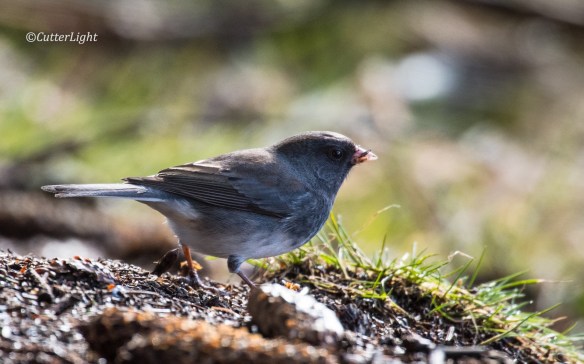
Sure enough, once we scattered a little seed along the brushy edge where they like to feed, they began to show up, and they brought a Dark-eyed Junco with them. Seldom observed out on the Alaska Peninsula – and absent altogether or marked with a question on most of the region’s birding lists – Juncos have shown up in small numbers each of the three winters we’ve spent here. In fact, we think we have the only documentation on the peninsula of Oregon race juncos.

While there have been fewer Juncos at the Lake than there were last year, every so often we see one or two or three.

The Golden-crowned Sparrows appear to have just begun growing in their breeding plumage. Some of the male Siskins though are already there, showing off brilliant canary yellow in their primaries. At one point a Belted Kingfisher rattled by, most likely a male getting things ready for the females that will soon return. Ravens called in throaty croaks from a far hill. No ducks on the water and no eagles on their usual perches, which is a little unusual. Perhaps the ducks are already up at Black Lake where most of the nesting occurs. Gulls will begin returning any day.

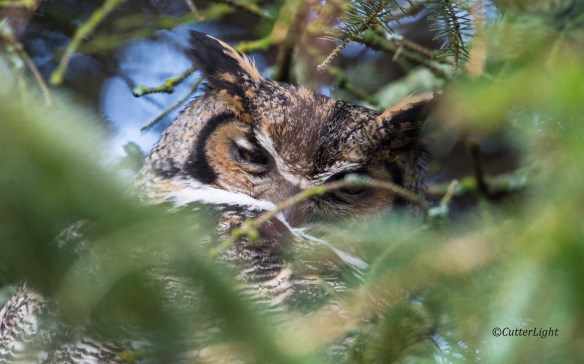
Sleepy but looking well fed, she lost both of her fully-fledged chicks last year, one to an electrical box on a utility pole and the other to some other cause. We’re hoping she nests again this year with much better luck.

We aren’t always lucky enough to see one and we rarely see both of them, but this was a red letter day as both of our Great Horned Owls – the female and the slightly smaller, more lightly colored male – were perched where we were able to find them. As is usually the case, they were buried in shadows behind thick evergreen boughs, aware of our presence but seemingly unconcerned. The ground beneath their favorite roosts is littered with bits of hair, feather, bone and beaks and oblong balls the size of two thumbs placed together packed tight with the remains of the various voles, Magpies, ermine, lemmings or whatever else constitutes one of their meals. Last year the female spent several days perched atop a winter-white Snowshoe Hare – several meals.

Discernibly smaller and with brighter plumage, we feel fairly certain that this is the male. The Ainu – Japan’s indigenous people – believed that owls protected their villages. They are certainly regal animals.

Frost on the ground this morning, but if you look closely at the photos, you can see other signs that spring is coming to Chignik Lake. Hopefully I’ll be posting a video of a Fox Sparrow singing in the near future.

With their uplifting songs and stunning plumage, if birds didn’t actually exist I don’t think we’d believe that they even could exist. They certainly brighten our world.

Skiffin’ – A Chignik Version of the Sunday Drive: Sunshine, Sea Birds, Seals and Snow-covered Mountains)

The view at Hatchery Beach, a wind-swept shore on Chignik Lake where sufficient upwelling and pea-sized gravel create ideal conditions for Sockeye Salmon to spawn. The stream-fed pond behind the strip of land is a feasting area for our huge brown bears from summer through fall.

It was a perfect day for skiffin’ – full-on sunshine, light breezes and a mid-day high tide pushing far enough up the river for The Shallows to be passable. The tide meant access to the Lagoon, the saltwater estuary where Chignik River debouches into the Alaska Gulf and an opportunity to photograph Emperor Geese. So when a friend called with an invitation to go out in his 18-foot Lund, we made quick work of lunch and pulled our camera gear together. Oh, and we bundled up; highs are only reaching 40° or so (4 or 5 degrees C) and it’s always colder on the water.

The Chignik Mountains surrounding the lake were shouldered in fresh, powdery snow. Kudos to Barbra on the landscape photographs in this article. It can be tough getting good shots from a bouncing boat.

Every plane coming into the village prompts two questions: Mail? Freight? Other than this plane and one other skiff, we had the lake, the river, the lagoon and the day to ourselves. 

Check out those talons… and that beak! Although we see eagles nearly every day, we always pause to admire these magnificent birds. I surprised myself a little with this shot. Even with a light breeze there was enough chop on the water to have the skiff (Chignik for what Pennsylvanians would call a boat) bouncing like crazy – a problem magnified several times over with a long wildlife lens and a teleconverter attached to my camera. Most of the time I couldn’t even find the bird in my viewfinder, and when I did I had less than a second to shoot before the boat rocked and the bird wildly bounced out of the frame. But he (or she) was patient with me and I had plenty of light to shoot fast when the chance came. They’ll be nesting soon, I imagine.
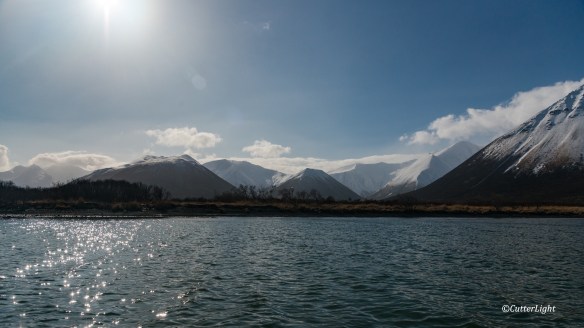
Here’s Hatchery Beach looking back toward the Clarks River watershed – a significant spawning tributary and with its nearly clear-as-air flow a magical place to fly-fish.

And a third shot moving up the lake along the Hatchery Beach shoreline. We’ve often thought that a lot of these mountains, which top out at just over 3,000 feet (1,000 meters), would make for a good climb. The main feat might be getting through the jungle-thick alders at the base.
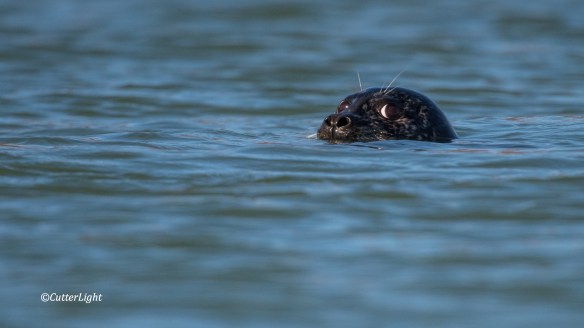
Cute, right? There always seem to be a few Harbor Seals in Chignik Lake and, I’m told, further up in the headwaters at Black Lake.
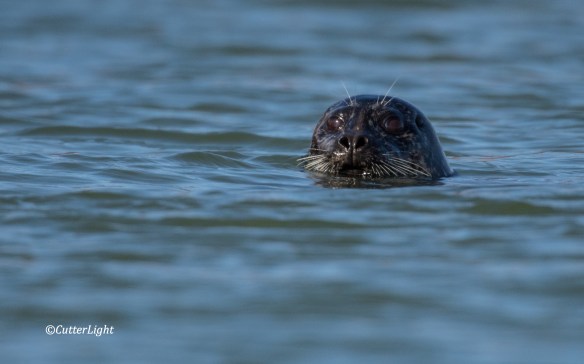
Here in Alaska, the population of Harbor Seals in Lake Iliamna gets a fair amount of attention. Yet we’ve never read a single word about the year-round seals in the Chignik System. One year I got a photo of nine seals hauled out together on lake ice across from our house. On this day, we saw this one and another that was sunning itself on a rock. I’d love to know more about what they eat once the salmon runs are finished.

Heading back down the lake toward the lagoon we passed our village on the right. Our house is the white duplex closest to the water toward the right of the photo. The large building to the left and behind our house is the school, and just to the left of that, almost center, you can see the golden steeple on the Russian Orthodox Church. Just 30 yards from the lake, our living room/dining room windows are ideal for wildlife viewing. From these windows we’ve seen a wolf, a wolverine, a beaver, moose, ermine, voles, lemmings and a number of brown bears, otters and harbor seals. Eagles, kingfishers, several species of ducks, common loons, magpies, ravens and a number of passerines are common along with our resident Great Horned Owls. Falcons are less common but Merlins nest here, and during summer we frequently hear and occasionally see sandhill cranes.
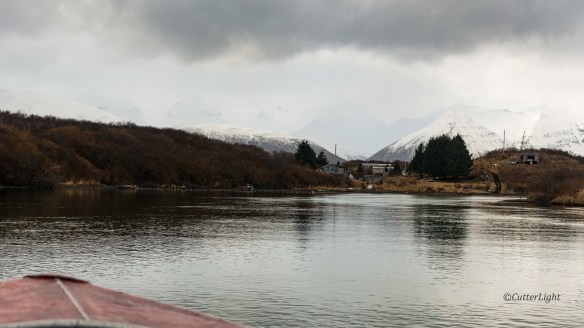
This photo was taken at the head of the Chignik River on the return upriver to the village. I include it because it shows the copse of 20 trees we call White Spruce Grove – a small but important piece of bird habitat. This is where we see most of the black-capped chickadees, juncoes and other sparrows, redpolls, Pacific wrens, golden-crowned kinglets, pine siskins and white-winged and red crossbills we’ve written about in other articles. Thus far, we’ve documented over 70 species of birds in or near Chignik Village, a few of which had, to our knowledge, never before been reported on the Alaska Peninsula. Predators such as sharp-shinned hawks, merlins, owls and shrikes use these trees as well. Note the net, marked by a line of white floats on the water, extending from a skiff out into the river. A neighbor has been catching Sockeyes of about 22 to 23 inches, most probably a resident strain of fish that never go out to sea.
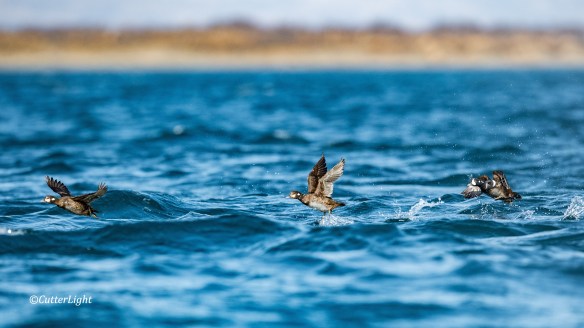
Although they occasionally visit the river during summers, and rarely are seen on the lake, we found lots and lots of harlequin ducks at the lagoon, the males (far right) already beginning to come into breeding plumage.

As with the harlequins, pelagic cormorants are uncommon visitors to the lake and river but abundant in the lagoon. And as with the photo of the eagle, some of these shots surprised me when I got them on the computer. This was a point, swing, hope and click effort with a pelagic heading in the opposite direction as our skiff cruised by.

I can count on one hand the number of times long-tailed ducks have shown up on the lake. Usually mixed in with other species, their distinctive coloration (a little like a scoop of strawberry, chocolate and vanilla Neapolitan ice cream) always makes me do a double-take. But they proved to be probably the most common bird on the estuarine lagoon on this outing, rivaled only by harlequins. The center bird is displaying his eponymous tail. Like harlequins, long-tailed ducks are fairly catholic in their dining habits and there’s simply a broader smorgasbord in the lagoon than in nearby freshwater. We foolishly left our binoculars behind, but there were a number of other species on the lagoon including what appeared to be a football-shaped phalarope so stuffed with whatever it was eating it could barely fly. From June through September the lagoon and nearby waters are a staging area for millions of returning salmon – in good years nearly two million reds (sockeyes) along with tens of thousands of silvers (coho) as well as pinks, chums and kings. 

Our friend had mentioned the lagoon’s flocks of Emperor Geese and I was hopeful of getting some photos. Unfortunately, as a hunted species, they proved to be fairly wary. Here a group of 200 or so birds take flight while we’re still well off their sand spit roost. (Thanks for the hero shot, Barbra!)
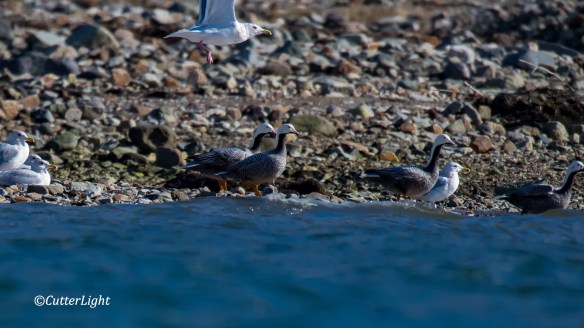
At the one place where we were able to get reasonably close to a few geese, colliding current and wind caused the skiff to bounce like crazy. But these handsome birds with white heads and napes, pink bills and yellow-orange legs are emperors – the first I’d photographed and a new bird for my Chignik List.

There’s little as stirring as wildlife abundance. I estimated close to 200 geese crowded together along with a few gulls on this last significant spit before the lagoon opens into the Alaska Gulf.

And there they go. I hate spooking wildlife. Just prior to this shot, birds were still dropping in to join the roost – but often it only takes one bird with antsy wings to get the rest up and going. The day was a lot of fun though and we got a few shots. Hopefully we’ll do another episode of skiffin’ in a few weeks to inventory the bird population again!

If you enjoyed this article, try typing “birds” into the search bar near the top of the page. You can find additional reading about our tiny bush village of Chignik Lake by typing those words into the search bar as well.

Chignik Lake Bald Eagle

Waiting for Salmon, Chignik Lake, Alaska

May 1, Tuesday Morning, frost: Eagles are once again daily encounters as they take up familiar roosts and join the village in watching for salmon. A few fish have trickled in, but usually it’s June before the run really gets going. A couple of nice char have been caught. Catkins on the willows, leaf buds everywhere ready to burst. A small flock of Pine Grosbeaks was in the village yesterday, the males as brilliant pinkish-red as they’ll ever be.

Ink and Light: Chickadee Flamenco and thoughts on art and spring from Su Tung P’o

Chickadee Flamenco

What a wonderful talent – that can create an entire Spring
from a brush and a sheet of paper. If he would try poetry
I know he would be a master…
Su Tung P’o – On a Painting by Wang the Clerk of Yeng Ling, c. 1080

Also known as Su Shi, Su Tung P’o (1037-1101) was a Song Dynasty writer, calligrapher, painter, poet, statesman and noted gourmet. The dish “dungpo pork” is named for him.

Ink and Light: Bohemian Waxwing and Lines from Robert Francis

Panache: Bohemian Waxwing, Ulaanbaatar, Mongolia

The red, waxy tips on the Bohemian Waxwings’ wings are actually flattened feather shafts. 

…beneath a silk-blue sky…
To sun, to feast, and to converse
and all together – for this I have abandoned
All my other lives.
Robert Francis – Waxwings, 1960

– Robert Francis (1901-1987) lived for 40 years in a two-room house he built in Amherst, Massachusetts. Of Francis, Robert Frost noted, “…of all the great, neglected poets, (he is) the best.”

Purple Martins: The Highest-Flying Swallow

purple martins w draggonfly n

The Catch: Purple Martins, Kimiwan Lake Bird Walk, Alberta, Canada

Swallows are a favorite bird wherever they fly, and among them North America’s largest and most universally appreciated species is without a doubt the Purple Martin (Progne subis). Before Europeans ever came to North America, Native Americans in the South were known to hang hollow gourds as nesting boxes to attract these birds. The beneficial nature of Martins is well known: not only do they consume enormous quantities of insects that humans consider pests – among them horseflies, beetles, termites and grasshoppers -, they also aggressively drive away birds of prey as well as crows and thus were traditionally welcomed by farmers. Often soaring at altitudes of several hundred feet, Martins capture their prey exclusively on the wing; they quench their thirst on the wing as well, skimming the surface of ponds, lakes and rivers.

purple martin male gun metal n

Iridescent purples and gun metal blues mark the plumage of the male Martin.

Although the range of the three subspecies of Martins covers most of the U. S. and sections of southern Canada, they tend to be rather uncommon. This is due in part to their very specific nesting requirements and to the fact that invasive species – European starlings and house sparrows – frequently outcompete Martins for preferred sites. Formerly found in hollow trees, Eastern Martins have almost exclusively shifted their nests to human created housing: apartment-like complexes on poles, rows of houses side-by-side, or, particularly in the South, hollow gourds. Like Chimney Swifts and Barn Swallows, Eastern Purple Martins have become dependent upon humans for nesting sites.

purple martin female n

The plumage of females is lighter in color, predominated by shades of brown.

Writing in the early 1800’s, John Audubon observed the ubiquitous nature of Martin nesting boxes in America:

The… Indian is also fond of the Martin’s company. He frequently hangs up a calabash on some twig near his camp, and in this cradle the bird keeps watch, and sallies forth to drive off the Vulture that might otherwise commit depredations on the deer-skins or pieces of venison exposed to the air to be dried. The slaves in the Southern States take more pains to accommodate this favourite bird. The calabash is neatly scooped out, and attached to the flexible top of a cane, brought from the swamp, where that plant usually grows, and placed close to their huts. Almost every country tavern has a Martin box on the upper part of its sign-board; and I have observed that the handsomer the box, the better does the inn generally prove to be. 

All our cities are furnished with houses for the reception of these birds; and it is seldom that even lads bent upon mischief disturb the favoured Martin. He sweeps along the streets, here and there seizing a fly, bangs to the eaves of the houses, or peeps into them, as he poises himself in the air in front of the windows, or mounts high above the city, soaring into the clear sky, plays with the string of the child’s kite, snapping at it, as he swiftly passes, with unerring precision, or suddenly sweeps along the roofs, chasing off grimalkin, who is probably prowling in quest of his young. Birds of America, John J. Audubon, printed 1827 – 1838.

Purple Martin male wings n

Healthy Martin colonies indicate a healthy environment.

The next time you see a large flock of dark birds, look closely. Although often starlings, Martins, too, come together in the thousands and even hundreds of thousands, particularly in late summer as they prepare to migrate to South America.

For more information about Purple Martins, or to learn more about building a nesting complex of your own to attract them, visit www.purplemartin.org

For more information on the wonderful Kimiwan Nature Walk and Interpretive Center in McLennan, Alberta, please visit www.kimiwanbirdwalk.ca.


Common Merganser with Chicks, Tuul River, Ulaanbaatar

common merganser 2015 Tuul River n

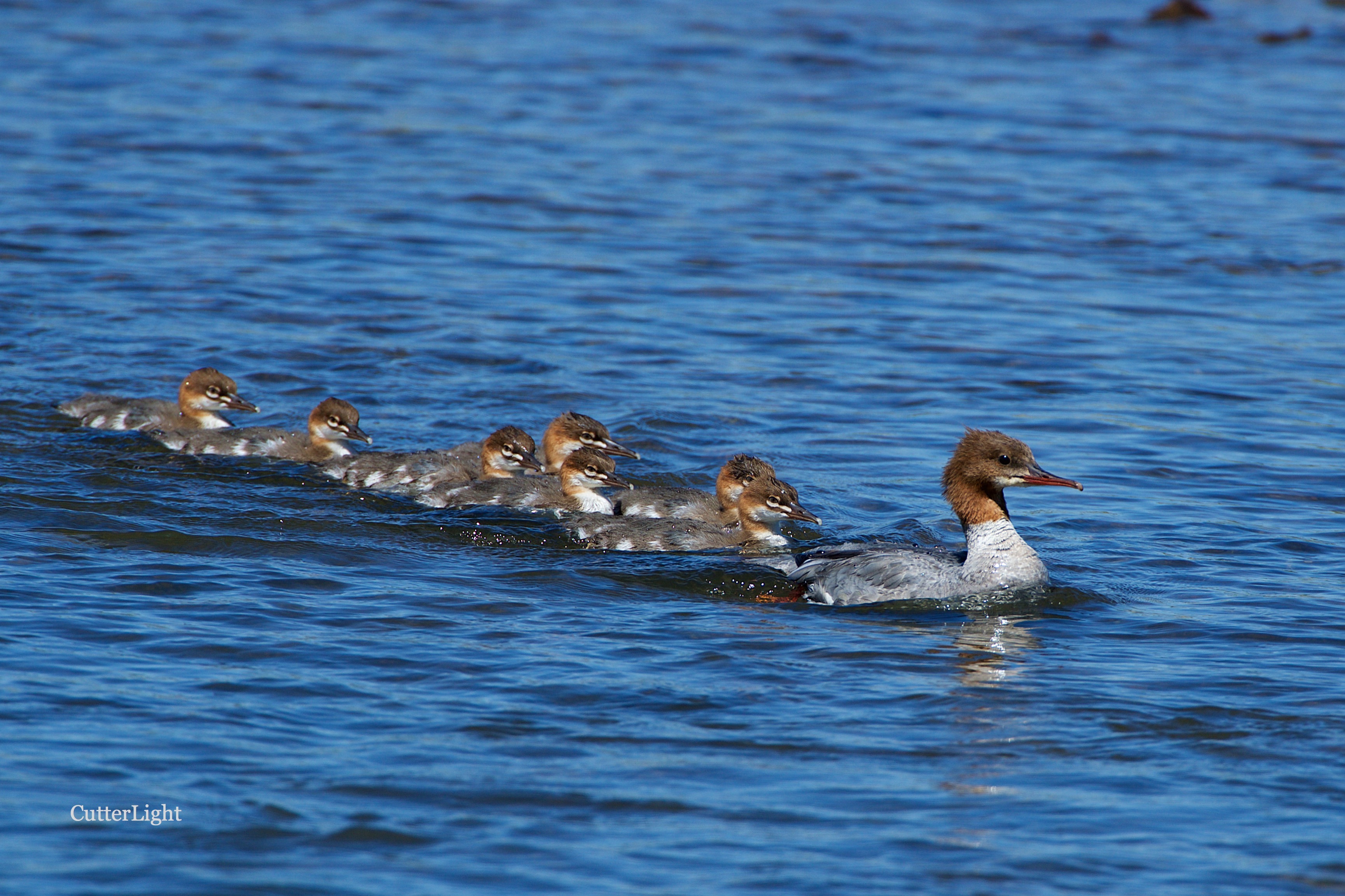
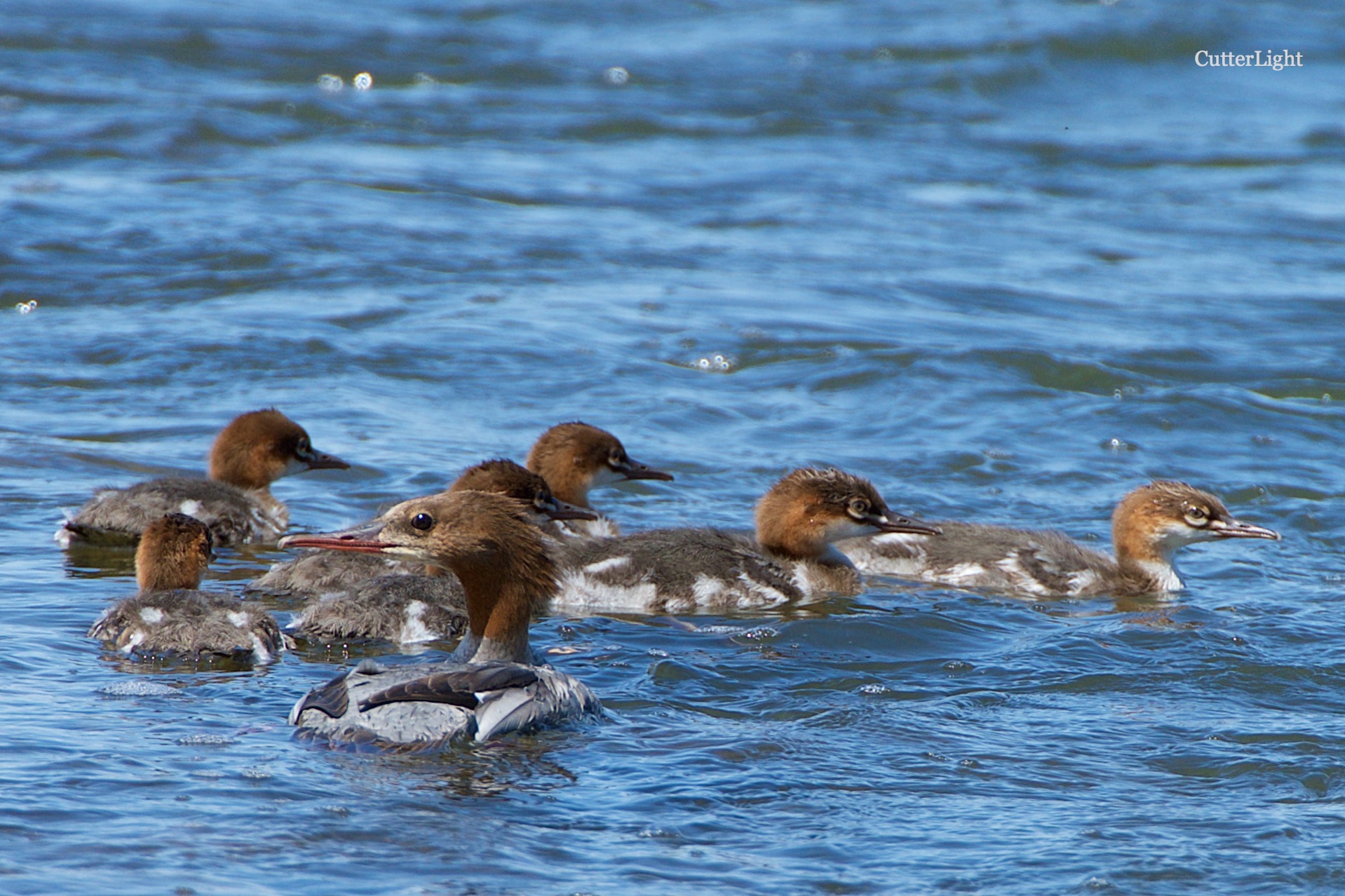
A healthy family of common mergansers (Mergus merganser) indicates an abundance of small fish in the Tuul River on the outskirts of Ulaanbaatar, Mongolia.

Mergansers are large diving ducks that subsist primarily on fish, although the young also fill up on aquatic insects such a the larva of mayflies and stoneflies. They make their nests in cavities in trees, sometimes a good distance from water. Less frequently, mergansers nest in holes in cliffs or high banks. They can be found on open water throughout the Northern Hemisphere, and are a good indicator of clean water and healthy populations of small fish.

Common Merganser hen 2015 n

If you look closely, you can make out the serrations on her bill – the perfect adaptation for holding onto fish. In contrast to the females, the drakes’ heads are dark green, their flanks are white and their backs are black. Although common mergansers are usually encountered on freshwater lakes and rivers, they are frequently seen in coastal bays and estuaries as well.

Common merganser family Tuul n

A baleful eye tells us we’ve approached close enough. Undisturbed this family went about their business, dipping their heads underwater in search of food as they paddled along the river’s current breaks.

Ptarmigan and Cloudberries: A Walk on Alaska’s Arctic Tundra

willow ptarmigan pair n

Looking almost like exquisite mounts in a museum diorama, these Willow ptarmigan (Lagopus lagopus) proved to be quite approachable. While hiking on the tundra near Point Hope in September we came across two coveys totaling about 20 birds.

cloudberries early frost

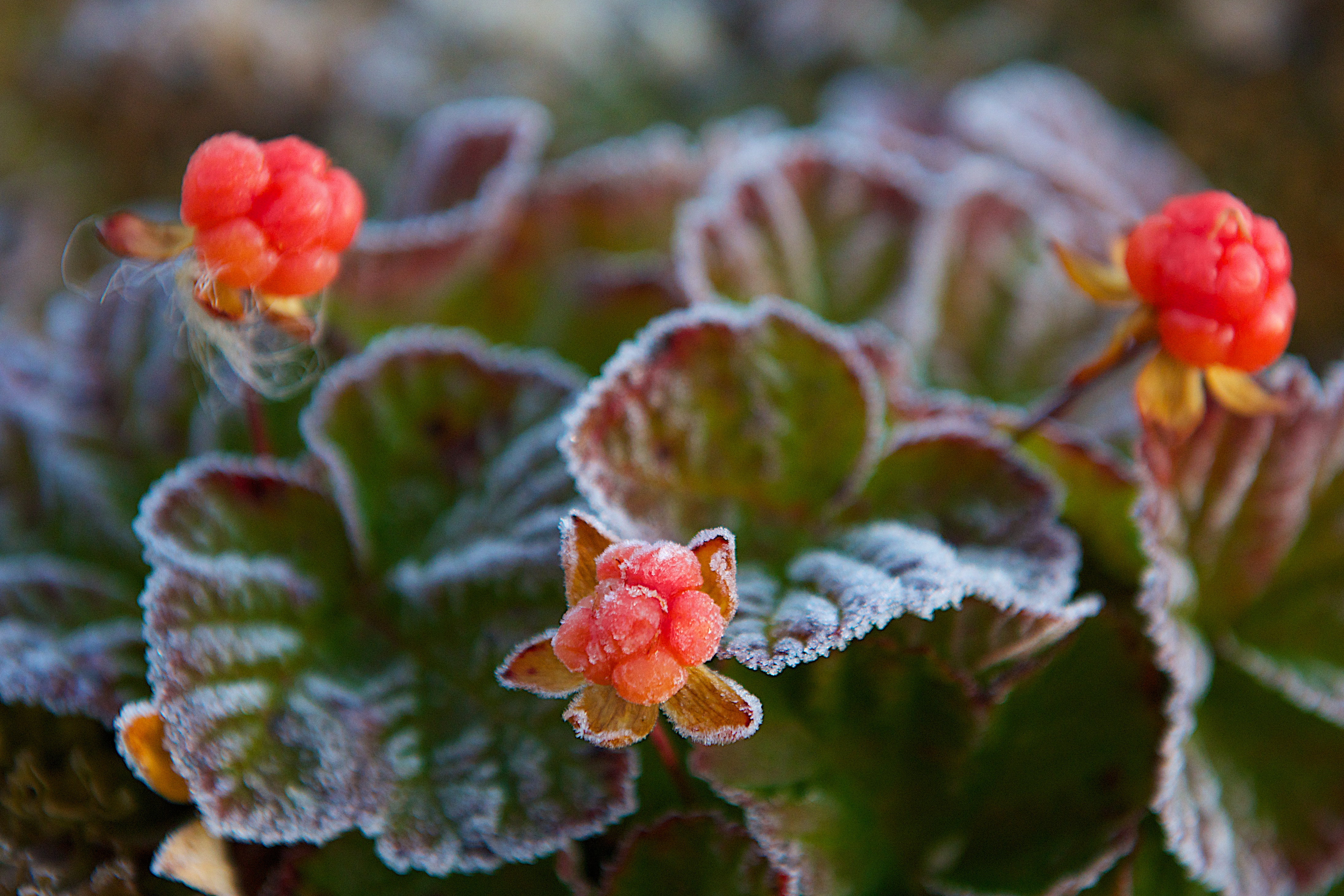
Nipped with frost, these cloudberries tasted like sorbet and were no doubt what had drawn the ptarmigan.

willow ptarmigan jack shooting n

Barbra cautiously approached the birds as I lay on my stomach, inching through the boggy terrain, shooting, hoping a few shots might come out.

willow ptarmigan solitary n

The plumage of these fall birds is in transition from the mottled browns and reds of summer to the snow white of winter. These are the same species as the red grouse of Scotland.

willow ptarmigan barbra approaching n

Barbra crouches and stalks closer to the birds. Note the densely feathered legs. The Latin lagopus translates to “hare foot” for the resemblance of ptarmigans’ feather-covered legs and feet to those of snowshoe hares. 

caribou antler fall tundra n

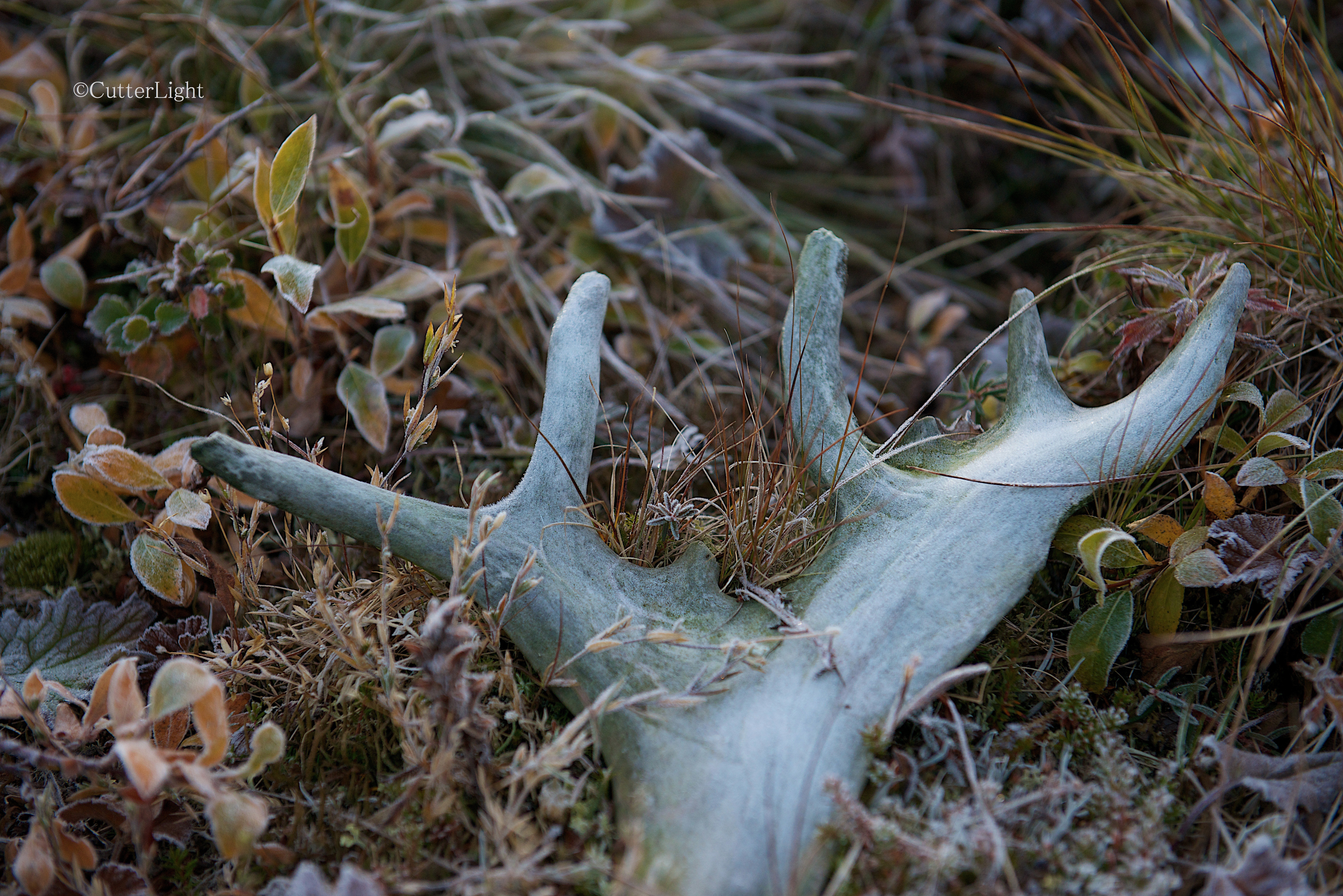
There’s always evidence of a rich ecosystem on the Arctic tundra. Caribou antlers, bird nests, animal burrows and an amazing array of plants are part of our walks.

brown bear track tundra beach n

Brown bears (grizzlies) are common visitors to the beaches and tundra near Point Hope. We found a set of fresh tracks along the shores of an inlet off the Chukchi Sea not far from where we encountered the ptarmigan. Red foxes, Arctic foxes, Arctic ground squirrels, weasels and caribou are frequently seen mammals. Wolves and musk oxen are less common, but also figure in the mix. In the foothills and mountains east of Point Hope there are wolverines and at higher elevations, Dall sheep. Rarely, moose are seen in the scrub willows along the nearby Kukpuk River, and during the winter months polar bears show up both on the sea ice and on land. 

snow geese lifting off n

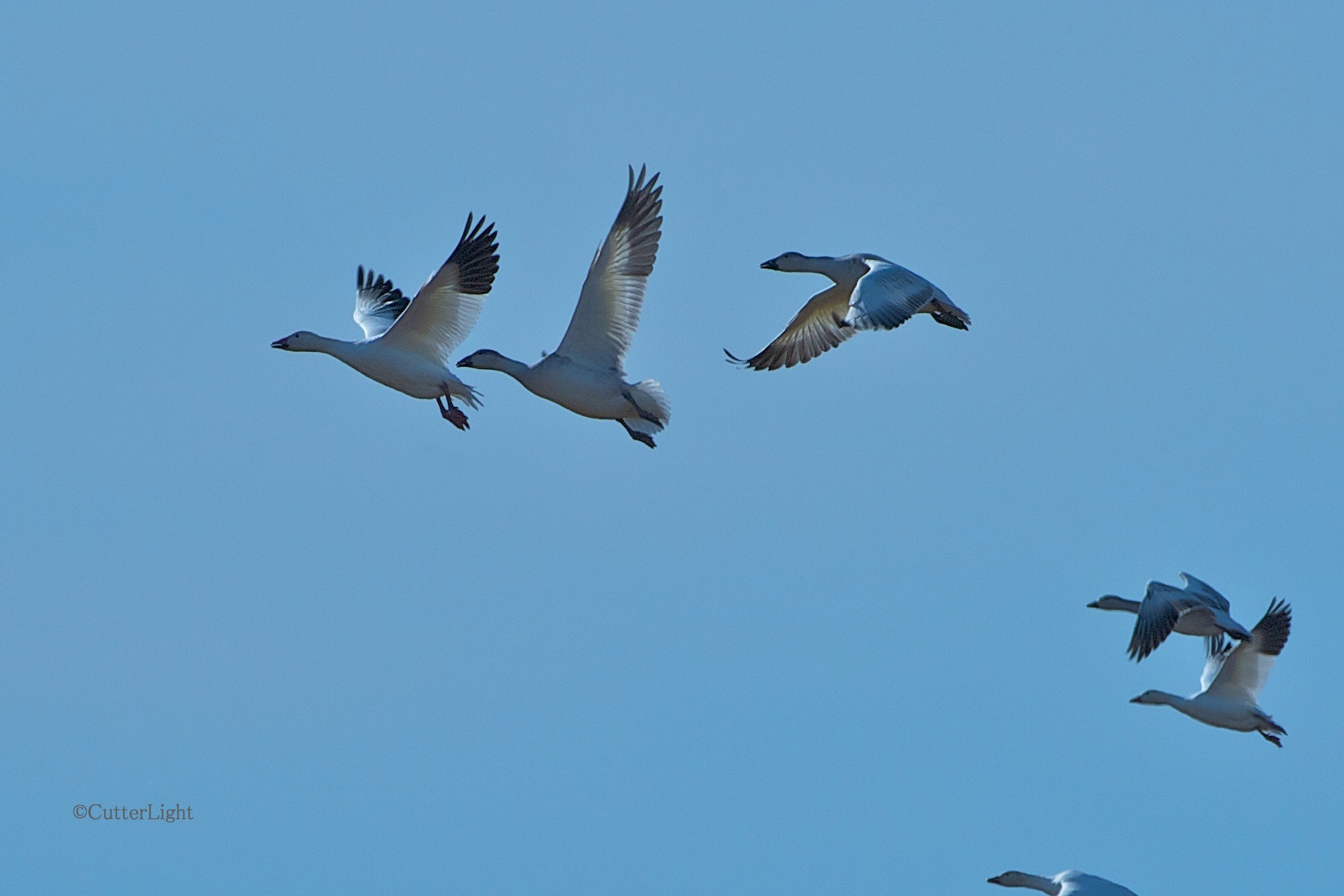
During the fall migration, snow geese are fairly common. (Above and below)

snow geese lifting off close n

Brandt, Canada geese, and a wide variety of ducks and shore birds are also common.

willow ptarmigan in flight n

When the ptarmigan finally had enough of us, they glided off a few yards, regrouped and resumed feeding. At that point we turned for home. 

cloudberries frozen in hand n

A handful of frozen sweetness for the road. 

cranes flying into the hills n

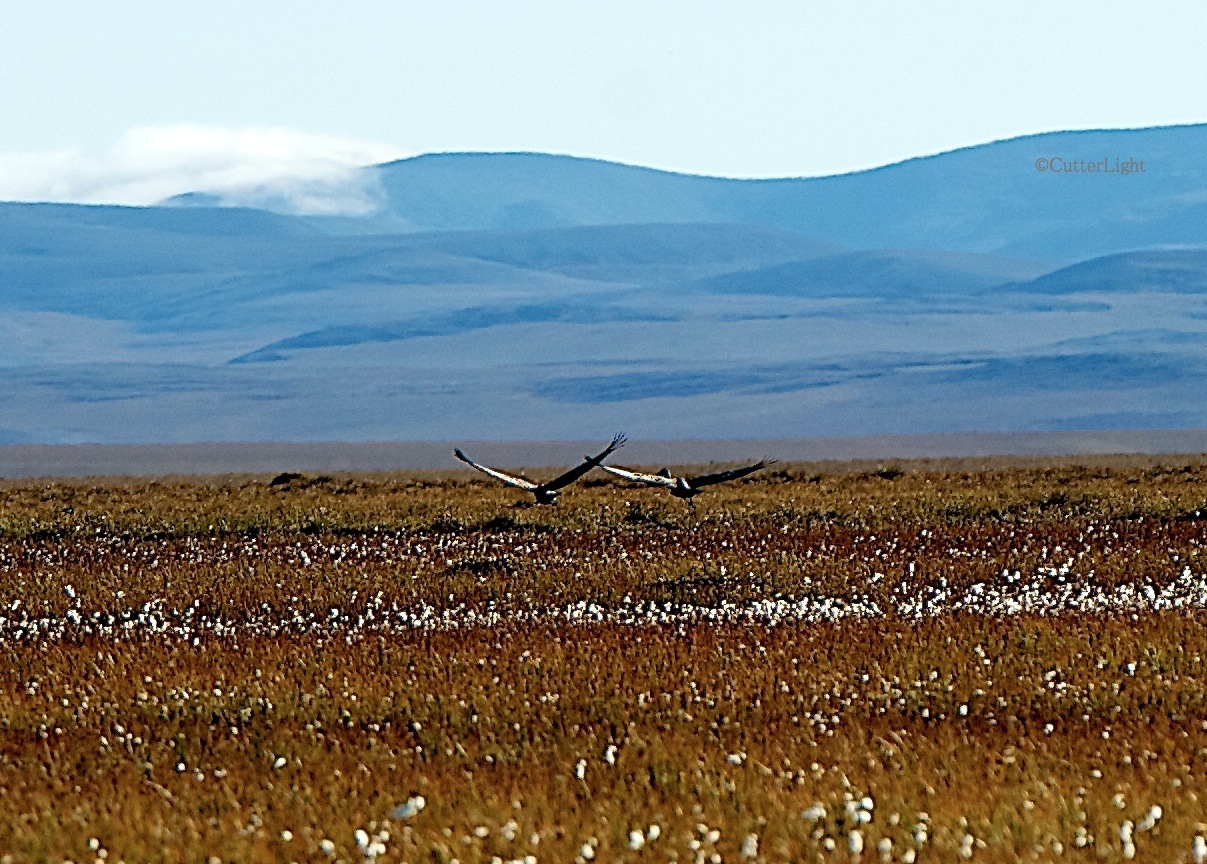
A pair of sandhill cranes lifts off above the last of the cotton grass on the tundra near Point Hope.

The Arctic Terns of Tern Lake: Artists that Redefine the Air

arctic tern hovering n

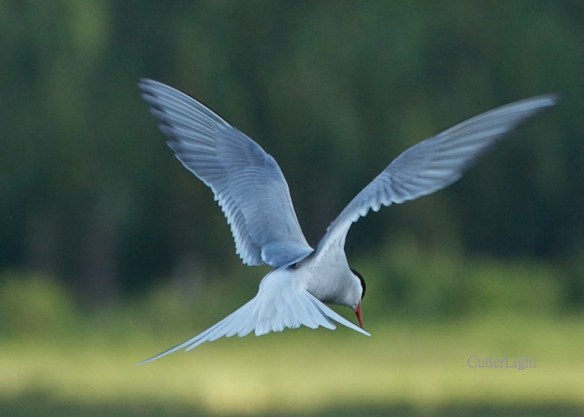
With a brood of chicks waiting to be fed, this Arctic tern (Sterna paradisaea) hovers above the water in search of small fish, its primary food source. Minute control over individual tail and wing feathers enables terns to be graceful, formidable hunters as well as inspiring to watch.

Making an annual round-trip of roughly 50,000 miles (80,000 km) between their breeding grounds in the Arctic and their summer feeding grounds in the Antarctic , Arctic terns are a species that fill one with awe and wonder. Unlike most of their cousins in the gull family, they are true seabirds as their migrations take them over vast oceans far from land. To stand on northern beach and watch terns fly is to watch an artist redefine the air.

arctic tern scouting n

Breeding pairs mate for life and most terns return year after year to the same grounds where they were hatched. There they scratch out a shallow depression in the earth and lay one to three eggs (sometimes more) the size and color of large, brown-flecked olives. Approximately three weeks later the eggs hatch and three to four weeks after that the young birds are fledged. In fall, they will join their parents in making the longest migration of any bird species.

arctic tern head on n

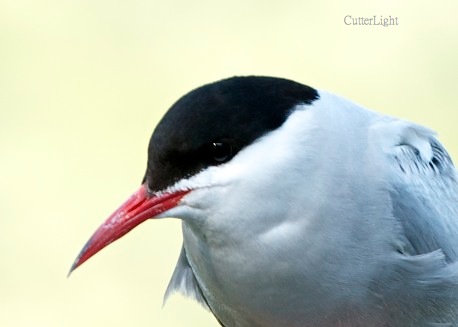
Inky black eyes almost disappear into a jet black cap. Although their legs seem impossibly short, terns are fairly adept on land. A specialized gland allows Arctic terns and other seabirds to extract the salt they ingest and expel it through their nasal cavities. 

Arctic tern close nAlthough one individual is reported to have lived to the advanced age of 34, the average lifespan of an Arctic tern is about 20 years. Their preferred nesting sites are on islands where they’re relatively safe from predators such as foxes and domestic cats, although they lose some eggs and young to gulls and other birds. At one point the millinery trade took a heavy toll on tern populations, but in recent years the greatest threat appears to be decreasing food supplies due to human overfishing. At present, there are estimated to be about one million Arctic terns worldwide.

arctic tern soaring n

Above: An Arctic tern scans the water below for the tell-tale silvery flash of a school of small fish. 

tern showing scissored tail n

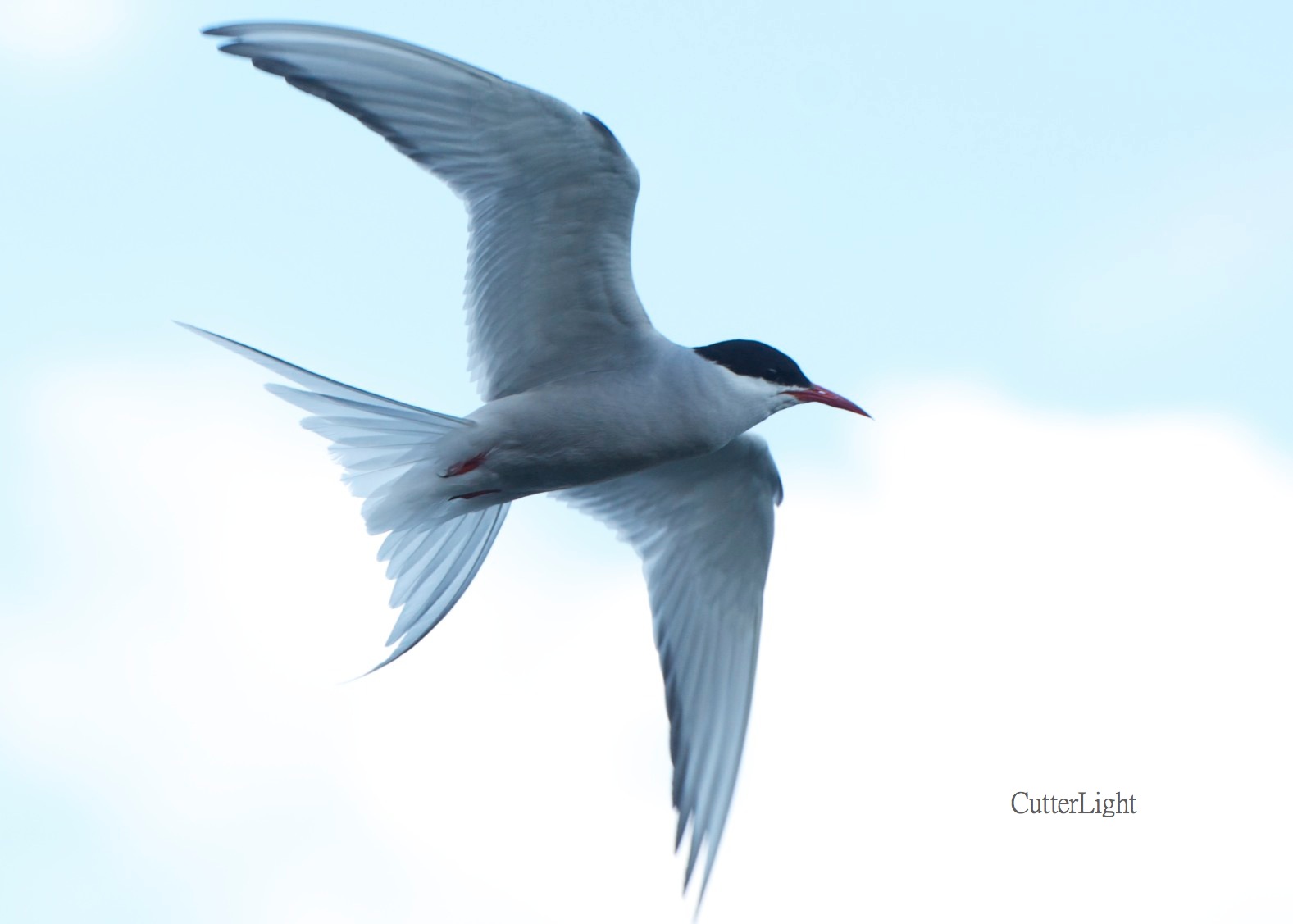
Often flying with a scissored tail and the ability to execute amazing aerial acrobatics – including backflips – account for the Arctic tern’s genus specific name paradisaea – paradise – reminiscent of birds of paradise.

arctic tern reflected n

He’s probably not really looking at his own reflection, but with a snappy red bell and a handsome black cap like that, who could blame him if he is?