Birds of Chignik Lake: Pelagic Cormorant

A hint of iridescent gloss in its plumage, a Pelagic Cormorants skims above Chignik Lagoon on a blue-sky day in late winter. Pelagics are common in The Lagoon where the fish they feed on are plentiful. Only very occasionally do they stray inland to the river and lake. (Chignik Lagoon, May 9, 2019)

My first close encounter with cormorants came at a pool I was fishing on Japan’s upper Tama River some years ago. I was in the midst of a fruitless morning when a cormorant of some sort showed up and elbowed its way into my pool. In no more than a few minutes it dove six times and caught six fish. Impressive.

Pelagic Cormorants are common all along the rocky, fish-rich Pacific side of the Alaska Peninsula. Red-faced and Double-crested Cormorants can be found along this coast as well. As for Pelagics, most of the very few we saw in the study area of this project were in flight as they headed up or down the Chignik System – perhaps from one side of the peninsula to the other.

Although their feet are webbed, cormorants’ middle toes are hooked – an aid in preening. 

Belying their common name, (and their binomial specific name, pelagicus), Pelagics rarely venture far out to sea, preferring rocky nearshore ocean waters.

This first-year Pelagic was encountered feeding below the salmon weir on Chignik River. (October 24, 2018)

Pelagic Cormorant Range Map: with permission from The Cornell Lab of Ornithology, Birds of the World

Pelagic Cormorant Phalacrocorax pelagicus
Order: Suliformes
Phalacrocorax: from ancient Greek name for cormorants – literally “bald raven”
pelagicus: of the open ocean

Status at Chignik Lake 2016-19: Uncommon/Occasional: At times are regular summertime visitors near the mouth of Clarks River on Chignik Lake

David Narver, Birds of the Chignik River Drainage, summers 1960-63Occasional on Chignik Lake after storms

Alaska Peninsula and Becharof National Wildlife Refuge Bird List, 2010:
Uncommon in Spring & Fall; Common in Summer; Rare in Winter

Aniakchak National Monument and Preserve Bird List: Presence Documented

Previous Article: Pied-billed Grebe

Next Article: Tundra Swan

*For a clickable list of bird species and additional information about this project, click here: Birds of Chignik Lake

© Photographs, images and text by Jack Donachy unless otherwise noted.

Birds of Chignik Lake: Pied-billed Grebe – an Alaska Peninsula First

As far as I can determine, this is the lone example of a Pied-billed Grebe recorded on the Alaska Peninsula. The facial striping indicates a first-year bird. (Chignik Lake, January 5, 2019)

The sun hadn’t yet peeked over the mountains rimming Chignik Lake when I noticed a small, grebe-like bird working a nearshore cove. I picked up the binoculars always handy near the living/dining room window and glassed the little bird.

The same bird as above in profile, skim ice in the background. (Chignik Lake, January 5, 2019)

Whoa! There’s a Pied-billed Grebe down below Fred’s! I exclaimed to Barbra. A couple of minutes later, I was clad in waders, camera fixed to its tripod slung over my shoulder. I quietly worked my way toward this out-of-place fellow. Wading out into the water, I stood still, hoping the bird might come closer to check me out.

The grebe did move in a little, but it was still a long shot and there was very little light. I set my aperture to its maximum opening, spun the ISO dial further than I would have cared to, and managed a couple of shots. Then the grebe swam off. Although it hung around for a few days, after that first morning it was always on the far side of the lake. And then it was gone.

From Wikipedia, a Pied-billed in summer plumage. (Mdf – First upload in en wikipedia on 21:02, 27 May 2005 by Mdf)

It’s hard to know what to make of a one-off such as this. Pied-billeds very occasionally have been reported in southern Alaska, but as the map below indicates, this individual was well beyond the typical range for this species. Things are changing in our world; it could be that Pied-billeds are pushing north. For now though, an occurrence such as this is best thought of as an “accidental.” In any event, I was happy to record this species. Maybe this small puzzle piece will have some significance in the future when others study the Chignik area.

Pied-billed Grebe Range Map: with permission from The Cornell Lab of Ornithology, Birds of the World

Pied-billed Grebe Podilymbus podiceps
Order: Podicipediformes
Podilymbus: Podi from Greek, refers to feet at the rear; lympus from the Greek kolympus = diver
podiceps: from Latin for rump-headed

Status at Chignik Lake 2016-19: Accidental

David Narver, Birds of the Chignik River Drainage, summers 1960-63: Not Reported

Alaska Peninsula and Becharof National Wildlife Refuge Bird List, 2010:
Not Reported

Aniakchak National Monument and Preserve Bird List: Not Reported

Previous Article: Red-necked Grebe

Next Article: Pelagic Cormorant

*For a clickable list of bird species and additional information about this project, click here: Birds of Chignik Lake

© Photographs, images and text by Jack Donachy unless otherwise noted.


Birds of Chignik Lake: Red-necked Grebe

What a beauty. The face striping marks this specimen as a juvenile. The Bend on the upper Chignik (just below the lake) proved to be a consistently reliable place to get close enough to waterfowl to score good photographs. (October 23, 2017)

Red-necked Grebes are another among the Chignik’s several fish-hunting birds. We didn’t see them often, but when they were on the lake or river we always grabbed our binoculars for a closer look. It’s a good bet that they breed on Black Lake or nearby tundra ponds.

Buffleheads, goldeneyes, mergansers… and center stage an adult Red-necked Grebe in nonbreeding plumage. (Chignik Lake, January 24, 2017)

These were two of three juveniles that visited the lake in the fall of 2017. (Chignik Lake, October 20, 2017)

Example of a Red-necked Grebe in breeding plumage. (Potter’s Marsh, Anchorage, Alaska. June 24, 2017)

Red-necked Grebe Range Map: with permission from The Cornell Lab of Ornithology, Birds of the World

Red-necked Grebe Podiceps grisegena
Order: Podicipediformes
Podiceps: from the Greek
podicis = rump – refers to the posterior positioning of the grebe’s feet
grisegena: from the Latin
griseus = gray & gena = cheek 

Status at Chignik Lake 2016-19: Occasional in Fall & Winter

David Narver, Birds of the Chignik River Drainage, summers 1960-63: Common on Black Lake; Rare on Chignik Lake

Alaska Peninsula and Becharof National Wildlife Refuge Bird List, 2010:
Uncommon in Spring, Summer & Fall; Rare in Winter

Aniakchak National Monument and Preserve Bird List: Presence Documented

Previous Article: Yellow-billed Loon

Next Article: Pied-billed Grebe – An Alaska Peninsula First

*For a clickable list of bird species and additional information about this project, click here: Birds of Chignik Lake

© Photographs, images and text by Jack Donachy unless otherwise noted.


Birds of Chignik Lake: Yellow-billed Loon

This handsome Yellow-billed Loon was hanging out in an eddy favored by piscivores on the Chignik River. During breeding season, in addition to a distinctive black-and-white chessboard back and bright red eyes, that massive bill would be a diagnostic lemon-sunshine yellow. (November 27, 2017)

When I began this project, I didn’t know that there was such a thing as a Yellow-billed Loon, so I was stoked when in November of 2016 a “different looking” loon sent me to my copy of The Sibley Field Guide. I’d love to see this species in its dramatic breeding plumage, but any sighting of this fairly rare bird constitutes a red-letter day.

What first drew my attention to the Yellow-bills I encountered was their size. Compared even with Commons, they’re large. And of course there’s that dagger Yellow-bills are armed with. While the bills of wintertime Commons can take on a light, blueish-silver color, there’s no mistaking the yellow in a Yellow-billed.

Salmon parr dimple the surface of The Bend on the Chignik River just below Chignik Lake. This is a good place to set a net for Sockeyes, cast a fly for Silvers, or check for fish-eaters such as otters, seals, eagles, kingfishers, mergansers and goldeneyes. (May 7, 2019)

—————————————————————

Range: Yellow-billed Loons are circumpolar Arctic breeders with about half of the world’s 10,000 birds living in Alaska. Their winter range includes the coastal waters of the Aleutian Islands, the Alaska Peninsula, and the Alaskan coast as it extends south and on into British Columbia. They are occasionally observed in fall and winter as far down the Pacific Coast as California, rarely to Mexico, occasionally to inland lakes.

Yellow-billed Loon: Gavia adamsii
Order: Gaviiformes
Gavia: sea mew
adamsii: after British naval surgeon & naturalist Edward Adams who collected and sketched this species

Status at Chignik Lake 2016-19: Occasional in Fall & Winter

David Narver, Birds of the Chignik River Drainage, summers 1960-63: Not Observed

Alaska Peninsula and Becharof National Wildlife Refuge Bird List, 2010:
Rare in Fall & Winter; Not Observed Spring & Summer

Aniakchak National Monument and Preserve Bird List: Probable but not Verified

Previous Article: Common Loon

Next Article: Red-necked Grebe

*For a clickable list of bird species and additional information about this project, click here: Birds of Chignik Lake

© Photographs, images and text by Jack Donachy unless otherwise noted.
 

Birds of Chignik Lake: Common Loon

Common Loon – Chignik Lake, August 17, 2018

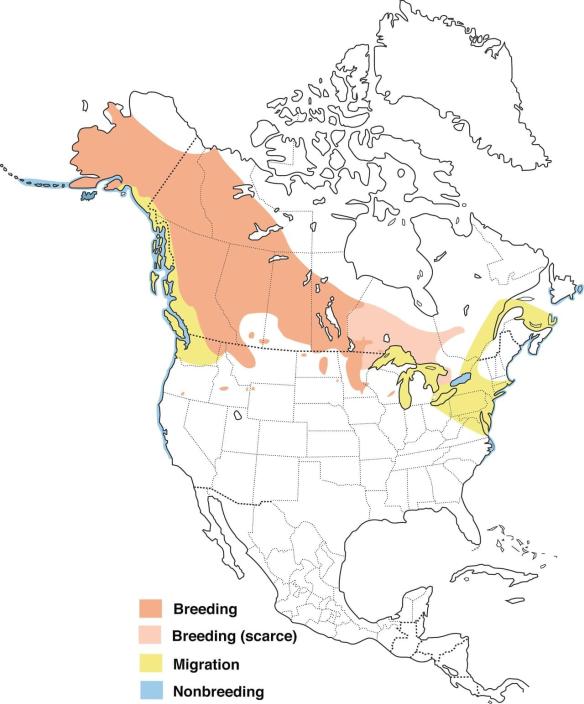
Words such as “common,” “uncommon” and “rare” can be vexingly imprecise. So, what are the chances of seeing a Common Loon on Chignik Lake? Generally pretty good, which prompts the question: Have Common Loons – which David Narver recorded us “uncommon” back in the early ’60’s – become more common on The Lake in recent years? And if so, does that explain the relative absence of the smaller Red-throated Loon – which Narver reported as “common?” I love questions like this, even if the answers are tough to know.

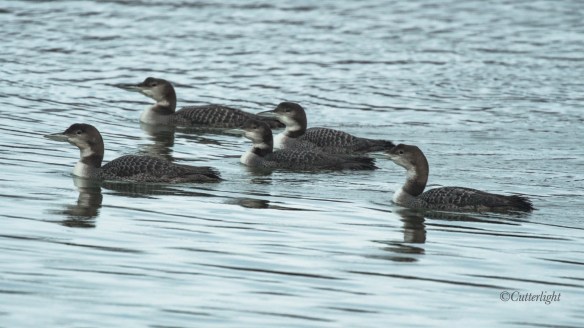
These Commons appeared to be cooperatively feeding as they worked their way along the shoreline. (Chignik Lake, January 14, 2018)

We encountered Common Loons with some frequency – as individuals, in pairs, and at times in what appeared to be family groups of four or five. Commons’ diets are comprised mainly of small fish – lots and lots of them. According the Cornell Lab of Ornithology, a pair with two chicks can consume about half a ton over a 15-week period. Unlike River Otters, mergansers and goldeneyes, Commons usually swallow their prey underwater. I was therefore unable to observe what species of fish they might be targeting. Sticklebacks, small char and juvenile salmon are all likely candidates. The system also holds populations of smelt and sculpins.

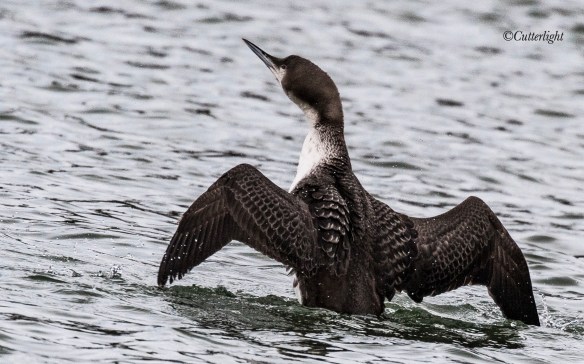
Right down to it’s gem-like eye and armed with a serious bill, Common Loons surely rank as one of North America’s most striking birds. (Chignik Lake, August 17, 2018)

Even in silhouette, there’s no mistaking a loon. (Common Loon, Chignik Lake, August 20, 2016)

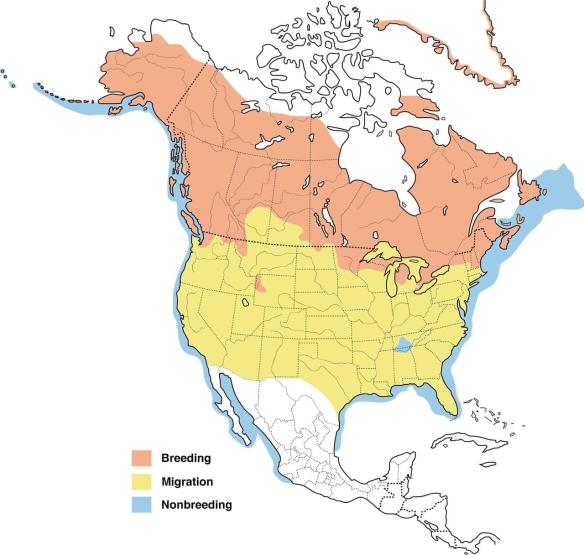
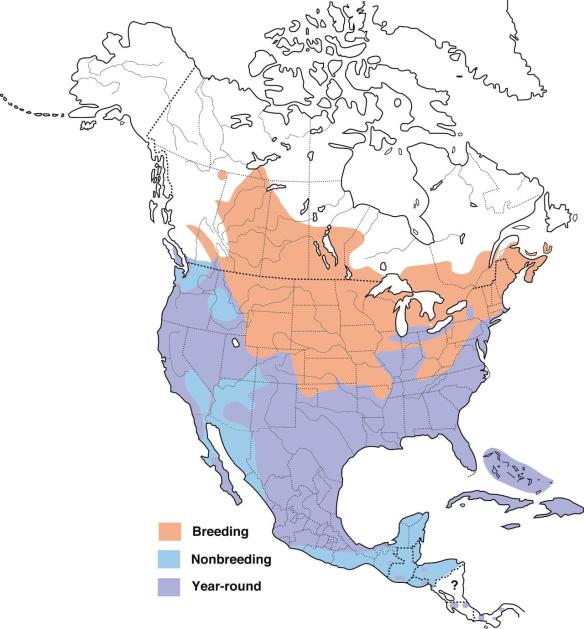
Common Loon Range Map: with permission from The Cornell Lab of Ornithology, Birds of the World

Common Loon Gavia Immer
Order: Gaviiformes
Gavia: sea mew
immer: perhaps from the Latin immergo – to immerse; or from the Swedish immer – which refers to the ashes of a fire and suggesting the loon’s coloration

Status at Chignik Lake 2016-19: Common to Uncommon

David Narver, Birds of the Chignik River Drainage, summers 1960-63Uncommon

Alaska Peninsula and Becharof National Wildlife Refuge Bird List, 2010:
Common in Spring and Summer; Uncommon in Fall; Rare in Winter

Aniakchak National Monument and Preserve Bird List: Presence Documented

Previous Article: Pacific Loon

Next Article: Yellow-billed Loon

*For a clickable list of bird species and additional information about this project, click here: Birds of Chignik Lake

© Photographs, images and text by Jack Donachy unless otherwise noted.


Birds of Chignik Lake: Pacific Loon

A Pacific Loon stretches between dives on a cold winter day. The Pacifics we encountered on Chignik Lake and Chignik River were wintertime visitors and therefore in their more drab plumage.  (Chignik River, January 12, 2018)

Pacific Loons are uncommon to occasional wintertime visitors on Chignik Lake and Chignik River. Although they sometimes appear in pairs, they didn’t arrive until well into wintertime and I saw no Pacifics in breeding plumage. As this species is known to nest on the Alaska Peninsula, it is possible that Pacific Loons could be found in spring and summer on Black Lake.

Abundant fish attract loons and other piscivorous birds to The Lake. As with other loons, in wintertime the estuary might be the best place to look for them. (Chignik Lake, December 5, 2017)

Several years before I got into birding (or serious photography), Barbra and I encountered this beautiful specimen in breeding plumage on a pond near Point Hope, Alaska. At the time, I didn’t realize that there is more than one species of loon! (Point Hope, Alaska, August 24, 2012)

Pacific Loon Range Map: with permission from The Cornell Lab of Ornithology, Birds of the World

Pacific Loon Gavia pacifica
Order: Gaviiformes
Gavia: sea mew
pacifica: of the Pacific region

Status at Chignik Lake 2016-19: Uncommon/Occasional

David Narver, Birds of the Chignik River Drainage, summers 1960-63: Not Observed

Alaska Peninsula and Becharof National Wildlife Refuge Bird List, 2010:
Rare in Spring and Summer; Uncommon in Fall and Winter

Aniakchak National Monument and Preserve Bird List: Probably Present but not Documented

Previous Article: Red-throated Loon

Next Article: Common Loon

*For a clickable list of bird species and additional information about this project, click here: Birds of Chignik Lake

© Photographs, images and text by Jack Donachy unless otherwise noted.


Birds of Chignik Lake: Red-throated Loon

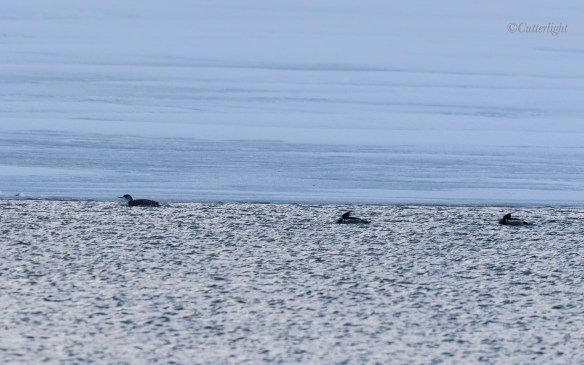
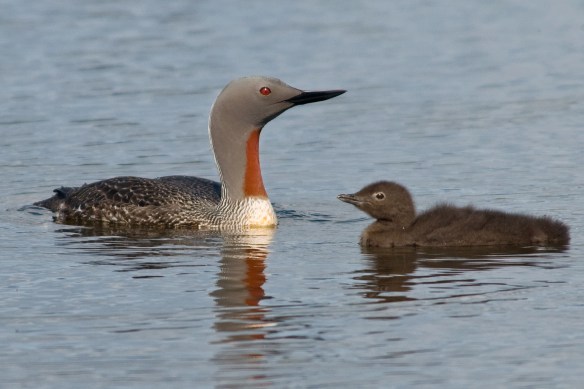
Fine and far off. In fly-fishing, the phrase refers to light tippets and long casts to wary trout. Here it refers to my lone Red-throated Loon sighting on Chignik Lake. It’s difficult to see the eponymous star-like speckling on its back in this photo, but a fine bill angled up slightly, a face showing more white than in other loons, and a smaller, more rounded overall profile add up to Red-throated. A pair of male Red-breasted Mergansers nap to the right on an icy Chignik Lake. (April 1, 2017)

Although Narver regularly encountered Red-throated Loons during his summertime observations in the early 1960’s, I recorded only one specimen during my three years at The Lake. This could reflect that in summertime Red-throateds mainly reside further up the watershed at Black Lake – and possibly breed there -, or it could indicate that in recent years Common Loons have supplanted their smaller cousins in the Chignik Drainage. Except for the breeding season, Red-throated Loons show a decided preference for salt water, so from fall through early spring Chignik Lagoon and nearby ocean waters – areas beyond the scope of this study – might be good places to check for them.

Red-throated in breeding plumage: Photo by David Karnå / Wikimedia Commons / CC BY 3.0

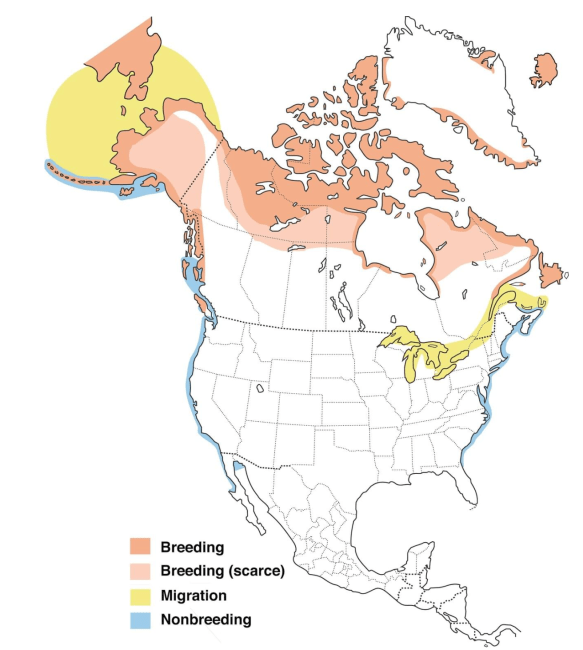
Red-throated Loon Range Map: with permission from Birds of North America

Red-throated Loon – Gavia stellata
Order: Gaviiformes
Gavia: sea mew
stellata: set with stars

Status at Chignik Lake 2016-19: Rare

Status on other relevant checklists:

David Narver, Birds of the Chignik River Drainage, summers 1960-63:
Common on Black Lake; Occasional on Chignik Lake

Alaska Peninsula and Becharof National Wildlife Refuge Bird List, 2010:
Uncommon in Spring and Summer; Rare in Fall and Winter

Aniakchak National Monument and Preserve Bird List: Presence Documented

Swallow Silhouette

Previous Article: Loons of Chignik Lake

Next Article: Pacific Loons

*For a clickable list of bird species and additional information about this project, click here: Birds of Chignik Lake

© Photographs, images and text by Jack Donachy unless otherwise noted.


Finches of the Dandelion Jungle

With just a few days remaining for us in Chignik Lake, we continue to add to our project documenting bird species within a three-mile radius of this tiny, remote village on the Alaska Peninsula. With approximately 75 different types of birds observed – and good photographs of most of those species – much as been accomplished, including getting photographs of birds that, to the best of our knowledge, had never before been recorded out here. But, as with any project of this scope and complexity, much remains undone. We only now are getting into making videos and immediately have been intrigued by the unique possibilities this medium offers. With open invitations to return for future visits, we hope to make it back to this paradise by The Lake.

Aside from brief clips of a Fox Sparrow in song, Pine Siskins coming to Barbra’s hand for seed, and a Red Crossbill going to town on White Spruce cones, this is the only bird video we’ve made. It’s the first video we’ve planned out and edited.

For the past few days, dozens of finches – Pine Grosbeaks, Pine Siskins and Common Redpolls – have been foraging virtually nonstop on dandelion seeds in the unmown lawn outside our front door. We’d been enjoying watching this show (and listening to the constant, cheerful bird chatter) from our kitchen and from the boardwalk leading from our house to the school where Barbra teaches. The Pine Grosbeaks in particular have been quite tolerant of our presence – if not downright curious to the point of approaching us. (I once had a Pine Grosbeak land on my head as I was photographing them.) In fact, individual of all three species have approached so close at one time or another we might have reached out and touched them.

The siskins’ numbers appear to be populated by recently fledged members. Earlier this past spring, we saw a redpoll with nesting material and they, too, appear to have young among them. We’re not sure about the Pine Grosbeaks. At present there are about eight grosbeaks – an even number of male and female birds – and although this species might be seen in any season here in Chignik Lake, we’re not sure if these are individuals that overwintered here and filled the spring air with their beautiful song, or whether this a group that is merely passing through. In any event, although David Narver who, back in the early 1960’s compiled the only other detailed list of birds occurring in we’ve been able to find, reported redpolls as “uncommon” and made no mention at all of Pine Siskins and Pine Grosbeaks, redpolls and grosbeaks have been common during our entire three years here. Siskins showed up for the first time two winters ago and have been common since. At times, we’ve counted upwards of 60 birds in flocks of redpolls and siskins, and at least 40 in a flock of Pine Grosbeaks that spent a week or two in the village stuffing themselves on alder cones.

After the Fog Burned off – Eagles

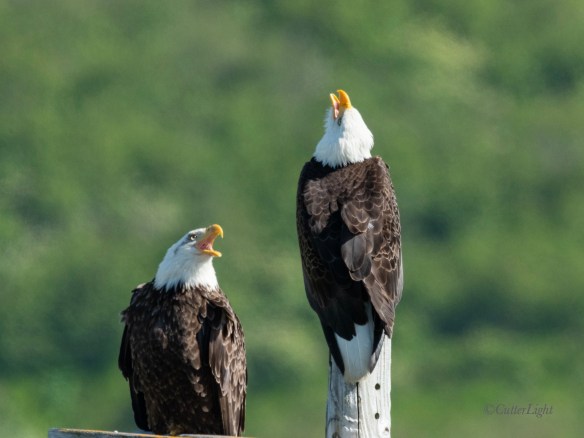
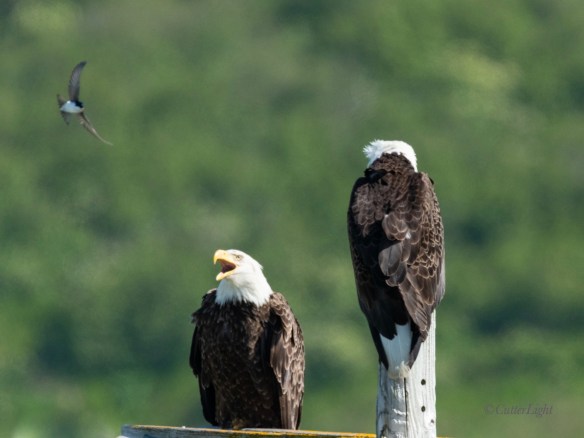
As swallows swooped and soared, this pair of Bald Eagles began a chorus of their characteristic high-pitched piping. The sunshine must’ve felt as good to them as it did to us.

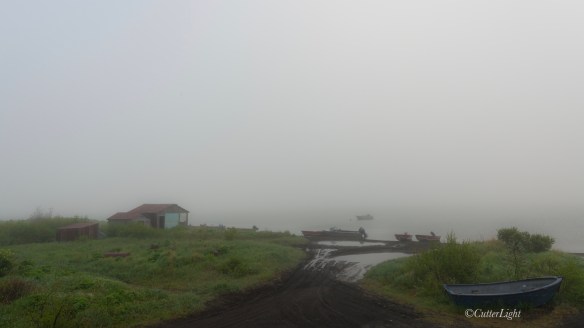
Two days in a row we’ve woken to heavy fog here at The Lake. It wasn’t forecast either day. Yesterday by mid-morning, the mist had burned off. When it did, the birds came out in force. From our vantage point on the deck outside my “office,” Barbra and I saw or heard Pine Grosbeaks, Pine Siskins, Redpolls, Wilson’s Warblers, Ravens, Magpies, Golden-crowned Sparrows, American Robins, Fox Sparrows, Violet-green Swallows, Tree Swallows and out on the lake a small group of Black Scoters and a few passing Glaucus-winged Gulls. But the stars of the morning were a pair of mature Bald Eagles that took up perches on a favorite utility pole near the lakeshore.

This was the view from our dining room window yesterday morning just after dawn. The village of Chignik Lake lies only a few miles upriver from a bay on the Alaska Gulf, so we get our share of wet weather. 

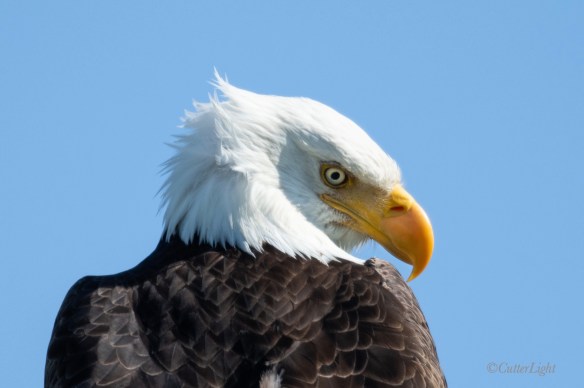
As the sun began peeking through the fog, the first eagle to arrive did its best to dry its soggy wings. Either that, or this is one of those rare Peacock Eagles.

His (her?) mate hadn’t yet arrived and I moved a little closer to capture a portrait. Once the fog lifted, we had a day of blue skies. Temperatures climbed into the 60’s so we took the opportunity to work on our “Alaska Tans” – defined as tans that cover the backs of one’s hands, face and neck down to the level of a shirt or coat collar. But by early afternoon, it was warm enough (mid-60’s) to sit outside in a just a shirt, shorts and bare feet and read (Barbra) and play guitar (me).

While I worked on photos, Barbra scanned for birds from the deck outside her former classroom. Off in the distance to the right, along the far edge of the lake, the second eagle can be seen soaring low. (You might have to enlarge this photo.) The duplex in front of Barbra is where we live – on the righthand side. 

There are at least 50 nesting boxes in this bird-loving village of only about 50 to 70 residents. The boxes are occupied almost exclusively by either Violet-green or Tree Swallows. Both species seem inclined to investigate anything out of the ordinary in their neighborhood – us, eagles, other birds. The real threats to swallows are Chignik Lake’s abundant Magpies – notorious nest robbers. In years past, Merlins, Northern Shrikes and occasional Sharp-shinned Hawks have also posed a threat, but none of these species appear to be present this year – at least so far.

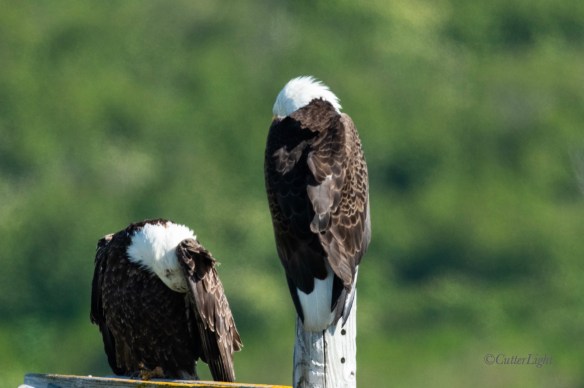
A mated pair? Siblings? Friends? (Do eagles have friends?) It was interesting to watch these two repeatedly mirror each other’s behavior. We’ve read about these dreaded Dracula Eagles – another rare sighting.

As I mentioned, we’ve had two consecutive mornings of heavy fog. Inspired by the way the morning cleared up yesterday, last evening we prepared our pack raft in anticipation of doing a three-mile river float today. Unfortunately, the weatherman got it completely wrong. The fog only grudgingly lifted late in the morning and instead of the calm that had been forecast, winds – the bane of rafting – kicked up. So I spent the morning working on photos. Yet hope springs eternal. The prediction for tomorrow morning is for partial sunshine and calm, so perhaps we can get in one last river float before we have to pack up the gear and mail it to Newhalen. Every hour of these final days at The Lake is a time to savor.

If you enjoyed this post and would like to see some of the birds mentioned and more of the landscape around Chignik Lake, check out the link below:

Morning Nature Walk, the Chigniks

Hope your day is going well!

Our Violet-greens are Back at The Lake!

A single Violet-green Swallow can consume hundreds of mosquitoes and midges a day. With 40 or so nesting box cavities scattered throughout the village of Chignik Lake (population 50), these iridescently-plumaged little fellows and their Tree Swallow cousins are local favorites.

Chignik Lake’s first swallows, multi-hued Violet-greens, made their seasonal debut yesterday, May 15. This morning we went out to get photos of these much anticipated first arrivals. Tree Swallows, which will also use the dozens of nesting boxes residents have put up, should be arriving any time now along with the Bank Swallows that have established a colony on a bluff a mile or so down the Chignik River.

The Native American tradition of hanging nesting cavities for swallows goes as far back as anyone knows. Writing in the 1800’s, John J. Audubon noted that:

The… Indian is also fond of the Martin’s company. He frequently hangs up a calabash on some twig near his camp, and in this cradle the bird keeps watch, and sallies forth to drive off the Vulture that might otherwise commit depredations on the deer-skins or pieces of venison exposed to the air to be dried. The slaves in the Southern States take more pains to accommodate this favourite bird. The calabash is neatly scooped out, and attached to the flexible top of a cane, brought from the swamp, where that plant usually grows, and placed close to their huts. Almost every country tavern has a Martin box on the upper part of its sign-board; and I have observed that the handsomer the box, the better does the inn generally prove to be. 

It’s sad to see those annoying, energy-wasting, indiscriminate electric bug zappers, which kill beautiful moths along with everything else, hung more often than nesting boxes in these modern times. A nesting pair of birds will do a better job keeping pests under control, add cheer to any property, and when the wooden box has seen its best days it can be be left to return to soil rather than discarded to fill our world with yet more plastic, toxic parts and slowly-decomposing metal.

If nesting boxes around our village are any indication, they need not be elaborate. All that’s needed is untreated wood, a saw, a means to cut a hole, nails or screws and the appropriate tool for securing that hardware. Although it is often recommended that boxes be cleaned out annually, we know of no one here who does so. The swallows themselves seem perfectly capable of spring cleaning when they arrive, as they have done with natural cavities for as long as swallows have been around. However, if you’d feel better about cleaning out the boxes once the nesting season is finished, by all means go for it; you’ll be creating a clean space for birds that use the boxes as overnight and foul weather shelters during wintertime.

Engaged in housekeeping (removing his offsprings’ excrement) this Violet-green and his mate made a nest behind a knothole in the side of a store in McCarthy, Alaska.  

Two additional tips for your own backyard nesting boxes:

  1. Do Not put any sort of ledge or peg in front of the hole. As you can see in the photo below, swallows and other cavity nesters don’t need a perch. Their claws are adapted to cling to the sides of trees. The only purpose a ledge or peg serves is to give nest-raiders such as magpies, crows and other predators a perch from which to get at eggs and nestlings.
  2. Give some thought to the species of bird you hope to attract, then research the size of entry hole and the size of the interior cavity that bird prefers.

To those tips, we’ll add a third. Invasive European Starlings and House Sparrows haven’t yet found us out here on the Alaska Peninsula. If they are a problem where you live, we urge that they be discouraged from nesting by any means necessary. Both of these birds represent a significant, growing threat to species diversity.

Don’t have the time or the right tools to build your own boxes? Consider purchasing. A cedar box will last a long time, making it an economical gift to birds for years or even decades to come. And don’t be discouraged if your boxes don’t attract guests right away. Sometimes it takes more than one season for birds to move in.

Flowers are blooming, insects are out, swallows are returning and salmon are beginning to stage in the bay for their annual spawning run up the Chignik River. It still feels like spring, but summer is just around the corner.