
Happy Valentine’s Day – for all you love
July 20, 2012


I had only recently acquired the kind of camera equipment necessary for serious avifauna documentation when one fall morning as I was walking through the village, 20 pounds of camera, lens and tripod slung over my shoulder, a flock of Pine Grosbeaks descended all around me in the willows, scrub alders and salmonberry brakes along the dirt road. I knew the species from books but had never encountered them. Keen to get photographs, I set up to shoot. No sooner was I in position than one of their tribe flew over, rested for a moment on the long lens of my camera, and then hopped onto on my head. A passage from Walden came immediately to mind:
“I once had a sparrow alight upon my shoulder for a moment while I was hoeing in a village
garden, and I felt that I was more distinguished by that circumstance than I should have been by any epaulette I could have worn.” (Thoreau, Walden, “Winter Animals”)
I quickly made photographs documenting the species’ presence in that part of the world (David Narver did not observe them in the Chignik Drainage during his field work in the early 1960’s, and they are listed as “rare” or “uncommon” on peninsular checklists), but the species proved to be common in the years we were at The Lake and year by year I improved on those first pictures. As I continue sorting through the many thousands of photographs comprising “The Chignik Files,” I will show other photos of these beautiful finches… the Cardinal of the Far North.

I’ve gone around knocking on hollow trees most of my adult life, hoping a flying squirrel or owl would pop it’s head out. And then one day, it happened!
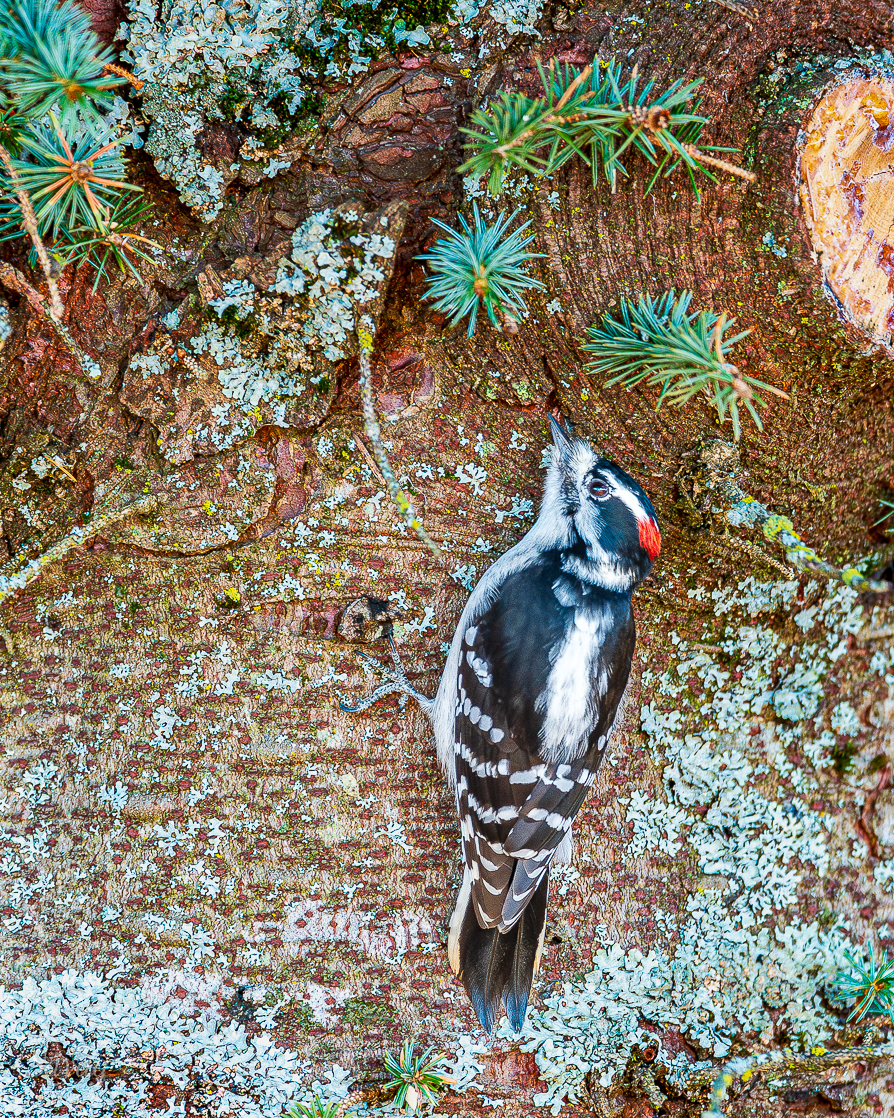
It is suggested in T. Gilbert Pearson’s Birds of America (1917) that the moniker Tommy Woodpecker would better suit North America’s smallest member of the woodpecker tribe “…for his boyish, buoyant disposition makes friends for him wherever he goes.” Perhaps for a moment we can set aside the sexism and celebrate an era and it ornithologists who took such a personal and personified approach to avian studies. I’d like to see any number of birds renamed, starting with discarding all those appellations that are essentially slave names applied by the person who “discovered” a given species – Wilson’s Warbler; Audubon’s Oriole; Steller’s Jay; etcetera. But Downy seems apt for this six-inch bird with its soft breast feathers.
No woodpeckers appear in David Narver’s study of the Chignik River Drainage conducted in the early 1960’s. Range maps have historically placed the Three-toed Woodpecker on the Alaska Peninsula – with no mention of Downies -, but this is surely in error as historically there was essentially no suitable habitat for spruce-and-pine-loving Three-toeds in that part of the world. My guess is that someone conducting an early biological survey got a glimpse of a woodpecker, made a guess, and that became the text for the peninsula. Very recently, I’ve noticed that the Cornell Lab of Ornithology and other authorities have begun to make corrections.
Though they are often common – the woodpecker one is most likely to encounter throughout much of North America – even in the most suitable habitat Downies are seldom abundant. And although the above photograph was recorded in the Sitka Spruce Grove at The Lake, Downies are equally likely to be found in the peninsula’s alder thickets and occasional cottonwoods. Though they are generally listed as uncommon or rare on the Alaska Peninsula, they are in fact regularly seen along the length of the Chignik River. It is probably a lack of nesting cavities rather than a shortage of food that limits Downy numbers on the peninsula, so as the land becomes more forested and trees mature and die and cavities are created their numbers will increase. Listen for their distinctive Peek! Peek! call and then for tell-tale light tapping.


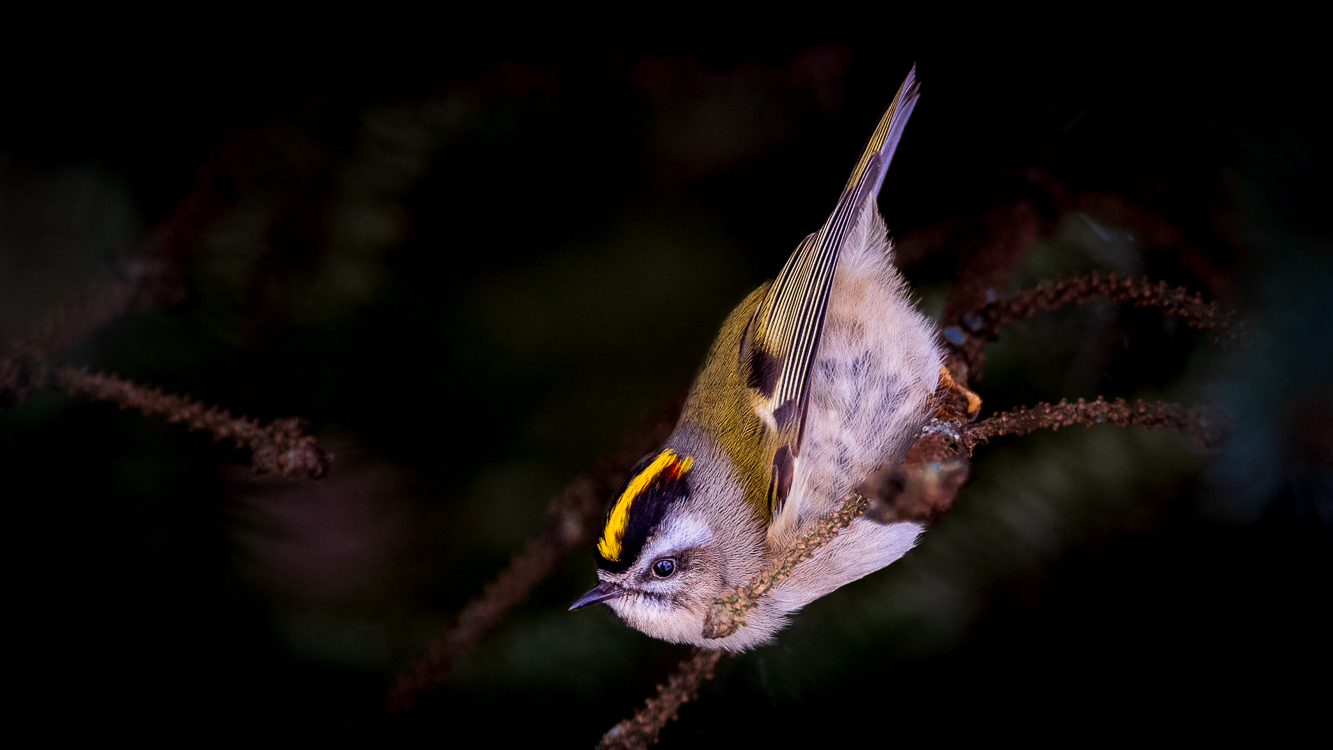
Every autumn coinciding with the peak of the Coho run on the Chignik River, we’d begin to hear a new voice as we pushed through thick stands of alders or walked by the village’s scattered spruce trees. By this time, there weren’t many other passerines around, and so there was no mistaking the high, almost cricket-like call of returning Golden-crowned Kinglets. They were a new species for for us, always in motion, difficult to locate in the dense alders and dark spruce boughs they prefer, and they are not indicated on the Alaska Peninsula on any of the range maps we checked – Cornell, Audubon, Sibley – so we were very happy when we finally got binoculars on them and could make positive identification. Kinglets tended to remain at The Lake throughout winter. At some point, they presumably had cleaned all the invertebrate eggs and dormant insects they could find and moved on to other grounds, but they were there every year in those fall and winter months and should be added to peninsular checklists and range maps.
 CutterLight