Nature Watching & Nest Finding: An Exercise in Mindfulness

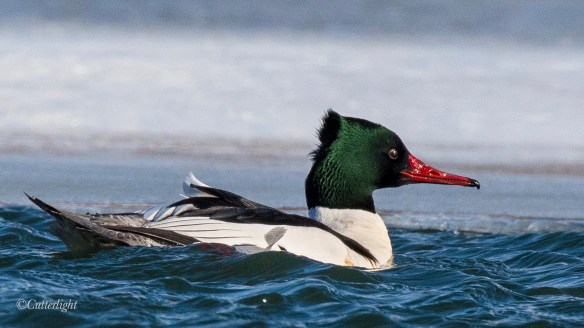
Male Common Merganser, Chignik Lake, March 23, 2017

I have a particular photograph that, when I got it, I was quite stoked. It’s beautiful. Everyone who has seen it says it’s a great picture. But I look at it now…

It’s a shot of a Common Merganser taking wing. Click. Capture. The camera settings were correct. The light was wonderful. The moment is frozen in time.

He was feeding. Diving. Occasionally coming up with a small fish of some kind. Stocking  calories on a cold winter day.

I moved closer. And closer. And I flushed him.

See the nest? Spring through summer, anytime you flush a bird – and especially if a bird is behaving as though it is injured, tread carefully; there’s probably a nest nearby.

The speckling, which breaks up their silhouette, makes these Semipalmated Plover eggs especially difficult to see from a distance – unless you’re looking for them. (Interior Alaska, June 2017)

It’s a dilemma. Ongoing. As a naturalist, a photographer, a student of wildlife, I want to get close. I am drawn toward invading a being’s space. I want to see them in detail. I want to find their nest or den. I want to see what they are eating. I want to learn where they roost or rest.

But I really don’t want to disturb them. Most of my favorite photographs of animals are those in which they aren’t looking at me – photos in which they are going about their business hunting, eating, digesting, loafing, soaking up sunshine or huddling against a storm.
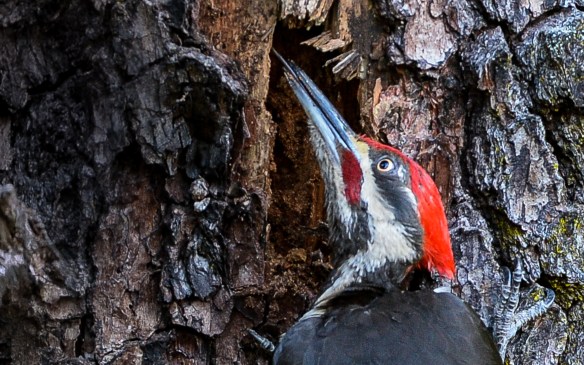
This is how I hope to capture birds – going about their business, oblivious to me. (Pileated Woodpecker, Oregon, June 2012)

As sportsmen and naturalists, we disturb animals all the time. We flush birds. We invade habitat. If my fishing season was limited to catching only what I need to stock my freezer, it would be a mighty short season. But I love to fish. So I fish for charr and trout that I have no intention of keeping, and I cast flies for salmon long after I’ve got plenty of fillets to get me through another year, letting go the additional Silvers that come to hand after I’ve got my quota.

This is not a dilemma to be solved, I think. Rather it is one to keep in mind.

As soon as we step foot in nature, we’re going to have an impact. Plants and invertebrates will be crushed underfoot. Birds will be flushed. A friend of mine walking on a river island once heard a crunch underfoot. He lifted his shoe to find a dripping smear of yolk and albumen from the crushed remains of a Killdeer’s nest. He felt really bad about that. If the world was populated only by bird-loving naturalists, I suppose evolution would have arranged for eggs in shades of neon and florescence.

Let’s hope all four of these greenish, brown-speckled eggs made it into fully fledged Siberian Rubythroats. (Hokkaido, Japan, June 2017)

In recent years, I’ve become pretty good at finding birds’ nests – a skill I’m reluctant to put into practice unless circumstances make it necessary. Hiking through an overgrown field in Hokkaido, Japan, a Siberian Rubythroat burst into flight practically beneath my feet. I knew from experience that there was undoubtedly a nest nearby, and that I’d better take great care with each footstep until I either located the nest and avoided trampling it or had gingerly stepped altogether clear of the area.  
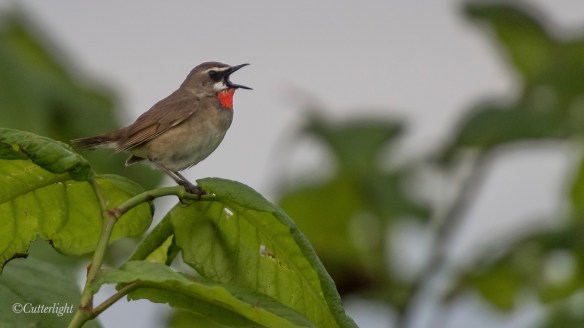
Singing his heart out not far from the above nest, this male Siberian Rubythroat has staked out his small piece of Hokkaido. (June 2017)

I once flushed a mallard off her nest. Didn’t know she had a nest until I walked closer to where she had been. I quickly backed away, but it was too late. Before I could get completely out of the area, a pair of crows were happily going to town on eggs that would not become ducklings. Initially, I was mad at the duck for choosing such an open place to build a nest. But the fault was mine; I didn’t know enough about duck behavior to understand that she was brooding.

Those crows knew, though. Smart birds.

Birds are amazingly aware of their surroundings, and so I have little doubt that this merganser and her brood were aware of my presence. But I was tucked away behind vegetation photographing terns. She passed by with a circumspect eye directed my way, but not in panic. Good. A short distance upriver, they resumed feeding. (Tuul River, Mongolia, July 2015)
loon silhouette

Previous: Red-breasted Merganser – Not just Flashy. Fast!

Next Article: Northern Harrier – Rare but There

Birds of Chignik Lake: Red-breasted Merganser – Not Just Flashy. Fast!

With a crest reminiscent of peacock herl and a bright red orange bill meant for the business of catching fish, Red-breasted Mergansers are both stunningly handsome and adapted for success in the Chignik Drainage. (Chignik Lake, December 31, 2016)

While there is some dispute as to the actual speed it can attain, it is said that the Red-breasted Merganser is the world’s fastest bird in level flight. That means that at speeds of somewhere in the vicinity of 80 miles per hour, while it can’t match a diving Peregrine Falcon’s break-neck 240 mph, it could outrun the predator in a flight parallel to land or water.

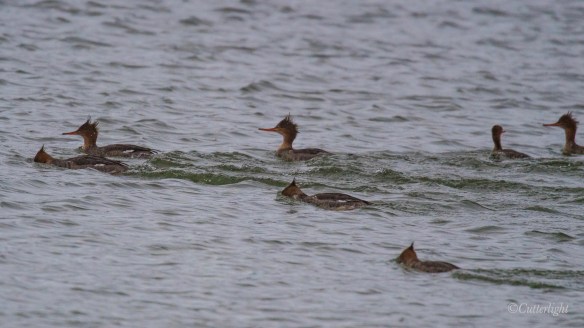
In winter and spring, it’s not unusual to see Red-breasted drakes associating with Common Mergansers. Note the Common’s slightly more stout bill, her light colored chest and distinctive white chin. Commons are also somewhat larger and bulkier looking than Red-breasteds. (Chignik Lake, December 2016)

As is the case with their Common cousins, Red-breasteds generally aren’t high on hunters’ lists. Mergansers are sea ducks, most of which are not esteemed as table fare. Though I must say as a fly-tier, the drake’s plumage is tempting. Fortunately there are synthetic materials that obviate the need to take one of these beautiful ducks merely for its feathers.

Mergansers are well-known for cooperative feeding strategies – behavior they learn as chicks while hunting with their mother. Although immature birds and females look a lot like immature and female Commons, note A) the very thin bill which can appear to be upturned, B) dark chest and C) absence or near absence of white on the chin. (Chignik Lake, January 14, 2018)

Unlike Common Mergansers, Red-breasteds don’t nest in cavities. They nest on the ground near water. Thus, they are known to breed on the largely treeless Alaska Peninsula.

A Red-breasted drake (forward most) mixes in with a group of Common Mergansers on a fishing expedition. Common Goldeneyes often join these groups. (Chignik Lake, March 23, 2017)

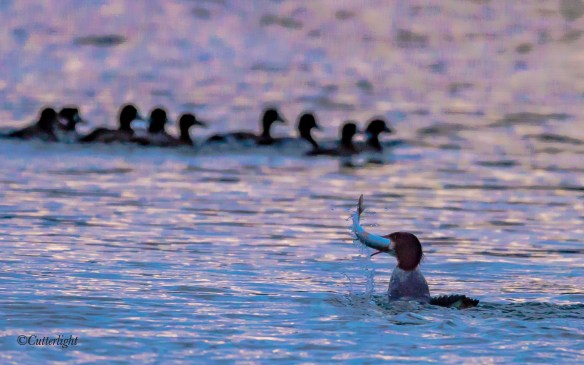
This drake, just coming up with a stickleback, was working an ice edge along with a female Common Merganser and a Common Goldeneye as another day on Chignik Lake came to a close. (December 2016)

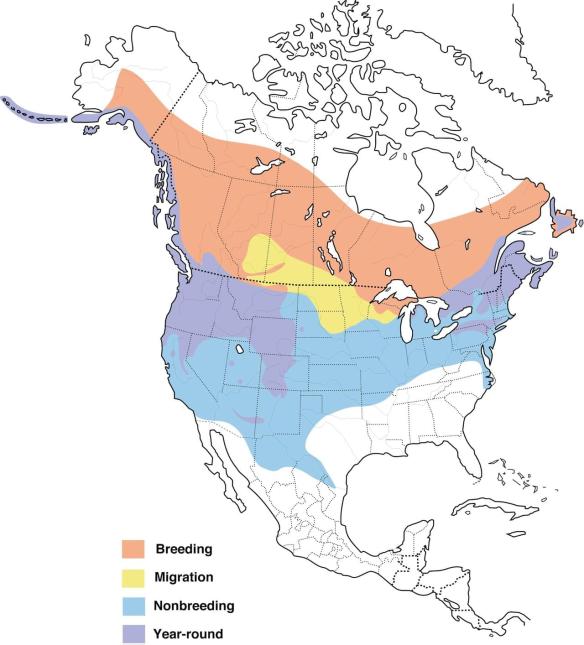
Red-breasted Merganser Range Map: with permission from The Cornell Lab of Ornithology, Birds of the World

Red-breasted Merganser Mergus serrator
Order: Anseriformes
Family: Anatidae
Mergus: from Latin for an unspecified waterbird
serrator: Latin serra = saw

Status at Chignik Lake, 2016-19: Common

David Narver, Birds of the Chignik River Drainage, summers 1960-63: Common

Alaska Peninsula and Becharof National Wildlife Refuge Bird List, 2010Common in Spring, Summer and Fall; Rare in Winter

Aniakchak National Monument and Preserve Bird List: Present

loon silhouette

Previous: Common Merganser- She Wears the Crown

Next Article: Nature Watching & Nest Finding: an Exercise in Mindfulness

*For a clickable list of bird species and additional information about this project, click here: Birds of Chignik Lake

© Photographs, images and text by Jack Donachy unless otherwise noted.

Birds of Chignik Lake: Common Merganser – She Wears the Crown

Another stickleback bites the dust. Along with sculpins, the Chignik’s Three-spine and Nine-spine Sticklebacks frequently feature in the Common Merganser’s diet. (Female Common Merganser, Chignik Lake, March 14, 2017)

Often called Saw-bills for their serrated, fish-grabbing bills, Common Mergansers are one of the Chignik’s more common wintertime ducks. And happily for naturalists photographers, they’re one of the more approachable species. This is probably due to the fact that they aren’t much sought by gunners.

In typical duck fashion, the drakes are indeed strikingly handsome. Here a breeze out of the north is pushing the feathers on his crown up a bit, but they’re considerably shorter and never so dramatically displayed as the hen’s, making Common Mergansers the only species of duck in which the hen shows more of a crown than does the drake. (Chignik Lake, March 14, 2017)

The reason mergansers aren’t much hunted was nicely summed up by Edward Howe Forbush in Birds of America when he wrote: Its flesh as ordinarily cooked is so rank and strong that its flavor is not much superior to that of an old kerosene lamp-wick… As a result, their numbers are stable in North America and appear to be expanding in Europe, where they are known as the Goosander.

Dawn hadn’t yet broken over the lake’s southern mountains when I looked out my window to see a group of a dozen or so mergansers working together to herd Dolly Varden Char against the shoreline. I snuck down to the lake, positioned myself behind a spruce tree and made a few photographs. During my youth back in Pennsylvania, we’d have called a char of that size a “nice keeper.” This merganser is probably a first-year bird and could be either a male or a female. The ducks in the background are Greater Scaup with a drake Common Goldeneye (second from left) mixed in. (December 12, 2016)

Common Mergansers primarily nest in tree cavities, and as they are large ducks (a little over two feet long on average), they require large trees. This would appear to be a key limiting factor in their range and distribution, and the main reason they are not commonly found in The Chigniks during the mid-spring through summer breeding season. As such, this is a species that would benefit from the installation of nesting boxes.

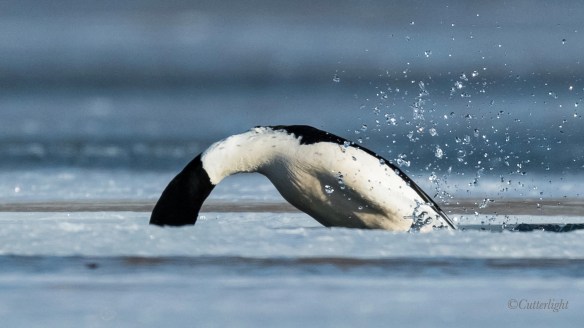
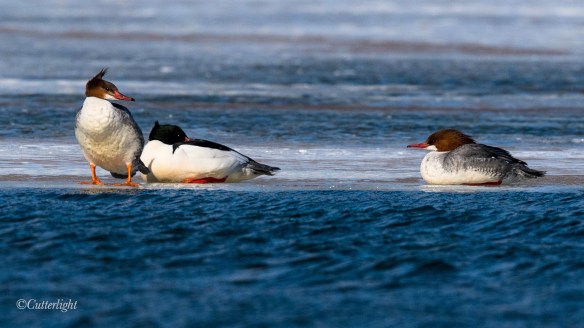
Deadly efficient piscivores, mergansers disappear in an arcing dive in a flash. Once they locate a school of fish, virtually every dive is successful, leaving them plenty of time to sleep or loaf on the water surface, shoreline, rocks or ice. (Chignik Lake, January 31, 2017)

Bellies filled with fresh fish, it’s time to loaf and catch some rays. The longer the ice remains, the longer the mergansers hang around in spring. As soon as forested ponds and lakes in the interior become ice free, these mergansers will be gone. But I have to wonder if nesting boxes of the right size might induce a pair to stay at the lake. (Chignik Lake, March 23, 2017)

Common Merganser Range Map: with permission from The Cornell Lab of Ornithology, Birds of the World

Common Merganser Mergus merganser
Order: Anseriformes
Family: Anatidae
Mergus: from Latin for an unspecified waterbird
mergansercompound word from the Latin “mergus” as per genus name + “anser” = goose

Status at Chignik Lake, 2016-19: Common from late summer through early Spring

David Narver, Birds of the Chignik River Drainage, summers 1960-63: Not Reported

Alaska Peninsula and Becharof National Wildlife Refuge Bird List, 2010Common in Spring and Winter; Rare in Summer; Uncommon in Fall

Aniakchak National Monument and Preserve Bird List: Present

loon silhouette

Previous: Bufflehead – Our Smallest Diving Duck

Next Article: Red-breasted Merganser – Not just Flashy. Fast!

*For a clickable list of bird species and additional information about this project, click here: Birds of Chignik Lake

© Photographs, images and text by Jack Donachy unless otherwise noted.

Birds of Chignik Lake: Bufflehead – Our Smallest Diving Duck

Seen from a distance, Buffleheads often appear black and white – like plump, buoyant miniature Panda Bears bobbing on a lake surface, Viewed more closely and in the right light, the purples and greens on heads of this species’ males are brilliant and stunning. (Chignik Lake, December 31, 2016)

Averaging only 13 to 16 inches from bill to tail, Bufflehead are small but striking. Their diminutive stature plays to their advantage when it comes to nesting. Like their cousins, the goldeneyes, Bufflehead are cavity nesters. But thanks to their small size, they can make use of the not particularly large holes made my Northern Flickers, a medium-sized member of the woodpecker family.

The Chignik River in late winter is often a good place to see various species of ducks biding their time till waters further north become ice free. Beginning at nine o’clock and proceeding clockwise: female Bufflehead; 3 Mallard drakes; Mallard hen; Ring-necked drake; Bufflehead drake; Mallard drake; Greater Scaup hen; and at seven o’clock, that’s a Ring-necked hen on the outside and a Bufflehead drake on the inside. (Chignik River, March 14, 2017)

Buffleheads’ diets shift with seasons and habitats. I’ve seen them eat sculpins in the Chignik system, but they take in all manner of aquatic invertebrates as well as some plant material. Quick and wary, they’re agile divers – a headlong leap and disappear below the surface. Relatively easily fooled by decoys and relentlessly hunted and shot in the early part of the 20th century, their numbers have never fully recovered, though they remain fairly common.

The white sides and black back are consistent, but in the right light the drake’s head lights up with various shades of purple, blue and green. (Chignik Lake, January 27, 2017)

As with most other cavity nesting birds, this species is a good candidate for the benefits of strategically placed nesting boxes. Because their breeding range is generally limited to areas where Northern Flickers live, boxes could help Buffleheads expand their range and shore up their numbers elsewhere. Boxes suitable for Buffleheads might also attract small owls, which would also be interesting.

Even at a distance, it’s easy to identify the ducks this Bald Eagle is strafing as male Buffleheads. There’s no need to worry about anyone’s safety here; unless one of the ducks is injured or sick, they’ll all easily disappear beneath the water before the eagle closes in further. (Chignik Lake, December 31, 2015.)

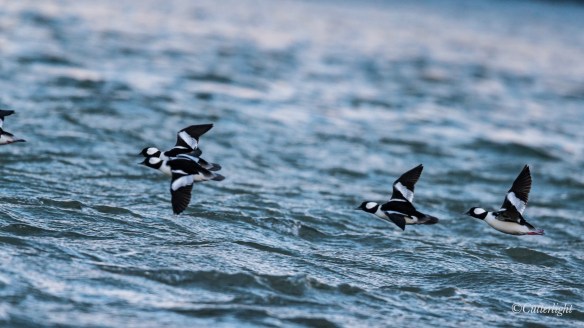
Bufflehead drakes in flight, Chignik River. (December 3, 2016)

This is about as close as I’ve been able to get to one of these shy little ducks. Clearly if I’m to improve my photographs of this species, I’ll need to set up a blind and put patience to practice. (Chignik River, January 17, 2017)

Bufflehead Range Map: with permission from The Cornell Lab of Ornithology, Birds of the World

Bufflehead Bucephala albeola
Order: Anseriformes
Family: Anatidae
Bucephala:  Ancient Greek, boukephalos = bullheaded
albeola: from Latin albus = white

Status at Chignik Lake, 2016-19: Common in late Fall, Winter and early Spring

David Narver, Birds of the Chignik River Drainage, summers 1960-63: Not Reported

Alaska Peninsula and Becharof National Wildlife Refuge Bird List, 2010Rare in Spring, Fall and Winter; Absent in Summer

Aniakchak National Monument and Preserve Bird List: Present

loon silhouette

Previous: Barrow’s Goldeneye

Next Article: Common Merganser – She Wears the Crown

*For a clickable list of bird species and additional information about this project, click here: Birds of Chignik Lake

© Photographs, images and text by Jack Donachy unless otherwise noted.

Birds of Chignik Lake: Common Goldeneye

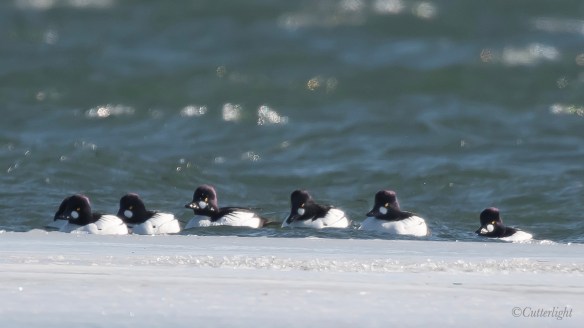
Dapper drake and handsome hen, a pair of Common Goldeneyes hang out at The Lake on a calm, midwinter day. (Chignik Lake, January 2, 2017)

From fall through spring, Common Goldeneyes are indeed common throughout the Chignik River system. Although they seem to generally prefer the lake, they readily shift to the river if ice takes that option away. In either location they spend virtually all of their time on the water, loafing, sleeping or diving for small fish such as sticklebacks and sculpin.

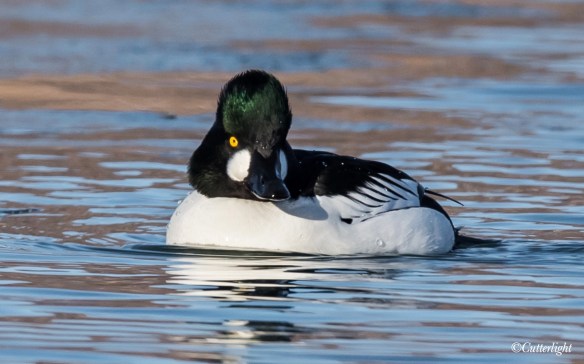
The shimmering emerald green on the drake’s head doesn’t always show; it frequently appears black and in the right light can even look purple. But they’re called “goldeneye” for good reason. (Chignik Lake, January 2, 2017)

Hunted and cautious, these ducks cast a wary golden eye on any indication of human presence. Getting the right combination of somewhat approachable birds on a day calm enough and with enough light to photograph well at a distance is rare in the windblown Chignik drainage. Picking up the binoculars, glassing out the living room window and seeing these white-bodied ducks was a common occurrence. Being granted favorable shooting conditions was far less so.

Seen from straight on, the head shape of many diving ducks is reminiscent of an old-fashioned lightbulb held upside down. I suspect the pronounced jowls have something to do with the prodigious  jaw muscles required for pulling clams out of muck, clamping down on fish and crustaceans, and yanking up weeds. (Chignik Lake, January 2, 2017)

Those bright amber-yellow eyes aren’t the only unmistakable goldeneye characteristic. Many times, Barbra and I have been standing waist-deep in the river casting flies for salmon when our thoughts were interrupted by an approaching high-pitched whistling sound.

“Goldeneyes!”

We didn’t even have to look up, although of course we always did.

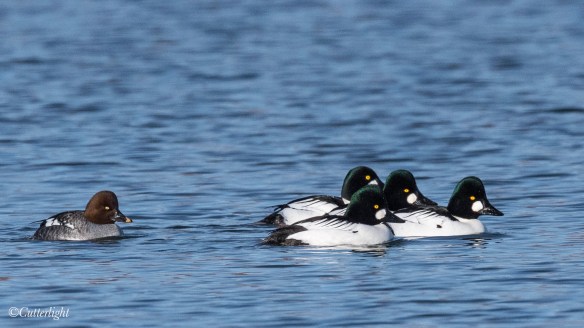
There are times when their numbers on the lake are in the dozens. Here four handsomely-marked drakes are followed by a more demurely-marked hen. Note the yellow at the tip of the hen’s bill. (December 31, 2016) 

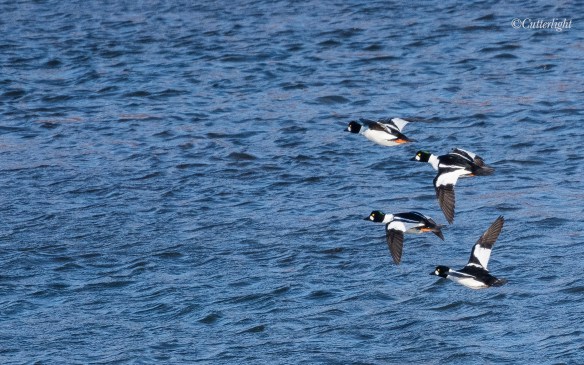
The distinctive whistling sound goldeneyes in flight make has led to their nickname: Whistler. Clangula, their scientific specific name is misleading; they don’t seem to be nearly as vocal as other ducks. When feeding, they are quite active, paddling with purpose and diving in a sudden arch. They often join in with mergansers to cooperatively feed along a shoreline or underwater edge – birds of both species surfacing with wriggling fish.

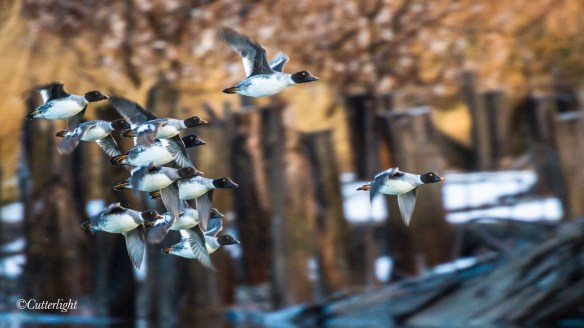
Led by a mature female, this is very likely her brood winging and whistling down the Chignik River. (November 27, 2017)

Although goldeneyes visit The Chigniks, it is unlikely that they breed there. The reason: there aren’t any trees to speak of. Goldeneyes are among the several species of ducks that are cavity nesters, preferring holes in trees that have been hammered out by woodpeckers or that have occurred due to broken off limbs and so forth. The female chooses cavities only a few feet above the forest floor to several tens of feet high, leading to the drama of her brood being forced to literally leap into the world.

Except for a the few White Spruce trees people have planted in the Chignik villages, the area is devoid of large trees. No trees. No tree cavities. No cavity-nesting goldeneyes. With old-growth forests being relentlessly reduced to lumber throughout the boreal regions where goldeneyes breed, installing a nesting box or three (or more) would make an excellent citizen scientist project.

As is the case with other “green-head” drakes, Greater Scaup and Mallards, in certain light the head feathers of Common Goldeneyes can appear purple, as is the case with all seven birds in this photo. (Chignik River, March 12, 2017)

Drakes in Springtime. (Chignik River, May 14, 2017)

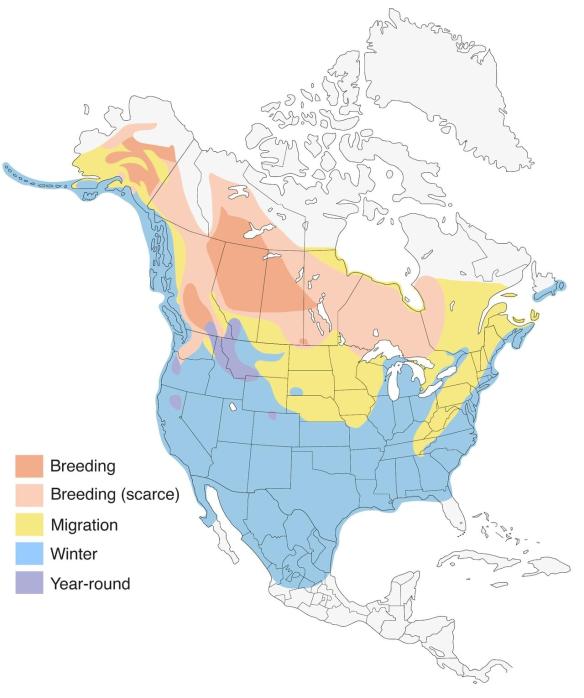
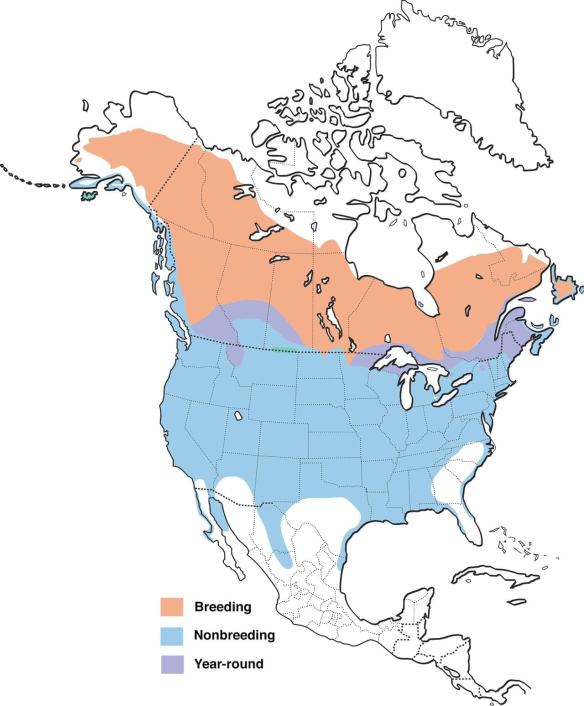
Common Goldeneye Range Map: with permission from The Cornell Lab of Ornithology, Birds of the World

Common Goldeneye Bucephala clangula
Order: Anseriformes
Family: Anatidae
Bucephala:  Ancient Greek, boukephalos = bullheaded
clangula: Latin, to resound

Status at Chignik Lake, 2016-19: Common on Chignik Lake and Chignik River from late fall through Spring

David Narver, Birds of the Chignik River Drainage, summers 1960-63: Common on both lakes in Spring and Fall; rare in midsummer

Alaska Peninsula and Becharof National Wildlife Refuge Bird List, 2010Common in Spring and Winter; Rare in Summer; Uncommon in Fall

Aniakchak National Monument and Preserve Bird List: Present

loon silhouette

Previous: White-winged Scoter – A Lone, Rainy Day Visitor 

Next Article: Barrow’s Goldeneye – a Duck that will Nest in a Box

*For a clickable list of bird species and additional information about this project, click here: Birds of Chignik Lake

© Photographs, images and text by Jack Donachy unless otherwise noted.

Birds of Chignik Lake: White-winged Scoter – A Lone, Rainy Day Visitor

In winter rain… White-winged Scoter. (Chignik Lake, January 6, 2017)

A species that only shows up once in three years at a given location would best be described as “accidental,” and so it is with the White-winged Scoter, a bird much more likely to be found in the salt chuck most of the year. There they take in the usual diving duck diet of mollusks, crustaceans and small fish. Formerly classified as conspecific with Europe’s Velvet Scoter (cool name), White-wingeds nest in boreal forests – and less frequently on tundra – from interior Alaska through western Canada.
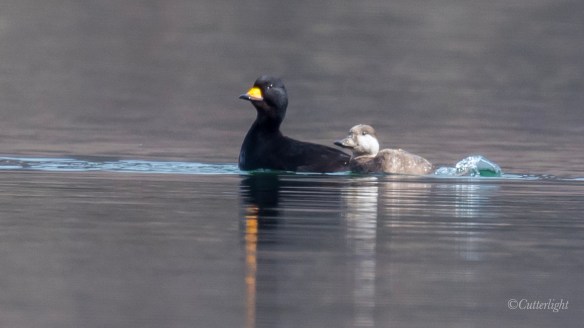
With almost silky-black plumage, it’s easy to see why the European version (Melanitta fusca) is called Velvet Scoter. The colorful bill and Nike eye-swoosh add to the White-winged’s striking look. (Wikipedia: Len Blumin)

I’ve read elsewhere that White-wingeds can be quite difficult to get close enough to for a photograph, so I felt lucky to make good my one opportunity with a bird in flight showing his diagnostic white markings. He was probably passing from one side of the peninsula to the other on that windy, rain-soaked January day when he decided to give the lake a look.

White-winged Scoter Range Map: with permission from The Cornell Lab of Ornithology, Birds of the World

White-winged Scoter Melanitta deglandi
Order: Anseriformes
Family: Anatidae
Melanitta: from Ancient Greek: melas = black; netta = duck
deglandi: Latinization of Degland, for French ornithologist Côme Damien Degland

Status at Chignik Lake, 2016-19: Rare to Accidental on Chignik Lake

David Narver, Birds of the Chignik River Drainage, summers 1960-63: Rare on Chignik Lagoon

Alaska Peninsula and Becharof National Wildlife Refuge Bird List, 2010Common in Spring and Fall; Uncommon in Summer and Winter

Aniakchak National Monument and Preserve Bird List: Present

loon silhouette

Previous: Black Scoter – Springtime Courtship on a Wilderness Lake

Next Article: Common Goldeneye

*For a clickable list of bird species and additional information about this project, click here: Birds of Chignik Lake

© Photographs, images and text by Jack Donachy unless otherwise noted.

Birds of Chignik Lake: Black Scoter – Springtime Courtship on a Wilderness Lake

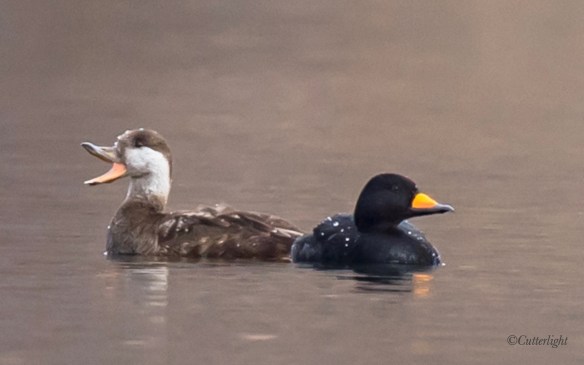
Female (left) and male Black Scoters frequently visit Chignik Lake in springtime, usually in what appear to be mated pairs or small groups of hens and drakes. (Chignik Lake, May 3, 2018)

Formerly lumped together with coots and until fairly recently considered conspecific with European Common Scoters, not as much is known about Black Scoters as is known about most other North American Ducks. A few nests have been found – depressions the female lines with grass in treeless environments. I witnessed a pair mating on the lake, so it might be presumed that they intended to nest someplace not too distant.

After making his intentions known with displays featuring wing-flapping and rearing up with his bill pointed to the sky, Sir mounted his Good Lady. With Narver reporting the species as common on both lakes during summers, Black Scoters must surely nest in the Chignik Drainage. (May 3, 2018)

Considered “sea ducks,” nearby ocean bays are likely where Black Scoters winter. I never saw them on the lake earlier than spring. With the male’s black plumage and bright orange bill, these ducks are unlikely to be overlooked. For that matter, the female too is fairly easily distinguished by her contrasting dark brown cap and pale, almost white, face. If you can get a look at the bill, check for a distinctive hook at the tip. This may be an adaptation for digging up shellfish, the Black Scoter’s favorite food.
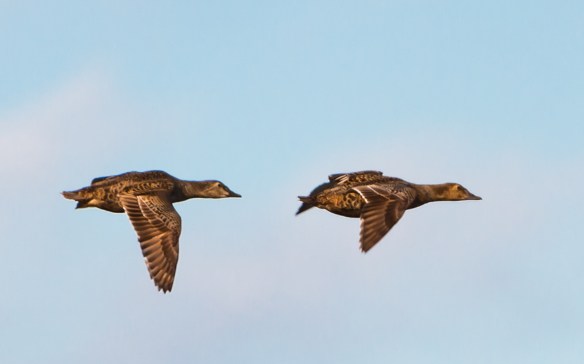
Female Black Scoter in flight over Chignik Lake. Note the hook at the tip of her bill. (August 16, 2018)

Another nearly diagnostic characteristic is the call the drakes produce. Gentle, high-pitched tones sung in a minor key are the norm. At other times the whistling sounds slightly reedy, though still quite pleasant. It’s a music I’ve come to associate with springtime at The Lake.

A peaceful morning on Chignik Lake (May 3, 2018)

Perhaps Chignik Lake is only a stopover for this pair as they travel up the drainage to the marshy tundra around Black Lake where the female will make her nest. Or maybe they’ve already got a nest, above the tree-line on one of the mountains overlooking the lake. The Chigniks remain a wonderfully under-explored and seldom studied corner of the world. (May 3, 2018) 

Black Scoter Range Map: with permission from The Cornell Lab of Ornithology, Birds of the World

Black Scoter Melanitta americana
Order: Anseriformes
Family: Anatidae
Melanitta: from Ancient Greek: melas = black; netta = duck
americana: Latin, of America

Status at Chignik Lake, 2016-19: Occasional on Chignik Lake

David Narver, Birds of the Chignik River Drainage, summers 1960-63: Common on both lakes (Reported by former name, Common Scoter Oidemia nigra

Alaska Peninsula and Becharof National Wildlife Refuge Bird List, 2010Common in all Seasons

Aniakchak National Monument and Preserve Bird List: Present

loon silhouette

Previous: Steller’s Eider

Next Article: White-winged Scoter – A Lone, Rainy Day Visitor

*For a clickable list of bird species and additional information about this project, click here: Birds of Chignik Lake

© Photographs, images and text by Jack Donachy unless otherwise noted.

Birds of Chignik Lake: Steller’s Eider

Female Steller’s Eider, Chignik River. Rarely seen on the river, Steller’s Eiders inhabit The Chignik’s nearby ocean bays and estuaries. (November 16, 2016)

Straight away I could see that the small, dark duck bobbing on the Chignik on a cold, windy, misty November day was something “different.” As it was milling around at a downriver location I couldn’t get to, I snapped a couple of photographs from a distance and hoped I’d be able to figure it out when I got home and could look at my Sibley’s Field Guide and the various bird websites bookmarked on my computer.

I was not guessing eider. New to birding, the only eiders I’d ever seen were further north – rocketing splashes of color pointed out to me by local Natives as they winged by. Brilliantly marked drakes. A friend at The Lake tells me he sees King Eiders down at The Bay. If I can get my boat out to The Lake…

Steller’s Eider drakes are, to say the least, eye-catching when they’re in breeding plumage. (Wikipedia: Ron Knight from Seaford, East Sussex, United Kingdom – Steller’s Eider Polysticta stelleri)

During the breeding season, Steller’s Eiders head to Siberia and the Alaskan Arctic. The rest of the year, the Aleutians and the Alaska Peninsula are good places to find them. As is the case with Brant, Cackling Geese and Emperor Geese, Izembek National Wildlife Refuge, located at the end of the Alaska Peninsula, is a good place to find them.

Like many other diving ducks, eiders are catholic in their diets. At sea they primarily go for mollusks, worms, small fish and crustaceans. While on their tundra breeding grounds, they consume fairy shrimp, insects, grasses, sedges, and berries.

Eiders, Point Hope, Alaska. (August 30, 2012)

These Arctic ducks are especially sensitive to a changing climate. Their numbers are in decline. Probably one reason for this is that as temperatures warm, various predators – particularly those of eggs and nestlings – are able to move northward.

Steller’s Eider Range Map: with permission from The Cornell Lab of Ornithology, Birds of the World

Steller’s Eider Polysticta stelleri
Order: Anseriformes
Family: Anatidae
Polysticta: from Greek: poly = many; sticte = varied or spotted
stelleri: Latinization of Steller – German zoologist/naturalist George Wilhelm Steller

Status at Chignik Lake, 2016-19: Rare Wintertime Visitor on Chignik River

David Narver, Birds of the Chignik River Drainage, summers 1960-63: Not Reported

Alaska Peninsula and Becharof National Wildlife Refuge Bird List, 2010Common in Spring, Fall and Winter; Absent in Summer

Aniakchak National Monument and Preserve Bird List: Present

loon silhouette

Previous: Long-tailed Duck – Political Correctness or Respect… When is a Name Change Merited? 

Next Article: Black Scoter – Springtime Courtship on a Wilderness Lake

*For a clickable list of bird species and additional information about this project, click here: Birds of Chignik Lake

© Photographs, images and text by Jack Donachy unless otherwise noted.

Birds of Chignik Lake: Long-tailed Duck – Political Correctness or Respect… when is a Name Change Merited?

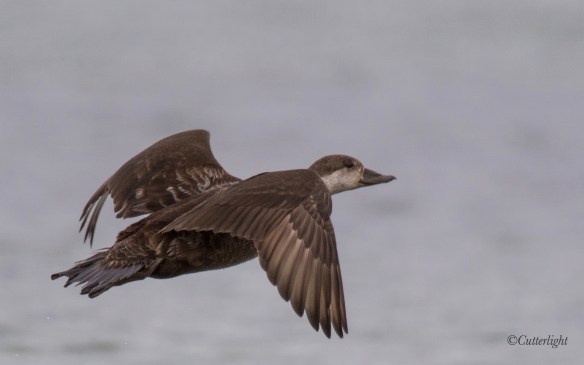
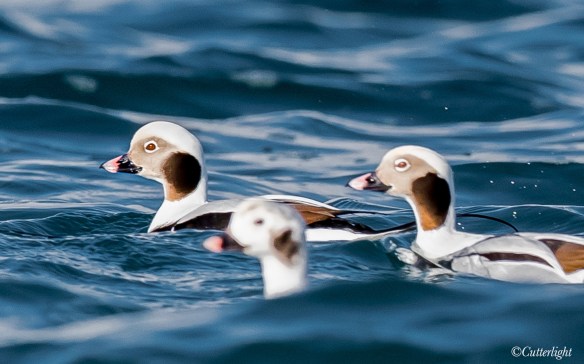
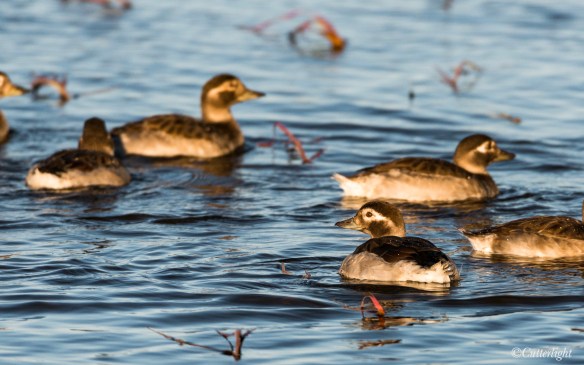
No duck dives deeper (up to 200 feet) or more frequently than the Long-tailed. To catch The Chignik’s handsome, Neapolitan-ice-cream-colored drakes at their most colorful, you’ve got to get out on the lagoon in late winter when they are at their most abundant and resplendent. Later in spring and on through summer, they’ll disperse to tundra ponds where they molt into drabber plumage and lose their eponymous tails. (Chignik Lagoon, March 9, 2019)

You can find passages in older texts in which Long-tailed Ducks are identified by their former moniker, Old-squaws, an appellation assigned to these stunningly beautiful creatures for their habit of gathering in large groups where their somewhat gull-like calls and melodies fill the air almost without cessation. The name is a trifecta of insult – besmirching women, elders, and Native Americans in one fell-swoop. Come to think of it, it doesn’t do any honor to the ducks either. Several thoughts tempt my fingers to give them voice on this keyboard, but I refrain.

On patrol for mollusks and whatever else might be presented during a dive, a Long-tailed (left) ambles along with a female scaup on Chignik River. (December 30, 2016)

When, in the year 2000, the U.S. Fish and Wildlife Service in Alaska petitioned the American Ornithologists’ Union Committee on Classification and Nomenclature to change C. hyemalis’s common name, the committee balked. Categorizing empathy for those who might be offended by the term Old-squaw as “political correctness,” members of the AOU took the position that such sensibilities alone did not justify new nomenclature.

One might reasonably counter, “For goodness sake, why not?” We’re talking about language here; shouldn’t the way we speak be permitted to evolve alongside insight, understanding, and other manifestations of enlightenment?

The above Long-tailed Ducks were part of a group of 13 we came across on an Arctic tundra pond near Point Hope, Alaska. (August 25, 2013)

The objections of some AOU members notwithstanding, the pressure was on. Refuge was found by couching the long overdue change as a matter of maintaining consistency with the rest of the English-speaking world where “Long-tailed Duck” had already long been designated.

The matter of naming birds (and other beings) is interesting. Wouldn’t we all be better served by appellatives that describe a characteristic of the animal in question rather than some anthropomorphized perception of their behavior, or more arbitrary still, the surname of whomever claims first to have “discovered” it?

In any event, in the matter of C. hyemalis, Long-tailed Duck it is. Though, I’ve got to say, I can’t look at a drake in late-winter plumage and not think of that tri-colored Neapolitan ice cream, the candy-red eye a cherry on the chocolate.

From Flattop Mountain, you can take in a view of the Chignik River flowing into Chignik Lagoon. The entire drainage is rich with aquatic vegetation, mollusks and other invertebrates, and small fish, all of which represent potential meals for the area’s waterfowl. (September 21, 2018)

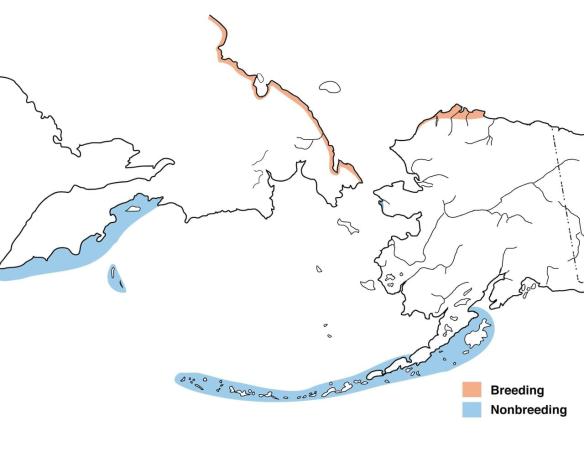
Long-tailed Duck Range Map: with permission from The Cornell Lab of Ornithology, Birds of the World

Long-tailed Duck: Clangula hyemalis
Order: Anseriformes
Family: Anatidae
Clangula: from the Latin clangare = to resound
hyemalis: Latin, of winter

Status at Chignik Lake, 2016-19: Common. At times abundant on Chignik Lagoon; Occasional on Chignik Lake; Summer ?

David Narver, Birds of the Chignik River Drainage, summers 1960-63: Not Reported

Alaska Peninsula and Becharof National Wildlife Refuge Bird List, 2010Common in Spring & Winter; Rare in Summer; Uncommon in Fall

Aniakchak National Monument and Preserve Bird List: Present

loon silhouette

Previous: Canvasback – The Duke of Ducks

Next Article: Steller’s Eider

*For a clickable list of bird species and additional information about this project, click here: Birds of Chignik Lake

© Photographs, images and text by Jack Donachy unless otherwise noted.

Birds of Chignik Lake: Harlequin Ducks – Lords and Ladies of the Aquatic Court

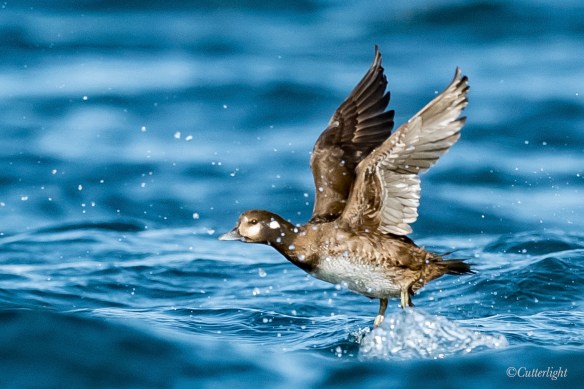
A beautifully marked Harlequin Drake explodes from the waters of Chignik Lagoon. (March 8, 2019)

The nickname Rock Duck is apt for this species that favors swift-flowing, rocky rivers and ocean coasts with wave-lashed rocks. In search of insects, mollusks, crustaceans and small fish, Harlequins go where few other species will venture.  In fact, studies have shown that these birds’ roughhousing ways frequently result in broken bones.

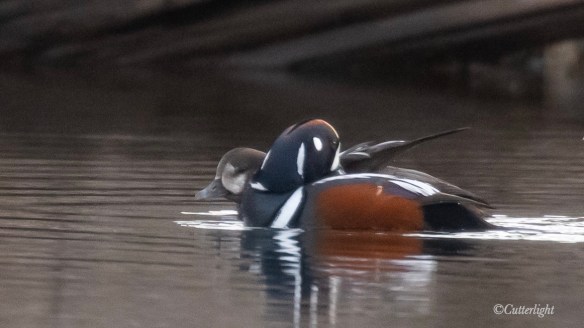
Hen and Drake, Chignik River. (May 5, 2019)

At just 14 to 18 inches in length (34 – 46 cm), these daring ducks may be small, but they are eye-catching. And so another sobriquet, Painted Duck, suits well, particularly when considering the male’s impressively complex plumage featuring rusty red, navy blue, deep aqua and brilliant white. The female’s contrasting white face and cheek dot make her a standout even at surprising distances.

Hens are mousy gray-brown, but that dot near the back of her cheek stands out. Her white face readily distinguishes her from female Buffleheads, which also have the white cheek marking but lack the Harlequin’s white face. (Chignik Lagoon, May 5, 2019)

They’re even sometimes called the Sea Mouse for their rather unducklike high-pitched squeak – and perhaps as a nod to the hen’s mouse-brown plumage as well.

Springtime love – a pair of Harlequins cruises a secluded location on a far bank of the Chignik River. (May 5, 2019)

But it’s hard to imagine a more appropriate appellation for this colorful navigator of mad currents than Harlequin. The name comes from Arlecchino, a character introduced to a form of Italian theater, Commedia dell’arte, in the 16th century. Arlecchino became Harlequin when this type of theater appeared in England. Watching these elaborately-plumed ducks effortlessly bounce down the rock-strewn rapids of a mountain stream, no descriptor could be better than one evoking an actor clad in bright costume and described as “light-hearted, nimble and astute.”1

One Mr. Ellar in the role of Harlequin, 19th century:  Marks, J.L. Details of artist on Google Art Project 

1wikipedia.org/wiki/Harlequin

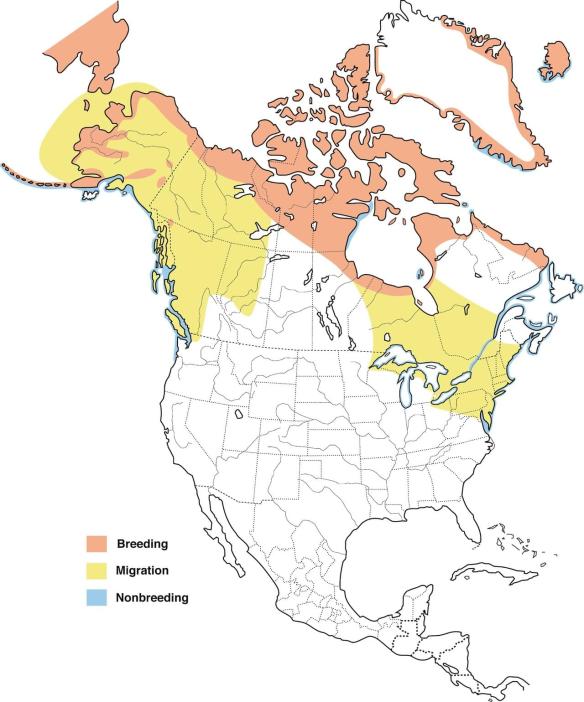
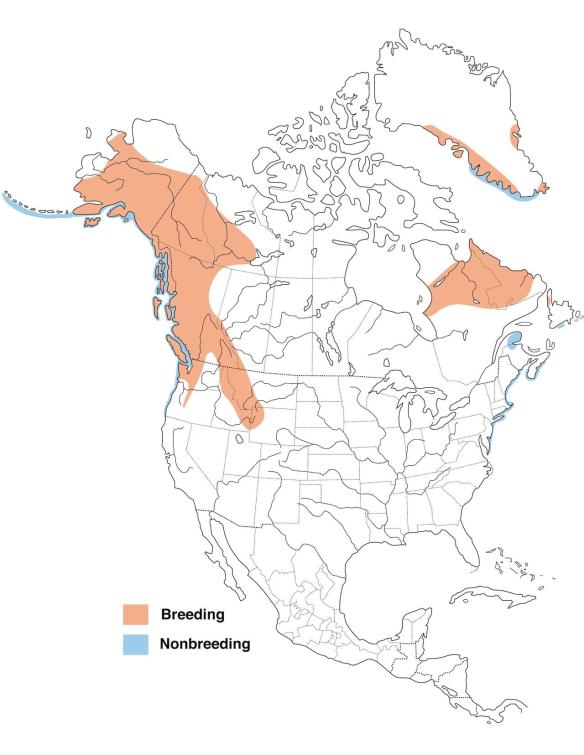
Harlequin Duck Range Map: with permission from The Cornell Lab of Ornithology, Birds of the World

Harlequin Duck Histrionicus histrionicus
Order: Anseriformes
Family: Anatidae
Histrionicus: from the Latin histrio = actor
histrionicushistrio = actor

Status at Chignik Lake, 2016-19: Common. Look for Harlequin in freshwater from spring through early fall; in the lagoon and nearby ocean throughout the year

David Narver, Birds of the Chignik River Drainage, summers 1960-63: Common on all rivers & streams

Alaska Peninsula and Becharof National Wildlife Refuge Bird List, 2010: Uncommon in all seasons

Aniakchak National Monument and Preserve Bird List: Present

loon silhouette

Previous: Canvasback – The Duke of Ducks

Next Article: Long-tailed Duck

*For a clickable list of bird species and additional information about this project, click here: Birds of Chignik Lake

© Photographs, images and text by Jack Donachy unless otherwise noted.