

A Sandhill Crane fluffs his feathers on a patch of tundra and scrub a short hike from Chignik Lake. The photos accompanying this article were all taken on May 23, 2019 within 2½ miles of this village of about 50 residents.

We got an early start and this chubby fellow or gal appears to be barely awake. Wonderful singers, Sooty Fox Sparrows might be the most abundant bird in and around the village right now. Their only rival in that regard are Wilson’s Warblers.
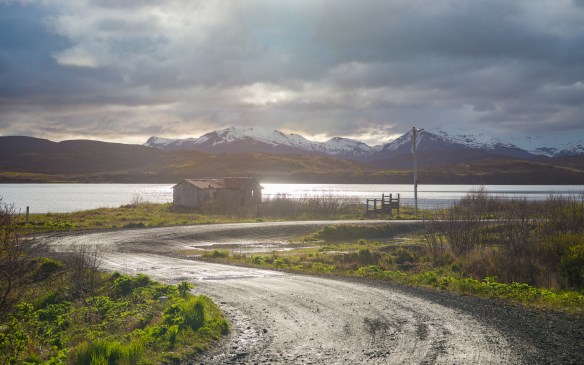
While I focused on a warbler singing near the creek, Barbra turned around and got this elegant frame looking back at one of the village’s abandoned houses and the wooden jungle gym at the old playground.
The weather doesn’t always cooperate. All last night it rained hard and blew a gale, the winds whistling around our snug little home on The Lake. I listened and listened for the little Saw Whet Owl that has been coming around to wake me the past few nights. I could hear waves slapping the sandy beach, the wind… but no owl. There’s light in the sky over the mountains across the lake to the east as I begin this piece of writing in the pre-dawn. Maybe it’ll clear up. After a winter of day after day of spot-on weather forecasts, Spring has returned such prognostication to its usual hit and miss spin of the roulette wheel. It’s supposed to be raining right now, but the sky is clearing. If it does I’ll go out and look for birds. With just four weeks remaining in our life at The Lake, we’re making every day count.
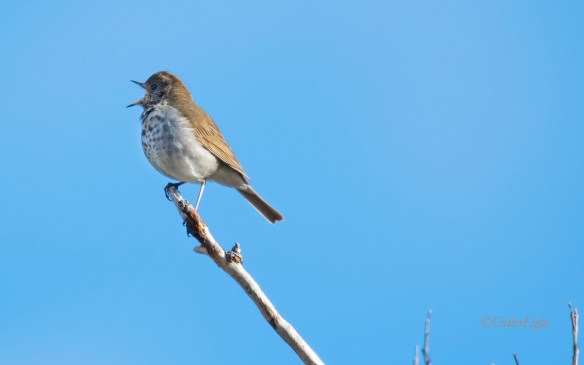
It’s spring and everyone is singing. One of the morning’s objectives was to photograph the Hermit Thrushes that came in with Wilson’s Warblers about a week ago. I’m still looking for a great shot, one with catchlight in the subject’s eye and the bird near enough to crop in portrait close, but this is a start.
Two days ago we woke to a sky that was broken but clearing. The faintest of breezes barely rippled the lake’s surface. We hurried through breakfast, got our camera gear in order, packed a small bag of trail mix and a water bottle, grabbed our binoculars and headed out. Bird song was everywhere and our recently-arrived Tree and Violet-green Swallows had already taken command of the skies. Three elements make for a good birding walk: little or no wind, nice light and birds. We had all three.

We weren’t sure if these Black-capped Chickadees were gleaning insects or gathering nesting material from the last of the catkins in this willow. Either way they didn’t sit still for a moment.
Before we even came to the edge of the village, about a quarter mile walk from our door, we identified 10 species of birds. (There’s a list of what we encountered at the end of this article.) With copses of White Spruce, thickets of alder and willow, salmonberry brakes, open patches of grasses and flowers, rolling terrain, a creek filled with small char and salmon parr and a large lake and river where midges and other insects are constantly hatching, the local landscape features diverse habitat and varied food sources. The dozens of nesting boxes established throughout the village further add to Chignik Lake as a bird paradise.

He’s up there! A tiny speck at the top of the tree on the right, you’d think this Wilson’s Warbler would feel safe from the gentle photographer far below. But I know from experience that as I’m not shooting from a blind, I’m already pushing the bird’s comfort zone. A step or two closer and he’ll disappear.
Thus far in my ongoing project to document birds within a three-mile radius of The Lake, I’ve identified 76 species, the recent appearance of the Saw Whet Owl being the 76th. Because until recently Barbra’s school district didn’t allow teachers to remain in the district’s housing beyond the school year, this is the first summer we’ve been able to stay for summertime birding. Already this has allowed us to more thoroughly document the two species of swallows that visit The Lake each year, and we’re told that a short way down the river is a colony of Bank Swallows as well. We’re keenly interested to see what else might turn up over the next four weeks.

And there he is, all 4¾ inches of male Wilson’s Warbler, dapper in his jaunty black cap, king of his world overlooking Post Office Creek. In previous years we’ve had quite a few Yellow Warblers and a very few Orange-crowned Warblers as well, but no sign of either of those yet.
Wilson’s Snipe nest right here in the village. Their vocalizations and winnowing can be heard throughout the day, but I can count on three fingers the times I’ve been close enough to a sitting snipe to get a decent photograph; I’m still looking for my first Chignik Lake shots.

At times, Golden-crowned Sparrows can be cooperative subjects. We have one that visits the lawn just outside our door multiple times a day and no longer pays much attention to our comings and goings. But the bird in this photo is less accustomed to human traffic and chose to eye us warily from inside a thicket of branches while I composed this shot.
A lightly-traveled ATV trail begins at the Northwest edge of the village and winds its way over varied terrain through patches of crowberry and cranberry, stands of fireweed, willow and alder thickets, bog and tundra all the way to the mouth of Clarks River. We’ve hiked this path often, seldom encountering anyone along the way. Muddy places along the trail often have imprinted evidence of foxes, wolves, bears and moose. We pause often to listen and to look and even to use our noses.

It is a landscape that invites a hike, and on a day like this… who can say “No?”
Every hike is different. The landscape changes from day to day, and with the shifting play of light sometimes the changes are from moment to moment. In the depths of winter, it is possible to hike this trail and encounter nothing save for perhaps a handful of chickadees – a species we’ve come to greatly admire for their intelligence and tenacity. The Native American wisdom that “Every animal knows more than you know,” sinks home when you’re out on a cold, blustery day and these little guys are going about their business, thriving. On this morning we took note of the receding snow line, budding alders, willows leafing out and new flowers, fresh shoots of all kinds of plants popping up everywhere – geranium, yarrow, fireweed, lupine, iris, cow parsnip, star gentian… Each of these plants is like a calendar of the summer, marking the days in different stages of growth.

Is there any plant more graceful than a springtime fern unfurling?
The more you walk, the more you learn, until eventually the generalized mix of bird song is differentiated into individual voices – the chattering of a certain type of warbler, the melancholy Here I am… of a sparrow. What was once a wash of varicolored green becomes an intricate web of individual plants, each kind with its own name, lifecycle and place in this complex ecosystem. Over time you come to know where the owls roost, how to find the nests of ground-nesting sparrows, what kind of tracks have been left in the sand and perhaps how long ago they were placed there. A bird lets you have a glimpse of its form as it flits across the path and where many miles of walking ago you might have thought to yourself “a bird,” you now know precisely what kind of bird and where it might nest and what it likes to eat and you know all this without thinking much about it. It just is.

We have been coming across tracks for close to two weeks – tracks left by large bears, tracks left by sows and their cubs, tracks left by young adults perhaps embarking on their first full season alone. But these were the first two bears we’ve seen this year. Skinny from a dormant winter and quite likely from not having gotten as many salmon as they would have liked given the low return of salmon to the Chignik River last year, these spring bears will manage to begin to put on weight on a diet of grass and tubers. They’ll even eat insects this time of year.
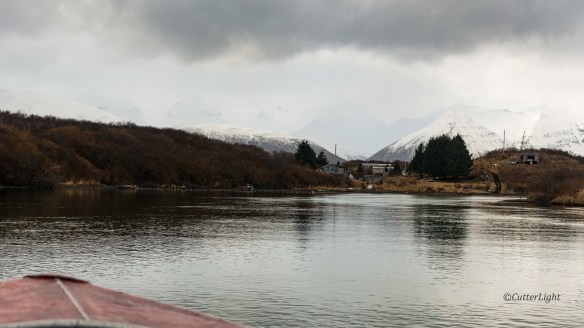
Two miles up the trail a steep bluff provides a vantage point overlooking the lake and an adjacent savannah-like area. We always stop here to glass for wildlife – bears on the beaches, ducks on the water and anything that might happen to be out in the flat where we’ve seen foxes, cranes and signs of wolves, bears and moose. It’s a good place to look for Savannah Sparrows, another species that just recently arrived.

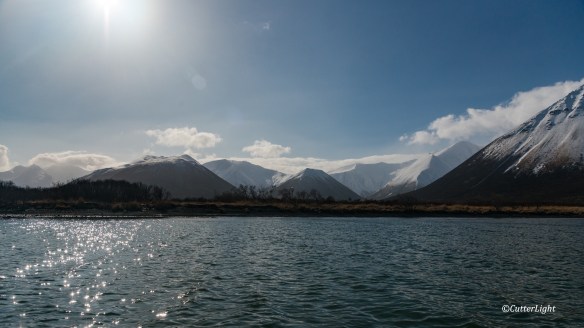
We’ve come to call this view of the lake The Infinity Pool.
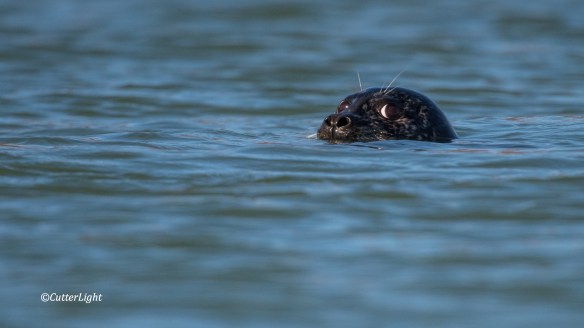
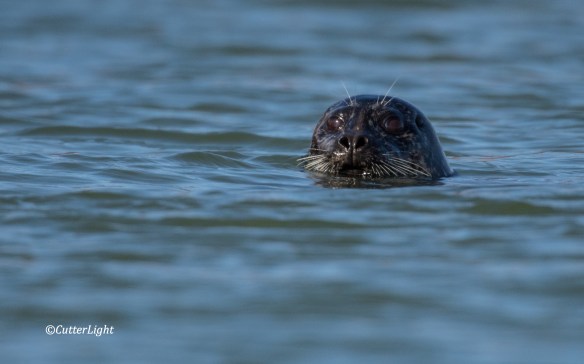
Far out on the lake, a few Black Scoters were milling around, occasionally quacking. A young Harbor Seal, barely more than a pup, popped up to have give us a curious look. Three or four Bald Eagles and half a dozen Mew Gulls were resting on a sand spit at the mouth of Clarks. While Wilson’s Warblers and Fox and Golden-crowned Sparrows seemed to be everywhere, the Savannah Sparrows we’d hoped to photograph proved to be more elusive. Here and there we’d hear their distinctive, almost blackbird-like call, but aside from a couple of distant views through binoculars, we didn’t have much luck. We left the grassy area to follow the lake shore. As our boots crunched along the sandy beach, little schools of shore-hugging salmon parr skittering for deeper water.

This stickleback was so ripe with eggs she could barely swim. I cupped her in my hands for a quick photo and released her into a patch of filamentous algae where she tucked in. The Chignik watershed has two types of stickleback – Three-spined and Nine-spined. Slow swimmers, they are preyed upon by everything from River Otters to Mergansers. Most of the time when I see a duck with a fish, it’s a stickleback.
Seeing young salmon along the lake shore and in the several small creeks feeding in the lake always puts a lightness in our hearts. Sockeyes and Coho and lots of them. When a midge hatch is on, the surface of the lake becomes dimpled as though rain is falling as these fish rise to intercept the insects. When I turned over a few rocks in one of the streams, to my surprise I found the undersides to be thick with mayfly nymphs. There were also a few stoneflies, which equally surprised me. In late summer we’ve been here for the heaviest midge hatches we’ve ever witnessed, but other than sporadic hatches of caddisflies we haven’t noticed much else, a very occasional stonefly and a few small mayflies notwithstanding. The undersides of lake rocks can be thick with caddis cases, so there must be significant hatches of those at some point. And if the feeder streams are home to mayflies, maybe we’ll be around for a hatch of those. There’s always something new to look forward to.
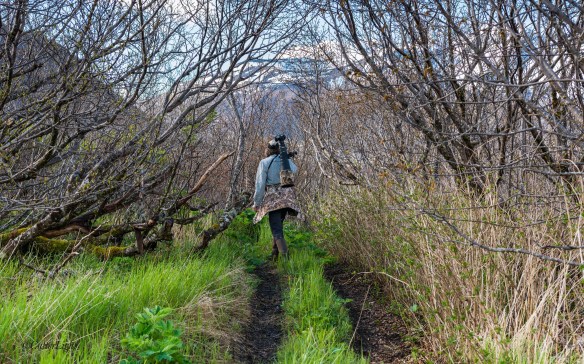
We call this stretch of the trail The Tunnel – a fitting name when it’s crowded in with leafed out alders. We’re usually quiet hikers, but in places such as this where you can’t see more than a few feet ahead, we make a little noise, not wishing to surprise or be surprised by any four-legged beings.
Well, the morning’s half gone. A big patch of blue has pushed its way through the clouds and although the best light is past, it might still be worth it to go out for a look around. Yellow Warblers should be showing up any time now, and I’m still looking for a photograph of a Hermit Thrush with a bit of catchlight in its eye.
Here’s the list of the birds we came across on this walk:
Black Scoter
Common Merganser
Tundra Swan
Greater Yellowlegs
Wilson’s Snipe
Sandhill Crane
Mew Gull
Bald Eagle
Black-billed Magpie
American Robin
Hermit Thrush
Black-capped Chickadee
Tree Swallow
Violet-green Swallow
Wilson’s Warbler
Savannah Sparrow
Golden-crowned Sparrow
Sooty Fox Sparrow
Redpoll
Pine Siskin











 CutterLight