
Frost Fox – of the Chignik Lake Foxes
3

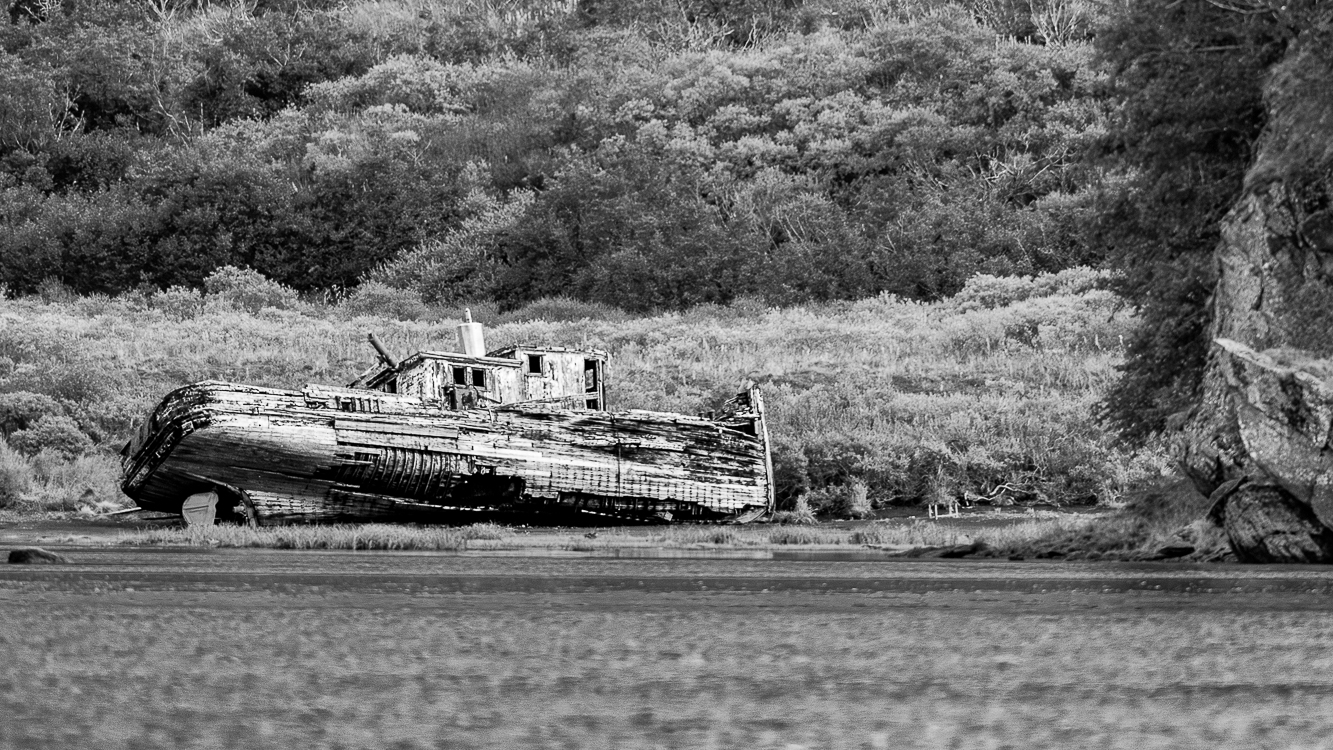
Concurrent with publishing this photo, I’m putting out a request on other social media asking my Chignik friends for more information on this vessel. I don’t know a lot about boats, but I’m fairly certain that this is a salmon seiner, perhaps built sometime in the 1940’s or 1950’s. It was aground, as you see here, about two miles up from the salt chuck when I noticed it tucked into the back of a wide river cove accessible only on high tides. The tide was out, the person whose skiff I was riding in was in a hurry to get down to Chignik Bay, so I settled for this passing shot. I always intended to go back and get additional photographs, but it never worked out. Years later, I saw what appeared to be the same vessel on a beach at Chignik Bay – perhaps towed there by someone who valued its history.
The lesson here, such as a lesson exists, is to be careful… mindful… about passing up shots – even if the composition is imperfect. No doubt every serious photography has in their memory banks a list of pictures that they passed on and later came to regret not getting. You arrive at a new locale, note a species of bird that is new to you, assume that they must be abundant there, pass on the shot and never see another bird like it. You keep telling yourself you’ll make a portrait of that special friend – and never create the right moment. Or you tell yourself that you’ll come back to make a photo of the stunning landscape before you. But way leads to way and you never return.
While no one can get every shot they’re presented with, some of the ones we pass on haunt us. They become very much like those big fish that got away, growing larger over time… until all those photos and fish meld into a single image of a monster of a Japanese Sea Bass emerging from the surf, shaking her massive head, and then dark tunnel vision as the white jig breaks free from her jaws and comes springing back through the air as your knees turn to rubber – that Sea Bass my own personal metaphor for In my life as a photographer: a rare Spotted Redshanks flitting around me as I cast flies to Chignik River Salmon, assuming the bird to be more common than it is; a Parasitic Jaeger stuffed so full of fish it could barely fly perched near me on shore the first time I hiked out to Tikigaq Point, again, making the assumption that this would be a regular occurrence I’d have other opportunities to capture; portraits of my friends and neighbors at The Lake… the “some other day” I was going to photograph them never arriving.
So, imperfect as this photograph is, I’m glad I got it when I had the opportunity. A boat like this will never again be seen on the Chignik.
I’ll update this post if I discover additional information.

If you’re reading this, you are among more than six thousands subscribers and countless additional readers who have popped in at one time or another over the years from virtually every country on the planet. We truly appreciate it! Thanks! Barbra and I wish you and yours all the best in 2024. Van Gogh? An old friend from Chignik Lake.
- Jack & Barbra Donachy, Cordova, Alaska


My love of fire and firelight goes back as far as I can remember. At a young age, I was shown the trick of how to safely pass my fingers through the white of candle light. Later, I learned how to squeeze orange oil from peels onto candle flames to make sparkling sprays of orange-scented light. Learning how to build and tend a fire in our home fireplace followed naturally from those early lessons.
On a December night that could scarcely have been more perfect, I was reminded of these and other happy fire-connected memories as I tended our celebratory solstice spiral fire. Just as we finished setting up the spiral, full darkness descended beneath a cloud-filled sky. As we huddled near the center fire, our breath came out in thick clouds and distant Christmas lights illuminated the far shore of Eyak Lake. A street light flicked on and large snowflakes began to fall in dense, fluffy flurries. The street lamp created magical beams of light that cut through the tall spruce and hemlock forest surrounding the luminaria spiral. I found myself encircled in magic while performing what is probably my favorite job – tending a fire.
I spent many of my growing-up years in California. In sort of a funny irony, the house I lived in had a big fireplace. Of course, as a Californian, once the temperature hit 50° F, it was time to warm up the “chilly” house with a cozy fire. As most of the heat was drawn up the chimney, maybe a fireplace was a perfect adornment to a California home. I spent many winter days and nights close to that fireplace – basking in the warmth and staring into the coals as they assumed ever-changing shapes and fueled fiery imaginary scenes. I had been taught how to build and tend the fire, and so was allowed to stoke and feed it without supervision. There was always something so magical in this activity that I never tired of it.
This pyrofascination continued into my adulthood. I think my prowess in fire tending might have been a selling point to Jack. One of our first adventures together was a camping trip up the West Coast. Looking back, I now believe that the trip was a test. We set up camp the first night. Like a well-choreographed dance, we seamlessly set up the tent together, after which we divided the camp tasks. Jack set up the camp kitchen while I went about making a fire inside a rock-lined circle. I quickly created a small kindling pile topped with a teepee of larger wood. In no time, I had a roaring fire going. Jack was pleasantly surprised. Test passed with flying colors!
It’s been almost fourteen years in Alaska now. Life here has given me an appreciation of the loss and gain of sunlight as the months come and go that I never had in California. When we lived above the Arctic Circle in Point Hope, after Winter Solstice, once the sun again showed above the horizon in early January, we gained an incredible six minutes of sunlight every day. It was as though the sun was racing toward us. By mid-March, we had gone from the total dark of early January to nearly 12 hours of daylight; by late June, the sun never left the sky. In the different places of Alaska we’ve lived, of course, the increase of daylight hours came at different paces. But it is universally true that summer days are long and winters are dark. Regardless of the pace at which the sun returns after solstice, just knowing that daylight is now increasing adds an extra spark of happiness to each day.
We wish you, our readers, many sparks of happiness as we are coming back into long light-filled days. Happy winter solstice!


 CutterLight