A male White-Crowned Penduline Tit pauses bin front of the opening to his nest, Tuul River, Ulaanbaatar, Mongolia. June 13, 2015
Known as the Hatan Tuul or Queen Tuul, the Tuul River constitutes a vital greenbelt in Mongolia’s capital city of Ulaanbaatar, and thus an important refuge for a variety of birds. Noticing a couple of sock-like nests in leafless wintertime trees along the river, we set about to find an active nest the following spring. As the above photograph indicates, we were successful, and although shooting into dense foliage in a valley that only received decent light once the sun had cleared the surrounding tall buildings and mountains presented challenges, we managed to get several captures of both male and female White-crowned Penduline Tits. Only about four inches or slightly less in length (8 to 11 cm) and continuously in motion through leafy trees, they made for challenging subjects.
Woven of soft, cottony material from willows and similar trees, we were told that in former times the nests were occasionally used as children’s slippers. In the above photo, the entryway is mostly obscured behind the bird’s torso. Nest-making is primarily the male tit’s responsibility, and although I can’t at the present locate the source, I recall reading that they may make two or even three nests of which only one will be used. What a cozy home for the nesting female and her brood.
I want that OneEarly morning light splashes a trio of bachelor Takhi in Khustai National Park, Mongolia. December 19, 2024
Although colloquially called “wild” it is a misnomer, technically speaking, to refer to the free-roaming mustangs of North Carolina’s Outer Banks and the American West as such. In both cases, the horses in question are escapees from from domestic stocks and therefore, biologically speaking, are feral, not wild. But neither a 10-year-old boy nor a 64-year-old man is as likely to eagerly crane his neck from a car window to look at merely “feral” horses as for a glimpse of wild horses, and so in most cases the colloquial “wild” stands. In any regard, the distinction matters to some, less so to others.
The word “takhi” translates to spirit or spiritual in English, a fitting appellation for these noble beings – far more so than the alternative, Przewalki’s horse, applied as though the person who “discovered” them for Western Europe has the right to enslave them with his clunky name in perpetuity in an illusory pursuit of his own immortality. Just as all humans have a right to a name of their own choosing, should not all beings be distinguished with their own, unique, noble title.
The above having been accounted for, there is in fact one truly wild species of Equus still remaining in our world – the Takhi of Mongolia. The species was on the very brink of extinction by the 20th century and in fact became extinct in the wild by mid-century, having been hunted for meat. The few remaining Takhi were scattered in zoos in Europe and the United States, their outlook bleak. But in 1990, at the same time Mongolia became a Democracy, a breeding program was established and a few horses were reintroduced to Mongolia’s steppelands – perhaps the world’s greatest remaining uninterrupted grasslands.
And so now, in the year 2023, one can travel to Mongolia’s Khustai National Park and to a few other places and see for themselves these beautiful animals.
It was a long held dream to walk along the ridges of Khongoryn Els, the Gobi Desert’s famed Singing Dunes. Mongolia, October 19, 2014
There are several examples of singing sands around the world. Not to be confused with the pleasant squeak sand sometimes makes as one walks along a beach, these dunes really do sing, producing a range of eerie, harmonious and lovely tones as the wind reshapes the peaks and ridges, causing individual grains of sand to rub against each other. Even the mini avalanches of sand caused by walking can produce music.
A traditional robe worm by both men and women in Mongolia is called a deel. The attire can be quite simple, as in the example I posted a few days ago in the article Herdsman, Mongolia, or beautifully elaborate, as in the finely crafted example this woman is wearing. (February 5, 2016)
This was a challenging image for me to create. The scene occurred in a poorly lighted, poorly staged school auditorium. And at the time, my understanding of how camera’s work was still quite imperfect. A fundamental misapprehension I was laboring under was regarding ISO. No need here to lumber through all the incomplete and inaccurate information I subjected myself to. Instead, let’s take a quick dive into the subject.
First this: ISO is both an acronym and a word. In that way, it is akin to the word-acronym ASAP. I-S-O stands for International Organization for Standardization. According to this organization, the correct pronunciation of ISO is eye-soh, not eye-ess-oh. On that authority, (there is no higher), Barbra and I treat ISO as a word, pronounce it eye-soh, and since despite its capitalization it isn’t a proper noun, we play it in Scrabble. Similarly, during my entire enlistment in the United States Navy, I don’t think I ever heard anyone pronounce ASAP spelled out as A-S-A-P. Instead, ASAP was treated as a word, pronounced A-sap, and was used to mean something like “five minutes ago.” As in, “Petty Officer Donachy! Where is the report I asked you to type up? I need it A-sap!” Thus eye-so and A-sap it is, at least in our house.
Second, allow me to suggest this: It is a wise policy to take with a grain of salt manufacturers’ and marketers’ claims regarding the high ISO levels their cameras and “handle.” I suppose it comes down to what is meant by the word “handle,” but a general truth is that the higher the ISO value, the greater the risk for noise in your images. Noise… graininess, strange lines, aberrant coloration.
If you take a picture in fairly decent light, and you get the exposure right, and you don’t do much retouching, you might get away with a fairly high ISO setting. Since ISO sensitivity varies from camera to camera, I won’t provide an exact number here. “High” means whatever “high” means for each camera. Don’t think too much about specific numbers. It’s the concept here that matters.
Problems associated with high ISO settings will begin to manifest themselves when you a) significantly retouch an image, or; b) attempt to make a large print. Noise will appear as you attempt to darken an overly bright sky, lighten shadows, or sharpen subjects. As a serious photographer, once you begin to notice noise you will start looking for it. You won’t be able to help yourself. That’s good. Because magazine editors, gallerists, clients and others you hope to build relationships with will be looking for it too.
Not advice, but an observation: If you strive to keep ISO settings low, you will find that you have more flexibility in retouching and enlarging images. These days, shooting primarily with a D850, I find myself carefully considering making any image where I have to push the ISO past about 400. If I could make all my images at ISO values of 100 or less, I would. In most cases, I will sacrifice depth of field and shutter speed rather than push the ISO past 800.
Of course, there are times when there isn’t much choice in the matter. I have images of bears and owls that were captured in very low light. In order to maintain shutter speed and avoid motion blur, I had to go with a fairly high ISO. No real choice.
The above photograph? No flash, shutter speed 1250, aperture 2.8, ISO 4000. Were I making this image now, I’d reduce the shutter speed which in turn would allow me to reduce the ISO. Reduced shutter speed might also have given me room to increase the depth of field by closing the aperture a bit. The picture probably looks pretty good on a phone, a tablet or a small computer… but beyond that, I’m limited in what I can do with it.
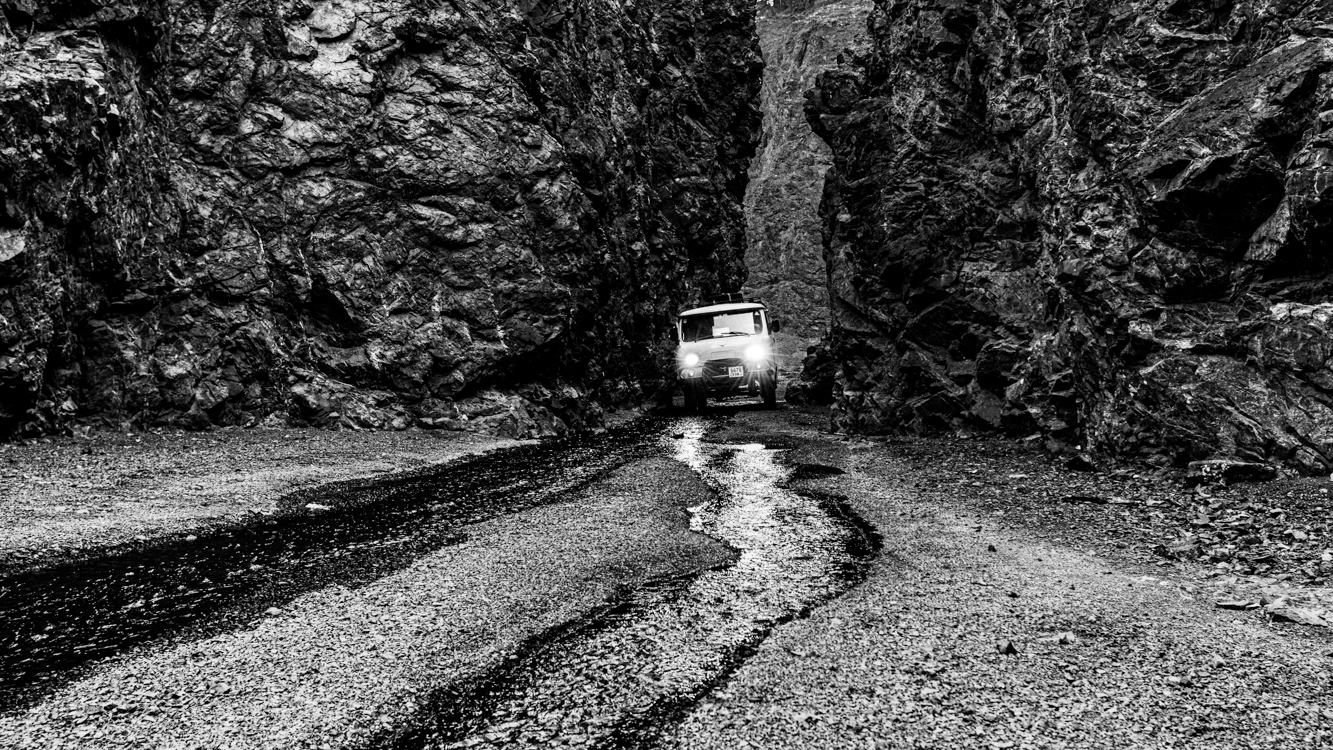
Our driver maneuvers the Russian-built van we were traveling in through a narrow passage in Yolan Am, a gorge in the Gobi Desert named for the Lammergeiers (Bearded Vultures) which are fairly common there.The stream is you see in this photograph is what remains of a thick ice field that builds up in the gorge each winter. In years past, the ice remained year-round. These days, the ice is mostly gone by fall. Gobi Desert, Mongolia, October 19, 2014.
Our brief time in Yolan Am, a narrow gorge in the northern Gobi Desert, was a highlight of our two years in Mongolia. We encountered a number of Siberian Ibex there – the Eurasian wild Mountain Goat, the males of which sport massive, backward curving horns -, a Central Asian Pit Viper, raptors including eagles and Lammergeiers, Red-billed Choughs, Chukars and other birds, Mongolian Pikas, gerbils and other wildlife. We stayed in a nearby ger, a yurt-like home common in the Mongolian countryside, and kept our energy up on traditional Mongolian fare (goat meat and mutton are commonly featured).
The Yolan Am Ice Field, which formerly became several meters thick over the course of each winter and remained throughout the year, now becomes a small stream by early fall. If you get the opportunity, by all means go. The entire Gobi Desert region is fascinating. And things are changing. Quickly.
The sun hadn’t yet crested the horizon when we came upon a covey of these strikingly marked fluff balls – Daurian Partridges in Khustai National Park, Mongolia. December 30, 2014
I’d been shooting for about four years when I took the above photograph. Still not sure what I wanted to photograph, our Lightroom catalogue was becoming populated with images of wildlife, portraits, landscapes, fishing, food, family events and so forth. But no doubt about it, birds have always held a fascination – and, though I didn’t know it at the time, would become my pathway forward.
It may be that for most of us a general approach is the most logical entry into a new endeavor. But based on my own experiences as well as observations of others, it seems that it is not until we specialize that rapid growth begins. So the angler eventually finds her way into fly-fishing, and not just fly-fishing broadly, but a specific type of fly-fishing. A cook becomes a chef when he undertakes to master a specific culinary repertoire. And so on. The interesting thing is that as one specializes, broader skills and knowledge are acquired and sharpened. So that even catching bluegills or frying an egg is performed with greater proficiency… while simultaneously a leap into a new kind of fishing or cooking, launched for a base of expertise, is also made easier.
A generalized approach feels comfortable, particularly at the start of a journey. The broadness, the lack of pressure to get one thing right, feels safe. But if one truly wishes to master a vocation, it is sound advice to not linger overly long with as a generalist. Specialize. Pick an area and dive deep. Take what is in front of you. Doable. For a couple of years, the best angling available to me was carp fishing. Not my first choice of fish, but I lived within a short bicycle ride of a fine river with a good population of the cyprinids, and so I threw myself into it… and saw my skills in virtually all areas of angling improve. Surely this is the way it is with most things – photography, culinary arts, writing, art… Begin the journey with a broad approach, but with eyes open for a narrowing path.
Red-billed Chough, Mongolia. This was one among about a dozen choughs in an open field, gathered around the remains of one of their own – feathers, blood. It appeared that a raptor had made a kill; and the choughs were holding a funeral service.
I must’ve been around 13 years old, walking up the Route 322 hill to my summertime job at Martin’s Exxon Plant when I came upon a stunningly bright Indigo Bunting hovering and circling madly back on forth from nearby brush to the shoulder of the road. There on the stony berm, lifeless, was a brown bird of similar size and shape. His mate. The victim of an automobile – most of which, in this man’s opinion, are permitted to travel far too fast for anyone’s safety and sanity… this unending modern obsession with “getting somewhere.” I digress.
Male and female Indigo Buntings. Plate by Louis Agassiz Fuertes in Birds of America (1917) edited by Thomas Gilbert Pearson (1873-1943) et al.
It was my first encounter with the deeply rooted connection – emotions – birds can feel for one another. Fearing the frantic male’s behavior would result in him joining his mate as a victim of the traffic whizzing by, I picked her up and placed her in an open area in the brush away from the highway. So that he could mourn more safely.
As years went by I witnessed other examples of similar behavior among various species of birds: crows, magpies, a pair of Narcissus Flycatchers – the one fallen and the one who would not leave his or her mate’s or offspring’s side. A group of Magpies that would not leave an injured member of the flock. A family of Ravens appearing to search for a child that had gone missing.
But the behavior of these Red-billed Choughs was a first for me: not merely a pair of birds bonded through nesting and breeding, but a small flock, gathered on the ground, unwilling to leave a fallen brother or sister. I wish I had thought to make a video record of the event.
On the other side of the rock the chough in the above photograph is perched upon was a jumble of feathers, bony, disembodied feet, blood. The remains of a friend, a loose circle of other choughs pacing solemnly around those remains. I have since wondered what, if anything, the bird in the photo’s perch on the rock, slightly above the others, may have indicated about its status.
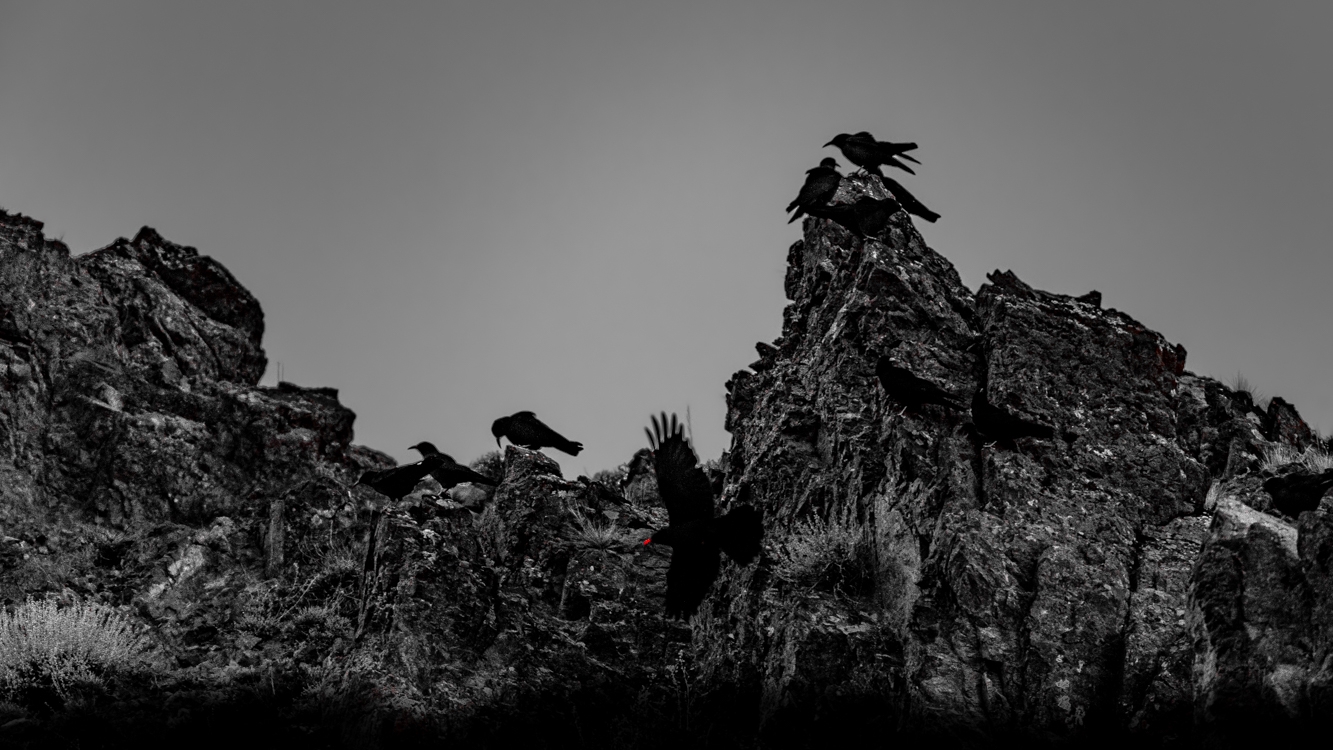
Red-billed Choughs at Dusk Gobi Desert, Mongolia, October 20, 2014
I decided to render this as a subtle duotone – a two-colored photograph – by enhancing the red on the one (and only) bill that showed the characteristic coloration of this corvid species. There was very little light when I captured this hand-held image; thus the remaining bills on these otherwise mostly black birds appear in colorless silhouette. Duotones can feel a bit gimmicky, but I like the effect here. What do you think?
I have begun working on a color portrait of one of these fascinating birds and will publish it tomorrow if all goes well.




 CutterLight