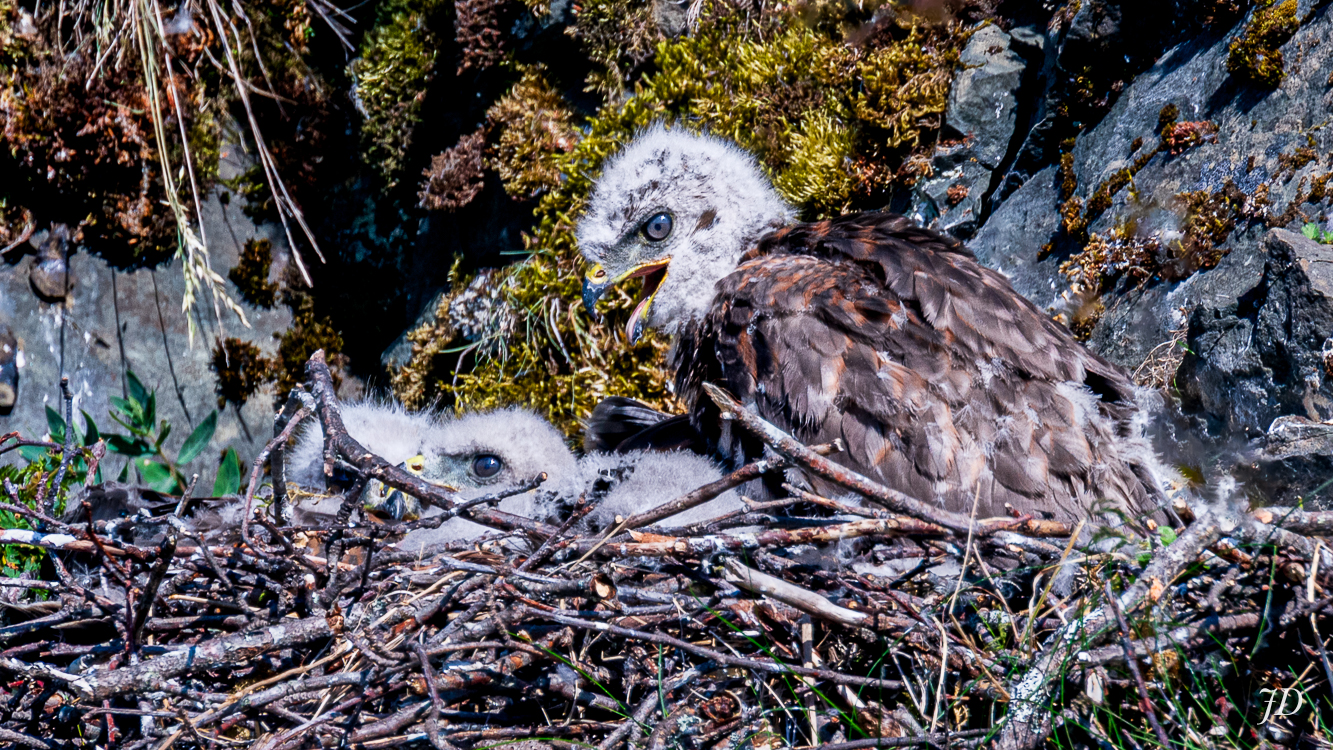
Hawk Chicks

Rough-legged Hawk Chicks
Chignik River, Alaska Peninsula, July 14, 2020

When I had the opportunity to make images of the Rough-legged Hawk nest at the cliffs along the lower Chignik River, I was still thinking of myself as primarily a documentarian. Additionally, human proximity to the nest was clearly upsetting to the chicks as well as to the parents. And so, a couple of times I waded into the river, made quick photographs, and left. Documentation accomplished.

In hindsight, it might have been worthwhile to construct a blind at a respectful distance and to thereby more thoroughly record the nesting events that occurred every summer until recently at this little ledge about 60 feet up from the surface of the river. A regret is that I never made a video of the birds. Unfortunately, in July 2021, a magnitude 8.2 earthquake rocked the Chignik area and in so doing deposited a volleyball-sized boulder squarely in the center of the nest. The little ledge had always been a precarious site – exposed at times to high winds, vulnerable to potential predation by our resident Great Horned Owls, and subject to regular skiff traffic (and associated engine noise) – and in fact the summer of the big quake after laying just one egg, for unknown reasons the hawks abandoned the nest, before the earthquake struck.

After the big earthquake, with a large rock left in the middle of the nest, the site was no longer usable. We think we discovered a new nest further up the drainage, so hopefully Rough-legged Hawks will continue to be a part of Chignik fauna.

Mosquito Falcon

Male Tree Swallow
Chignik Lake, Alaska Peninsula, May 23, 2020

I was surprised this morning when I checked the Cornell Lab of Ornithology’s All About Birds site to note the absence of Tree Swallows on the Alaska Peninsula on Cornell’s range map. In fact these birds are common at least as far Southwest on the peninsula as the Chignik River drainage, particularly near settlements where nesting boxes have been established. Further down the peninsula they are listed as “uncommon,” their presence probably limited due to the lack of suitable hollow trees for nesting.

In villages throughout the peninsula the return of swallows each spring is widely anticipated as a true sign of spring. It is reported that one swallow consumes roughly 2,000 small insects (such as mosquitoes and midges) every day. Thus, a nesting box or two installed around one’s home can have a measurable impact on the population of bothersome bugs.

You Comin’?

You Comin’?
Coastal Brown Bears, Chignik River, Alaska Peninsula, June 19, 2020

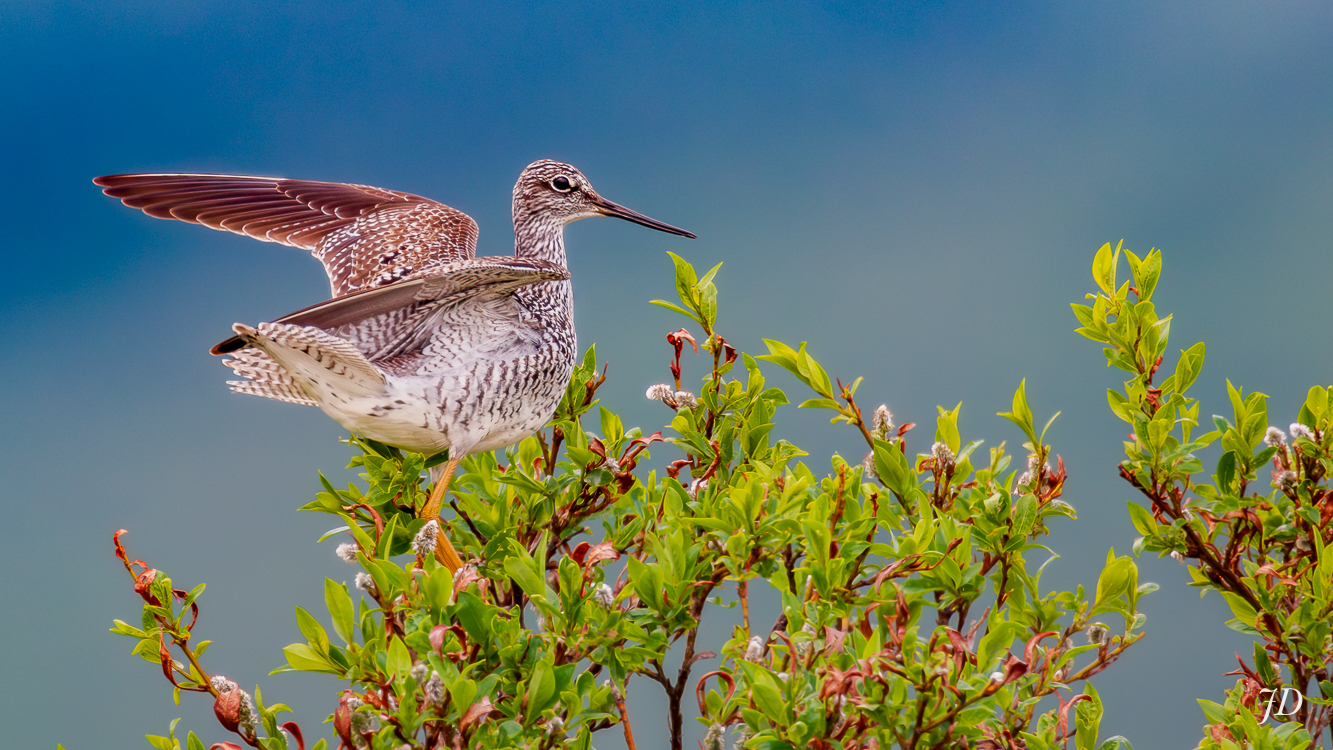
Treetop Shorebird

Treetop Shorebird
Greater Yellowlegs, Chignik Lake, Alaska Peninsula, June 14, 2019

Greater Yellowlegs (as well as Lesser Yellowlegs and Wandering Tattlers) are well known as shorebirds that often perch in trees, particularly near their nesting sights, which are on the ground. They are abundant throughout the Chignik River drainage where they primarily feed on various small fishes.

Waterbird

Waterbird
Greater Yellowlegs (Tringa melanoleuca)
Paradise Bend, Chignik River, Alaska Peninsula, May 17, 2019

May and June of 2019 became somewhat of a turning point both in terms of photography and our relationship with the Chignik. The school at Chignik Lake had failed to meet the state’s requirement for a minimum enrollment of 10 students from kindergarten through grade 12 and was therefore to be closed at the end of May. Barbra was reassigned to the school at Newhalen, 278 miles Northeast up the peninsula, above where the ball of the hip joint might be, on the mainland. We were heartbroken about the move. Artistically, I felt as though I was just beginning to figure out my relationship with the river. Emotionally, we were both deeply attached to the people and the landscape at The Lake.

With the move scheduled for late June (we flew ourselves and everything we owned out on a small plane chartered for us by the school district), I was doing my best to take advantage of good days… good light… and reimagining what our experience at The Lake had meant… what the essence of it had been. And so I began breaking away from strictly representational documentary, looking for images that captured not merely what things looked like, but how we would remember them. JD

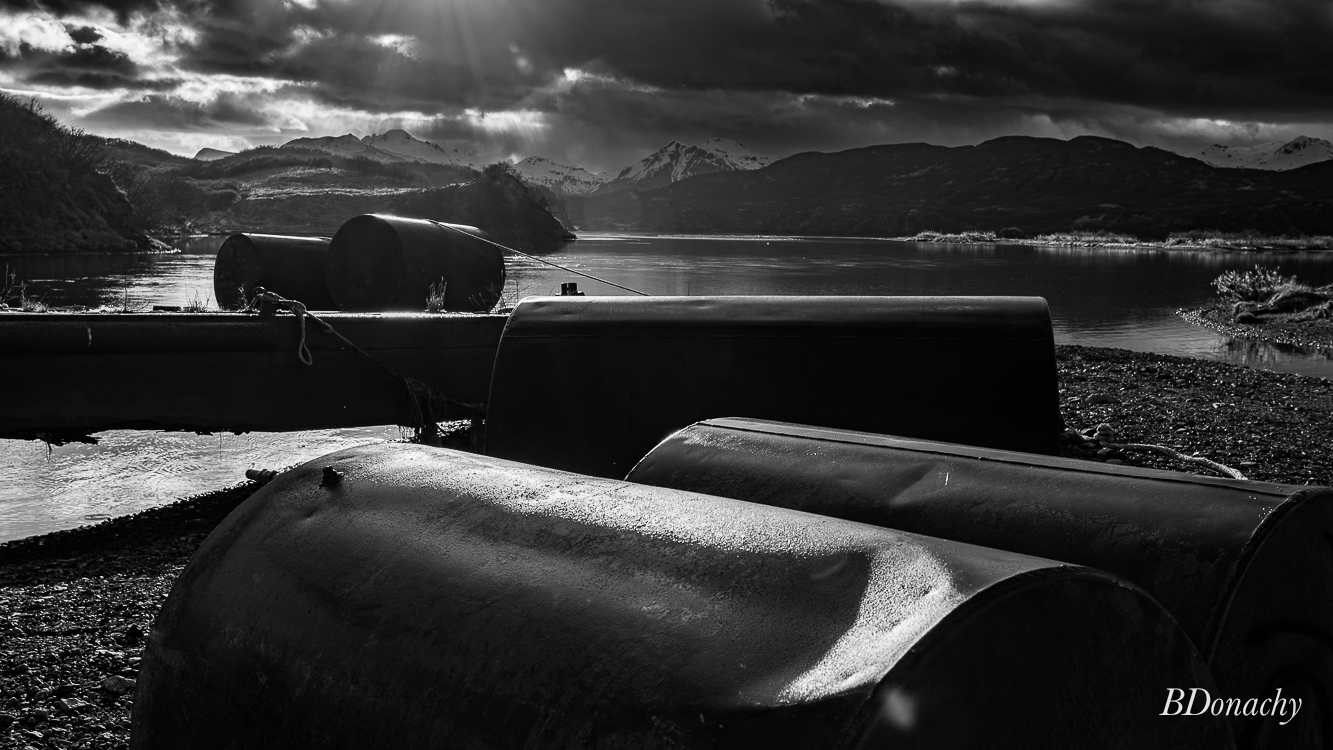
Fuel Oil Drums at The Pad

Fuel Oil Drums at The Pad
Chignik River Barge Landing, May 16, 2019

Barbra has an eye for moody images such as this early morning landscape of diesel oil drums at the barge landing on Chignik River. The scene is the terminus of the three-mile road that travels from the airstrip, winds through the village of Chignik Lake (population 50 something), and then follows the river along steep hillsides till it ends here at the landing. These drums are barged to this point, about six miles upriver from the salt water lagoon, on high tides of about 10 feet or more. On lesser tides, the river is too shallow for the barges to run. From here, the fuel is loaded onto a truck and carried to the diesel generators that provide the village’s electricity. Gasoline, too, along with any sort of large stuff such as vehicles and building material is brought into the village in this fashion.

Such are some of the logistical consideration in a wilderness village.

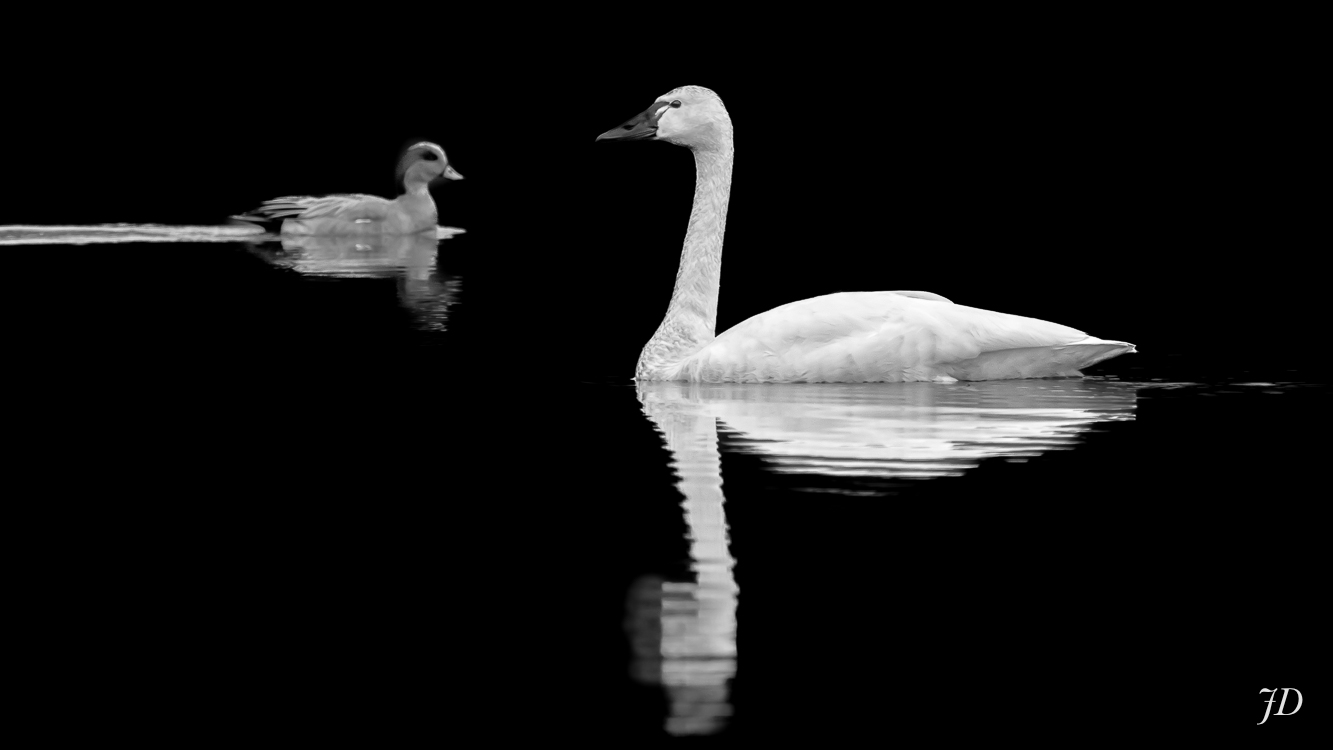
Tundra Swan with American Wigeon at Broad Pool

Tundra Swan with American Wigeon at Broad Pool
Broad Pool on Chignik River, Alaska Peninsula, May 4, 2019

The best place to look for returning Tundra Swans (Cygnus columbians) on the Chignik is at Broad Pool, about a mile downriver from the village. One evening the swans announce their arrival with far off, lonesome-sounding notes and by morning they’ve settled at the pool. There the slow-moving, weedy water provides food for the swans as well as for migrating dabbling ducks such as Mallards, Green-winged Teal, Northern Pintails and American Wigeons. Diving ducks, mostly Common Goldeneyes, Buffleheads, Greater Scaup and both Common and Red-breasted Mergansers are also likely to be present. At this time, the banks are covered in scraggly, winter-brown grasses, sedges, willows and alders and there may still by ice along the river’s edge. By the end of the month the ice is gone and the swans and most of the ducks will have dispersed to nesting areas further up the drainage, but at least one pair of Mallards and another of wigeons usually stay to nest along along the margins of Broad Pool. They are often joined there by a brood or two of Black Scoters.

Good Morning

Good Morning
Alaska Peninsula Brown Bear, Ursus arctos gyas. Chignik Lake, October 3, 2018

Alaska Peninsula Brown Bears share the same genus and specific name as Grizzly Bears of interior Alaska, Canada and the Lower 48: Ursus arctos. They differ only in the subspecific name: gyas in the case of these Peninsula Brown Bears; horribilis for Grizzlies.

I present this image here at a 16:9 ratio because that works well on most screens. But when I print it to show, I will print it as a square and ask that it be hung at eye-level, as a kind of mirror. There is more going on behind those eyes than where the next meal is coming from.

And yes. My heart was pounding wildly to find myself suddenly this close…

Blue Skies and Sunshine

Brown Bear in Sunshine
Paradise Bend, Chignik River, September 24, 2018

We didn’t get a lot of days like the one depicted above out on the cloudy, windswept Alaska Peninsula. Blue skies reflected in the river, sunshine casting everything it touched in a patina of gold. I hurried through breakfast, donned waders and a camouflage jacked, packed my camera into its soft case and bungee-corded it to the front rack of my honda. Two-and-a-half miles down the Top Road I parked near the boat landing, slung 20 pounds of tripod, camera and long lens over my shoulder and followed a trail to the broad, seldom-visited collection of braided water and islands we called Paradise Bend – the best place on the Chignik to catch morning light. Along the trail there were bear and moose tracks in soft mud, the last Wild Geraniums and Yarrow barely holding onto their purple and white blooms respectively. A snipe exploded from a little swale – late in the year for that species to be hanging around. Curious Black-capped Chickadees called from alder thickets and approached on either side to examine the intruder striding through their world and from the river I could hear the ratchety cry of a kingfisher. Further out gulls squawked and chattered – Glaucous-winged and Short-bills -, and I could just barely hear the soft, murmuring quacks of Mallards and Green-winged Teal. A pair of eagles began piping.

As I reached the bend, the wary ducks rose and repositioned themselves further downriver. There were more bear tracks in the sand along with a set of wolf prints, fresh, probably from the previous night. I waded across a river braid out to an island covered in graywacke, set up in front of small wall of autumn-yellow willows and waited. The morning sun poured over my left shoulder, a light breeze touched my right cheek. Salmon splashed in the channel in front of me as well as in shallows two hundred yards downriver to my left. My eyes were drawn to the sky as I became aware of steady, high-pitched honking growing closer – a pair of Tundra Swans winging south.

What a day. All I needed now was for a bear to come by.

Fall Bear

Fall Bear
An older cub traveling with her mom along the Chignik River on the Alaska Peninsula in September