Male Golden-crowned Sparrow on his way to his mate and their babies Chignik Lake, Alaska Peninsula, June 19, 2019
Golf Courses laced with poisons, mosquito traps, bug zappers, Rotenone and other toxins used to remove undesired fish species (and incidentally aquatic insects) from streams, the biological desserts called lawns, industrial agriculture and that “little bit” of whatever “cide” sprayed on the family garden – and all the additional instances in which invertebrate populations are suppressed with toxins and by other means…
…also suppress bird populations.
Even among avian species that typically consume mostly seeds, nuts or nectar, in order for the mother to create viable eggs and for the babies to develop into healthy adults, the rich supply of nutrients insects provide are critical.
The Dandelion Jungle Male Pine Grosbeak (Pinicola enucleator), Chignik Lake, Alaska Peninsula, June 14, 2019: Note his bulging crop – stuffed with dandelion seeds.
I can’t remember a time, ever, when I understood lawns. “We’d have more animals around our house if it was more like the rest of the woods and fields around here,” I once observed to my father. “We don’t want more animals around here,” came the reply. My antipathy toward lawns grew when for a brief time as an adult I owned a home where it was the neighborhood expectation that I keep the yard regularly mowed. And thus, for a while, I joined the ranks of suburban farmers, periodically harvesting a crop of grass. But at least I had the sense to use a mulching mower, thereby returning the clippings to the soil rather than gathering them and thus necessitating an endless need for ever more fertilizer.
The only place at The Lake appointed with a lawn was the school. I suppose it made some sense to keep those grounds trimmed as the yard was a popular play area for children. Fortunately, neither weedkillers nor fertilizer was part of the scene (though after each mowing the maintenance crew insisted, pointlessly, on raking up the clippings – and so it can be assumed that year upon year the soil there loses some nutrition). But thanks to the absence of poisons, all kinds of wildflowers volunteered themselves among the blades of grass: wild strawberries, willowherb, avens, yarrow, and around the edges even lupine and an occasional chocolate lily found a place to put down roots. But best of all I think was the spectacular carpet of dandelions the yard acquired each spring. And fortunately, we were able to prevail upon the lawn crew to delay mowing until well after this event.
All winter long, redpolls, siskins and Pine Grosbeaks – took advantage of feeders, alder cone seeds and spruce cone seeds. And then, when the dandelions went to seed, these finches would descend on the lawn and gorge themselves on nutritious, oily dandelion seeds, filling the yard with their happy chatter.
Chin Scratch American Robin, Chignik Lake, Alaska Peninsula, May 20, 2019
Having long associated American Robins with manicured lawns in the Lower 48, I was mildly surprised the first time I encountered the species along the Chignik River. They were not reported in David Narver’s Birds of the Chignik River Drainage study based on his observations in the early 1960’s, and although they are considered common further up the peninsula, from Aniakchak National Monument and Preserve (which encompasses much of the Chignik Drainage) all the way to Izembek National Wildlife Refuge near the peninsula’s western tip, the species is either not documented at all or is listed as only an occasional migrant.
For the most part, that’s how we encountered them at and near The Lake – a few birds passing through in mid-spring, late summer and early fall. But, they seem to gradually be establishing themselves along the Chignik. In two years, at least one pair remained late into spring, well after the peak of the dandelion bloom. We thought that in at least one of those late springs a pair of robins had attempted to nest. However, the weather became persistently cold, rainy and windy and there was no indication of success.
Along with the weather, abundant magpies and ravens – well-known nest predators – might be limiting factors to breeding robins. Nonetheless, it is likely only a matter of time before American Robins become established as regular nesters on the peninsula, particularly in villages such as Chignik Lake where lawns provide easy access to the earthworms they like to forage on.
Waterbird Greater Yellowlegs (Tringa melanoleuca) Paradise Bend, Chignik River, Alaska Peninsula, May 17, 2019
May and June of 2019 became somewhat of a turning point both in terms of photography and our relationship with the Chignik. The school at Chignik Lake had failed to meet the state’s requirement for a minimum enrollment of 10 students from kindergarten through grade 12 and was therefore to be closed at the end of May. Barbra was reassigned to the school at Newhalen, 278 miles Northeast up the peninsula, above where the ball of the hip joint might be, on the mainland. We were heartbroken about the move. Artistically, I felt as though I was just beginning to figure out my relationship with the river. Emotionally, we were both deeply attached to the people and the landscape at The Lake.
With the move scheduled for late June (we flew ourselves and everything we owned out on a small plane chartered for us by the school district), I was doing my best to take advantage of good days… good light… and reimagining what our experience at The Lake had meant… what the essence of it had been. And so I began breaking away from strictly representational documentary, looking for images that captured not merely what things looked like, but how we would remember them. JD
I almost wasn’t going to show this photo. Despite my nicknaming him Ol’, he’s probably a fully mature but young bull – perhaps in his fourth year. He’s missing his right paddle, and the remaining antler isn’t impressive. In fact, since to be legally taken during Alaska’s moose hunting season the tip to tip, antler to antler spread has to span at least 50 inches (127 cm), he probably wouldn’t have passed muster. So, no Boone and Crockett award here.
But this is easily the closest I’ve ever been to a moose, and when he suddenly emerged -seemingly to simply materialize from a thick tangle of willows, alders and salmonberries, he took our breath away. I had mere seconds to set up and make the shot has he strolled by, appearing unconcerned, barely glancing our way – our own hearts meanwhile racing like mad. Even a young bull such as this weighs close to half-a-ton and although the big ungulates are generally peaceful, mind-your-own-business types, each year here in Alaska more people are injured by moose than by bears. In fact, an Alaska man was stomped to death by a cow protecting her calf less than two weeks ago. So anytime one finds oneself this close to an animal of this size, the thrill involves wildly mixed feelings.
As I mentioned, the moment lasted mere seconds. And then, more miraculously than its sudden appearance, this fellow simply vanished. There was no departing view of dark rump disappearing into the vegetation, no hint of willows and alders shaking as he brushed by them. He crossed before us, I made 12 quick captures, the last of which featuring mainly an eyeball, part of the rack, an ear and his nape… and then he was gone, swallowed without a sound into a thicket of alders. Had we not been exactly where we were during those few seconds, we would never have guessed a moose was nearby.
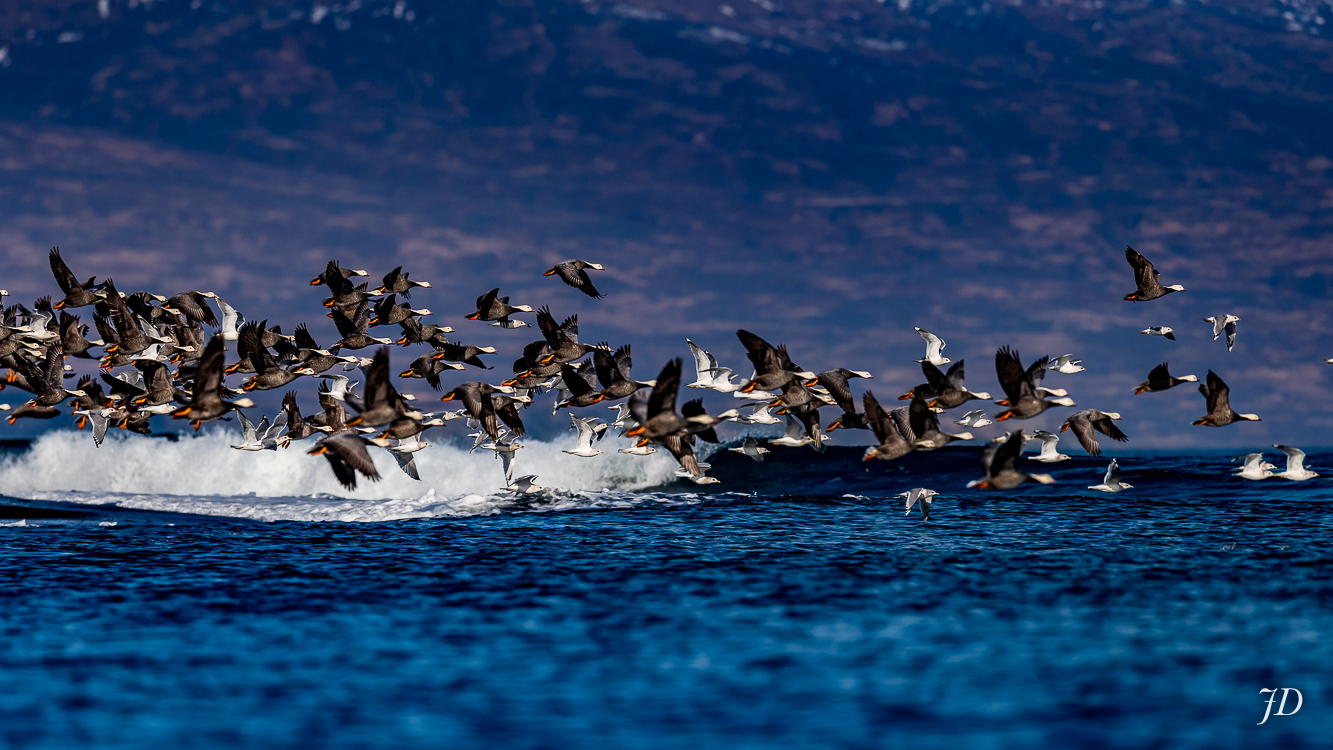
Painted Geese over Breaking Surf Emperor Geese, Chignik Lagoon, March 9, 2019
With the bright white head and nape reminiscent of the ermine capes European Royals of yore garbed themselves in, Emperor Geese (Anser canagicus) present a striking visage. But to catch a glimpse of these smallish, colorful, somewhat rare birds you have to go to coastal Western Alaska or Eastern Russia. A few dozen sometimes stop over at the sand spit at the mouth of Chignik Lagoon on the Alaska Peninsula. That’s where we found this flock, a few Glaucous-winged Gulls mixed in.
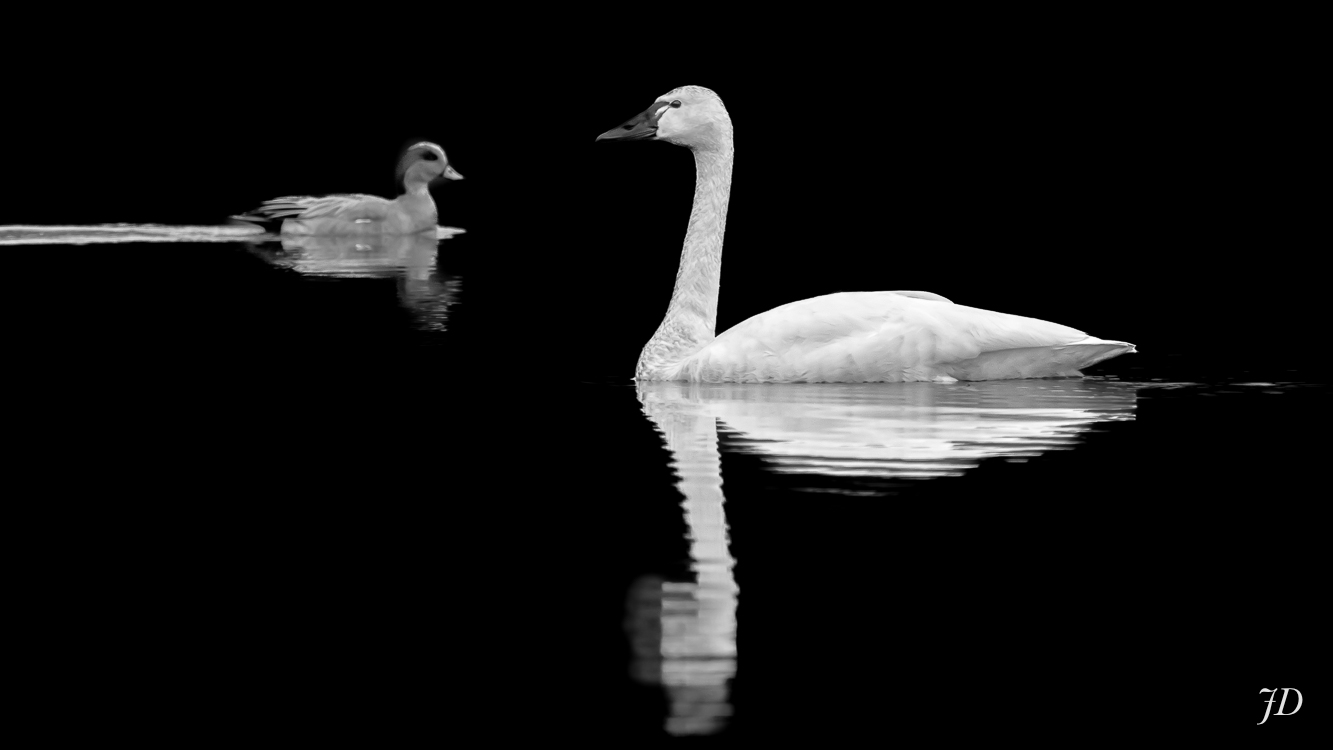
Tundra Swan with American Wigeon at Broad Pool Broad Pool on Chignik River, Alaska Peninsula, May 4, 2019
The best place to look for returning Tundra Swans (Cygnus columbians) on the Chignik is at Broad Pool, about a mile downriver from the village. One evening the swans announce their arrival with far off, lonesome-sounding notes and by morning they’ve settled at the pool. There the slow-moving, weedy water provides food for the swans as well as for migrating dabbling ducks such as Mallards, Green-winged Teal, Northern Pintails and American Wigeons. Diving ducks, mostly Common Goldeneyes, Buffleheads, Greater Scaup and both Common and Red-breasted Mergansers are also likely to be present. At this time, the banks are covered in scraggly, winter-brown grasses, sedges, willows and alders and there may still by ice along the river’s edge. By the end of the month the ice is gone and the swans and most of the ducks will have dispersed to nesting areas further up the drainage, but at least one pair of Mallards and another of wigeons usually stay to nest along along the margins of Broad Pool. They are often joined there by a brood or two of Black Scoters.
Elegant Redpoll (Acanthis flammea) Chignik Lake, Alaska Peninsula, April 25, 2019
Although peninsula checklists list redpolls as uncommon or rare, during our years at Chignik Lake they proved to be common, at times hanging around the village in flocks of dozens. The above bird is a male in brilliant breeding plumage. Although I photographed him in spruce trees and the original forest green background is pleasing, I like the way the black makes the red pop and brings out his eye.




 CutterLight