Hard to say where this bear, a mere dot on this icefield, was coming from. Somewhere across that vastness, heading toward Exit Glacier, down to salmon rivers. To a place I suppose he thinks of as home. 6/13/2011
The hike to Harding Icefield is a little over four miles up a mountain trail, more or less following a ridge above Exit Glacier. Patches of snow, wildflower meadows, birds, bears, maybe other wildlife along the way. There are many vast landscapes in Alaska. The view out over the Harding Icefield, the great mother ice lake that feeds Exit and dozens other glaciers is… otherworldly. We were on a rock outcrop overlooking part of Harding’s eleven hundred square miles. I was preoccupied with alpine flowers when Barbra noticed a trail across the snow-covered ice. It didn’t make sense. Till we spotted the bear.
Moving on from the photos we took in Mongolia, I’m now going through “Alaska Summers.” Some of these catalogues predate our trip to Mongolia. As I come upon images I really like – such as the above composition – I’ll share them here and on Instagram. jackdonachy, if you’re interested in following there. I also put most of these photos on Facebook – Barbrajack.
I like this photograph for the way it recalls a quote by Bob Dylan that describes Barbra, and me, and maybe this bear, and maybe you.
I was born very far from where I’m supposed to be, and so, I’m on my way home…
The sun hadn’t yet crested the horizon when we came upon a covey of these strikingly marked fluff balls – Daurian Partridges in Khustai National Park, Mongolia. December 30, 2014
I’d been shooting for about four years when I took the above photograph. Still not sure what I wanted to photograph, our Lightroom catalogue was becoming populated with images of wildlife, portraits, landscapes, fishing, food, family events and so forth. But no doubt about it, birds have always held a fascination – and, though I didn’t know it at the time, would become my pathway forward.
It may be that for most of us a general approach is the most logical entry into a new endeavor. But based on my own experiences as well as observations of others, it seems that it is not until we specialize that rapid growth begins. So the angler eventually finds her way into fly-fishing, and not just fly-fishing broadly, but a specific type of fly-fishing. A cook becomes a chef when he undertakes to master a specific culinary repertoire. And so on. The interesting thing is that as one specializes, broader skills and knowledge are acquired and sharpened. So that even catching bluegills or frying an egg is performed with greater proficiency… while simultaneously a leap into a new kind of fishing or cooking, launched for a base of expertise, is also made easier.
A generalized approach feels comfortable, particularly at the start of a journey. The broadness, the lack of pressure to get one thing right, feels safe. But if one truly wishes to master a vocation, it is sound advice to not linger overly long with as a generalist. Specialize. Pick an area and dive deep. Take what is in front of you. Doable. For a couple of years, the best angling available to me was carp fishing. Not my first choice of fish, but I lived within a short bicycle ride of a fine river with a good population of the cyprinids, and so I threw myself into it… and saw my skills in virtually all areas of angling improve. Surely this is the way it is with most things – photography, culinary arts, writing, art… Begin the journey with a broad approach, but with eyes open for a narrowing path.
Red-billed Chough, Mongolia. This was one among about a dozen choughs in an open field, gathered around the remains of one of their own – feathers, blood. It appeared that a raptor had made a kill; and the choughs were holding a funeral service.
I must’ve been around 13 years old, walking up the Route 322 hill to my summertime job at Martin’s Exxon Plant when I came upon a stunningly bright Indigo Bunting hovering and circling madly back on forth from nearby brush to the shoulder of the road. There on the stony berm, lifeless, was a brown bird of similar size and shape. His mate. The victim of an automobile – most of which, in this man’s opinion, are permitted to travel far too fast for anyone’s safety and sanity… this unending modern obsession with “getting somewhere.” I digress.
Male and female Indigo Buntings. Plate by Louis Agassiz Fuertes in Birds of America (1917) edited by Thomas Gilbert Pearson (1873-1943) et al.
It was my first encounter with the deeply rooted connection – emotions – birds can feel for one another. Fearing the frantic male’s behavior would result in him joining his mate as a victim of the traffic whizzing by, I picked her up and placed her in an open area in the brush away from the highway. So that he could mourn more safely.
As years went by I witnessed other examples of similar behavior among various species of birds: crows, magpies, a pair of Narcissus Flycatchers – the one fallen and the one who would not leave his or her mate’s or offspring’s side. A group of Magpies that would not leave an injured member of the flock. A family of Ravens appearing to search for a child that had gone missing.
But the behavior of these Red-billed Choughs was a first for me: not merely a pair of birds bonded through nesting and breeding, but a small flock, gathered on the ground, unwilling to leave a fallen brother or sister. I wish I had thought to make a video record of the event.
On the other side of the rock the chough in the above photograph is perched upon was a jumble of feathers, bony, disembodied feet, blood. The remains of a friend, a loose circle of other choughs pacing solemnly around those remains. I have since wondered what, if anything, the bird in the photo’s perch on the rock, slightly above the others, may have indicated about its status.
We came across this herdsman tending goats in Khustai National Park, Mongolia. August 7, 2013
I rendered this as both a monochrome and a color image – a coin flip as to which I prefer.
I’d been interested… very interested… in photography ever since my early teens, but I didn’t pick up a camera and use it in any meaningful way until we traveled to Arctic Alaska, four years prior to the above photograph. I could have benefitted – perhaps a great deal – from a formal course of study in the subject. I guess. I’m not sure. Generally speaking, there are both benefits and drawbacks imbedded in the process of learning from others; just as there are benefits and drawbacks to learning on one’s own. Despite four years of somewhat purposeful shooting in Alaska, when we arrived in Mongolia I still didn’t really understand how a camera works. Nor did I have a vision of what kind of images I hoped to make. But once in a while I saw something I liked and I did what I could to make a capture… camera settings often somewhat randomly chosen, insufficient thought and visualization as to what the final, retouched image might look like (or what I hoped it would look like)… and any time a human subject was involved, struggling to overcome what is at times almost crippling shyness and apprehension on my part in order to get the picture. Often failing to overcome that apprehension and letting the moment pass.
So the question remains: Would I have benefitted from, for example, attending formal classes in photography at a respected institution under the guidance of expert instructors? Well, yes, for certain in regards to speeding up my learning curve with respect to technical and scientific aspects as to how a camera works and how film or an image sensor interprets light, and to gain a better understanding of the interplay between camera bodies and lenses. I read, on my own, and viewed a number of instructional videos addressing these subjects… and can report that while they were somewhat helpful, there is a lot of misinformation, and incomplete information, and misleading information on these matters – much of it dispensed by experts and by people who present themselves as experts. People who perhaps know what they are talking about or writing about, but who are not teachers and who don’t know how to teach and who have a difficult time imagining or understanding what a student needs to know… or how a student will receive and apply a given piece of information. Setting that aside, I suppose the answer is probably “Yes,” I – or anyone new to photograph – would benefit from interactive instruction where the primary purpose is to acquire knowledge of how a camera works and how light works and how a camera interprets light.
I suspect such a course of study would be helpful in the same way that prior to writing a novel or a magazine article, it’s necessary to have acquired an understanding of punctuation, syntax, paragraph structure and plot. Understanding basic structures – in any endeavor – can spare one from a lot of fumbling around.
But I wonder if, after 10,000 hours of mindful practice (a concept toward mastery I fundamentally accept), the person who began the journey initially studying under a master doesn’t end up more or less at the same place as the person who embarked alone, and vice versa. After all, whether the matter at hand is photography, writing or fly-fishing, once basic skills are acquired it is left to each individual to determine their own path as to how they hope to develop those skills. Realistic or conceptual; poetry or prose; salmon rivers or saltwater flats.
A problem with instruction beyond basic concepts is that it can end up creating a box around the student.
So… I think that, if it’s an option, by all means find someone from whom to learn the fundamentals – in any endeavor. But don’t linger there. Get the basics. And then go out and put them to use… learning more basics along the way, but more importantly, freeing oneself to pursue one’s own passions and to thereby develop one’s own vision.
I suppose the main thing, in any endeavor, is simply to get started.
Looking out across the Chukchi Sea from the very tip of Tikigaq Peninsula. Near Point Hope, Alaska, August 12, 2012.
It was a two-and-a-half mile walk from our home in Point Hope to the terminal point of Tikigaq Peninsula where it hooked into the Chukchi Sea. Cape Lisburne lay to the north; other rocky sea cliffs lay to the southeast. Dense colonies of seabirds – murres, puffins, various ducks, gulls and other birds – nested in these natural sanctuaries, and if you stood at the tip of the peninsula you could watch the adult birds fly back and forth all day long in the summer, in one direct bills and bellies empty, on the return their bellies crammed full of food and what they couldn’t fit in their bellies hanging from their bills. Sand Lances and other fish to be presented to nesting mates and offspring. It was a difficult hike out, a good bit of it along a pebbled beach. At that time in our lives we hadn’t yet made a study of wildflowers, but they were abundant and brightened the path. And you never new when you might come across an Arctic Fox, a Snowy Owl or something else of interest.
Hiking for any distance along a sand beach becomes work, and If you’ve ever walked far along a pebbled beach you know that pebbles make for an even more arduous hike. The ocean breeze was almost always cold at that latitude above the Arctic Circle.
Wishing at times to travel light, we did not always take camera gear.
Which was, of course, a mistake.
One morning in early fall, we arrived at the point and – not knowing what we were in for – found ourselves looking out at more birds than we had ever in our lives seen. Quite probably, more than we will ever see again. Wave upon wave of puffins, murres, kittiwakes, shearwaters and I don’t know what else were streaming out from the cliffs and capes, chicks fledged, the season over. Most of these seabirds would not return to land again until the following spring when they would begin a new nesting season. We had seen films depicting African migrations of wildebeests and other ungulates, and in Alaska of great herds of caribou, and those films were called to mind. I once, in Kentucky, found myself amidst a late spring migration of Box Turtles; I pulled my car to the shoulder and assisted over a dozen of them safely across the country road I was traveling. If I had that to do over, I’d have stayed for as long as it took and helped more…
Surely that morning on the tip of Tikigaq, Barbra and I were witness to one of the world’s greatest migration events. We felt, suddenly, a deep connection with… something… overwhelming. Thoreau’s contact, or a final couplet from Wordsworth:
To me the meanest flower that blooms can give Thoughts that lie too deep for tears.
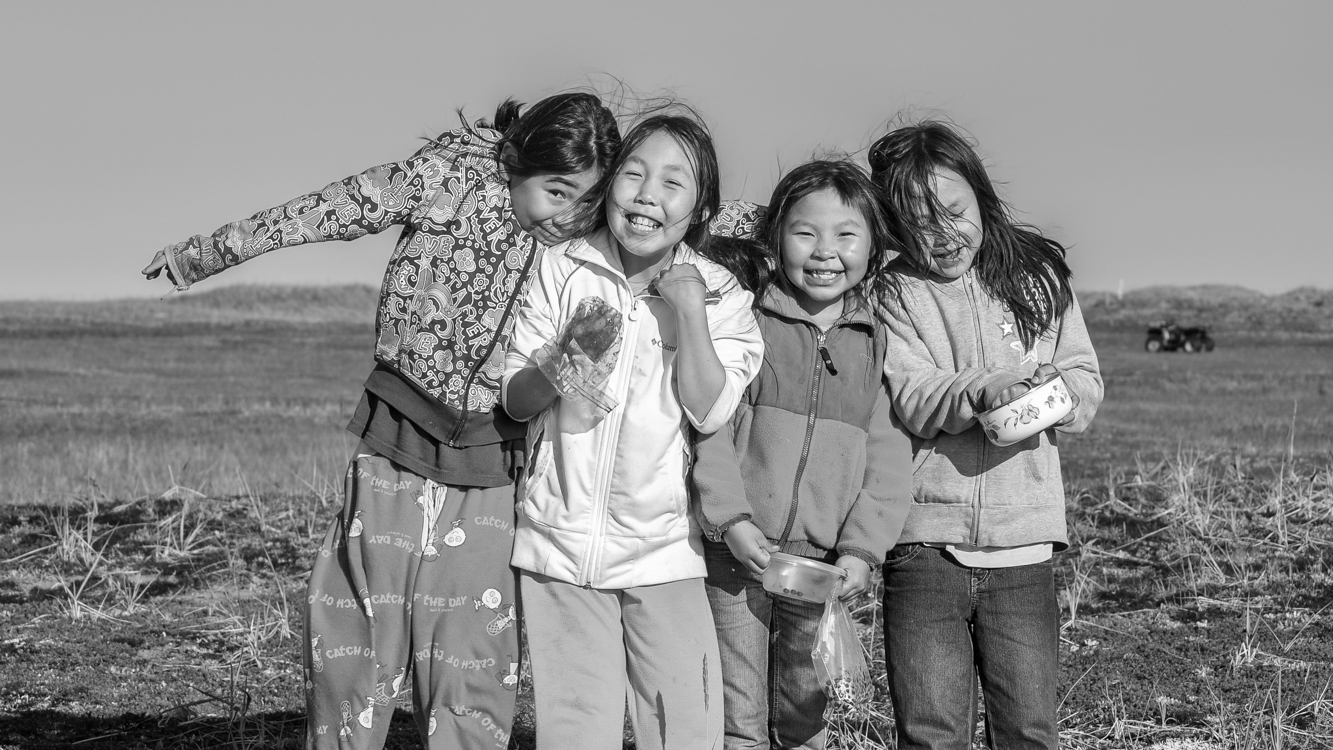
Blueberry picking on the Arctic tundra. This photograph was used in a Ted Talk about Climate Change. Sarichef Island, September, 2010
As is the case anywhere one might go, there are multiple realities in Shishmaref – or in any bush village. Some of these realities fit together neatly in a positive and even happy manner, like smiling faces after berry picking on a pleasantly crisp fall morning. Some realities exist more as collective memories, and you’d have to dig and observe closely to find their vestiges. Other realities contradict and clash and it can be difficult to understand how they are connected to the broader cultural, and still other realities go mostly undiscussed – pretended away – as they seep into village fabric like a sludgy toxin.
A reality in the “sludgy toxin” category in most bush communities we are familiar with are the schools. For anyone who was fortunate enough to be educated in a fairly decent k-12 system, or who has taught in such schools, the level of professional misfeasance and malfeasance – the combination of indifference, incompetence and outright corruption in Alaska’s bush schools – would probably defy belief. Before coming to Alaska, Barbra and I taught in good schools in the lower 48. So we know what that looks like. Nothing in that experience prepared us for what we encountered in the Alaskan Bush. The blame, when one talks to many teachers and administrators in bush Alaska, is placed on the children themselves and their parents. These educators and administrators spin their tales to state legislators, the governor’s office, department of education officials, university education departments and anyone else who asks, and Alaska’s state legislators, the governor’s office, department of education officials and university personnel nod along, agreeing that little can be done to improve matters.
But the reality is that any of the schools we taught in, visited or heard about from others could have easily… and I emphasize easily… been improved with a bit of competent administration. The acquiescence to self-serving fictions among Alaska’s leadership – the phony wistful sighs followed by reassurances among themselves that the problems can’t be fixed, so therefore they aren’t obliged to try – continues year after year.
Because it is easy to dismiss these bush schools and the Native communities they serve. After all, these are other people’s children.
Thank you for allowing me to finally get that off my chest. Comments, as always, are welcome. JD
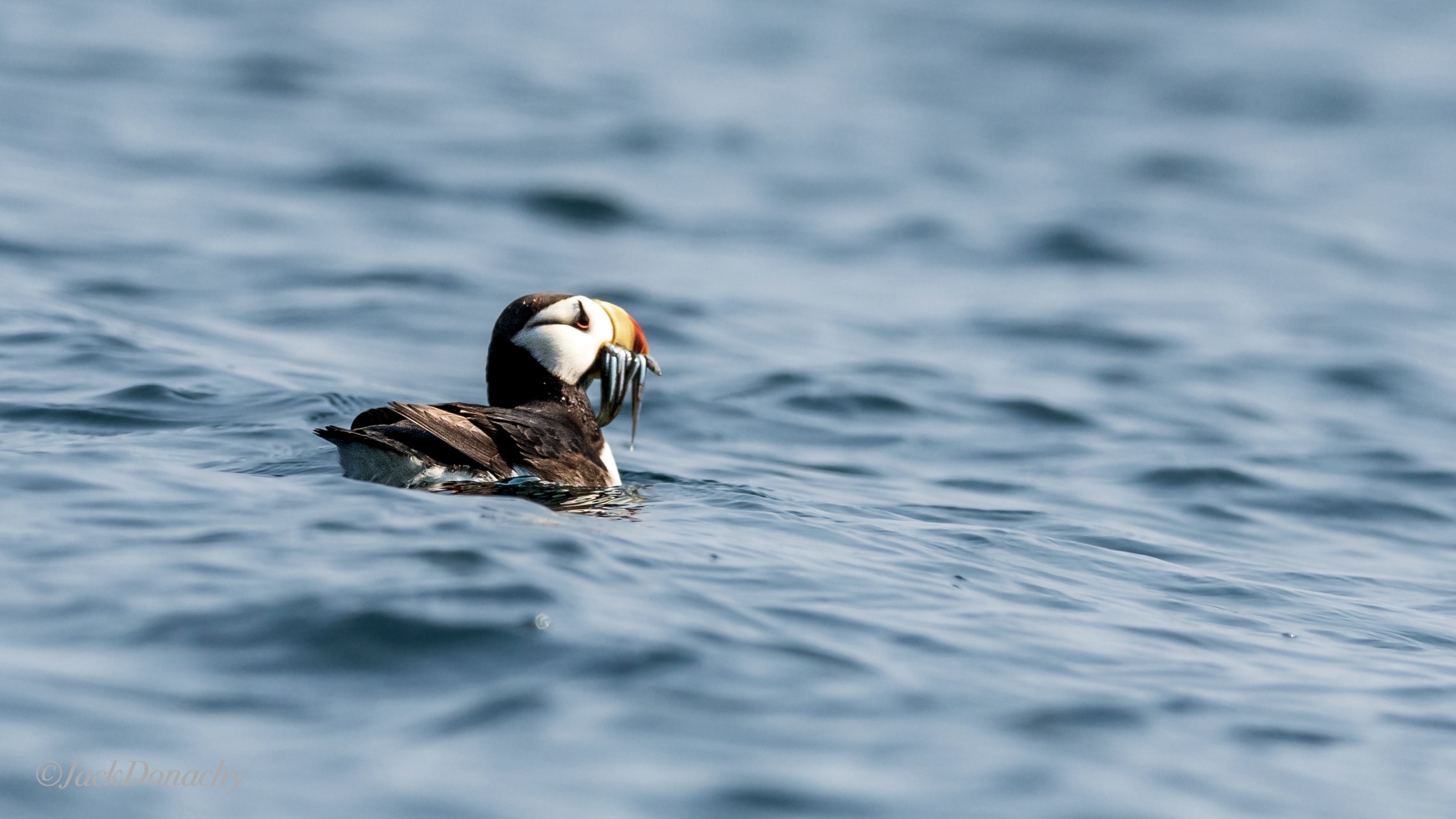
This photo of a pair of Horned Puffins was taken in late May, right in the heart of their breeding season which runs from mid-spring through mid-summer. This is when their enormous bills are at their largest and most colorful – literally fluorescent. Males and females are monomorphic; that is, they show the same plumage. (Alaska Gulf)
Who knew that in some species of birds, bill shape, size and color changes with the seasons? Such is the case of the Horned Puffin, which grows additional layers of colorful keratin – the same material hair, feathers and fingernails are made of – during the breeding season. When the season concludes, puffins sluff off the additional material and their beaks become smaller and duller. The vibrant lemon-yellow coloration mostly disappears and the tangerine-orange becomes a more mellow peach. While relatively large, the bills of juveniles are smaller than those of adults and appear gray or a coal-dusted orange.
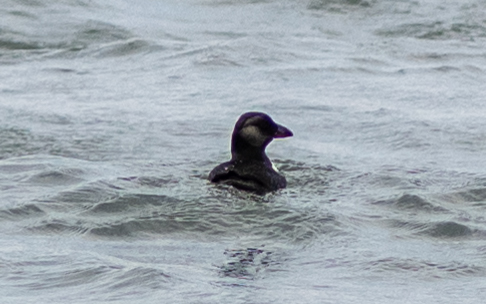
Juvenile Horned Puffin, Chignik Lake, September 11, 2021.The Chignik Drainage cuts through mountains, creating an avian corridor across the Alaska Peninsula at a point where it is about 40 miles across from the Alaska Gulf on the southwest side to the Bering Sea to the northwest. From passerines falling out in nearby spruce groves to oceanic species seeking refuge during storms or pausing during migration to forage, you never know what you’ll encounter along the Chignik.
With puffin breeding colonies on nearby Alaska Gulf islands as well as additional sites on peninsula headlands, the estuary and seas near Chignik Lake are an excellent year-round place to encounter Horned Puffins. Here they feed on abundant herring, sand lances, juvenile salmon, sculpins and other forage. Dense, well-oiled feathers and wings that become flippers propel puffins to depths of 100 feet and possibly more. Feeding for themselves, puffins swallow most of their prey underwater. If you see one with a beak overflowing with silvery sand lances or herring, it’s undoubtedly taking them back to its nest.
It is reported that a Horned Puffin can carry dozens of small fish in its bill. I counted eight sand lances here. (Alaska Gulf near Chignik, July 28, 2020,)
In former times, puffins were shot and salted down for food by the barrelful. They were even considered acceptable fare on Catholic holy days when fish rather than other forms of meat was to be consumed. In Alaska, both Tufted and Horned Puffins were traditionally hunted with hooks baited with fish a well as with hoop nets on long handles. Also, a type of bola was thrown into the air to entangle seabirds returning to their nests. In addition to utilizing puffin meat and eggs, the skins and feathers were used in clothing. Historical accounts describe puffins as curious and friendly, but they are apparently still hunted in some areas and anytime that’s the case they can be challenging to approach.
Horned Puffins, so named for a small, fleshy point protruding above each eye (see the first photo in this article) are easily distinguished from Tufted Puffins, above. Both species are present in the Alaska Gulf near Chignik.
The best time to see puffins along the Alaska Peninsula is during the summertime breeding season. The weather is often mild, the seas calm, and the birds, hunting for themselves as well as for their chicks, can often be found close to shore. Look for the same sorts of current breaks you might look for when salmon fishing, as these rips concentrate baitfish.
In flight, they skim the seas like some form of exotic bee, chunky dark bodies pulled along by those wonderfully colorful bills, determined wings rapidly beating the air into submission. Suddenly they glide upward along the face of a rocky headland and unerringly disappear into a crevice where a chick or mate is waiting. Over and over they repeat the circuit – the flight out, the deep dives, the return flight – until one day they gather their forces and all the puffins and perhaps other nearby nesters as well head en masse out to sea where they will spend the winter months. Juveniles, no longer under the care of their parents, will struggle at first to tag along, often not making it far before they need a rest. And then, they too will find themselves over the sea’s depths. For the youngsters, it will be two years before they return to their natal headlands or island. But the adults return each year, finding familiar ledges and spaces between rocks, watching over a single egg, and joining other puffins, murres, auklets and guillemots over shoals of herring, sand lances and out-migrating salmon smolts. It is an amazing sight to behold.
Horned Puffin Fratercula corniculata Order: Charadriiformes Family: Alcidae Genus: Fratercula – Medieval Latin fratercula = friar for the semblance of their plumage to monks’ robes Species: corniculata – Latin for horn-shaped, referencing the bill
Status in Marine Waters near Chignik: Common to Abundant; rare or accidental in the freshwater drainage
Five degrees, calm, a raven’s throaty croak echoing across the ice. Gaining about four minutes of light each day now, the earth moving into position to give us back our beautiful sunrises.
After a big Sunday morning breakfast we hiked across the lake and up into the foothills for a couple of miles. Otters, mergansers, other ducks and a pair of Pacific Loons in the little bit of open water where the lake empties into the river. The acres of tundra where we picked berries this past summer locked beneath two or three inches of hard ice, the result of snow melt and rainwater accumulating atop frozen ground and another cold snap. Icy snow firm as hardpan. Soft crunch under our boots. Easy hiking.
Once in a while a Red Fox trots across the lake or along the frozen shoreline. Arctic Hare tracks everywhere the snow is soft enough to show them. Yesterday I counted 80 birds at the window feeders – Pine Grosbeaks, Redpolls, Black-Capped Chickadees, Oregon-race Juncos, a couple of Pine Siskins. Bears denned up two months ago. Gulls and eagles gone. Wolf tracks lacing trails just beyond the village. We keep watching for a wolverine in the place we’ve seen them before. Tomorrows forecast says rain. Hope not.
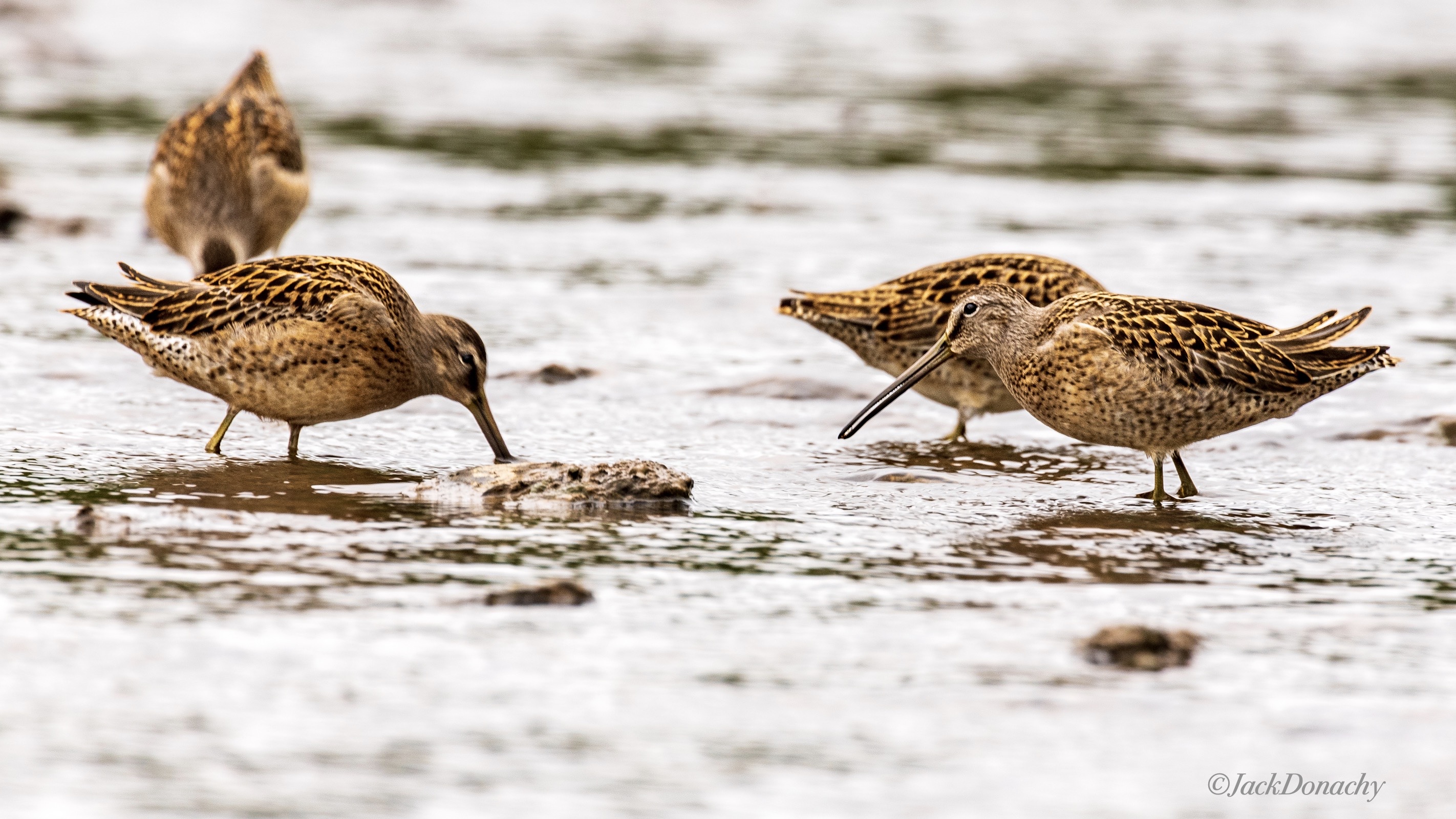
Having encountered them only once on the Chignik River in the past five years, Short-billed Dowitchers would have to be considered a rare species here. I was happy to be surprised by a small flock of them one late-summer day while looking for teal.
It’s a bit difficult and somewhat sad to think that not so long ago, shorebirds such as dowitchers were considered fair game by many shotgun-toting sportsmen. Ernest Hemingway mentions this in a couple of his books, noting (happily, I think) in his posthumously published Islands in The Stream that he loved watching the little plovers and other peeps and could no longer think about shooting them. Perhaps the early American ornithologist Elliot Coues said it best in a passage he wrote in the 1917 edition of Birds of America:
“(The dowitcher’s) gregarious instinct, combined with its gentleness, is a fatal trait, and enables gunners to slaughter them unmercifully and sometimes to exterminate every individual in a ‘bunch.’ To turn a 12-gauge ‘cannon’ loose among these unsuspicious birds, winnowing in over decoys with friendly greeting, is about as sportsmanlike as shooting into a bunch of chickens. To capture them with a camera requires skill and patience, and herein lies the hope for future existence of our disappearing wild life – substitution of the lens for the gun!”
Note the bill serrations on this dowitcher which has just come up with a tidbit of some sort – perhaps the larval stage of an insect or a mass of invertebrate eggs. The tip of the bill contains sensitive receptors called Herbst corpuscles which aid it in searching for food. Short-billed and Long-billed Dowitchers both have exceptionally long bills, and as the bill lengths fo the two species vary and overlap, it is not a reliable diagnostic. In fact, unless the birds are vocalizing, distinguishing Long-billeds from Short-billeds in the field is quite difficult. The flock of over a dozen dowitchers I encountered were in freshwater on the Chignik, several miles above the estuary – habitat where one might more likely encounter Long-billed Dowitchers. They were not vocalizing, but I believe these are Short-billeds based on more overall spotting than barring, a more sloped forehead, and the fact that Short-billeds are more common than Long-billeds on the Alaska Peninsula. But I am happy to have someone with more experience with these peeps offer a correction. It is also entirely possible that both dowitcher species were represented in this flock.
In recent years, dowitchers have experienced rather steep population declines. According to the Cornell Lab of Ornithology All About Birds website, reasons include sea level rise, loss of habitat due to development and other factors, and hunting. Regarding the latter reason, I have to agree with Messrs. Coues and Hemingway. With the species in decline, it would seem the better part of discretion to stow the shotgun and opt for chicken breasts.
It’s common for shorebirds to travel in mixed flocks with each species taking advantage of slightly different feeding strategies. Here a pair of Least Sandpipers get in on the action.
The dowitcher’s needlelike bill probes silt, mud and sand with an astonishing speed that has been compared to that of a sewing machine. I’ve recently begun broadening my documentation to include video and was happy to have had the presence of mind to do so with these birds. The “sewing machine” feeding style is well demonstrated – as is the challenge of getting a good, clear still capture of these frenetic birds in typical Chignik low-light conditions.
Dowitchers feeding at Devil’s Flats on the Chignik River, Alaska
Partially concealed behind tall grasses, sedges and Arctic Dock, camera at the ready, its long lens wrapped in a camouflage sleeve, Barbra and I watch as a group of shorebirds bank in unison, the white of their underwings flashing. A short way upriver, they wheel and come back, pass overhead, bank and wheel again a little ways down river, and then return to settle in over the shallows we’ve been watching. I look at Barbra and she smiles. New birds. Our 99th species in the freshwater portion of the Chignik Drainage between Chignik Lake and the estuary. Hemingway was right. They are wonderful to watch.
Although the range map below does not indicate the presence of Short-billed Dowitchers on the Alaska Peninsula, David Sibley includes the peninsula on the range map in his field guide as does the Audubon website.
Short-billed Dowitcher, Limnodromus griseus Order: Charadriiformes Limnodromus: Ancient Greek limne = marsh, and dromos – racer. marsh racer griseus: Medieval Latin for gray
Status at Chignik Lake: Only one sighting in five years, however it is likely that this species is a regular if brief late summer migrant in the drainage and may even nest in nearby areas of tundra or marsh.
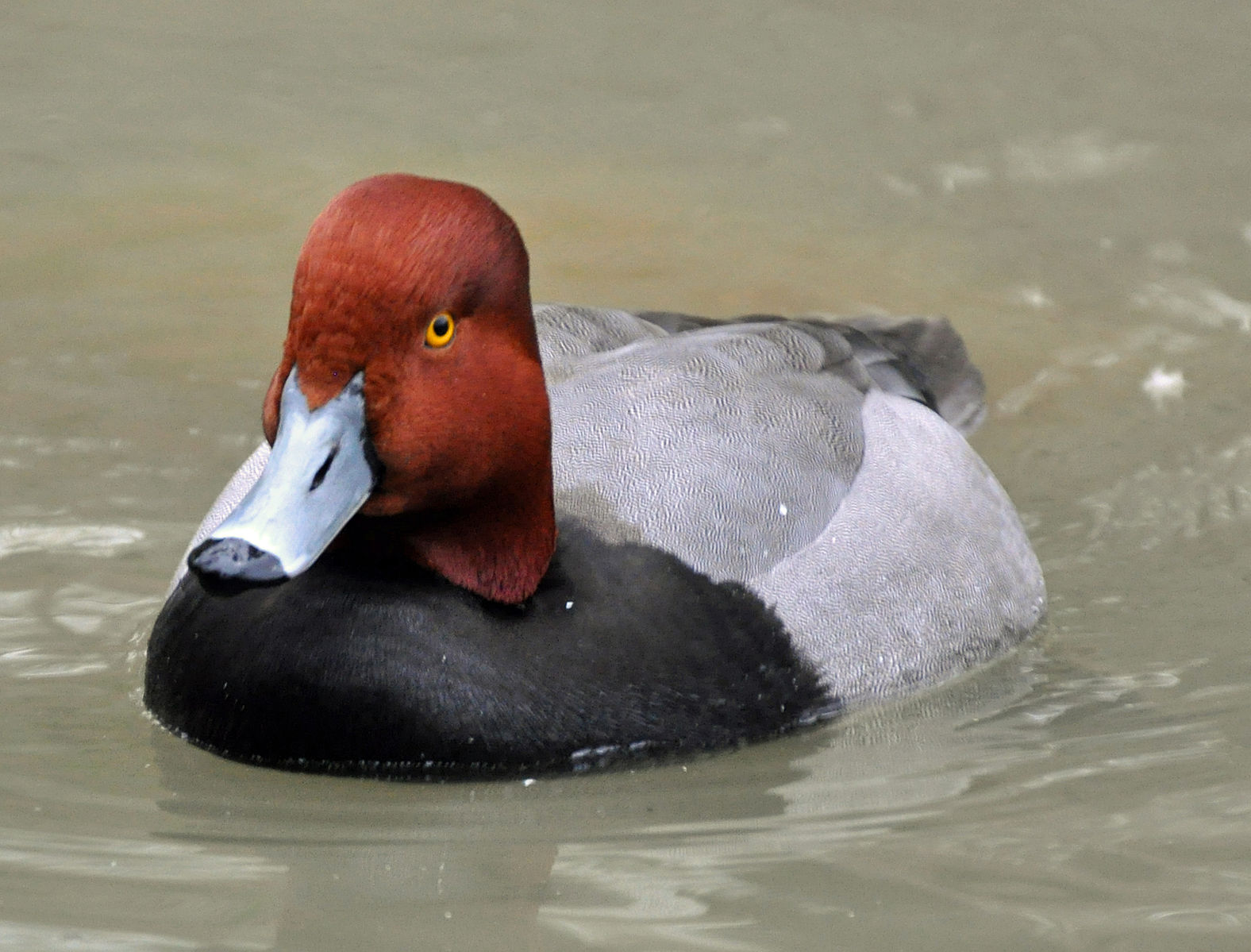
In breeding plumage, a male Redhead. The question is, how did one of these get mixed in with a flock of Greater Scaup out on the Alaska Peninsula? (Photo courtesy of Kevin Bercaw, Wikipedia)
One of the most fascinating aspects of birding in the Chignik River drainage is that at any given moment, you might encounter something rare or unexpected. Under the “rare” category are species such as Northern Shrikes, Gyrfalcons, Yellow-billed Loons and xanthochromic Common Redpolls – birds that are seldom seen outside the far north, and even in Alaska are generally not frequently encountered. But, in part because of the unique geography of the Chigniks, there are also fairly common birds that unexpectedly end up here, many miles beyond what is generally considered to be their range. Our river cuts a path between rugged mountains on the Alaska Peninsula creating an obvious migration route for passerines, raptors and waterfowl. And then there are the fierce winds that funnel through this valley, so that Pied-billed Grebes, Red-breasted Nuthatches, White-throated Sparrows, Great Blue Herons and other birds that “aren’t supposed to be here” occasionally find their way to The Lake.
Some of these birds may represent the vanguard of a species expanding its range. I’ve documented Oregon-race Dark-eyed Juncos as wintertime residents from fall through early spring every year at the lake since we first arrived here in 2016. In fact, there are a dozen in the village right now, hundreds of miles from what is considered their range. And a pair of male and female Red-breasted Nuthatches that stayed in the village for awhile this year may portend things to come for that species as the climate continues to warm and more trees populate the peninsula.
And the Redhead? I suspect that something else entirely was going on with the lone male I photographed in a group of Greater Scaup last spring. Brood parasitism. Among all ducks, female Redheads are best known for their habit of laying their eggs in the nests of other birds. According to Audubon, Redheads have been documented leaving their eggs to the care of at least 10 other species of ducks, American Bitterns and even a raptor, the Northern Harrier. Scaup are a frequent target of their brood parasitism. Knowing how ducks imprint on whatever or whomever they take to be their parent, it is quite possible that this Redhead thinks of himself as a Greater Scaup.
This is part of a flock of perhaps three dozen Greater Scaup and a few Red-breasted Mergansers. Just left of center, the bird flying highest is the Redhead. We do occasionally see Canvasbacks out here, a close relative of the Redhead. By comparison, the red of the Redhead is brighter, the head is much more rounded, and the wings in flight are darker.I searched the flock for a female counterpart, but found none.(Photo March 11, 2021, Chignik Lake)
Whether he is traveling with brood-mates or he simply fell in with a flock of fellow diving birds, it’s likely that eventually this Redhead will eventually get things sorted out. On the other hand, with breeding season fast approaching when the above photo was made, hybrid crosses between scaup and Redheads have been recorded. You never know what will turn up next at The Lake.
Redhead, Aythya americana Order: Anseriformes Family: Anatidae Aythya: from the Latin aithuia for an unidentified seabird referenced by Hesychius, Aristotle and others americana: Latinized version of America
Status at Chignik Lake, 2016 to present: Rare or accidental.









 CutterLight