Male Golden-crowned Kinglet – Chignik Lake, Sitka Spruce Grove, January 23, 2018 Making our way along a bear trail I hacked open as it descends through a dense alder thicket toward creek bottom, we hear them – cricket-like whisper-chirps. They’re in there somewhere, hidden in a jungle leaves the alders are stubbornly holding onto even as nighttime temperatures dip and we awake to frosted mornings. Kinglets. The Silvers are in, all but the Monkey Flower, Goldenrod and maybe the last of the Yarrow is gone… Fireweed gone to seed, big brown bears fat with Sockeyes, terminal dust on the mountains. Fall on the Chignik.
Golden-crowned Kinglets are another species that is either absent or listed only as “rare” on Alaska Peninsula avian checklists. This might be because they are only a fall through early spring visitor to that part of the world, as is the case at The Lake. Or it could be that even in those non-breeding seasons these hardy little being rely on the shelter provided by mature spruce trees which, for now, only occur near the peninsula’s tiny, scattered villages. JD
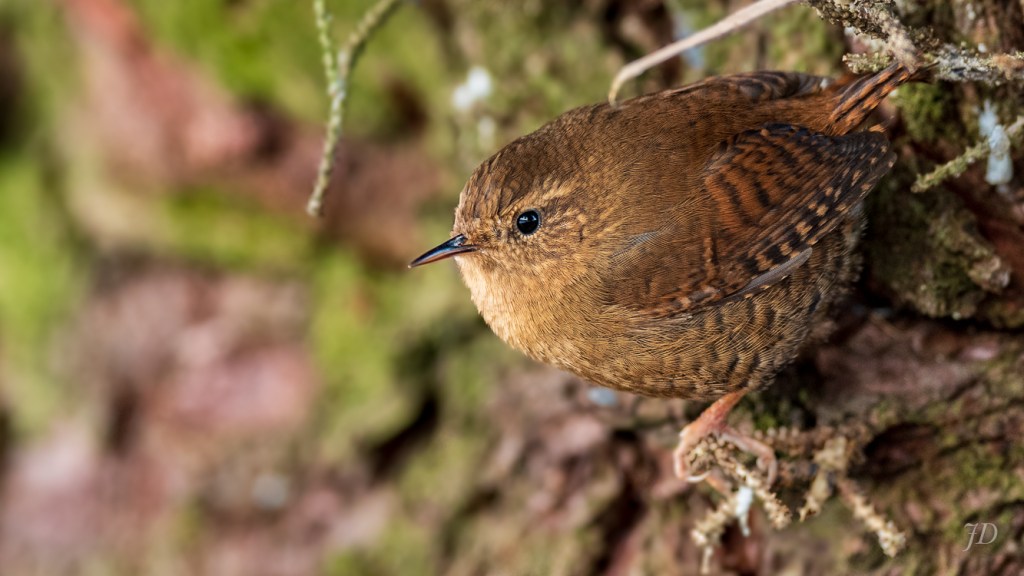
Pacific Wren – Chignik Lake, January 23, 2018 These hardy, tiny birds (8 – 12 cm, 4-4½ in) might be encountered in any season on the AlaskaPeninsula. Recently, as winter snows clear from the landscape here in Cordova, we’ve been hearing their jazzy song on walks through town – and even from the little grove of spruce trees across the quiet street from our home! These little fellows’ lungs are only the size of lima beans, but they sing loud and long in forests from Central California through the Aleutian Islands.
Click here to listen to the Pacific Wren’s songs and calls.
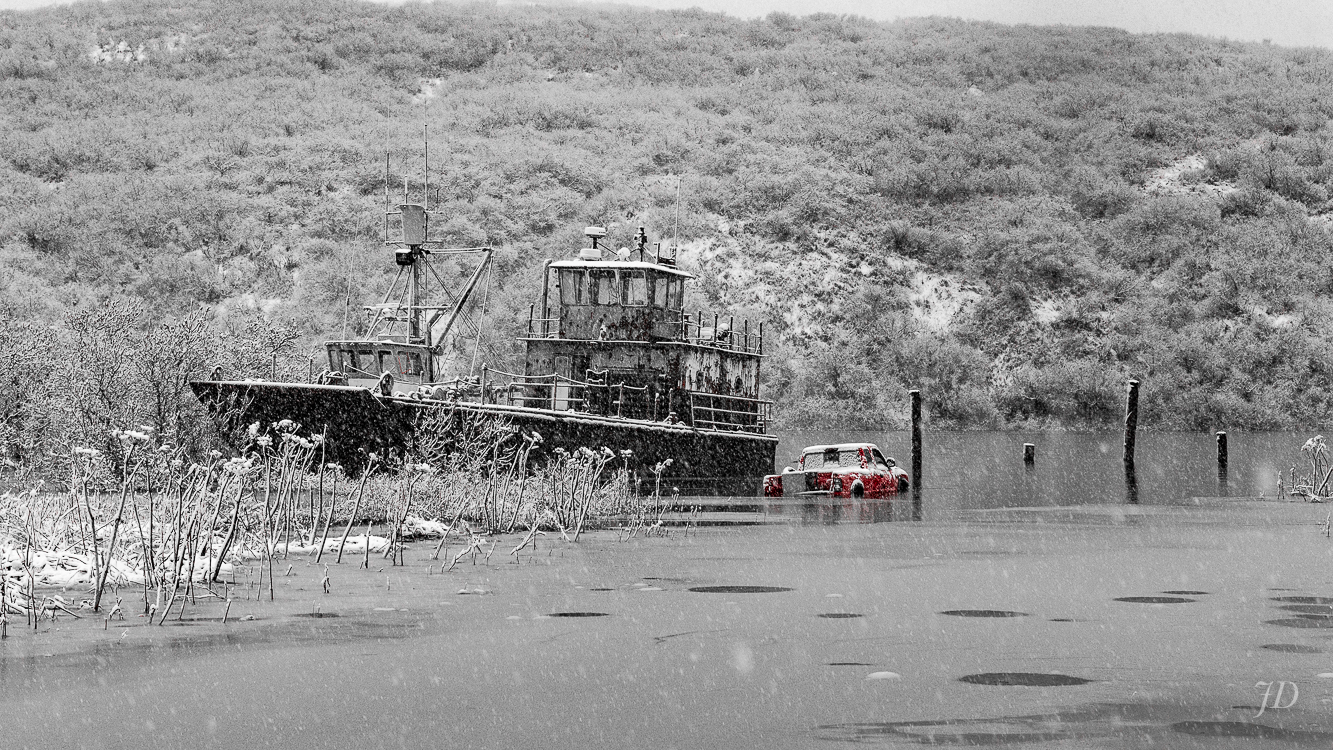
Located about four miles up from the salt estuary, this is the scene at the barge landing on the Chignik River during one of the big 11-foot tides that occur there when the gravitational pull of a full or new moon is at its peak. Upriver from here, the Chignik becomes unnavigable to large vessels, even at high-water. At low-water, this is a good place watch for bears, seals, otters and every so often moose. People have seen wolves here and, infrequently, lynx. This is where I once saw a nattily marked male Spotted Redshank, a bird that very rarely strays to North America from its native Asia and where on a different occasion a gyrfalcon swooped down and hovered just above me, as though to investigate. Occasional boat traffic notwithstanding, the landing is set in wilderness.
When the big tides roll up the river they bring salt scent and sea wrack, and even in the lake six miles and more up from the salt chuck the current pushes backwards and the receding water leaves behind eelgrass from the estuary. Depending on how you look at it, the landing is either the beginning or end of Chignik Lake’s lone road – three miles of dirt and gravel hugging steep hills as it winds above the river and then cuts through the village to connect the boat landing with the dirt airstrip. In fall, 10 and 11 foot tides are used to barge fuel up the river to the landing where it is loaded onto trucks that complete the short haul into the village. This is also how large equipment and building materials are brought into Chignik Lake which is otherwise accessible only by small plane.
You gotta watch where you park. These big tides come up awfully fast and will snatch a carelessly beached skiff in a blink – as just about all of us have learned through experience at one time or another. I would imagine the wheel bearings on the truck in this photo are pretty much shot… among other things.
Juvenile Black-billed Magpie The small pink patch at the base of this bird’s bill marks it as a youngster. This area on a mature bird is dark. Chignik Lake, Alaska January 2018
Among most humans (and perhaps among most of their fellow birds as well), magpies historically have had a low reputation. They rob nests and nesting boxes; their raucous calls grate; they bully other birds out of feeders; they assemble in packs, chattering in the manner of hoodlums planning their next escapade; and although their omnivorous feeding habits are generally focused on berries, seeds and scavenging (they love a good salmon carcass), a telltale hook at the end of their bill which grows more pronounced with age should be warning enough to small creatures that it is wise to give magpies a wide berth.
But I like magpies. In fact, I think I’ve grown to love and admire them – and not just cynically because they supply a steady source of prey to the Great Horned Owls at the Spruce Grove. (At times it’s a veritable boneyard of magpie skulls, femurs, bills and feathers beneath the owl roosts there). To establish a relationship with these intelligent beings, it is first necessary to ensure that they cannot prey on the eggs and young of passerines utilizing nesting boxes. To that end: 1. Make certain that nesting box entrance holes are no larger than what is recommended for the target species. 2. Never place a perching peg on the box. Nesters do not need such a perch, but predators will use it to get at eggs and young. 3. Take appropriate measures to limit these comparatively large birds from accessing feeders. (Suggestions can be found with a google search.)
Were one on vacation in, say, a tropical locale never having seen a magpie in the wild and an adult in elegant, iridescent breeding colors happened by it is likely the bird would be greeted with oohs and ahhs for its stunning beauty. In a future post or two, I’ll publish such photos of Chignik Lake magpies with summer sunshine lighting their regal emerald greens, glowing turquoise and royal purples. And if you listen, really listen, to magpies, you’ll soon begin to appreciate that there is a lot more going on in their language than harsh cries. It can be fascinating to watch a conventicle (the preferred collective descriptor for this species) gathered together, pacing about the ground, their soft utterances back and forth sounding very much like a secret language. And then, of a sudden, one takes flight. The others follow. To where and to what mischief or adventure? There is surely more on the minds of magpies than mere food, shelter and reproduction.
Magpies are one of the few nonhuman species able to recognize itself in a mirror. They can solve fairly complex puzzles – both under lab conditions and in life. They are remarkably attentive parents (even breaking up food into equal portions to ensure that all of their young are properly fed). They mourn their fallen fellows, attend to injured brethren and give all evidence of being able to distinguish among – to recognize – individual humans. Thus, they can be befriended – and no need to take away their freedom and make of them a “pet” to do so. Recently fledged magpies are typically curious and congenial. Show them respect and kindness. It may be surprising to discover what kind of relationship develops.
Tundra Swans at Black Lake – The jagged Aleutian Mountains loom in the background over this bay on remote Black Lake on the Alaska Peninsula. A flock of approximately six dozen Tundra Swans rests on ice in the foreground. Not readily discernible in this photo, a few ducks, mostly Mallards, are milling about in the open water near the ice. This broad, shallow, weedy lake at the headwaters of the Chignik River Drainage provides waterfowl habitat as well as an important nursery for salmon that spawn in various tributaries. The most practical way to access the remote waters of Black Lake is by skiff – about 17 winding miles from the village of Chignik Lake up Chignik Lake and then up Black River.January 3, 2018
Sunset over Mount Veniaminof at Black Lake – January 3, 2018
Veniaminof was active on and off in the years we lived at The Lake. There were times when, while out fly-fishing the river, we could hear it rumbling, it’s smoking cone just over 20 miles to the west. In this photograph from a remote cabin on Black Lake near the headwaters of the Chignik, the volcano is even closer – perhaps just 20 miles distance. The forecast during our stay on Black Lake had been for fair weather, but shortly after sunset the evening one of us took the above photo we were hit with a huge out-of-nowhere storm packing freezing temperatures and winds in excess of 100 miles per hour. The little cabin rattled and rocked and we dug deep under a pile of blankets and sleeping bags, hoping the shelter would hold together. It did. That morning we woke to calm and a lake locked in thick ice. Our way out – back to the village, was by boat – a mile down the lake, seven miles down Black River and then seven more miles down Chignik Lake. No cell service. We were locked in, solid.
Golden-crowned Kinglet – Chignik Lake, December 2017 Sitka Spruce Trees transplanted at The Lake from Kodiak shoots 70 years ago provide a great deal more than just cone seed forage for finches and chickadees. Golden-crowned Kinglets and a few other avian species glean the boughs, bark and understory for invertebrates. Here a lucky female kinglet has come upon a silk-wrapped treasure – perhaps a spider egg case or an insect trapped and wrapped.
Yellow-billed Loon – Chignik Lake, Alaska, 11/27/17
When I initially got into studying the Chignik Drainage’s birds, I thought that a loon was a loon was a loon, a species I knew primarily from seeing Common Loons. I assumed that that is what a loon is. It turns out that there are five species of Gavia, four of which occur in the Chignik Drainage. In order of common occurrence, they are: Common Loon, Pacific Loon, Yellow-billed Loon and Red-throated Loon. (Only the rare Arctic Loon is absent from The Chignik.) It is probable that in the salt waters of the nearby Alaskan Gulf that from fall through spring it is the Pacific Loon that is most common.
We encountered Yellow-billeds as wintertime visitors to the main lake and the river outflow just below the lake. In wintertime, their plumage is rather drab (you’ve got to go to the most northern parts of Alaska, or Siberia, to see them in their stunning breeding colors); however, even in winter these, the largest of the five loons, were easily distinguished from Common Loons by their big, lightly-colored, yellow-tinged bills. We found the Yellow-billeds to be shy and to prefer deep water. The only photos I was able to get were taken using a 600mm lens affixed with a 2.0 teleconverter of far off specimens – and even those images require significant cropping to present a picture such as the one above. Still, Yellow-billeds are uncommon to rare and adding them to the Chignik Drainage List – perhaps a first documentation and almost certainly a first photograph – was a thrill.
Any documentation of this sort is important. As the planet continues to rapidly warm – due largely to a certain overpopulated species’ reliance on burning fossil fuels and turning forests to farmland – things are changing. Fast. (It’s not just that the climate is warming – it’s been doing so for a very long time. It’s the recent rapidity at which it is warming.) Audubon’s climate model projects a 64% loss of winter range for Yellow-billed Loons in coming decades. Not centuries. Decades.
Wherever you live, it is likely that you can see changes in flora and fauna over time. And these changes are not due only do warming. Although in pure numbers countable trees have increased in many areas, most of this new growth is in the form of pulp and timber forests – trees destined to be cut down just as they are reaching maturity. As fewer forests are allowed to reach and sustain maturity, there is less mast (acorns, other nuts, seeds and seed-bearing cones) for animals to forage and often fewer nesting sites as well. Wild grasslands have nearly disappeared from our landscapes. In many locales, streams, rivers and lakes have become warmer, shallower and increasingly over-nutrified owing to run-off from fertilized lawns and farms. So grab a pair of binoculars, a notebook, your iPhone or camera and get out and observe. The regular outings might prove to be a great education, and a daily walk is invigorating.
Male Red Crossbillforaging on Sitka Spruce Cones, Chignik Lake, Alaska. These birds can only live where forests are allowed to mature and produce healthy cones. Forest management that focuses only on replanting trees destined to be turned into pulp before they mature provide little to no benefit to most species.
Anyone who has much studied biology in general, birds in particular, or evolution specifically has undoubtedly encountered “Darwin’s Finches” and the remarkable diversity in bill shape that evolved among a species related to tanagers (not true finches) that became geologically isolated on the Galapagos Islands. Darwin visited the islands, which straddle the equator approximately 560 miles west of Ecuador, in 1835. There he collected (his servant shot) an array of birds featuring 18 different bill shapes. The variation correlated with the different foods each type of food the birds had adapted to take advantage of on the islands. As all of the species Darwin identified originated from a single type in genus Geospiza, Darwin’s Galapagos finches have long been held up as an example of how evolution works. It’s a complex process that occurs over time and I don’t want to oversimplify it. However, for the purpose in this article, it is useful to think of 1) an underutilized food source and 2) genetic isolation. The original tanager-like specimens of a single type in genus Geospiza became isolated on the Galapagos islands. Given an absence of competition from other species of birds and an abundance of various foods – insects & invertebrates, berries, seeds of different size -, various forms of the original type of Geospiza evolved different bill shapes and sizes (and even different body types) as they keyed in on a given kind of food.
Somehow, I think, (speculate), vocalizations must have played a key role in the genetic isolation that concurred with the move toward food specialization among these Galapagos finches. Most species of birds have a variety of calls and songs, each of which conveys a specific meaning. Black-capped Chickadees, for example, communicate with at least 15 different sounds (let us think of them as words) differentiating everything from the approach of different kinds of predators (one vocalization for ground predators, another for aerial predators) to vocalizations used during breeding, to identify food sources, and so forth.
Bird vocalizations play an important role in differentiating similar species. For example, although certain thrushes to the untrained eye appear quite similar, their songs are different enough to easily distinguish. Similarly, the Pacific Wren found in west coast states from California to Alaska is nearly identical in appearance to the Winter Wren which is found in the east and midwest. But the songs of the two species are different. Thus, they are genetically isolated from each other as much by their vocalizations as by geography. After all, they have wings. They are thus able to transcend geographical boundaries. Their songs – agreeable to members of their own tribe, a foreign language to others – helps keep the two populations separate.
Apparently a good bit of the above applies to Red Crossbills. I have photographs of Red Crossbills from Montana that show a recognizable difference from the Red Crossbills we encountered at Chignik Lake. The Montana birds have larger bills. What causes the difference? Probably diet. The Montana birds we saw were feeding on the seeds of Ponderosa Pine cones. My guess is that it takes a more substantial bill to get into the harder, tighter pine cones than it takes to pry apart the looser scales of the softer Sitka Spruce cones found at Chignik Lake and other locales in Alaska.
So, just as ichthyologists have come to understand the significant genetic variation that can exist among a given species of fish – such as Steelhead or Coho Salmon – as each kind of Steelhead or Coho has adapted to thrive in a given river system – ornithologists are coming to understand that there can be a great deal of intra-species variation among birds as each type within the species has evolved features allowing it to thrive in a specific habitat.
To me, the take-away lesson here is that we should not merely be focusing on the preservation of life forms on the species level, but that instead we should be dedicated to the preservation of each unique biome and ecosystem.
Male Pine Siskin Thousands and thousands of photos either culled and discarded or key-worded, retouched and placed year by year, month by monthinto digital folders. Still lots to go. Now into late October and early November of 2017, I hadn’t remembered that I got some nice captures of Red Crossbills and Pine Siskins that fall – finch species that generally do not appear on range maps for the Alaska Peninsula and which David Narver did not observe in his Chignik River Drainage study conducted in the early 1960’s. With the exception of Pine Grosbeaks, Alaska’s finches – which also include White-winged and Red Crossbills, Hoary and Common Redpolls and Pine Siskins – depend heavily on cone seeds. The siskin in this photo would probably not be at The Lake were it nor for the Sitka Spruce trees transplanted as seedlings from Kodiak Island back in the 1950’s. Now mature and beginning to reproduce on their own, these spruces provide shelter and seeds for chickadees, sparrows, finches and magpies as well as a diverse array of invertebrates for all the above along with woodpeckers, wrens, kinglets and warblers. These passerines in turn provide a source of food for owls, falcons and shrikes. Want to change the world? Well, you could try yelling at the evening news on TV… or you could plant a few trees.



 CutterLight