Clarks Bay Beach with Brown Bear Tracks in September A few hundred yards up the beach from where this photograph was composed, Clarks River debouches into Chignik Lake. Small enough to cross when wearing waders but large enough to navigate in a skiff equipped with a jet drive, Clarks provides major spawning habitat for Sockeye and Coho salmon. Lots of salmon. Lots of bears.September 13, 2018
Western Sandpipers, Hartney Bay, Cordova, Alaska, May 3, 2024
This was the scene about six miles from the heart of Cordova this past Friday morning, and this is but a sliver of the many thousands of shorebirds that stop for a short while to fuel up and rest on tidal mudflats near the town as they make their way to nesting grounds further north. Figuring in nearby barrier islands and additional flats in the Copper River delta, some five million shorebirds represented by several species will visit the Cordova area over a few days in early May. While they are here, these Western Sandpipers will double their weight. The delta is absolutely critical to the health of these avian populations as there are only a few places in the world that offer the sheer biomass of invertebrates and biofilm these birds require in order to complete journeys that in many cases cover thousands of miles. Look for a more indepth article on this incredible migratory event in the coming days.
Harbor Seal and King Salmon Chignik River, September 9, 2018
Chinook Salmon begin entering the Chignik in late June. They continue spawning into August. By September, spawning has ended and the spent salmon begin giving into the current, death at hand the big fish slowly drifting back downriver – easy meals for the Chignik’s Harbor Seals.
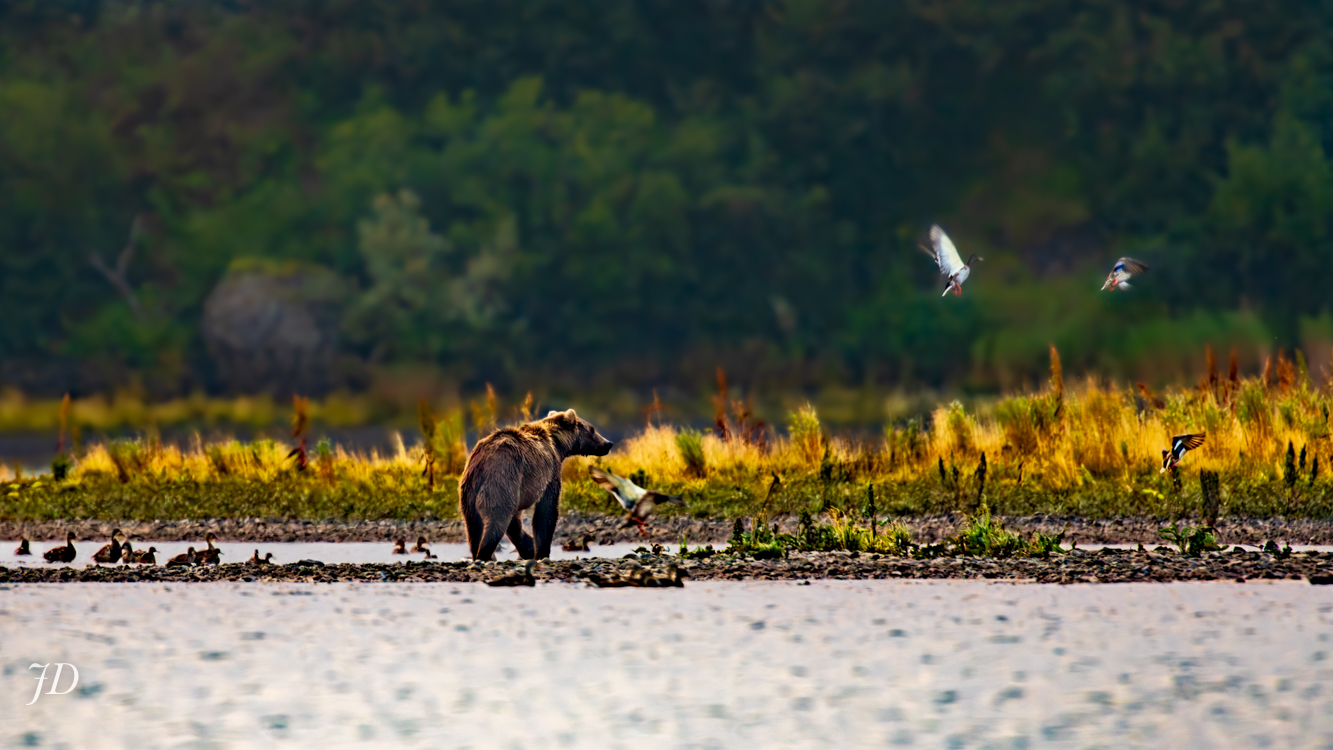
One Fine Morning – Paradise Bend on The Chignik River Ambling Bear, Mallards, Teal, White-fronted Geese, a splash of sunshine September 8, 2018
I went to the woods because I wished to live deliberately, to front only the essential facts of life, and see if I could not learn what it had to teach, and not, when I came to die, discover that I had not lived.Henry Thoreau, Walden
Ermine (Short-tailed Weasel) Chignik Lake, Alaska Peninsula, August 2018
A Collared Lemming burst from a thicket of grass and swam across a narrow finger in the lake which was filled to the brim with recent rains. Just as the little rodent disappeared in a patch of thick grass on the opposite side of the water, an Ermine popped out from where the lemming had just come, paused, looked around, appeared to sniff the air, then also swam the same course. I was scrambling with my camera hoping to capture something of the surprise sighting and managed to capture the above image just before the Ermine dove into the grass.
We didn’t often encounter either of these species during our years at The Lake, but there was hardly a walk after a fresh snowfall that we didn’t come across small paired tracks left by Ermines bounding through snow, so they appeared to be fairly abundant. Cool animals. I would love to have made friends with one the way Sam made friends with Baron in My Side of the Mountain… The closest I came was when one ran across the toe of my boot and into the entrance of our house as I opened the door one morning.
Imperial Diver (Common Loon, Gavia Immer) Chignik Lake, Alaska Peninsula, August 2018
Upon publishing a photograph of a Wilson’s Warbler under the title Black Cap Jazz Singera few days ago, reader Tanja Britton (see Tanja’s blog here), left a note alerting me to the American Ornithological Society’s decision to revisit the common names of species within AOS’s jurisdiction that are predicated on the names of the people (white men) who “discovered” or “identified” the bird in question as well as appellatives assigned by the “discoverer” to “honor” others. This would mean the renaming… the reimagining of a number of birds and our relationships with them: Steller’s Jay, Wilson’s Snipe, Baird’s Sandpiper, Audubon’s Oriole, Bachman’s Sparrow, and so on.
Hurray and about time. This “dibs!” approach to naming the beings we share this planet with could hardly reflect a more juvenile mindset. We, all of us, have the right to choose our own names, to imagine ourselves as we wish to be, to present our own identities and not to be enslaved by someone else’s idea of who we should be. We believe the same dignity should be accorded to all beings. And in fact, even in the instance of an “inanimate” object – such as, say, a salmon pool on a river – if one is looking at that landscape and can think only of imposing a person’s name on it, one is not looking closely enough.
Our view at Cutterlight has long been that if one creates a piece of art such as writing, a painting, a piece of music and so forth and one chooses to attach one’s name to said piece of art, it is appropriate and just that the creator’s name live on with that art for as long as the art lives. But this vain nonsense in pursuit of the illusion of immortality wherein buildings, airports, highways, and birding organizations are arbitrarily named after this person or that has always struck us as one of the least attractive impulses in Euro-American culture. The practice is as divisive as it is arbitrary – a fact we seem to be slowly waking up to as a society.
It is often the attitude among indigenous peoples of the Pacific Northwest that the totem poles they’ve created should be allowed to naturally decay over time rather than preserved. Their view is that all beings and all things have a span in which they exist in a certain state, at the end of which they must be allowed to follow their natural path into the next state of existing.
Amen.
Turning back to the matter of our avian friends…
As the AOS embarks on the enlightened task of reimagining the gray, nondescript names of men attached to various species, let them take one further step and strike from vernacular names disrespectful monikers such as “least,” “dwarf,” “lesser,” “house,” and the sobriquet we find most grating – “common.”
The only thing “common” about Gavia immer, the bird in the above photograph, is the unimaginative minds of whomever agreed this regal being should be so reduced. This bird can reach a bill to tail length of three feet (90 cm), a wingspan of four feet (130cm) and is reported to dive up to 250 feet (76 meters). “Common Loon” my foot.
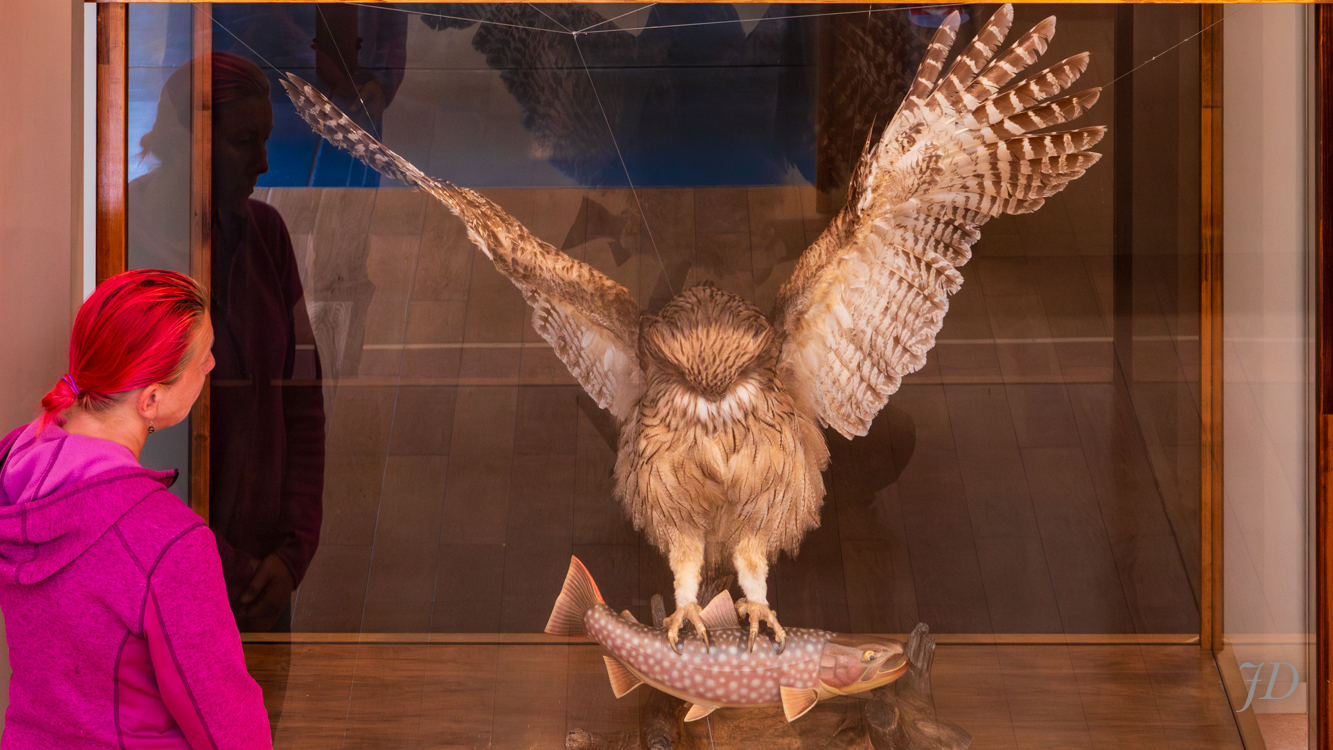
Blakiston’s Fish Owl Shiretoko Peninsula, Hokkaido, Japan, July 23, 2018
With a wingspan ranging from about 5′ 10″ to 6′ 3″ (170 – 190 cm), Blakiston’s Fish Owls are generally regarded as the world’s largest living species of owl. The photograph above is of one of a known wild pair which have been banded. The owls regularly visit a small stream where a pool has been created with natural rocks and is regularly stocked with Cherry Trout (sakuramasu, O. masau). A small inn with windows overlooking the pool provides guests with opportunities for a glimpse of this rare species which may visit the pool at any time during the night. The indigenous people of Hokkaido, the Ainu, regarded these great owls as spiritual protectors of their villages.
For context, Barbra with this taxidermy specimen grasping a White-spotted Char (Rain Char). Blakiston’s Fish Owl is a type of Eagle Owl and therefore related to the familiar Great Horned Owl of North America. The Great Horned Owl has a wingspan of approximately four feet, two feet less than the Blakiston’s span of around six feet.
Rhinoceros Auklet returning at Dusk with a Catch of Sand Lances and Squid The grayish-white protuberance on the bill – the horn that inspires the Rhinoceros Auklet’s name –is fluorescent and thus highly visible to their fellows when diving for fish or flying in dim light. Teuri Island, Hokkaido, Japan, June 19, 2018
You might encounter this puffin relative just about anywhere along North America’s Pacific coastline, and in fact there are breeding populations scattered from Canada through Alaska’s Aleutian Islands. But perhaps the best place to see Rhinoceros Auklets is on Terui Island off the west coast of Hokkaido where they gather in the hundreds of thousands to nest – the largest Rhinoceros Auklet breeding colony in the world.
The northwest cliffs of Teuri are pockmarked with burrows which the auklets have dug deep into the sandy soil to keep their eggs and chicks safe from gulls and other predators. During the day, the parents leave their chicks behind as they venture out to sea where they dive for food – primarily Sand Lances and squid. As twilight gathers, the adult auklets return to home, somehow sorting out their burrows from among the tens of thousands of similar tunnels. Gulls await the returning auklets, keen on stealing an easy meal. This is an example of why for many species it is so important that their numbers remain vast. Were only a few auklets to return, they’d each make an easy target for the waiting gulls. But with hundreds of thousands flying in, the relatively few gulls are overwhelmed, and although the gulls manage to take a few meals, most of the auklets make it safely to their burrows where hungry chicks are waiting.
On Terui Island, guides are available to take birders out to the nesting site to observe the spectacle of returning auklets. Along a pathway, a few low lights allow for a good view of the birds as they scurry through low, dense vegetation. Some of the auklets will be quite close, but in order to get good photographs a fast lens and a camera capable of handling high ISO values is necessary as using additional lighting is not permitted (and would be wrong, even it were). You’ll be hand-holding and so you have to hope you catch one standing still to momentarily collect its thoughts, as in the above photograph. JD







 CutterLight