

Growing up, I didn’t have many of what might properly be called “toys.” When I was young, friends would come over, look around, and complain, “There’s nothing to do.” And thereafter find reasons to not come over.
But I did have books. A few. And among those few were a handful of treasures I read over and over. They included Volume I of the Reader’s Digest Best Loved Books for Young Readers series. The volume was comprised of a four-story collection of abridged books which included Treasure Island and Call of the Wild, the latter tale so riveting I read it 13 consecutive times the year I was in third grade – with a flashlight under my blankets long after I was supposed to be asleep, in the backseat of the car, on my lap (second row, fourth seat) during Mrs. Dull’s third-grade math lessons. Other books included Our Amazing World of Nature, The Golden Book of The Civil War, a book titled something along the lines of George Washington and the Revolutionary War, all 20 volumes of the Pictorial Encyclopedia of American History, and Digging for Dinosaurs which included a Panorama slide show and a 33⅓ rpm vinyl record featuring Walter Cronkite’s resonant narration. Of course, there were other books, most treasured among them field guides for children – Golden Guides to fish and insects and a Peterson guide to seashells.
The funny thing – strange funny – is that for the most part these books either seemed to have always been there, on shelves in my room, or were presented to me with little ceremony. I never asked for any of them that I can recall, but they became a significant part of my world in a home in which I didn’t fit in and subsequently spent a great deal of time by myself in the forest that extended for limitless miles behind our home and upstairs in my bedroom stretched out on the bed or the floor, chin in palm, lost in the dream-world of a big-hearted dog going home to his wolf-roots in Alaska, battlefield maps, fascinating and fantastic stories about wild animals, pirates and their ships, and the lost world of dinosaurs. And whereas my parents subjected me – and themselves – to an unhappy annual ritual of ignoring whatever I’d asked for on Christmas and birthday wish lists, instead presenting me with things entirely unexpected, and then, after family friends and relatives saw that I had received a very fine gift indeed, taking away that gift when eyes were no longer on us, the books remained. Thus they were among the very few things I could think of as “mine” in a home where I was admonished by my father that “everything” belonged to him and to her, that nothing was mine, and that I needed to understand that “if you’re going to live here.” But the books were mine. None were ever taken back. They became a source of… safety. Peace. Comfort.
In the dinosaur book, there was a photo of fossilized eggs arranged as on desert earth as though in a nest – the first dinosaur eggs ever discovered, an incredibly important and exciting find. Text placed the nest in the Gobi Desert’s Flaming Cliffs. And so I grew up dreaming of sailing ships and seashells, of a world where, like Reddy, I might be freed from my present circumstances to go and live with my grandmother and know what love is. Alaska was mixed in with those dreams, along with a fascination with fish and insects, and though my interest in battlefields and wars has flagged, early reads in history brought with them an awareness of Native Americans, leading to my discovery of Dee Brown’s Bury My Heart at Wounded Knee on my parents’ shelves the year it was published. I was 12. I pored over the book, fueling dreams of experiencing life among Native Americans. Feathered in among all this was the thought that maybe one day I would go to the Gobi Desert and find fossils on my own.
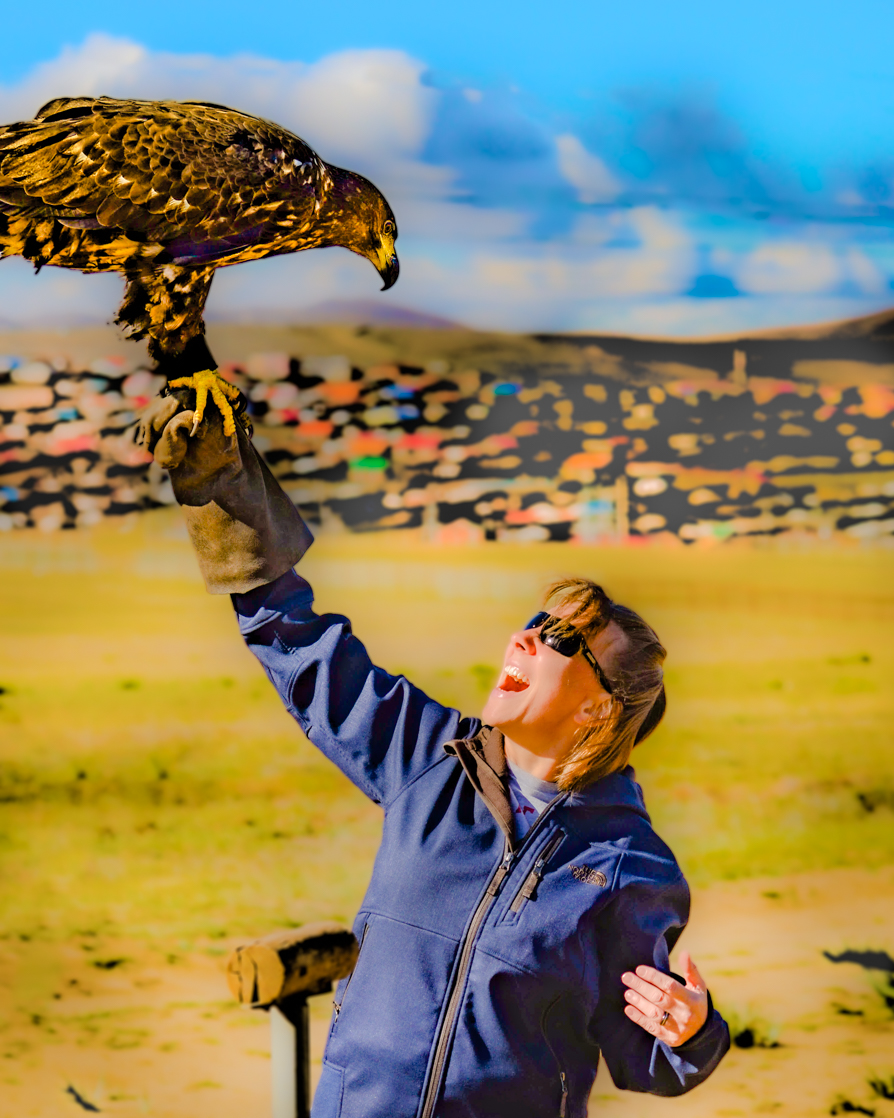
And so it came to be. Not eggs. But we found fragile fossilized remains of something large and dinosaur-like.
Two thoughts:
There is nothing like a well-written book in the right hands and the good fortune of being left alone for shaping dreams.
and
The problem with so-called bucket lists – a list of this and that to be chased down or “accomplished” before one “kicks the bucket” – is that the very name makes too great a nod to death. Experiences should not be guided by sand funneling through an hourglass. So here’s a different way to look at our dreams and the experiences we might wish to have.
No lists, and none of the randomness and disconnection between items implied in the term “list.” Milk, celery, double AA batteries, nail polish… randomness is fine as a prompt when grocery shopping, but that’s no way to live a life. No grail-chasing. No doomed-to-failure race against mortality.
Instead, imagine the coolest version of yourself you can imagine… and then go be that person.


 CutterLight