Big Boys of the Bear World: Here Come the Brownies of Chignik Lake

Until the salmon arrive en force, salad’ll have to do. Bigboy has been a regular visitor, here loafing about 40 yards from our living room window.

Between a proliferation of recently fledged finches (Pine Grosbeaks, Pine Siskins and Common Redpolls), baby Great Horned Owls (downy snowballs, their ears barely showing as tiny tufts of fuzz), a pair of Rough-legged Hawks brooding on their nest, and an abundance of Brown Bears ranging from itty-bitty little triplets all the way up to thousand-pound behemoths (and they grow larger than this), there hasn’t been much time to practice my guitar lately. It seems that no sooner do Barbra and I shoot and process one batch of National-Geographic-esque scenes than another bear (or four) strolls into view outside our window and another shoot is on, followed by another stint editing photos.

At the beach, looking for salmon. He’s gonna ruin his Brad Pitt highlights…

Meanwhile, we’re edging closer to the first 30,000 Sockeyes being counted at the weir – enough salmon to get the bears and everything else from eagles to ravens to us excited, but still only 3% or so of the nearly one million fish we hope will have been counted by the end of summer. Yellow Paintbrush, Chocolate Lilies, Lupine and Wild Geraniums are in full bloom. Salmonberries, Raspberries and Red Currants are beginning to set fruit. The White Spruces, transplanted from Kodiak Island back in the 1950’s when Chignik Lake became a permanently settled village, are sheathed in new, purple-red cones, each a promise of abundant mast this coming winter for the finches, chickadees and sparrows that relish the seeds.

Life at The Lake is bumpin’.

You don’t hear ’em called bluebacks much these days, but blue backs they have. Judging from a puncture on the other side, this Sockeye barely escaped an encounter with one of the Harbor Seals that follow these fish up the river. Badly injured, this is exactly the kind of easy meal patrolling Brownies are looking for.

Not yet wearing the startlingly white plumage of fully mature Bald Eagles, these are probably three-year-olds. The tin roof of a lakeside house Sam Stepanoff built – subsequently flooded out by annual high-water events – is a favorite salmon-watching perch for eagles, ravens and gulls.

So… about those bears….
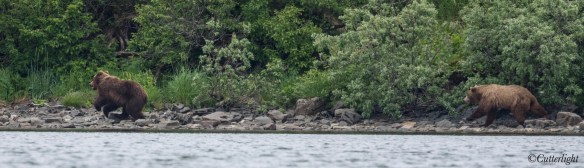
This male (left) got a little too close to the mom and her twin one-year-olds. She woofed a stern “Stay put!” in Brown Bear to her cubs and then put the intruding male to flight.

The Chignik River drainage is home to one of the densest populations of bears in the world. And these aren’t just any bears. Coastal Browns, big males can push 1,500 pounds and stretch to nearly 10 feet from snout to toe. Growing fat on a diet rich in salmon, sows give birth to as many as four impossibly cute, clumsy, curious cubs.

The village post office is located in a small room on the first floor of the house in the upper left. You can just make out a piece of Chignik Lake’s main road, which the bear is following. The wooden rail in the foreground partitions our yard from the blurry line between settlement and wilderness our village embodies.
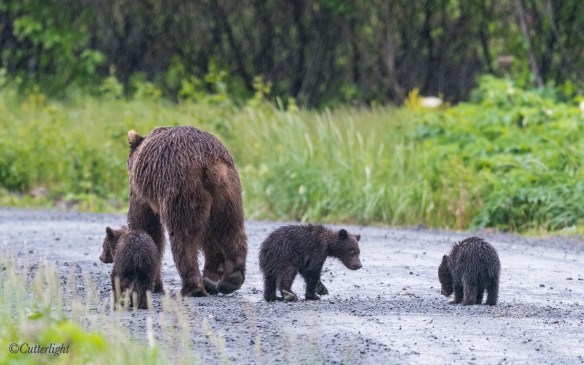
The little fella on the right isn’t entirely sure what to do with the salmon head he found down at the beach. Mom just filled up and now will head up Post Office Creek to find a quiet place to nurse the little guys.

When they emerge from their dens in mid to late spring, the bears begin regaining weight by grazing almost constantly on grasses, sedges, roots and other vegetation. But, like most of us humans who call Chignik Lake home, what they really want is salmon.
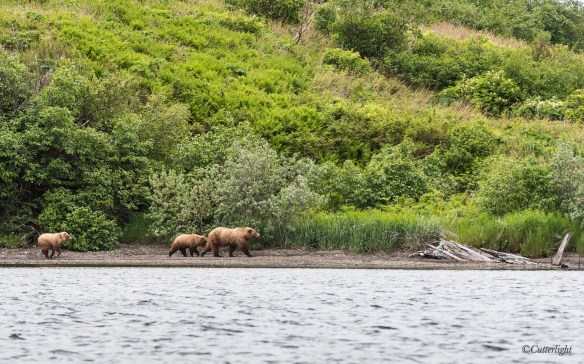
“Wait up!” By the time they enter their second season, unceasingly curious cubs seem to engage in a constant game of lagging behind to explore and then racing to rejoin mom.

Once the fish start running, the bears begin a perpetual patrol along the riverbanks and lake shoreline. Until the salmon get well up the system and into the various tributaries, there’s no easy place for the bears to catch them. So they amble along, grazing on grass and other vegetation, keeping an opportunistic eye out for any fish that has made easy pickings of itself.

Blondie gives himself a mighty shake after wading the shallows in search of salmon. Still skinny from his winter fast, once the salmon come in he’ll begin putting on serious poundage.

Watch a shoreline for any length of time, cruise up and down the river in a skiff, or simply keep your eyes open as you travel through the village: you’ll see bears. From now through November, we don’t even make the five-minute walk to the Post Office without carrying bear spray. Bears use the little creek we cross on that walk as a thoroughfare. There were four down in there just last night. Two more today. That we saw.

Could be checking to see if Kevin left the key in the ignition of this sweet skiff… more likely it was the scent of a recent catch of halibut from the sea a few miles downriver that had this guy’s attention. 

We do a fair amount of our bear photography right from the dining/living room window of our home which sits only 30 yards from the edge of the lake – a quarter of a football field; six car lengths. In the live-and-let-live world of Chignik Lake, fishermen sometimes leave salmon scraps on the beach and in the shallow water there, knowing that at some point bears, eagles, gulls, ravens and magpies will come along to clean them up.
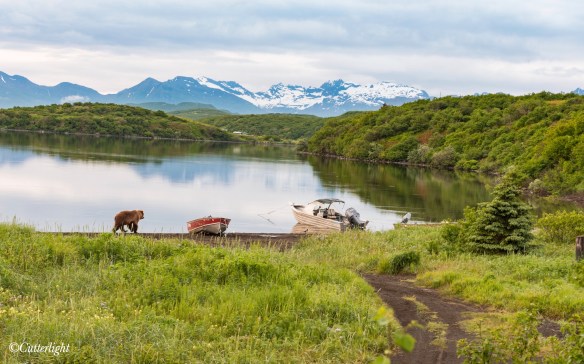
First thing after getting up and getting dressed this morning – 6:05 AM – I looked out the window. At 6:05:50 I made this photo. If you look closely, you can see salmon parr dimpling the lake as they take emerging midges.

But in actuality, a person could pick just about any piece of lake shoreline or riverbank, commit to sitting and watching, and see bears and other wildlife here. Thus far this season, we’ve counted 13 different individual Brownies. There are more around…

Last night as the sun lingered on past 10 0’clock, then 11 and on toward midnight, it seemed every time we looked out our window there were bears on the beach. First Mom and the triplets, who earlier in the day had surprised us as we were cleaning our skiff. The little ones are still suckling. They waited patiently on the sandy beach, taking turns standing on hind legs in imitation of mom as she scanned the shallows for salmon carcasses, the little guys steadying themselves with small paws pushing on their siblings’ backs.

Later one of the larger males came up the shoreline from the direction of the river. Finding no salmon, he went for a swim in the cove below Fred’s house and headed back down the lake.
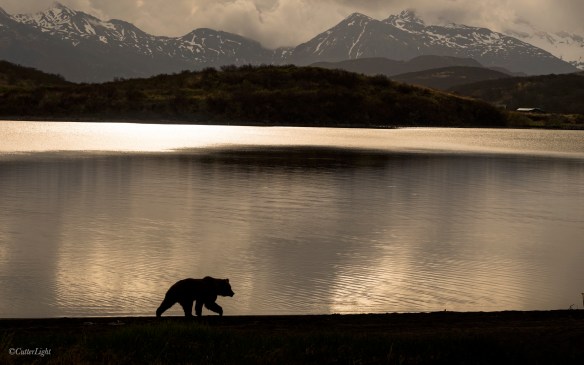
Barbra composed this early morning photo about a week ago. 

Not long after that a dark-coated male shot past our house right below our window. Leaning out to watch, we heard the cause for his burst of speed. Suddenly, a roly-poly light-coated male came charging into view, paws falling heavy on the sand 15 feet from our window, the big bear breathing hard, tongue rolling out of his mouth, hot on the trail of the previous bear, leaving us to wonder what the story there might be.

Conversation led to conversation as twilight descended, the snow-capped mountains glowing in the gathering darkness. We recalled our first visit to Alaska back in the summer of 2009. Experiencing the famed midnight sun for the first time that summer, we found it hard to go to sleep – not because of the daylight, but because of all there was to see and do and marvel at.

Eleven years later, it’s still like that.

After the Fog Burned off – Eagles

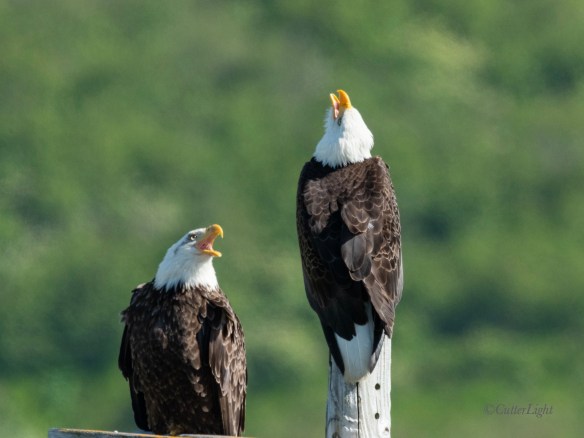
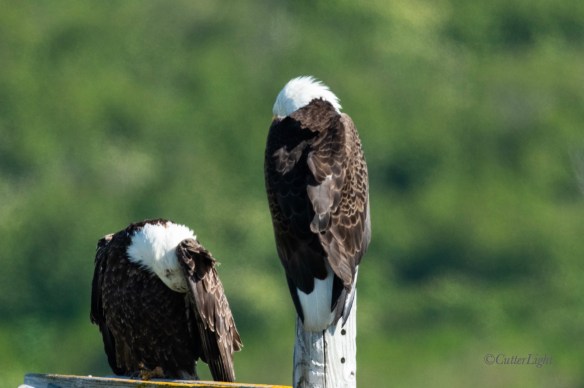
As swallows swooped and soared, this pair of Bald Eagles began a chorus of their characteristic high-pitched piping. The sunshine must’ve felt as good to them as it did to us.

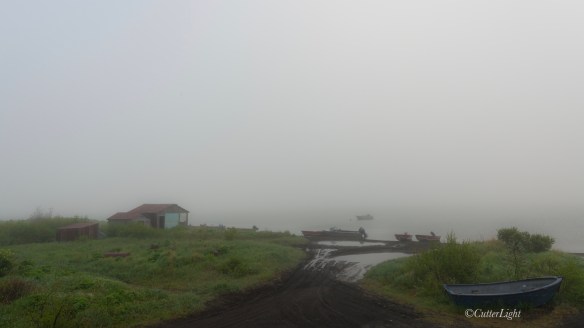
Two days in a row we’ve woken to heavy fog here at The Lake. It wasn’t forecast either day. Yesterday by mid-morning, the mist had burned off. When it did, the birds came out in force. From our vantage point on the deck outside my “office,” Barbra and I saw or heard Pine Grosbeaks, Pine Siskins, Redpolls, Wilson’s Warblers, Ravens, Magpies, Golden-crowned Sparrows, American Robins, Fox Sparrows, Violet-green Swallows, Tree Swallows and out on the lake a small group of Black Scoters and a few passing Glaucus-winged Gulls. But the stars of the morning were a pair of mature Bald Eagles that took up perches on a favorite utility pole near the lakeshore.

This was the view from our dining room window yesterday morning just after dawn. The village of Chignik Lake lies only a few miles upriver from a bay on the Alaska Gulf, so we get our share of wet weather. 

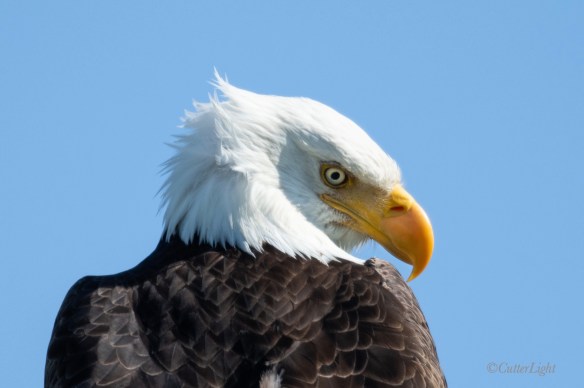
As the sun began peeking through the fog, the first eagle to arrive did its best to dry its soggy wings. Either that, or this is one of those rare Peacock Eagles.

His (her?) mate hadn’t yet arrived and I moved a little closer to capture a portrait. Once the fog lifted, we had a day of blue skies. Temperatures climbed into the 60’s so we took the opportunity to work on our “Alaska Tans” – defined as tans that cover the backs of one’s hands, face and neck down to the level of a shirt or coat collar. But by early afternoon, it was warm enough (mid-60’s) to sit outside in a just a shirt, shorts and bare feet and read (Barbra) and play guitar (me).

While I worked on photos, Barbra scanned for birds from the deck outside her former classroom. Off in the distance to the right, along the far edge of the lake, the second eagle can be seen soaring low. (You might have to enlarge this photo.) The duplex in front of Barbra is where we live – on the righthand side. 

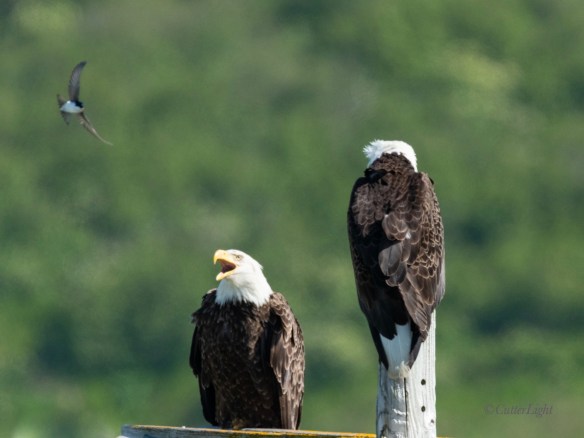
There are at least 50 nesting boxes in this bird-loving village of only about 50 to 70 residents. The boxes are occupied almost exclusively by either Violet-green or Tree Swallows. Both species seem inclined to investigate anything out of the ordinary in their neighborhood – us, eagles, other birds. The real threats to swallows are Chignik Lake’s abundant Magpies – notorious nest robbers. In years past, Merlins, Northern Shrikes and occasional Sharp-shinned Hawks have also posed a threat, but none of these species appear to be present this year – at least so far.

A mated pair? Siblings? Friends? (Do eagles have friends?) It was interesting to watch these two repeatedly mirror each other’s behavior. We’ve read about these dreaded Dracula Eagles – another rare sighting.

As I mentioned, we’ve had two consecutive mornings of heavy fog. Inspired by the way the morning cleared up yesterday, last evening we prepared our pack raft in anticipation of doing a three-mile river float today. Unfortunately, the weatherman got it completely wrong. The fog only grudgingly lifted late in the morning and instead of the calm that had been forecast, winds – the bane of rafting – kicked up. So I spent the morning working on photos. Yet hope springs eternal. The prediction for tomorrow morning is for partial sunshine and calm, so perhaps we can get in one last river float before we have to pack up the gear and mail it to Newhalen. Every hour of these final days at The Lake is a time to savor.

If you enjoyed this post and would like to see some of the birds mentioned and more of the landscape around Chignik Lake, check out the link below:

Morning Nature Walk, the Chigniks

Hope your day is going well!

Skiffin’ – A Chignik Version of the Sunday Drive: Sunshine, Sea Birds, Seals and Snow-covered Mountains)

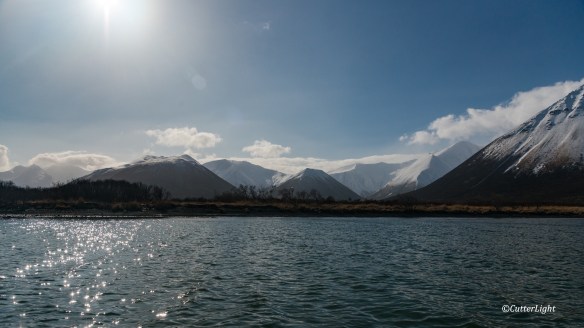
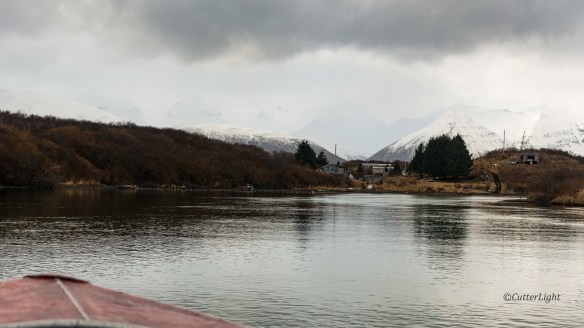
The view at Hatchery Beach, a wind-swept shore on Chignik Lake where sufficient upwelling and pea-sized gravel create ideal conditions for Sockeye Salmon to spawn. The stream-fed pond behind the strip of land is a feasting area for our huge brown bears from summer through fall.

It was a perfect day for skiffin’ – full-on sunshine, light breezes and a mid-day high tide pushing far enough up the river for The Shallows to be passable. The tide meant access to the Lagoon, the saltwater estuary where Chignik River debouches into the Alaska Gulf and an opportunity to photograph Emperor Geese. So when a friend called with an invitation to go out in his 18-foot Lund, we made quick work of lunch and pulled our camera gear together. Oh, and we bundled up; highs are only reaching 40° or so (4 or 5 degrees C) and it’s always colder on the water.

The Chignik Mountains surrounding the lake were shouldered in fresh, powdery snow. Kudos to Barbra on the landscape photographs in this article. It can be tough getting good shots from a bouncing boat.

Every plane coming into the village prompts two questions: Mail? Freight? Other than this plane and one other skiff, we had the lake, the river, the lagoon and the day to ourselves. 

Check out those talons… and that beak! Although we see eagles nearly every day, we always pause to admire these magnificent birds. I surprised myself a little with this shot. Even with a light breeze there was enough chop on the water to have the skiff (Chignik for what Pennsylvanians would call a boat) bouncing like crazy – a problem magnified several times over with a long wildlife lens and a teleconverter attached to my camera. Most of the time I couldn’t even find the bird in my viewfinder, and when I did I had less than a second to shoot before the boat rocked and the bird wildly bounced out of the frame. But he (or she) was patient with me and I had plenty of light to shoot fast when the chance came. They’ll be nesting soon, I imagine.

Here’s Hatchery Beach looking back toward the Clarks River watershed – a significant spawning tributary and with its nearly clear-as-air flow a magical place to fly-fish.

And a third shot moving up the lake along the Hatchery Beach shoreline. We’ve often thought that a lot of these mountains, which top out at just over 3,000 feet (1,000 meters), would make for a good climb. The main feat might be getting through the jungle-thick alders at the base.

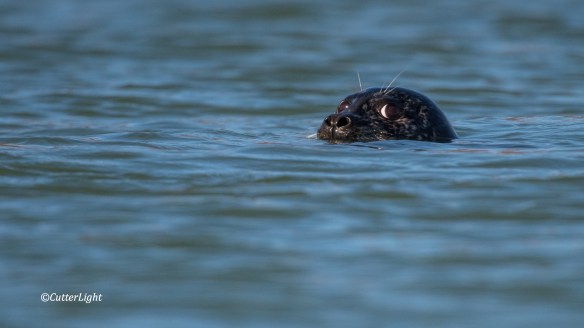
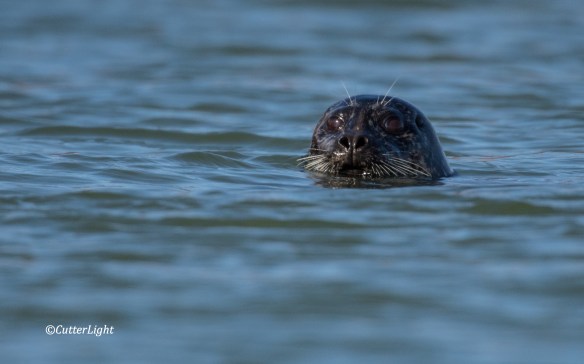
Cute, right? There always seem to be a few Harbor Seals in Chignik Lake and, I’m told, further up in the headwaters at Black Lake.

Here in Alaska, the population of Harbor Seals in Lake Iliamna gets a fair amount of attention. Yet we’ve never read a single word about the year-round seals in the Chignik System. One year I got a photo of nine seals hauled out together on lake ice across from our house. On this day, we saw this one and another that was sunning itself on a rock. I’d love to know more about what they eat once the salmon runs are finished.

Heading back down the lake toward the lagoon we passed our village on the right. Our house is the white duplex closest to the water toward the right of the photo. The large building to the left and behind our house is the school, and just to the left of that, almost center, you can see the golden steeple on the Russian Orthodox Church. Just 30 yards from the lake, our living room/dining room windows are ideal for wildlife viewing. From these windows we’ve seen a wolf, a wolverine, a beaver, moose, ermine, voles, lemmings and a number of brown bears, otters and harbor seals. Eagles, kingfishers, several species of ducks, common loons, magpies, ravens and a number of passerines are common along with our resident Great Horned Owls. Falcons are less common but Merlins nest here, and during summer we frequently hear and occasionally see sandhill cranes.

This photo was taken at the head of the Chignik River on the return upriver to the village. I include it because it shows the copse of 20 trees we call White Spruce Grove – a small but important piece of bird habitat. This is where we see most of the black-capped chickadees, juncoes and other sparrows, redpolls, Pacific wrens, golden-crowned kinglets, pine siskins and white-winged and red crossbills we’ve written about in other articles. Thus far, we’ve documented over 70 species of birds in or near Chignik Village, a few of which had, to our knowledge, never before been reported on the Alaska Peninsula. Predators such as sharp-shinned hawks, merlins, owls and shrikes use these trees as well. Note the net, marked by a line of white floats on the water, extending from a skiff out into the river. A neighbor has been catching Sockeyes of about 22 to 23 inches, most probably a resident strain of fish that never go out to sea.

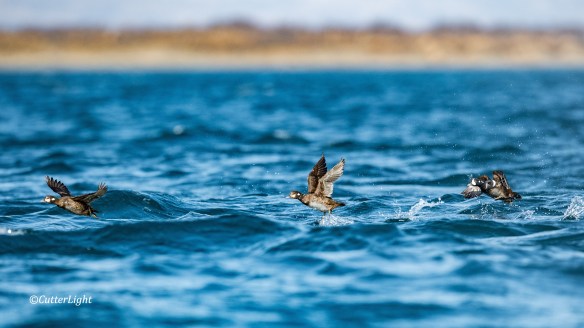
Although they occasionally visit the river during summers, and rarely are seen on the lake, we found lots and lots of harlequin ducks at the lagoon, the males (far right) already beginning to come into breeding plumage.

As with the harlequins, pelagic cormorants are uncommon visitors to the lake and river but abundant in the lagoon. And as with the photo of the eagle, some of these shots surprised me when I got them on the computer. This was a point, swing, hope and click effort with a pelagic heading in the opposite direction as our skiff cruised by.

I can count on one hand the number of times long-tailed ducks have shown up on the lake. Usually mixed in with other species, their distinctive coloration (a little like a scoop of strawberry, chocolate and vanilla Neapolitan ice cream) always makes me do a double-take. But they proved to be probably the most common bird on the estuarine lagoon on this outing, rivaled only by harlequins. The center bird is displaying his eponymous tail. Like harlequins, long-tailed ducks are fairly catholic in their dining habits and there’s simply a broader smorgasbord in the lagoon than in nearby freshwater. We foolishly left our binoculars behind, but there were a number of other species on the lagoon including what appeared to be a football-shaped phalarope so stuffed with whatever it was eating it could barely fly. From June through September the lagoon and nearby waters are a staging area for millions of returning salmon – in good years nearly two million reds (sockeyes) along with tens of thousands of silvers (coho) as well as pinks, chums and kings. 

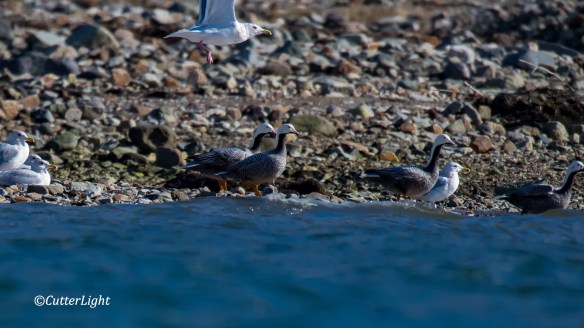
Our friend had mentioned the lagoon’s flocks of Emperor Geese and I was hopeful of getting some photos. Unfortunately, as a hunted species, they proved to be fairly wary. Here a group of 200 or so birds take flight while we’re still well off their sand spit roost. (Thanks for the hero shot, Barbra!)

At the one place where we were able to get reasonably close to a few geese, colliding current and wind caused the skiff to bounce like crazy. But these handsome birds with white heads and napes, pink bills and yellow-orange legs are emperors – the first I’d photographed and a new bird for my Chignik List.

There’s little as stirring as wildlife abundance. I estimated close to 200 geese crowded together along with a few gulls on this last significant spit before the lagoon opens into the Alaska Gulf.

And there they go. I hate spooking wildlife. Just prior to this shot, birds were still dropping in to join the roost – but often it only takes one bird with antsy wings to get the rest up and going. The day was a lot of fun though and we got a few shots. Hopefully we’ll do another episode of skiffin’ in a few weeks to inventory the bird population again!

If you enjoyed this article, try typing “birds” into the search bar near the top of the page. You can find additional reading about our tiny bush village of Chignik Lake by typing those words into the search bar as well.